As the Bitcoin ecosystem evolves from a value storage phase to a yield-driven finance phase, an increasing number of protocols are seeking ways to unlock BTC capital efficiency. Lorenzo Protocol and Solv Protocol represent two distinct paths—one focused on infrastructure development and the other on yield management platforms—making them key players in the Bitcoin Finance vertical.
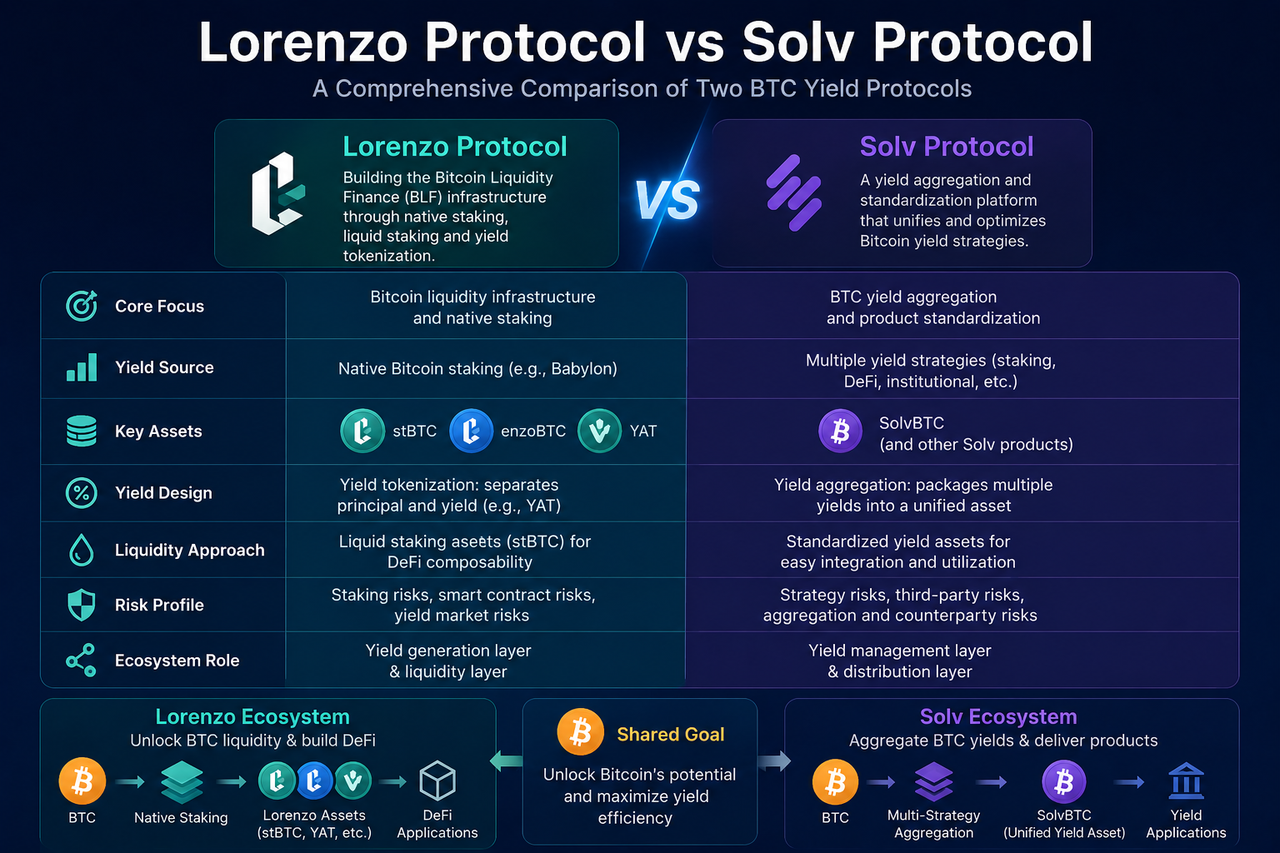
What Is Lorenzo Protocol?
As a liquidity finance protocol for the Bitcoin ecosystem, Lorenzo Protocol's core mission is to unlock BTC capital efficiency through native staking, liquid staking assets, and yield tokenization.
Lorenzo is built on Bitcoin's native staking infrastructure, linking the security layer, liquidity layer, and application layer to create a comprehensive Bitcoin Liquidity Finance (BLF) ecosystem.
Within the Lorenzo ecosystem, BTC can generate yields while also continuing to participate in DeFi applications via assets such as stBTC.
As a result, Lorenzo functions more as a BTC financial infrastructure network.
What Is Solv Protocol?
As a protocol specializing in digital asset yield management and standardization, Solv Protocol initially explored on-chain bonds and yield certificates before expanding into the BTC yield market and launching product suites like SolvBTC.
Solv's core strategy is to package BTC yields from various sources into a unified format, providing users with standardized yield assets.
Thus, Solv operates more as a BTC yield aggregation platform rather than a single-source yield protocol.
What Is the Key Difference in Their Core Positioning?
The fundamental difference between Lorenzo Protocol and Solv Protocol lies in their ecosystem positioning.
Lorenzo aims to build BTC liquidity finance infrastructure, emphasizing native staking, liquid staking, yield tokenization, and financial product layer development.
Solv, on the other hand, focuses on yield management and aggregation, integrating multiple yield sources into a unified asset framework.
In simple terms:
Lorenzo creates and releases yields.
Solv aggregates and manages yields.
What Is the Difference in Their BTC Yield Sources?
Yield source is one of the most critical differentiators between the two.
Lorenzo's Yield Source
Lorenzo primarily relies on Bitcoin native staking.
BTC enters the underlying staking system to earn rewards, which are then distributed to users via the protocol.
This makes the yield source relatively straightforward and transparent.
Solv's Yield Source
Solv adopts a multi-strategy yield model.
Yields can come from BTC staking, liquidity mining, DeFi yield strategies, institutional-grade yield products, and other on-chain sources. This makes Solv more of a yield aggregator.
In contrast, Lorenzo acts as a yield production layer.
What Is the Difference in Their Asset Architecture?
The asset structure reflects each protocol's core design philosophy.
Lorenzo's Asset Architecture
Lorenzo builds a multi-tier financial system primarily around stBTC, enzoBTC, and YAT, allowing principal, liquidity, and yield rights to be managed separately.
Solv's Asset Architecture
Solv establishes a unified yield asset framework mainly around SolvBTC and the SolvBTC Yield Vault.
Users interact more with standardized yield products rather than multiple functionally separated assets.
Therefore, Lorenzo follows an asset-splitting model, while Solv uses an asset aggregation model.
What Is the Difference in Their Liquidity Design?
Liquidity design highlights the different development directions of the two protocols.
Lorenzo's focus is on liquid staking. After receiving stBTC, users can continue participating in lending, DEX liquidity pools, and yield protocols.
Liquidity and yields coexist simultaneously.
Solv, however, emphasizes yield asset standardization.
Its liquidity primarily supports the circulation of yield products and yield management needs.
Thus, both support on-chain liquidity, but the liquidity serves different purposes.
What Is the Difference in Their Yield Tokenization Approach?
Yield tokenization is a key feature of Lorenzo.
Lorenzo uses the YAT mechanism to separate future yields from principal, allowing the market to trade independently:
- BTC principal;
- BTC yield rights.
This model closely resembles the traditional fixed-income market.
While Solv also offers yield assets, it typically uses yield aggregation and unified packaging instead of splitting yields into independent markets like Lorenzo.
Hence, Lorenzo emphasizes yield financialization, while Solv emphasizes yield productization.
What Is the Difference in Their Risk Structure?
Different design approaches naturally lead to different risk profiles.
Lorenzo's Main Risks
Lorenzo's risks primarily include:
- Native staking risk;
- Smart contract risk;
- Yield token market volatility;
- Liquid staking asset risk.
Solv's Main Risks
Solv faces more diverse risks, including:
- Yield strategy risk;
- Third-party protocol risk;
- Aggregator risk;
- Asset portfolio risk.
Theoretically, more yield sources mean more potential risk dimensions.
Therefore, the risk structures of the two protocols are fundamentally different.
Which Model Is More Suitable for the Bitcoin Finance Ecosystem?
The two models are not in a competitive substitution relationship.
Lorenzo addresses how BTC can generate yields.
Solv addresses how BTC yields can be managed.
From an industry chain perspective:
- Lorenzo operates in the yield production layer;
- Solv operates in the yield management layer.
As the BTC financial market matures, both types of protocols are likely to become integral parts of the ecosystem.
Thus, they function more as upstream and downstream partners rather than fully overlapping competitors.
Core Comparison: Lorenzo Protocol vs Solv Protocol
| Comparison Dimension |
Lorenzo Protocol |
Solv Protocol |
| Core Positioning |
BTC Liquidity Finance Layer |
BTC Yield Aggregation Platform |
| Core Goal |
Unlock BTC Liquidity |
Aggregate BTC Yields |
| Main Yield Source |
Native BTC Staking |
Multi-Strategy Yields |
| Core Assets |
stBTC, enzoBTC, YAT |
SolvBTC |
| Yield Structure |
Yield Splitting |
Yield Aggregation |
| Liquid Staking |
Supported |
Partially Supported |
| Yield Tokenization |
Strong |
Moderate |
| Application Direction |
BTC Financial Infrastructure |
BTC Yield Management |
| Ecosystem Role |
Yield Production Layer |
Yield Management Layer |
Overall, Lorenzo focuses on financial infrastructure construction, while Solv focuses on yield product integration.
Summary
Lorenzo Protocol and Solv Protocol both aim to improve Bitcoin capital efficiency, but they follow different development paths. Lorenzo builds a Bitcoin Liquidity Finance system around native staking, liquid staking, and yield tokenization, enabling BTC to generate yields while maintaining liquidity. Solv, through yield aggregation and standardized asset design, integrates BTC yields from various sources into a unified product.
In terms of ecosystem positioning, Lorenzo is closer to BTC yield production infrastructure, while Solv is closer to a BTC yield management platform. Together, they drive Bitcoin's evolution from a value storage asset to a yield-generating financial asset, but they focus on different parts of the value chain.
FAQs
What is the biggest difference between Lorenzo Protocol and Solv Protocol?
Lorenzo Protocol builds its ecosystem around Bitcoin native staking and liquidity finance, while Solv Protocol focuses on BTC yield aggregation and standardized yield asset management. Their core positioning is fundamentally different.
Where does Lorenzo Protocol's yield mainly come from?
Lorenzo Protocol's yield primarily comes from staking rewards generated by the underlying Bitcoin native staking network, distributed through liquid staking assets and yield certificates.
Is Solv Protocol a liquid staking protocol?
Solv Protocol is not a typical liquid staking protocol. Solv is more focused on integrating BTC yields from different sources and offering users yield products through standardized assets.
What is the difference between Lorenzo's YAT and SolvBTC?
YAT represents future yield rights and is a yield tokenization asset; SolvBTC is a standardized BTC yield asset that consolidates multiple yield sources. Their design logic differs significantly.
Are Lorenzo Protocol and Solv Protocol in competition?
Lorenzo Protocol and Solv Protocol overlap in certain markets, but their value propositions are different. Lorenzo handles yield generation and liquidity release, while Solv handles yield management and asset integration.