Users searching for this topic are typically evaluating whether MegaETH's high-performance architecture addresses real market needs, rather than merely serving as a technical narrative. The long-term value of a blockchain network often hinges on its capacity to sustain a vibrant and active application ecosystem.
This question generally covers five dimensions: trading scenarios, gaming experience, social interaction, developer requirements, and scope of applicability. Understanding these aspects helps clarify MegaETH’s positioning in the actual market.
What Are the Application Scenarios for MegaETH
MegaETH’s application scenarios refer to on-chain business activities that demand low-latency execution and high-frequency interaction.
Traditional on-chain applications typically involve asset transfers, lending, and straightforward trading, whereas high-performance networks are better equipped to handle complex business logic. For instance, order book matching, real-time game state synchronization, and multi-user interactive products all require rapid state updates.
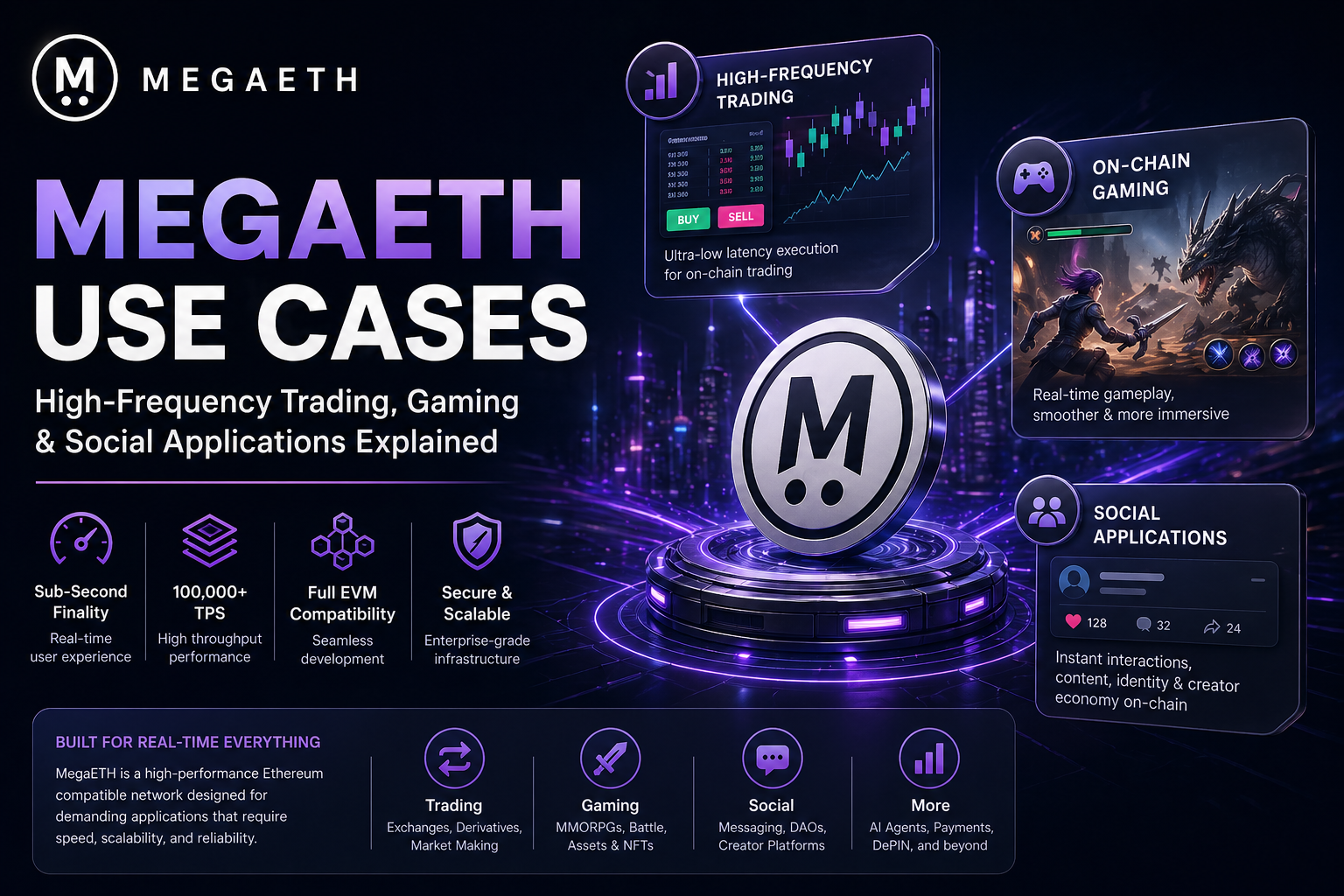
From a structural perspective, MegaETH is well-suited for three primary categories: high-frequency financial applications, blockchain gaming and digital asset interaction, and social/content platforms.
These scenarios are significant because they drive longer user engagement and sustained on-chain activity, rather than just isolated transaction events.
How Does MegaETH Support High-Frequency Trading Applications
MegaETH’s support for high-frequency trading centers on reducing transaction response times and boosting order processing efficiency.
Initially, users submit buy/sell orders or strategy trading requests. The system must quickly ingest large volumes of orders and process them in sequence.
Next, the network execution layer manages order matching, cancellations, or status updates, enabling users to view transaction results and account changes in real time.
When market volatility increases, the system must maintain stable throughput to prevent distorted offers or operational delays caused by congestion. Ultimately, traders enjoy an experience comparable to centralized platforms, while retaining on-chain asset transparency.
| High-Frequency Trading Demand |
MegaETH Capabilities |
| Fast order placement |
Low-latency execution |
| High-frequency order cancellation |
Rapid status updates |
| Multi-user concurrency |
High throughput processing |
| Transparent settlement |
On-chain record verification |
| Real-time asset changes |
High-frequency data synchronization |
These features are especially critical for on-chain derivatives, order book exchanges, and market-making systems.
How Does MegaETH Support Real-Time Blockchain Gaming Interaction
MegaETH enables real-time interaction in blockchain games by accelerating synchronization between gameplay actions and on-chain asset changes.
Players initiate actions—such as movement, combat, upgrades, or item usage—and the system must promptly record outcomes and update character status.
The network execution layer then processes equipment changes, reward distribution, or NFT asset transfers, allowing players to receive feedback instantly.
Multiplayer gaming scenarios require ongoing interaction, including racing, battles, or cooperative tasks. Excessive network latency leads to a degraded experience. Ultimately, a low-latency network allows blockchain games to approach the responsiveness of traditional online games.
In essence, blockchain games require not only asset ownership but also seamless interaction. MegaETH’s value lies in bridging gaps previously seen in blockchain gaming experiences.
How Does MegaETH Support On-Chain Social Products
MegaETH’s support for on-chain social products is defined by enhanced real-time content interaction and identity operations.
Users post content, like, follow, or message others. The system must rapidly record these social actions and synchronize them across user interfaces.
The on-chain identity system updates user profiles, badges, reputation credits, or social graphs. Slow data updates negatively impact product usability.
Creator economy scenarios may involve tipping, subscribing, content NFT conversion, and return distribution. A low-latency execution environment allows content interaction and asset flows to occur seamlessly within the same network.
Structurally, social products rely more heavily on high-frequency interaction than pure DeFi, and thus demand higher execution performance.
Why Developers Prioritize Low-Latency Experience
Developers prioritize low-latency because performance directly affects user retention and product design flexibility.
When users receive immediate feedback after clicking a button, their experience is smoother. Excessive wait times may cause users to abandon actions or reduce usage.
Developers can then design more sophisticated interaction logic, including real-time leaderboards, multiplayer collaboration, instant bidding, and dynamic content updates.
Low-latency networks also reduce reliance on front-end compensation logic and caching, simplifying product development. Teams can devote more resources to innovation rather than managing performance bottlenecks.
High-performance infrastructure not only accelerates speed but also expands the possibilities for application design.
Which Scenarios May Not Suit MegaETH
Not every on-chain business requires MegaETH’s high-performance architecture.
Single large transfers, long-term asset custody, or low-frequency settlement prioritize security and cost control over real-time responsiveness.
Some governance voting, DAO management, or basic NFT minting scenarios have limited transaction frequency and do not need high-throughput execution.
If a project’s user base is small, a complex high-performance architecture may increase deployment and maintenance costs. Ultimately, MegaETH’s suitability depends on the business model and user behavior.
| Scenario Type |
Suitability |
| High-frequency trading platforms |
High |
| Real-time blockchain gaming |
High |
| Social interactive products |
High |
| Low-frequency governance voting |
Medium |
| Single transfer settlement |
Medium-low |
This demonstrates that performance advantages only translate into application value when genuine demand exists.
Summary
MegaETH’s primary application scenarios are high-frequency trading, real-time blockchain gaming interaction, and on-chain social products—each requiring rapid feedback, high concurrency, and continuous online engagement. For developers, a low-latency network broadens product design possibilities. For low-frequency settlement or simple governance, high-performance architecture may not be necessary.
FAQ
What Applications Is MegaETH Best Suited For
MegaETH excels in high-frequency trading platforms, blockchain games, social protocols, real-time data platforms, and other interaction-intensive use cases.
Why Is MegaETH Ideal for High-Frequency Trading
Its core strengths are low-latency execution and rapid status updates, which enhance order processing efficiency and trading experience.
How Does MegaETH Benefit Blockchain Games
MegaETH accelerates character status, asset changes, and multiplayer feedback, resulting in a smoother gaming experience.
Is MegaETH Suitable for Social Products
Yes. Social products require frequent actions—likes, follows, messaging, and return distribution—where a low-latency environment offers distinct advantages.
Which Businesses May Not Require MegaETH
Low-frequency transfers, basic governance voting, long-term custody, and small-scale applications typically have minimal need for high-performance solutions.







