As stablecoins play an increasingly important role in the crypto market, more users are turning to them for trade settlement, asset hedging, and cross border payments. In today’s market, U.S. dollar stablecoins hold the dominant position. Among them, USDT and USDC have long been industry pillars, while PayPal’s PYUSD has introduced a new competitive variable.
For traders, a stablecoin’s liquidity and market acceptance directly affect trading efficiency. For payment users, payment capability and security matter more. Especially after PayPal entered the stablecoin sector, the competitive landscape across payment scenarios and onchain finance has begun to shift in new ways.
What Are PYUSD, USDT, and USDC?
PYUSD, USDT, and USDC are all U.S. dollar stablecoins, and they all aim to maintain a 1:1 peg to the U.S. dollar. However, they are issued by different institutions and have different market positioning.
USDT is a stablecoin issued by Tether and is currently the largest U.S. dollar stablecoin by market size. Because of its strong liquidity and broad support across trading platforms, USDT has become one of the most widely used stablecoins in the global crypto trading market.
USDC is issued by Circle and is known for stronger transparency and compliance. Because its reserve disclosures are relatively complete, USDC has earned a high level of recognition among institutional users and compliant trading platforms.
PYUSD is a U.S. dollar stablecoin launched by PayPal and issued by Paxos. Compared with USDT and USDC, PYUSD places more emphasis on payment functionality. Backed by PayPal’s global payment network, it enters the stablecoin market with the goal of driving large scale stablecoin adoption in payments.
What Are the Main Differences Between PYUSD, USDT, and USDC?
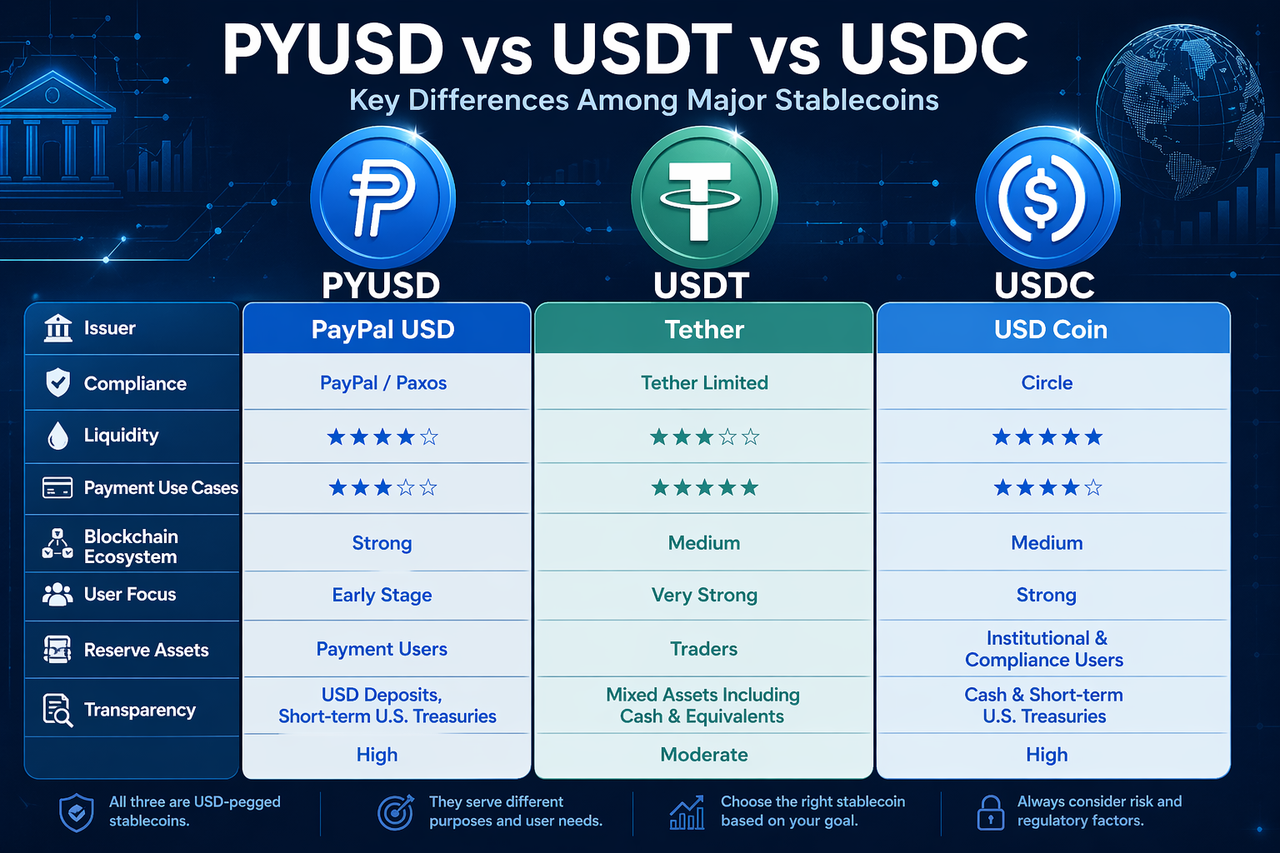
The core differences among these three major stablecoins mainly appear in their issuers, regulatory transparency, liquidity, and use cases.
| Item |
PYUSD |
USDT |
USDC |
| Issuer |
PayPal / Paxos |
Tether |
Circle |
| Value Peg |
U.S. Dollar |
U.S. Dollar |
U.S. Dollar |
| Compliance |
High |
Medium |
High |
| Market Liquidity |
Medium |
High |
High |
| Payment Use Cases |
Strong |
Medium |
Medium |
| Onchain Ecosystem |
Early Stage |
Strong |
Strong |
| User Positioning |
Payment Users |
Trading Users |
Compliance Focused Users |
Overall, USDT has a clear advantage in trading liquidity, USDC stands out in compliance, and PYUSD is more distinctive in its ability to integrate with payment scenarios. Since each stablecoin has different positioning in the market, their best use cases also differ.
Why Does USDT Dominate the Market?
USDT has long maintained its leading position in the stablecoin market mainly because of its extremely high liquidity and broad trading support. Nearly all major trading platforms support USDT trading pairs, making it a core settlement tool in crypto asset trading. For traders, high liquidity means lower slippage and higher execution efficiency, which is why USDT has become the most commonly used stablecoin.
In addition, USDT has built a large onchain circulation network spanning multiple public blockchain ecosystems, including Ethereum, Tron, and Solana. This broad ecosystem coverage gives it very high global usage frequency and further strengthens its market position.
Where Do USDC’s Advantages Stand Out?
USDC’s core advantages lie in transparency and compliance. Circle regularly publishes reserve asset reports and emphasizes that its reserves are mainly composed of cash and short term U.S. Treasury securities, which has helped USDC earn strong market trust in terms of transparency.
For institutional investors and regulated platforms, compliance is an important standard when choosing a stablecoin. Because of its more transparent issuance mechanism and clearer regulatory framework, USDC has become a preferred stablecoin for many institutional funds allocating assets onchain. Although its liquidity is slightly lower than USDT’s, it has clear advantages in safety and regulatory friendliness.
What Is PYUSD’s Competitive Advantage?
PYUSD’s biggest competitive advantage is the PayPal payment ecosystem behind it. Unlike USDT and USDC, which are mainly used for trading, PYUSD is positioned more as a payment tool. PayPal has a massive global user base and merchant network, which means PYUSD is naturally well positioned to enter retail payment scenarios.
If PayPal can deeply integrate PYUSD into cross border payments and merchant settlement, it may build a differentiated competitive advantage in the stablecoin payments market. This payment capability is an area where USDT and USDC are currently weaker, and it is also PYUSD’s most important potential growth point.
However, PYUSD’s current market size and onchain ecosystem are still relatively small. It is difficult for PYUSD to compete with USDT and USDC in trading liquidity, so its short term advantage lies more in payment strategy than in trading use cases.
Which Stablecoin Is More Suitable to Use?
The right stablecoin depends on the user’s purpose.
If users mainly trade crypto assets, USDT is usually the more suitable choice because it has high liquidity and a wide range of trading pairs, making it well suited to high frequency trading needs. If users care more about fund safety, compliance, and transparency, USDC is a more prudent choice because its reserve disclosure mechanism is more complete, making it suitable for long term holding and institutional use.
If users mainly care about payment scenarios, especially digital dollar payments within the PayPal ecosystem, PYUSD has a stronger advantage. Although its ecosystem is still small, it has long term potential in payment integration.
Conclusion
PYUSD, USDT, and USDC are all important U.S. dollar stablecoins, but their market positioning is not the same. USDT has become the dominant stablecoin in trading markets through strong liquidity. USDC has become a leading compliance focused stablecoin through high transparency. PYUSD, meanwhile, enters the digital payments field through PayPal’s payment network. For users, there is no single “best” stablecoin. The key is to choose the one that best fits their trading needs, payment scenarios, and risk preferences.
As the stablecoin market continues to develop, the three stablecoins will build advantages in different areas and jointly support the expansion of the digital dollar ecosystem.
FAQs
What Are the Differences Between PYUSD, USDT, and USDC?
All three are pegged to the U.S. dollar, but USDT is better suited to trading, USDC places more emphasis on compliance and transparency, while PYUSD focuses more on payment applications.
Why Is USDT the Most Widely Used?
Because USDT has high liquidity and broad support across trading platforms, making it the main trading stablecoin in today’s crypto market.
Is USDC Safer Than USDT?
From the perspective of reserve transparency and regulatory compliance, USDC is generally considered more transparent than USDT, but different users may define “safe” differently.
Does PYUSD Have a Chance to Challenge USDT?
It is unlikely to challenge USDT’s trading position in the short term, but PYUSD has potential competitive advantages in the payments field.
Which Stablecoin Is Best for Long Term Holding?
If transparency and compliance matter most, USDC is more suitable for long term holding. If trading convenience is the priority, USDT is more practical.







