Amid the rapid expansion of stablecoin payments and cross-border settlement, the competitive focus of payment protocols has shifted from raw transfer speed to programmable invoicing, cross-chain reach, and financial system compatibility. Notably, in March 2026, Request’s actions around merchant migration and decentralized product updates further underscored the real-world significance of this technical trajectory.
To truly understand Request Network, don’t just ask “Can it accept payments?” Instead, look at how its hybrid architecture ties requests, payments, records, and audits into a closed loop. The breakdown below covers the architecture layer, execution layer, and scenario layer.
Core Technical Architecture of Request Network
Request Network explicitly states that it is not a standalone blockchain, but a hybrid protocol. This distinction is critical, as it directly determines performance and cost strategy.
Architecturally, Request stores the bulk of request content on IPFS, records the content hash (CID) on-chain, and integrates indexing with event handling into protocol components. This yields three key results:
- Lean on-chain data. Only essential indexes and verifiable anchors are posted on-chain, reducing the cost of putting full business data onto the chain.
- Preserved data verifiability. Even with the request body off-chain, the CID and signature mechanism still prove content integrity.
- Simplified scalability. Payment logic can execute across multiple chains while the request standard remains consistent—no need to rebuild the entire invoice model for each chain.
From an engineering standpoint, this is a classic “on-chain trust minimization + off-chain data expansion” approach, designed to serve the throughput and audit needs of payment scenarios rather than to act as a general-purpose computing platform.
How the On-Chain Invoice System Enables Automated Payments
Request Network’s core unit is not an isolated transfer, but a traceable payment request.
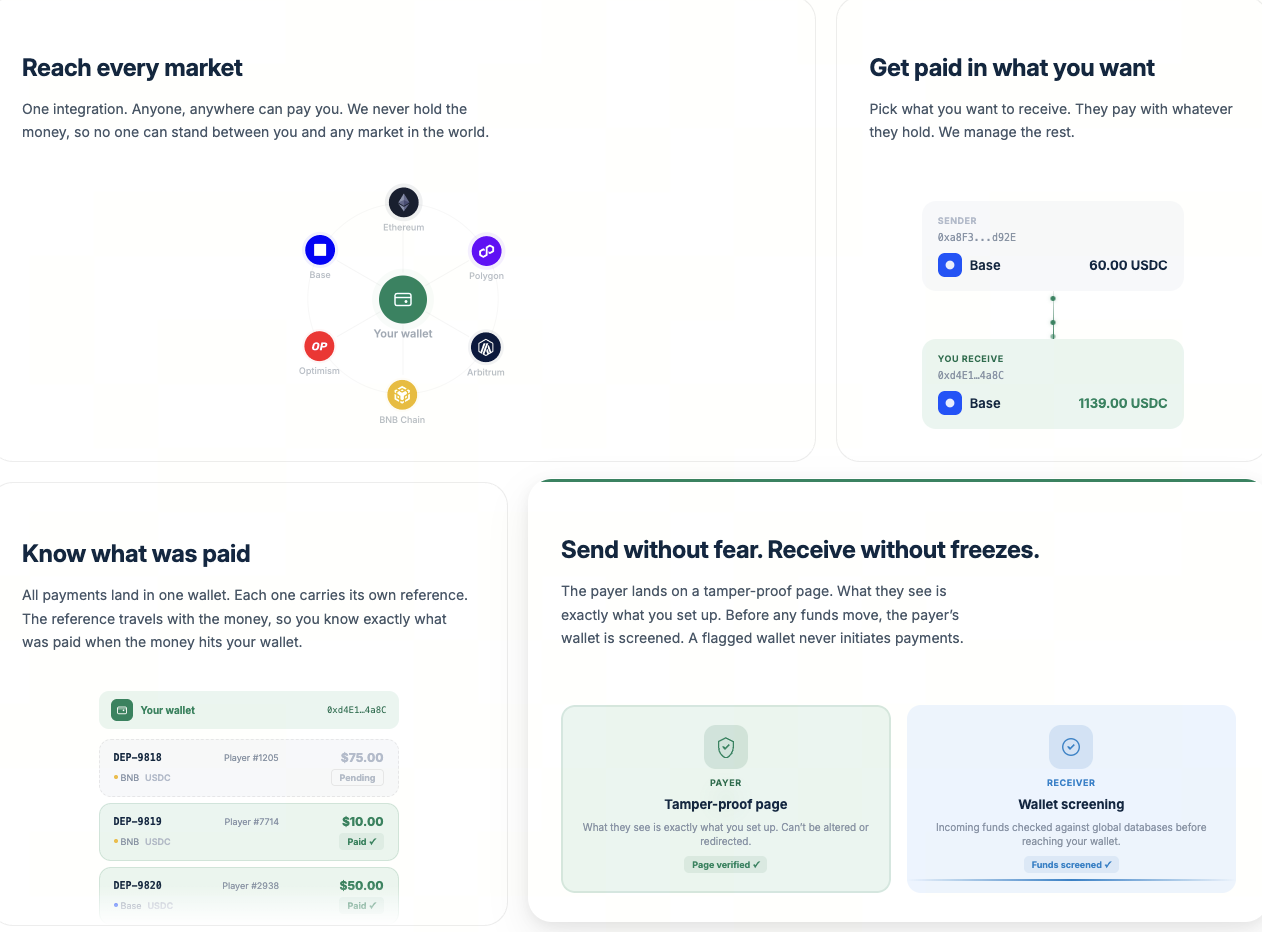
A typical request includes business fields such as payer, payee, amount, currency, expiration time, and additional notes. Once generated, the system binds the content via a signature and CID. Subsequent payments are then linked to that request, creating a verifiable “request → payment” mapping.
This model delivers automation value in three key areas:
- Automated reconciliation: Financial systems can match on-chain payment results by request ID directly, reducing manual work.
- Automated status tracking: Requests can be marked as pending, partially paid, or completed, simplifying receivables and payables management.
- Automated collaboration: Multiple teams can work under the same request semantics rather than relying on scattered emails, spreadsheets, and transfer screenshots.
Compared to the traditional “pay first, find proof later” flow, this approach front-loads invoice semantics, giving every payment an explicit business context—far more enterprise-friendly.
How Request Network Supports Multi-Currency and Cross-Chain Payments
At the payment layer, Request’s principle is “unified request standard, diverse payment paths.”
Official information indicates that its payment capabilities cover multi-chain and multi-asset scenarios, with a strong emphasis on stablecoin accessibility. For merchants, this means the front-end receipt experience remains consistent, while back-end routing and settlement are handled separately.
One technical nuance: according to official documentation, cross-chain payment capabilities are currently implemented primarily through Request’s API layer, not through the base SDK or the protocol itself handling all cross-chain logic. This design reflects a practical trade-off—cross-chain routing, asset swapping, and destination-chain selection involve high engineering complexity. Abstracting that complexity to the API layer allows faster deployment for merchant needs.
From a product perspective, multi-currency and cross-chain support isn’t just about “accepting more coins.” It lowers the operational burden for merchants navigating a fragmented chain ecosystem. For Web3 enterprises, this often outweighs the minor fee differences on any single chain.
How Smart Contracts Improve Payment Transparency
Request’s transparency doesn’t come from “everything on-chain,” but from the verifiability of key states.
What payment protocols truly need to be transparent about: whether a request exists, whether its content has been altered, whether payment occurred, and whether the amounts match. Through CIDs, signatures, and on-chain event indexes, the protocol answers all these questions.
This transparency is especially critical in enterprise settings for audit and compliance:
- Who initiated the request?
- When was the request created or updated?
- When was payment completed, and what are the payment chain and transaction hash?
Unlike the black-box flows of centralized payment gateways, verifiable records like these are far better suited for cross-team collaboration and external auditing.
At the same time, Request balances privacy and efficiency: it doesn’t expose all business details, but anchors the most critical verifiable points on-chain.
Traditional payment platforms operate on “account custody + card network clearing + platform reconciliation.”
Request Network’s logic is closer to “protocol standard + wallet-to-wallet settlement + request-to-payment mapping.” The key differences can be summarized as:
- Fund control: Traditional platforms often involve deep custody; protocol-based payments prefer non-custodial or low-custodial paths.
- Settlement speed: Traditional systems rely on business days and tiered clearing; on-chain settlement can be near-instant.
- Data structure: Traditional systems emphasize account flows; Request focuses on request objects and verifiable associations.
- Expansion model: Traditional platforms expand through regional licenses and networks; protocols expand through developer integration and multi-chain capabilities.
In March 2026, following Coinbase Commerce’s shutdown, Request positioned itself as an alternative for migrating merchants—further confirming the market shift from “centralized gateway single-point service” to “composable payment infrastructure.”
Request’s real-world value lies in the integration of “payment + finance.”
Typical use cases include global payroll, supplier payments, subscription billing, and DAO/project treasury management. The core demands are straightforward: fast settlement, currency flexibility, clear reconciliation, and auditability.
For a payment protocol to enter daily enterprise workflows, three conditions must be met:
- Integration with existing financial tools.
- Programmatically readable transaction status.
- Multi-chain asset management that doesn’t increase accounting complexity.
Request’s technical approach aligns with all three: request standardization, indexable payment status, and API integrability.
This is what sets it apart from products that only provide a “payment link.” It functions more as a financial infrastructure layer, not just a front-end payment button.
Challenges Facing Decentralized Payment Protocols
Despite a clear architecture, decentralized payment protocols face real-world hurdles:
- Cross-chain complexity: Asset standards, routing stability, and bridge risks can affect payment success rates.
- Compliance and regulation: Enterprise payments inherently involve KYC, tax, and jurisdictional differences. Protocol capabilities and compliance requirements need long-term alignment.
- User experience: Non-technical users still struggle with wallets, signatures, and chain selection.
- Ecosystem competition: The payment space includes both traditional fintech giants and exchange-built payment systems. Protocol products must consistently demonstrate efficiency and cost advantages.
- Developer costs: No matter how good a protocol is, poor documentation, SDKs, or debugging experience hinder large-scale integration.
These challenges don’t invalidate the model—they indicate that payment protocol competition has entered a comprehensive stage: “engineering capability + compliance adaptation + ecosystem operations.”
Future Development Direction of Request Network
From public updates over the past two years, Request’s direction is clear:
- Continue strengthening multi-chain and stablecoin coverage to lower the barrier for merchants accessing a fragmented chain ecosystem.
- Advance decentralized product capabilities to enhance protocol-layer independence and composability.
- Optimize developer experience—documentation, APIs, and integration paths.
- Tighten the link between payments and financial tools, moving on-chain payments from “usable” to “operable.”
In the long term, to expand network effects, Request must advance on two parallel fronts:
- Technical: Improve cross-chain settlement stability, indexing efficiency, and payment observability.
- Business: Ensure that real enterprise payment traffic stays within the protocol layer, not just as one-time migration flows.
When the request standard, settlement network, and financial tools form a closed loop, Request can evolve from a payment protocol into a Web3 financial infrastructure layer.
Conclusion
Request Network’s core technical architecture is hybrid: IPFS for request content, on-chain CIDs and events for verifiability, and multi-chain payment capabilities for real settlement needs. This structure moves on-chain payments from single transfers to programmable financial processes, addressing reconciliation, transparency, and cross-chain complexity in enterprise scenarios.
With product and ecosystem updates in 2026, Request’s development logic has shifted from “building a crypto payment tool” to “building composable payment infrastructure.” The future competitive edge lies not just in on-chain speed, but in the protocol’s stable execution across multiple chains, developer integration efficiency, and compliance adaptability.







