In the tokenized stock ecosystem, risk management is just as critical as technological innovation. Compared with mature traditional securities markets, tokenized stocks are still in the early stages of development, with regulatory frameworks, market structures, and underlying infrastructure still far from standardized. As a result, regulatory risk, custody risk, and liquidity risk are among the top concerns for market participants.
Why Tokenized Stocks Face Unique Risks
Tokenized stocks combine the characteristics of both traditional securities and digital assets, exposing them to challenges from two distinct market systems.
Traditional stock markets benefit from well-established regulatory regimes, clearing systems, and investor protection mechanisms. In contrast, blockchain markets prioritize decentralization, global circulation, and open access. When these two systems merge, certain traditional rules may not be directly transferable to an on-chain environment.
Thus, tokenized stocks must address not only technical hurdles but also complex legal, regulatory, market, and operational dynamics.
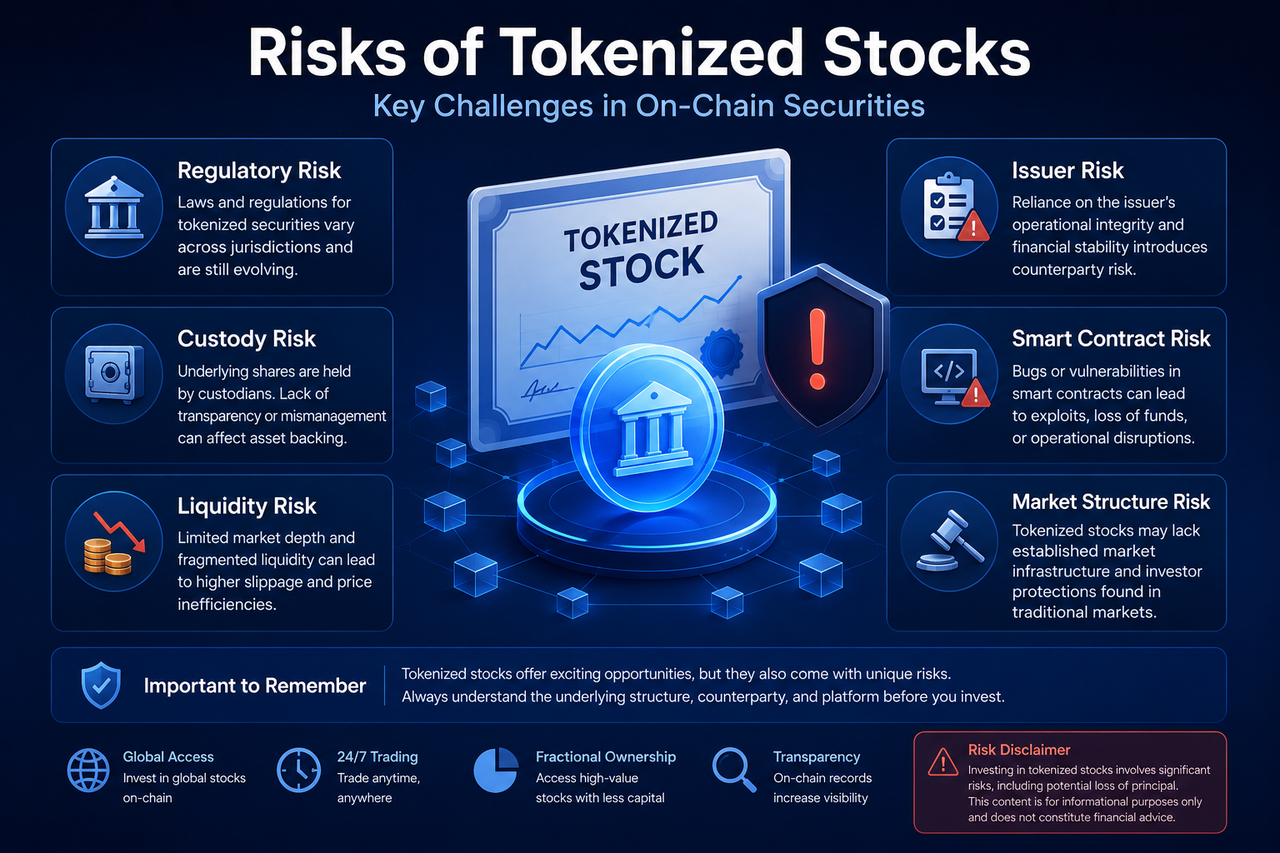
Why Regulatory Risk Is the Biggest Challenge for Tokenized Stocks
Regulatory risk is widely regarded as the most fundamental issue in the development of tokenized stocks.
Stocks are inherently regulated financial assets, and different countries and jurisdictions impose strict rules on securities issuance, trading, and custody. When stocks are tokenized and placed on a blockchain, their legal status can become ambiguous.
Some jurisdictions classify tokenized stocks as digital securities, requiring compliance with securities laws, while others have yet to establish a clear regulatory framework. With no global consensus on regulatory standards, the same tokenized stock product may face entirely different compliance requirements across markets.
These regulatory discrepancies directly impact product issuance, cross-border trading, and investor eligibility.
How Issuer Risk Affects Tokenized Stocks
Tokenized stocks typically rely on an issuer to establish a link between real-world stocks and on-chain tokens.
In most models, the issuer is responsible for purchasing the underlying stocks, arranging custody, and issuing the corresponding number of tokens. As a result, investors must trust that the issuer will fulfill its obligations.
If the issuer encounters operational problems, mismanages assets, or becomes entangled in legal disputes, the relationship between the tokenized stock and its underlying asset could be compromised.
Unlike native crypto assets such as Bitcoin, tokenized stocks are not purely blockchain-driven—they require ongoing maintenance by real-world entities.
Where Does Custody Risk Come From?
Custody risk is a defining feature that sets the tokenized stock market apart from traditional crypto assets.
Most tokenized stocks follow a "real stock custody + on-chain token issuance" model. The underlying stocks are held by professional custodians, while investors hold digital certificates representing those stocks.
Thus, the market depends on the custodian actually holding the assets and ensuring that the quantity matches the on-chain token supply.
If custody disclosure is insufficient, audit mechanisms are weak, or asset management issues arise, investors may be unable to verify the asset backing behind their tokens.
This is precisely why the tokenized stock market places such strong emphasis on proof of reserves and third-party audits.
What Is the Impact of Liquidity Risk?
Liquidity risk is a common issue in the tokenized stock market.
Traditional stock markets benefit from a high volume of institutional investors, market makers, and mature trading systems, resulting in high market depth. The tokenized stock market, by contrast, is relatively small with a limited number of participants.
When there are too few buyers and sellers, trades may be difficult to execute, and bid-ask spreads can widen significantly.
Low liquidity also reduces price discovery efficiency, leading to short-term deviations between the token price and the underlying stock price.
As the market grows and more liquidity providers enter, this problem is expected to ease—but it remains a key structural challenge.
Technical Risks and Smart Contract Risks
Since tokenized stocks operate on blockchain networks, they are also exposed to technical risks.
Smart contracts govern token issuance, transfers, and certain settlement processes. If a smart contract contains vulnerabilities, it could disrupt asset management and trade execution.
Additionally, the underlying blockchain infrastructure may face network congestion, system failures, or cross-chain bridge security issues.
While mature blockchain networks are generally secure, technical risk remains a non-negligible factor in the tokenized stock ecosystem.
For this reason, code audits, security testing, and risk control mechanisms are essential components of platform development.
How Do Investor Rights Risks Differ from Traditional Stocks?
Tokenized stocks do not necessarily grant the same rights as directly owning shares in a listed company.
Some products offer economic rights tied to the stock price but do not confer full shareholder rights. For instance, voting rights, the ability to attend shareholder meetings, or certain corporate governance rights may not be fully reflected on-chain.
Moreover, different issuers may handle dividend distributions, redemption mechanisms, and corporate actions in varying ways.
Risk Comparison: Tokenized Stocks vs. Traditional Stocks
| Risk Dimension |
Tokenized Stocks |
Traditional Stocks |
| Regulatory Framework |
No unified global standards |
Mature regulatory system |
| Custody Model |
Third-party custody + on-chain mapping |
Central securities depository system |
| Liquidity |
Relatively limited market size |
High market depth |
| Technical Risk |
Smart contract risk present |
Low technical risk |
| Rights Structure |
Some rights may be limited |
Clear shareholder rights |
| Cross-Border Compliance |
Higher complexity |
Relatively mature |
| Asset Verification |
Relies on proof of reserves and audits |
Relies on regulatory disclosure |
How Risk Management Mechanisms Mitigate Tokenized Stock Risks
The tokenized stock market is progressively building more robust risk management systems.
On the regulatory front, digital securities frameworks and RWA rules are evolving, offering clearer compliance guidelines. On the custody side, third-party audits, proof of reserves, and real-time disclosure mechanisms are improving asset transparency.
At the market level, market maker programs and liquidity support systems help enhance trading depth. Technologically, smart contract audits and security testing are becoming standard industry practice.
While these measures cannot eliminate all risks, they do increase transparency and stability in market operations.
Conclusion
Tokenized stocks bring traditional stock assets into the digital asset space via blockchain technology, giving global investors a new way to access assets. However, they are not without risk. The primary challenges span regulatory compliance, asset custody, market liquidity, issuer operations, and technical security.
Compared to traditional stocks, tokenized stocks introduce additional layers of blockchain and digital asset infrastructure, resulting in a more complex risk profile.
FAQs
What is the biggest risk of tokenized stocks?
Regulatory risk is often cited as the greatest challenge. Different countries and regions have inconsistent legal definitions for digital securities, which can affect the issuance, trading, and circulation of tokenized stocks.
Are tokenized stocks always backed by real stocks?
Not necessarily. Some products use a 1:1 stock custody model, while others only track the price of the underlying stock. Therefore, review the specific issuance rules.
Why is custody risk important?
Custody risk concerns whether the underlying stocks actually exist and whether their quantity matches the on-chain tokens. Insufficient transparency in custody can prevent investors from verifying the asset backing.
Why do tokenized stocks face liquidity risk?
The tokenized stock market is typically smaller than the traditional securities market, resulting in fewer buyers and sellers. Low liquidity can cause execution difficulties and wider bid-ask spreads.
Can smart contract vulnerabilities affect tokenized stocks?
Yes. Tokenized stocks rely on smart contracts for asset issuance and transfer. A security flaw in a smart contract could impair trade execution and asset management.
Are the risks of tokenized stocks the same as traditional stocks?
They share some common risks, such as market and company operational risk. However, tokenized stocks add regulatory, custody, smart contract, and digital infrastructure risks, making the overall risk profile more complex.







