Solana ETF Boom Arrives: How Can Retail Investors Seize the Opportunity?

Last Updated 2026-03-27 21:28:28
Reading Time: 1m
As the first spot Solana ETFs go live in the United States and capital continues to flow in, combined with the rollout of staking rewards, retail investors are facing new opportunities to position themselves. However, with SOL prices pulling back and volatility increasing, this article examines the opportunities and risks of Solana ETFs.

What Is Solana and What Are Its Network Advantages?

Let’s first examine the blockchain ecosystem represented by Solana (SOL). Solana is a public blockchain based on a Proof-of-Stake (PoS) consensus mechanism, renowned for high transaction speed and low fees, making it ideal for decentralized application (dApp) development. Compared to early chains like Bitcoin, Solana offers significant scalability advantages. Its network ecosystem continues to expand, supporting a wide range of DeFi protocols, NFT collections, and token projects. As such, Solana is not just a “crypto asset”—it also shows strong potential as foundational blockchain infrastructure.

What Is a Solana ETF? Latest Developments

An ETF, or Exchange-Traded Fund, allows investors to buy in using traditional brokerage accounts. For digital assets, Solana’s inclusion in “spot ETFs/ETPs (Exchange-Traded Products)” means regular investors can gain exposure through these funds without directly purchasing SOL tokens. Recent updates include:

  • The first spot Solana ETFs in the U.S. went live at the end of October 2025. Key players such as Bitwise Asset Management (BSOL) and Grayscale Investments (GSOL) have drawn significant market attention.
  • The U.S. Treasury and IRS issued guidance permitting these funds to participate in staking and earn rewards, providing Solana ETFs with a new yield mechanism.
  • Multi-day net inflow data indicates these products attracted capital immediately after launch, signaling growing institutional and market interest in the Solana ecosystem.

These developments signal Solana’s transition from a “blockchain-native asset” to a “mainstream financial product” accessible to traditional investors.

Market Capital Flows and SOL Price Performance
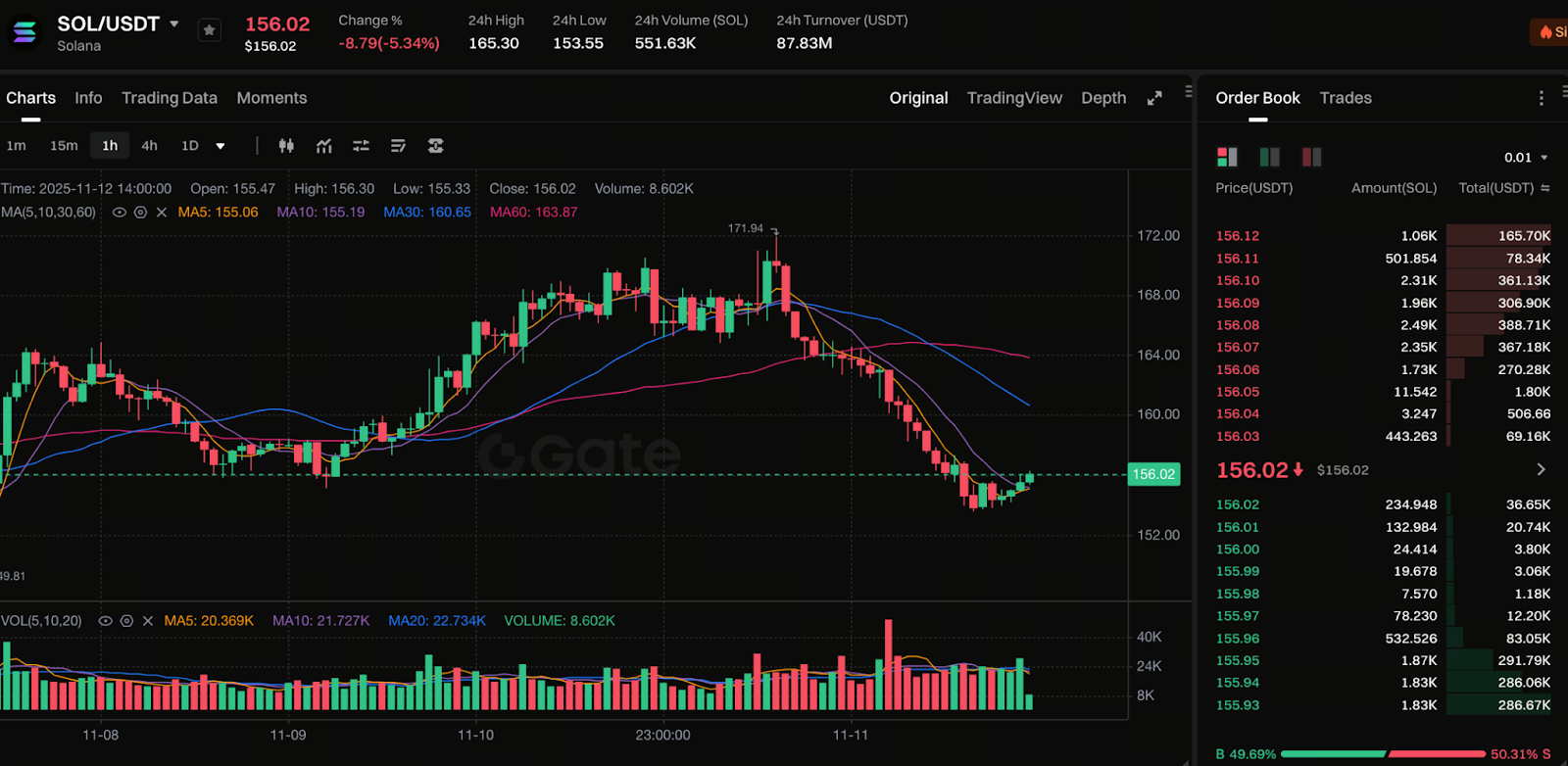

Chart: https://www.gate.com/trade/SOL_USDT

While Solana ETFs are attracting capital inflows, the price action of SOL tokens has been somewhat counterintuitive.

  • In the early days following the ETF launch, even with substantial inflows, SOL’s price fell by more than 20%.
  • Multi-day net inflow data shows both products consistently attracted capital after launch, but these gains were not fully reflected in the token’s price.
  • Technical analysis points to passive support for SOL and a heightened risk of further downside.

This highlights that, despite new product launches and increased investor participation, macro factors, on-chain activity, and overall market sentiment may still weigh on price. Investing in a Solana ETF does not guarantee price appreciation.

How Can Individual Investors Participate? Three Practical Steps

If you’re new to this, consider these three steps as a reference:

  • Account Preparation: Make sure your brokerage or trading account supports the relevant ETF products. As these funds trade like stocks, they’re different from buying crypto directly.
  • Asset Allocation: Treat Solana ETFs as a high-risk, high-volatility portion of your portfolio—not your entire allocation. Consider them as “growth/speculative” assets rather than your core 50-70% holding.
  • Long-Term View + Staking Yield: Since Solana supports staking, related ETFs may reinvest staking rewards as fund returns (now regulator-approved). Review the fund’s documentation for details on “staking yield reinvestment.”

With these steps, you can participate in the Solana ecosystem in a familiar format—without managing wallets, private keys, or exchanges yourself.

Risk Disclosures and Key Considerations

  • Even with ETFs, Solana remains highly volatile. Its price is influenced by macroeconomic factors, overall crypto sentiment, and on-chain activity. It has fallen into bear markets before and still faces downward pressure.
  • Regulatory developments do not equate to “complete safety.” The broader crypto market remains only partially regulated by traditional authorities.
  • While ETFs streamline access, they are not “risk-free.” Be sure to understand fund fees, management models, stability of staking rewards, and whether the fund accurately tracks SOL’s price.
  • Token price and capital inflows may diverge. Watch out for situations where “capital enters quickly, but price stagnates or drops”—a pattern recently seen with Solana.
Author: Max
Disclaimer
* The information is not intended to be and does not constitute financial advice or any other recommendation of any sort offered or endorsed by Gate.
* This article may not be reproduced, transmitted or copied without referencing Gate. Contravention is an infringement of Copyright Act and may be subject to legal action.

Related Articles

AI-Native Settlement Layers: How United Stables Is Building the Next Financial Rail
Beginner

AI-Native Settlement Layers: How United Stables Is Building the Next Financial Rail

Stablecoins were originally designed as dollar substitutes within exchanges, primarily used for asset pricing and trade settlement. As on-chain financial ecosystems have matured, their role has expanded beyond simple payments to include collateral assets, cross-chain liquidity mediums, and unified settlement units. In particular, as AI systems and automated agents begin to participate directly in economic activity, demand has risen sharply for programmable value units capable of instant settlement. This shift is pushing stablecoins toward the role of foundational financial infrastructure.
2026-03-25 03:16:17
The ve(3,3) Flywheel Explained: How AERO Tokenomics Powers Aerodrome’s DeFi Economy
Beginner

The ve(3,3) Flywheel Explained: How AERO Tokenomics Powers Aerodrome’s DeFi Economy

In the competition for DeFi liquidity, high-inflation mining alone is no longer enough to build lasting advantages. Aerodrome applies the ve(3,3) economic model to redesign token emissions, voting mechanisms, and revenue distribution, creating a liquidity flywheel centered on governance and cash flow. This article examines AERO tokenomics, the veAERO locking mechanism, and protocol revenue models to explain how Aerodrome builds a sustainable DeFi economic system.
2026-03-25 06:41:58
How Does PAXG Work? In-Depth Overview of the Physical Gold Tokenization Mechanism
Beginner

How Does PAXG Work? In-Depth Overview of the Physical Gold Tokenization Mechanism

PAXG (Pax Gold) is a tokenized asset backed by physical gold, issued by the fintech company Paxos and traded on the Ethereum blockchain as an ERC-20 token. The core concept is to tokenize physical gold on-chain, with each PAXG token representing ownership of a certain amount of gold. This structure enables investors to hold and trade gold in the form of a digital asset.
2026-03-24 19:12:51
Aerodrome Tokenomics: How ve(3,3) Powers Base's Most Profitable DEX
Beginner

Aerodrome Tokenomics: How ve(3,3) Powers Base's Most Profitable DEX

AERO is the native token of Aerodrome Finance, a core decentralized exchange and liquidity protocol in the Base ecosystem. It is primarily used for liquidity incentives and ecosystem operations. veAERO is a governance NFT that users receive by locking AERO, representing both voting power and the right to share protocol revenue. Through a dual track structure of AERO as a utility token and veAERO as a governance credential, Aerodrome separates liquidity usage value from long term governance power, allowing participants to act as liquidity providers, governance decision makers, and revenue sharers within the same system.
2026-03-25 06:40:31
How is the price of PAXG determined? Pegging mechanism, trading depth, and influencing factors
Beginner

How is the price of PAXG determined? Pegging mechanism, trading depth, and influencing factors

PAXG (Pax Gold) is a tokenized asset backed by physical gold reserves, launched by fintech firm Paxos and issued as an ERC-20 token on the Ethereum blockchain. The core concept is to digitally represent real-world gold assets, allowing investors to hold and trade gold via the blockchain network. Because each PAXG token corresponds to a specific quantity of physical gold, its price is theoretically expected to closely track the global gold market.
2026-03-24 19:11:40
Hybrid Collateral Stablecoins: Inside United Stables' Stability and Yield Architecture
Beginner

Hybrid Collateral Stablecoins: Inside United Stables' Stability and Yield Architecture

In the early stages of the crypto market, traditional stablecoins mainly relied on single-reserve or single-collateral models. Their primary focus was price stability and payment convenience, which allowed them to become foundational tools for on-chain trading and capital flows. As the market has entered a more mature financial phase, however, this structure has begun to reveal limitations, including high concentration risk and the difficulty of balancing liquidity with yield. These constraints have driven the evolution toward multi-layer collateral and portfolio-based designs, such as the dual-layer hybrid collateral architecture proposed by United Stables, which seeks to redefine the underlying logic of stable assets.
2026-03-25 03:17:39





