As RWA becomes one of the fastest-growing sectors in the global blockchain market, the integration of real-world assets with on-chain finance continues to accelerate. From the expansion of U.S. Treasury tokenization to the on-chain issuance of real estate digital securities and private equity funds, the demand for asset issuance infrastructure is steadily rising. Unlike simple asset trading platforms, comprehensive infrastructure that offers asset digitization, compliance management, on-chain settlement, and risk analysis is becoming a critical pillar of the RWA market.
From a technological evolution standpoint, T-RIZE is not merely about putting assets on the blockchain—it aims to build a foundational system that connects traditional finance with the Web3 world. By combining asset tokenization standards, federated learning models, on-chain governance, and a global distribution network, T-RIZE seeks to make real-world assets programmable, divisible, tradable, and composable, transforming asset digitization from a niche innovation into essential infrastructure for the future of finance.
T-RIZE Core Technical Architecture
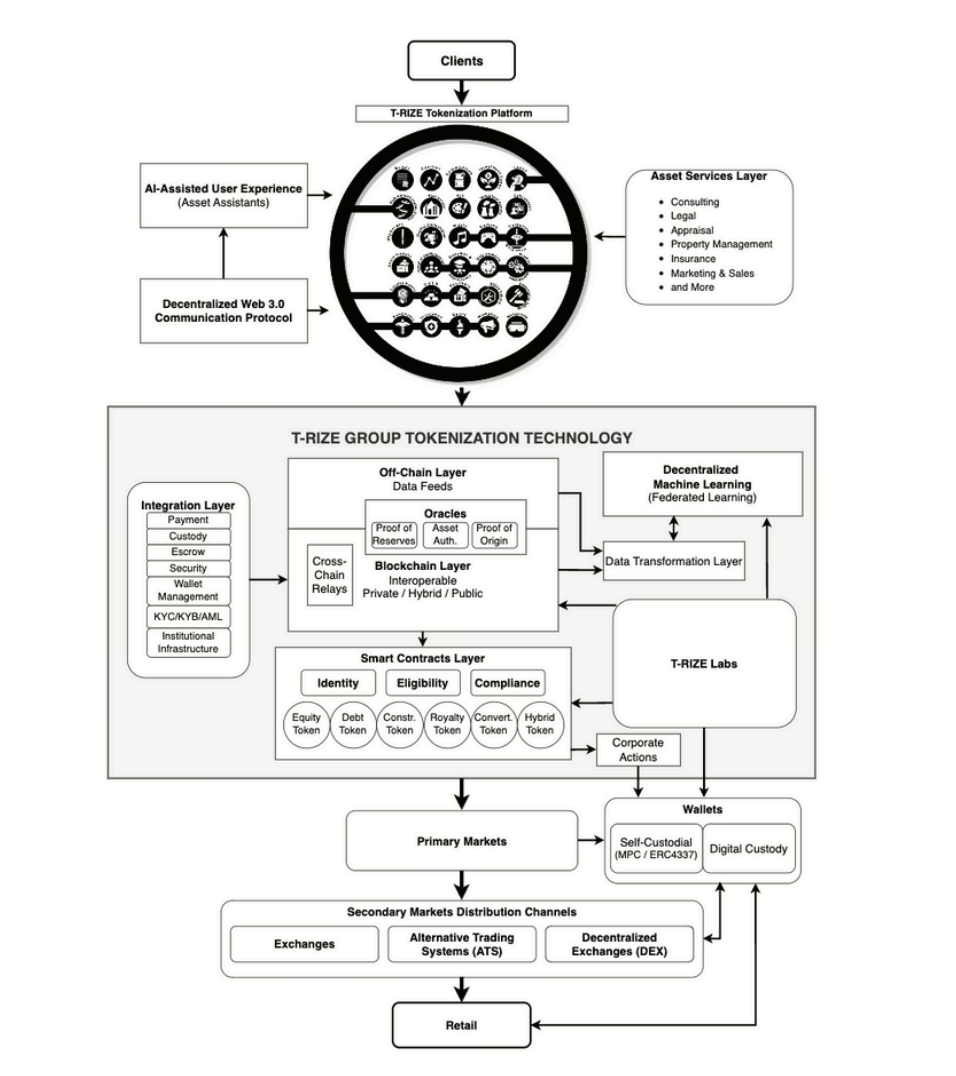
T-RIZE's technology stack comprises four core modules: the Asset Tokenization Engine, the RizeNet blockchain network, a federated learning-based intelligent analysis system, and a global compliance issuance network. The Asset Tokenization Engine converts real-world assets into on-chain digital rights; RizeNet handles issuance, settlement, and on-chain data storage; the federated learning system supports asset valuation, risk analysis, and data modeling; and the compliance network ensures that issuances adhere to regulatory standards across jurisdictions.
This architecture positions T-RIZE as more than an asset issuance platform—it is a complete RWA infrastructure solution. Unlike traditional finance, which relies on multiple intermediaries, T-RIZE leverages smart contracts and on-chain automation to restructure asset issuance and circulation.
What Is Asset Tokenization?
Asset tokenization is the process of mapping the ownership, income rights, or partial rights of real-world assets onto a blockchain network, representing them as digital tokens for trading.
Traditional assets commonly face the following issues:
- High investment barriers
- Limited liquidity
- Complex cross-border transactions
- Lengthy transfer periods
- High intermediary costs
Tokenization addresses these problems through blockchain technology. For example, a $20 million commercial property can be divided into millions of digital shares, allowing investors to purchase a fraction and hold proportional rights.
Income distribution, transfer records, and asset management can all be executed automatically via smart contracts. For real estate, funds, and private equity, this means greater liquidity and more inclusive investment opportunities.
How RizeNet Supports On-Chain Asset Issuance
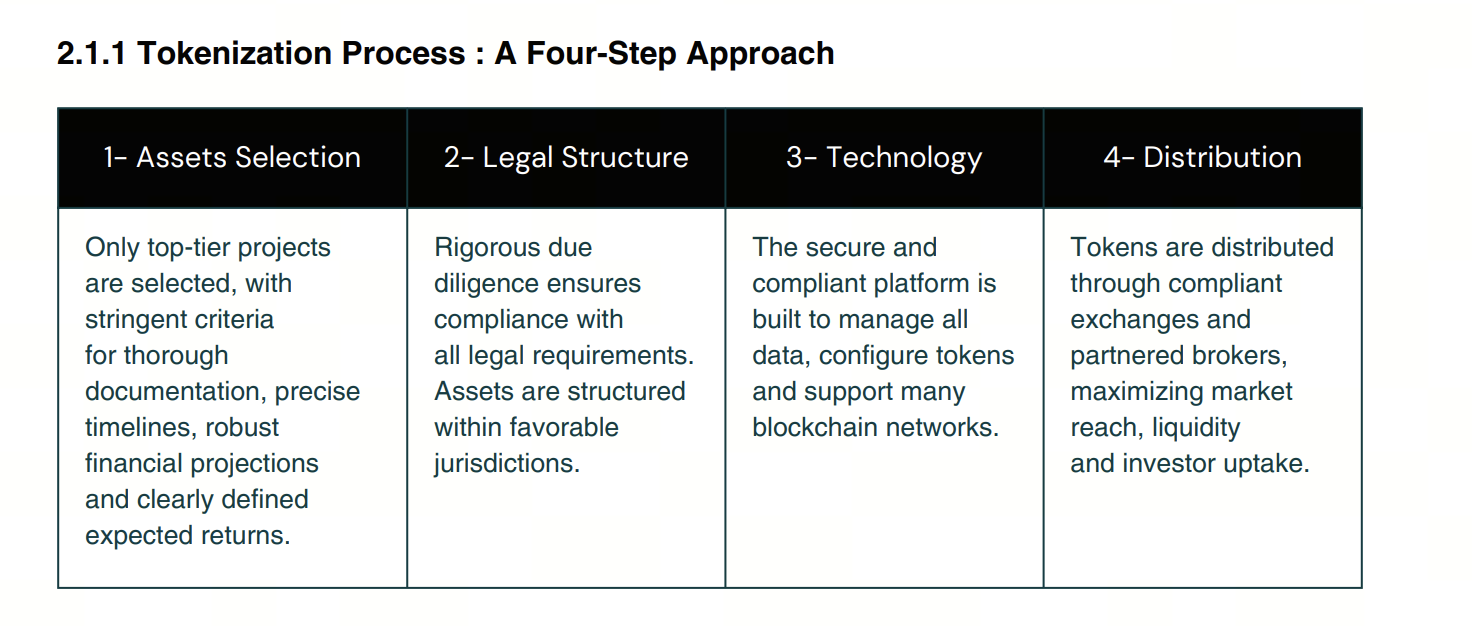
RizeNet is the underlying network of the T-RIZE ecosystem and the core infrastructure for asset issuance and management. Assets entering T-RIZE typically follow these steps:
Step 1: Asset Audit
The platform conducts legal, valuation, and compliance audits to confirm the asset's authenticity and issuance eligibility.
Step 2: Asset Digitization
The asset is mapped into on-chain digital rights via the tokenization engine, and the issuance rules are defined.
Step 3: Smart Contract Issuance
The smart contract automatically records:
- Ownership details
- Income distribution rules
- Transfer restrictions
- Investor eligibility criteria
- Asset status
Step 4: On-Chain Circulation
Investors trade within compliant markets, enhancing asset liquidity.
This streamlined process reduces manual intervention, improving both the efficiency and transparency of asset issuance.
How Federated Learning Is Applied to Asset Analysis and Risk Management
In addition to asset issuance, T-RIZE incorporates federated learning technology. Traditional finance often requires vast amounts of data for asset valuation and risk analysis, but privacy and regulatory constraints prevent centralized data sharing. Federated learning offers an alternative: raw data stays local, participants share model parameters, and the system performs joint training without exposing underlying data.
For real estate firms, fund managers, and financial service providers, this means they can collaboratively train risk models while preserving privacy. Combined with on-chain data, T-RIZE enables:
- Asset valuation analysis
- Risk rating
- Market trend prediction
- Yield assessment
- Portfolio optimization
- Liquidity monitoring
The convergence of AI and blockchain is emerging as a key trend in RWA infrastructure development.
How Compliant Issuance and Global Distribution Networks Work
Regulatory compliance is one of the biggest hurdles for real-world assets entering the blockchain market. Different countries have distinct requirements for securities issuance, investor qualifications, and asset trading. T-RIZE therefore embeds compliance into its technical architecture from the ground up.
The platform employs:
- KYC identity verification
- AML anti-money laundering checks
- Investor eligibility verification
- On-chain permission controls
- Smart contract compliance restrictions
These measures ensure that assets meet regulatory standards throughout issuance and circulation. Meanwhile, the global distribution network opens assets to a broader investor base. Under a unified framework, issuers can market real estate, funds, or private equity assets worldwide, boosting liquidity and capital-raising efficiency.
How T-RIZE Bridges Traditional Finance and Blockchain
Traditional finance and blockchain have long been separated by two key differences. On one side, traditional finance holds vast high-quality assets but suffers from low transaction efficiency. On the other, blockchain offers openness and global liquidity but lacks stable, real-world asset support.
T-RIZE’s mission is to serve as the bridge between them.
For Traditional Financial Institutions:
Leverage blockchain to issue digital assets, improve liquidity, reduce operational costs, and expand investor reach.
For the Crypto Market:
Gain access to real-world assets, enhance market stability, diversify investment products, and foster deeper integration between DeFi and RWA.
As more institutions enter the RWA space, the line between traditional finance and blockchain continues to blur.
Key Challenges in the RWA Infrastructure Sector
Despite a promising outlook, RWA infrastructure still faces significant hurdles.
Regulatory Complexity: Different countries have inconsistent definitions and rules for asset tokenization.
Asset Authenticity Verification: On-chain records ensure data immutability, but real-world assets still need credible legal and audit frameworks.
Liquidity Issues: Putting assets on-chain does not guarantee an active market; low investor participation can limit liquidity.
Technical Security: Smart contract vulnerabilities, cross-chain risks, and on-chain data security remain long-term concerns for the industry.
Future Development Directions for T-RIZE
In the coming years, the RWA market’s focus will shift from tokenization to infrastructure buildout. T-RIZE is likely to concentrate on several key areas:
- Expanding asset coverage to include real estate, corporate bonds, private equity funds, and yield-bearing assets.
- Strengthening RizeNet’s on-chain settlement and issuance capabilities to boost efficiency.
- Integrating federated learning and AI risk models more deeply into asset management for intelligent analysis.
- Building a more robust global compliance network to allow assets from different regions to be digitized, issued, and traded under unified standards.
As real-world assets increasingly migrate on-chain, infrastructure platforms that combine issuance, analysis, and compliance capabilities are poised to become cornerstones of the future digital financial system.
Summary
T-RIZE is a blockchain infrastructure platform dedicated to real-world asset tokenization. Through its Asset Tokenization Engine, RizeNet network, federated learning system, and global compliance framework, it provides a comprehensive technical architecture for asset issuance, management, trading, and risk analysis. Compared to traditional asset securitization, T-RIZE leverages blockchain to enhance asset circulation efficiency and offer global investors more open participation channels.
As real estate, funds, bonds, and other real-world assets progressively move on-chain, RWA is emerging as the critical bridge between traditional finance and Web3. The technical system built by T-RIZE represents a direction for asset digitization infrastructure—using blockchain, smart contracts, and AI to make real-world assets programmable, composable, and globally tradable, laying a new foundation for the future of finance.