As the DeFi market has developed, more blockchain protocols have begun adopting community governance models. Compared with traditional internet platforms, where companies make decisions centrally, decentralized protocols place greater emphasis on shared participation by users, developers, and liquidity providers. Against this backdrop, governance tokens have gradually become an important part of DeFi protocols, helping coordinate community interests and the direction of protocol development.
As one of the most representative decentralized trading protocols in DeFi, Uniswap has built an on-chain governance system through UNI. UNI affects not only protocol upgrades and parameter adjustments, but has also become an important case study for DeFi governance models. As Uniswap’s influence in the on-chain liquidity market continues to grow, UNI’s governance mechanism has also become a useful reference for observing how decentralized autonomous organizations, or DAOs, operate.
What Is UNI?
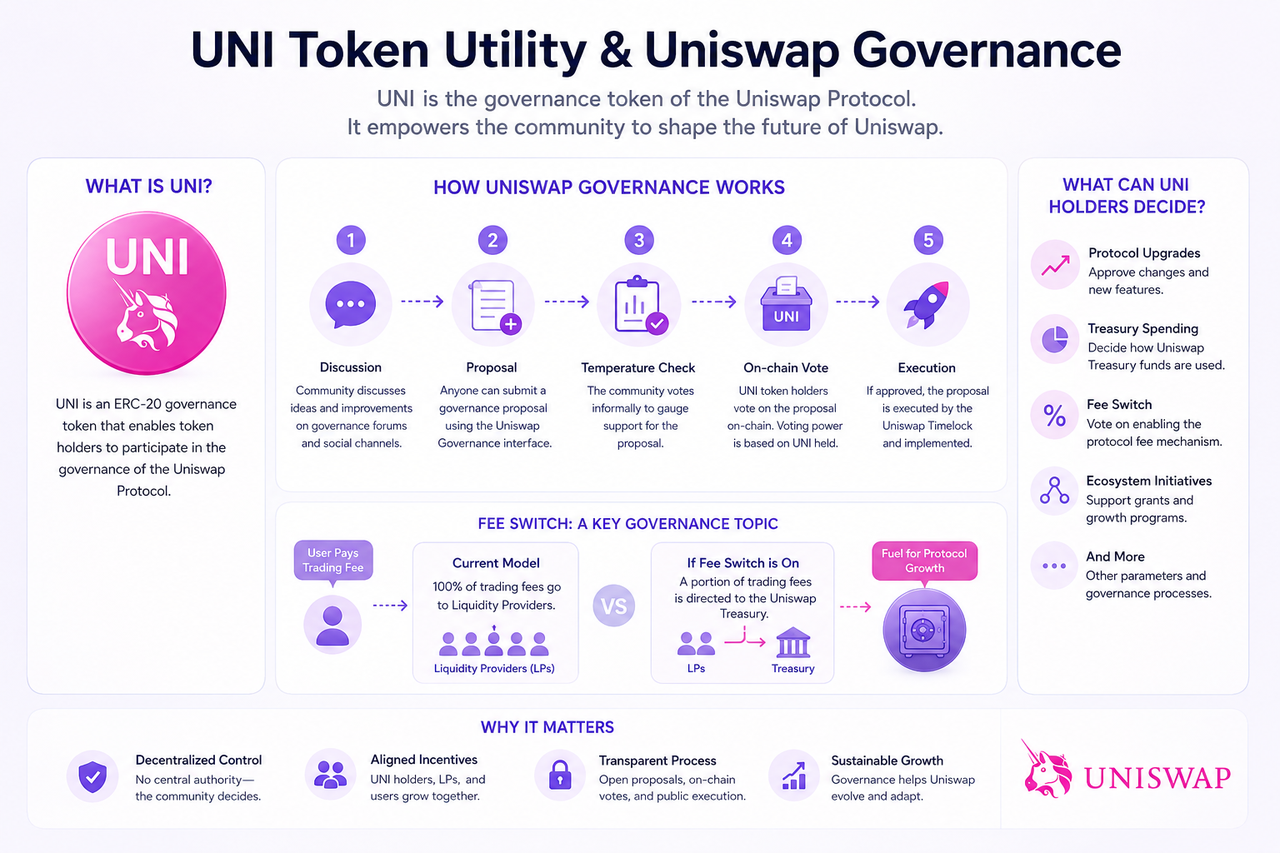
UNI is the governance token of the Uniswap protocol and is mainly used for community governance and protocol decision making. Users who hold UNI can take part in governance processes such as proposal discussions, on-chain voting, and protocol upgrades.
UNI was launched in 2020 and distributed to early protocol users through an airdrop. This distribution model strengthened community participation and helped promote the development of decentralized governance.
Unlike many platform tokens used to pay fees or provide trading discounts, UNI places greater emphasis on governance rights rather than direct financial return functions.
How Does UNI Governance Work?
Uniswap’s governance system operates through on-chain proposals and voting. UNI holders can submit governance proposals and vote on important protocol changes.
The governance process usually includes:
-
Community discussion
-
Proposal submission
-
Temperature check voting
-
Formal on-chain voting
-
Proposal execution
Once a proposal receives enough support, the relevant protocol upgrade or parameter adjustment can be executed automatically through smart contracts.
This governance model allows Uniswap to continue evolving without relying on a centralized management body.
What Can UNI Holders Decide?
UNI holders can participate in several key governance topics, including:
-
Protocol upgrades
-
Liquidity incentive programs
-
Treasury fund usage
-
Layer 2 deployment decisions
-
Governance structure adjustments
-
Fee Switch discussions
Among these, the Fee Switch has long been one of the community’s most closely watched issues. This mechanism concerns whether part of trading fees should be allocated to the protocol or governance system, which makes it a highly discussed topic in DeFi governance.
What Is the Fee Switch?
The Fee Switch is a potential function in Uniswap’s governance system that determines whether the protocol should enable a protocol fee mechanism.
At present, most trading fees are usually distributed to liquidity providers, or LPs. The core idea behind the Fee Switch is that the protocol could take a certain share of trading fees and use it for the Treasury or broader governance ecosystem development.
Supporters believe this mechanism could improve the protocol’s sustainability, while critics worry it may affect LP incentives and market liquidity.
Because it involves the protocol’s economic structure, the Fee Switch has remained one of the core issues in UNI governance.
UNI is clearly different from traditional centralized exchange platform tokens.
Many platform tokens are mainly used for fee discounts, platform activity benefits, and buyback and burn mechanisms. UNI, by contrast, focuses more on protocol governance and community decision making. Its value comes more from governance rights and ecosystem influence than from a centralized platform operating model.
This difference reflects the structural distinction between DeFi and traditional crypto platforms.
What Is UNI’s Significance in DeFi Governance?
The launch of UNI helped advance the development of DeFi governance systems. Through on-chain governance, protocol upgrades and key decisions no longer rely on a single company, but gradually shift toward a community coordination mechanism.
This model has also influenced many later protocols. Lending platforms, stablecoin protocols, and on-chain infrastructure projects have all begun adopting governance token models.
Summary
UNI is not only the governance token of Uniswap. It also represents the broader trend of DeFi protocols moving toward community governance. Through on-chain proposals and voting, UNI holders can participate in key decisions related to protocol upgrades, fund management, and ecosystem development.
As Uniswap’s influence in the on-chain liquidity market continues to expand, UNI’s governance structure is also shaping the design direction of more DeFi protocols and pushing decentralized governance models further forward.
FAQs
What is the UNI token used for?
UNI is mainly used for Uniswap protocol governance, including proposals, voting, and protocol upgrade decisions.
Can UNI be used to pay trading fees?
UNI’s core function is governance, not trading fee payment.
What is Uniswap Governance?
Uniswap Governance is an on-chain governance system based on UNI, used to decide protocol upgrades and community proposals.
What is the Fee Switch?
The Fee Switch is a potential protocol fee mechanism that determines whether part of trading fees should be allocated to the protocol Treasury.
UNI focuses more on governance rights and community decision making, while traditional platform tokens usually focus more on trading benefits and platform operations.
Does UNI represent equity in Uniswap?
UNI does not represent company equity. Its main role is participation in protocol governance.