AIG (American International Group), one of the world’s most prominent insurance groups, has long focused on property insurance, liability insurance, commercial insurance, and risk management services. It delivers diversified insurance solutions to corporate clients, institutional investors, and individual users. With a business network spanning multiple countries and regions, AIG has become a key player in the global insurance market.
For investors analyzing the insurance sector, AIG is more than just an insurer—it serves as a vital lens for understanding the global risk management landscape, corporate insurance demand, and industry trends.
What is AIG (American International Group)?
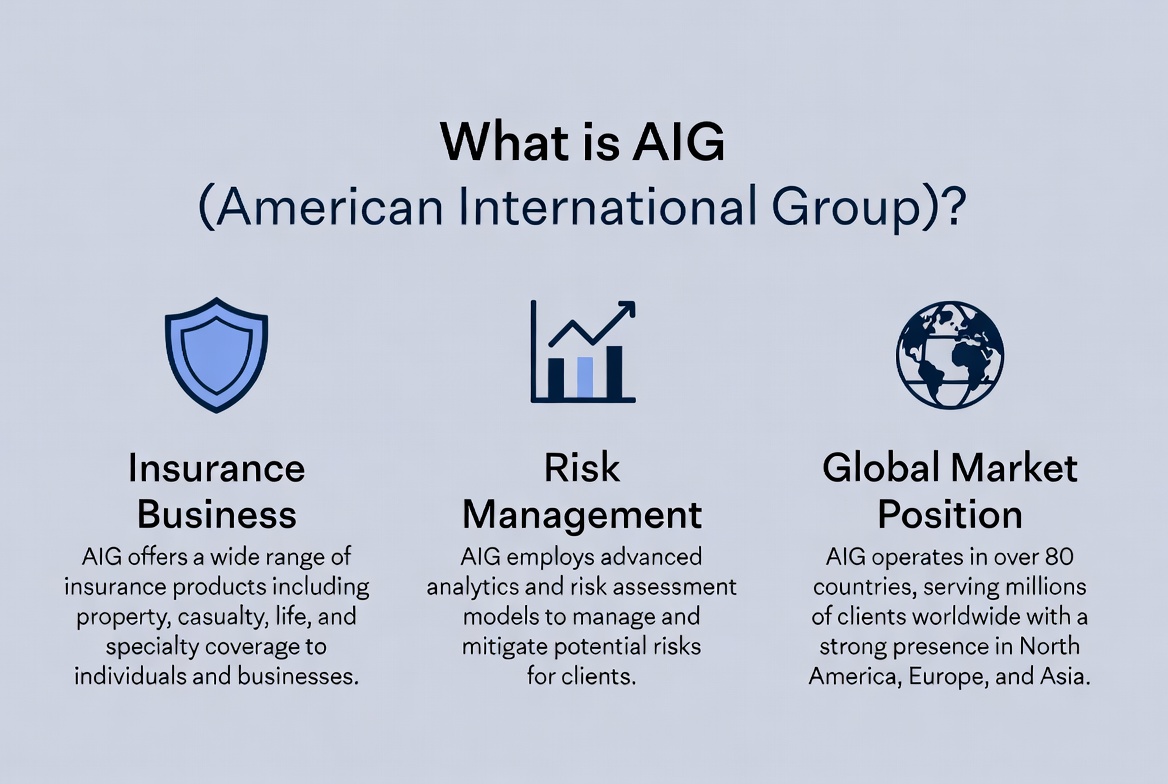
By business nature, AIG operates in the insurance sector. Its core offerings include property insurance, liability insurance, commercial insurance, and related risk management services. Unlike banks, which generate income through lending, insurance companies primarily help clients transfer risk and achieve profitability through premium income and investment returns.
AIG is the ticker symbol for American International Group. Headquartered in New York, U.S., it is one of the world’s foremost insurance and risk management groups.
AIG serves a wide-ranging clientele, including large multinationals, small-to-medium enterprises, and select individual customers. With operations across numerous industries and regions, the company participates in diverse economic activities such as manufacturing, aviation, energy, healthcare, and international trade.
In the global insurance market, AIG has long been regarded as a leading large-scale composite insurer, wielding significant influence through its business scale and international reach.
American International Group's Development History and Market Positioning
Founded in 1919, AIG has a history spanning over a century. The company began with international insurance operations and gradually expanded globally, evolving into one of the world’s leading insurance groups.
Over the decades, AIG has undergone phases of rapid expansion, global deployment, and business restructuring. Particularly in large corporate insurance and cross-border risk management, the company has accumulated extensive experience and built a service network covering all major global economies.
Today, AIG’s market positioning is increasingly focused on property and commercial insurance. Unlike insurers that primarily serve personal auto and home insurance, AIG excels in serving corporate clients and complex risk scenarios, such as large-scale engineering projects, cross-border trade, and professional liability.
This strategic focus enables the company to remain competitive in the global commercial insurance market, while elevating risk management capability as one of its core advantages.
How Does AIG's Insurance Business Operate?
The insurance business model is built on risk diversification. After clients pay premiums, the insurer assumes the risk of potential losses within the agreed scope. When a covered event occurs, the company compensates per the contract.
AIG builds a risk pool by covering a large number of clients across diverse risk categories. Since not all clients file claims simultaneously, the insurer can manage overall risk using statistical principles and maintain long-term viability through sound pricing.
Beyond premium income, insurers invest premium funds. Before claims liabilities materialize, these funds generate investment returns, becoming an important profit source.
For AIG, the business focus extends beyond selling insurance products to assessing risk, managing risk, and designing coverage solutions that meet client needs. Risk pricing ability and underwriting capacity directly influence long-term profitability.
AIG's Property Insurance and Commercial Insurance System
Property insurance and commercial insurance are among AIG’s core business segments and key revenue drivers.
Property insurance helps clients address risks of building damage, equipment breakdown, natural disasters, and other property losses. Factories, office buildings, logistics warehouses, and commercial facilities often require such coverage.
Commercial insurance covers a broader range of corporate operational risks, including liability, professional liability, cybersecurity insurance, employee-related coverage, and industry-specific solutions. As business environments grow more complex, the importance of commercial insurance continues to rise.
For large multinationals operating across multiple countries and regions, unified global insurance solutions are essential. Leveraging its international network and risk management expertise, AIG helps clients establish cross-regional coverage systems—a key competitive advantage.
Why Risk Management Is Core to AIG's Business
The essence of insurance is not selling policies but managing risk. Risk management capability determines an insurer’s long-term stability.
For AIG, risk assessment permeates every stage. Before underwriting, the company analyzes client risk levels; during underwriting, it continuously monitors changes; after a claim, it controls costs and refines risk models.
As the global economy evolves, enterprise risks become more complex—from cyberattacks and supply chain disruptions to natural disasters and trade volatility. Businesses require increasingly sophisticated risk management services. Insurers are thus transforming from compensation providers into integrated risk management partners.
AIG’s long-standing focus on corporate insurance has built deep expertise in complex risk analysis and tailored insurance solutions. This capability not only influences client choices but directly impacts profitability and market standing.
AIG's Role in the Global Insurance Market
The global insurance market is a vital component of the modern financial system. Through risk diversification, insurance helps businesses and individuals engage in economic activity, enhancing society’s overall risk tolerance.
As one of the world’s major insurance groups, AIG plays a crucial role in the international market. Its clients span multiple countries and regions, with products covering aviation, energy, manufacturing, healthcare, finance, and technology.
For multinationals, international operations often involve diverse legal environments and risk factors. With its global network, AIG helps enterprises establish unified risk management frameworks, reducing operational uncertainty.
From an industry perspective, AIG is not just an insurer but a key participant in the global risk management ecosystem, with activities closely tied to international trade, capital markets, and corporate operations.
What Are the Differences Between AIG, Chubb, and Travelers?
AIG, Chubb, and Travelers are all major U.S. insurers, but their business focuses differ significantly.
| Company |
Core Positioning |
Main Strengths |
| AIG |
Global commercial insurance group |
International reach and corporate risk management |
| Chubb |
High-end property and liability insurance |
Premium clients and global service |
| Travelers |
U.S. property insurance leader |
Domestic market coverage and stable operations |
AIG’s key distinction is its broad international footprint and long-term focus on large corporate insurance. Chubb excels in the high-end market, while Travelers concentrates on U.S. domestic property insurance.
Thus, despite operating in the same industry, the three companies differ in client structure, market focus, and risk management strategies.
Main Application Scenarios for AIG
AIG's insurance products are widely used across modern economic activities.
Large enterprises are among AIG’s most important clients. When building factories, engaging in international trade, operating logistics networks, or managing employees, companies need insurance solutions to reduce risk exposure.
Energy, aviation, healthcare, and manufacturing are also key sectors. These industries face high operational risks and have strong demand for specialized insurance and risk management.
With the digital economy, demand for cybersecurity insurance, data risk management, and new liability products continues to grow. AIG is expanding accordingly to address emerging enterprise risks.
How to Buy AIG (American International Group) Stock
AIG is listed on the New York Stock Exchange (NYSE) under the ticker AIG. Investors can purchase AIG stock through a securities account supporting U.S. equities, gaining exposure to the global insurance industry.
Insurance company performance is influenced by premium growth, loss ratios, investment returns, and economic conditions. When evaluating AIG, investors typically analyze underwriting profit, combined ratio, and portfolio performance.
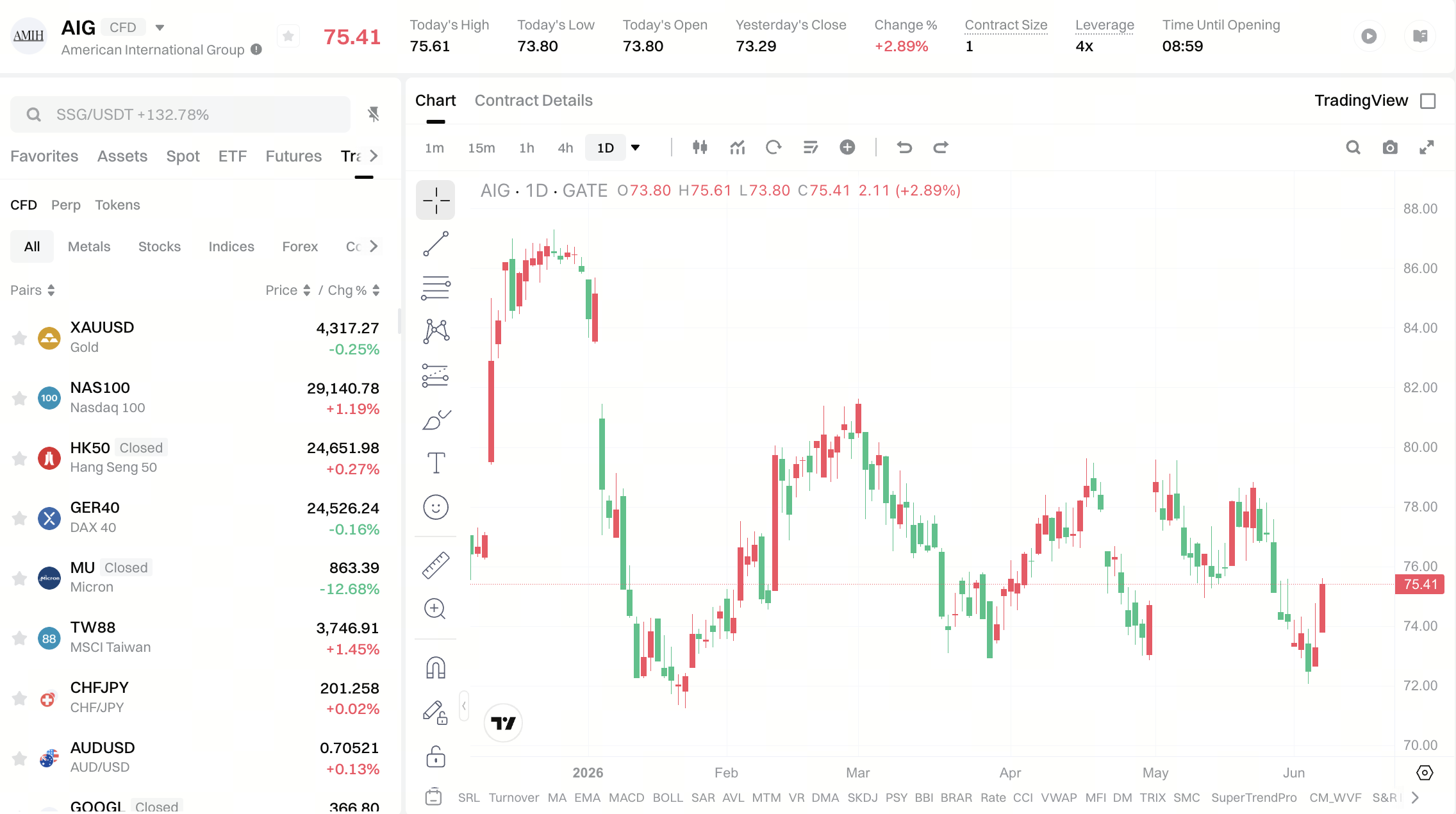
As digital and traditional markets converge, some platforms now offer products linked to U.S. stock prices. Gate TradFi is expanding its coverage of traditional assets, allowing users to monitor digital assets, U.S. stocks, ETFs, indices, and commodities from a single account. Certain markets also offer Gate CFD products, providing more options for cross-market asset management.
Regardless of the participation method, investors should fully understand product mechanisms, risk profiles, and local regulatory requirements.
AIG's Advantages and Limitations
AIG’s greatest strength lies in its global network and deep risk management expertise. It serves numerous large corporate clients and holds a strong market position in commercial and specialized insurance.
The insurance industry also has high entry barriers. Underwriting experience, risk models, capital strength, and brand reputation require long-term accumulation, creating strong competitive moats for established groups.
However, AIG faces common industry challenges. Increased natural disaster frequency, rising claim costs, and financial market volatility can affect profitability. The industry is also heavily regulated, with high capital requirements. Thus, AIG benefits from insurance’s long-term growth but must continuously navigate a complex risk environment.
Summary
AIG (American International Group) is a globally recognized insurance group, with core operations in property insurance, commercial insurance, and risk management. By helping businesses and individuals transfer and manage risk, AIG holds a significant position in the global insurance market. As demand for enterprise risk management grows, international commerce expands, and new risks emerge, the insurance industry’s importance continues to rise—and AIG remains a key participant in the global insurance ecosystem.
FAQ
What is AIG?
AIG is the ticker symbol for American International Group, one of the world's leading insurance and risk management groups.
What are AIG's main businesses?
They include property insurance, commercial insurance, liability insurance, and enterprise risk management services.
How does AIG make money?
The company earns profit through premium income and investment returns on insurance funds.
What is commercial insurance?
Commercial insurance helps enterprises manage various business risks, such as property loss, liability disputes, and operational disruption.
What is the difference between AIG and Chubb?
AIG emphasizes global corporate insurance and risk management, while Chubb has a stronger presence in the high-end insurance market.
Why is risk management important?
Risk management helps enterprises reduce potential losses and improve stability, and it is the core foundation of value creation in the insurance industry.