As the number of public chains, Layer 2 solutions, Rollups, and app chains keeps growing, more and more blockchains need to build their own security systems. But new networks often lack enough validators and token economic weight, which drives up security costs and exposes them to attack risks.
That’s where Babylon comes in with its Bitcoin Security Network concept—designed to extend the economic security Bitcoin has built up over the years to protect a wider range of blockchains. As a core piece of the Bitcoin Staking system, BSN is seen as key infrastructure bridging Bitcoin and the multi-chain world. Its goal: turn BTC into a cross-network shared security resource without changing Bitcoin’s consensus mechanism.
What Is Bitcoin Security Network (BSN)
Bitcoin Security Network (BSN) is a unique architecture that leverages Bitcoin’s security to offer shared security services across multiple blockchains. Traditional blockchains rely on their own tokens and validators to stay secure. BSN, by contrast, brings BTC into the mix via Bitcoin Staking, letting multiple networks tap into the same set of economic security resources.
Think of BSN as a security service network. Blockchains connected to BSN don’t have to depend entirely on their own token value to build security barriers—they can lean on Bitcoin’s economic guarantees to boost their overall security posture.
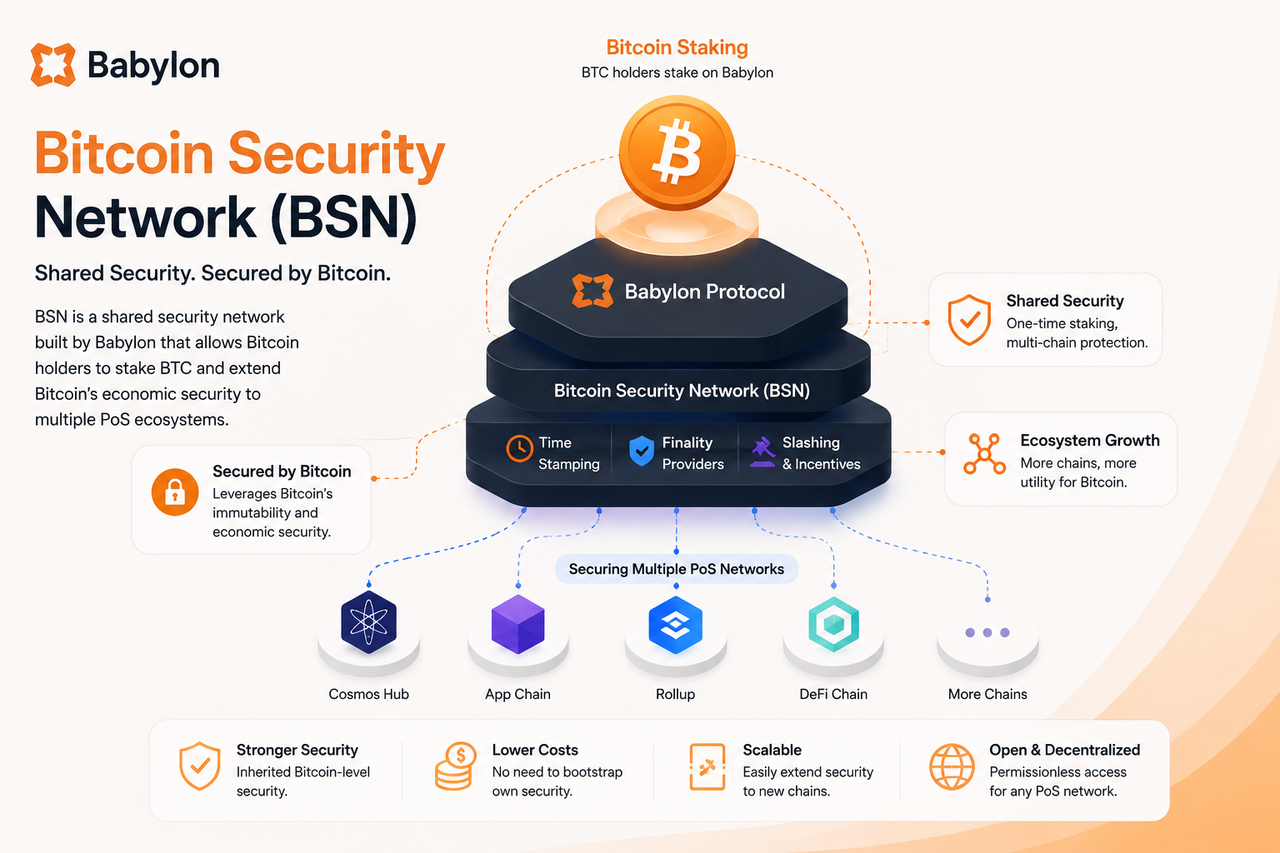
How Babylon Builds Bitcoin Security Network
Babylon constructs BSN using Bitcoin Staking and a shared security framework.
BTC holders can lock their Bitcoin through the Babylon protocol, putting those assets to work as economic guarantees for network security.
Those locked BTC never leave the Bitcoin network, and there’s no need to convert them into wrapped tokens on other chains. The protocol uses cryptographic proofs to record relevant states and allocates those security resources to blockchains plugged into the Babylon ecosystem.
What Role Does Bitcoin Staking Play in BSN
Bitcoin Staking is the bedrock of BSN.
In Babylon’s architecture, BTC serves as a source of economic security. Once users lock up their BTC, the protocol can use those assets to provide guarantee power to other blockchains.
When everyone plays by the rules, the shared security system hums along. When malicious behavior pops up, the protocol can raise the cost of cheating through preset mechanisms.
So Bitcoin Staking gives BSN its economic foundation, and shared security is what it all leads to.
How Finality Providers Maintain Shared Security
Finality Providers are key players in BSN.
In the Babylon system, Finality Providers help blockchain networks finalize their states and validate the shared security condition.
These nodes keep an eye on Bitcoin Staking activity, take part in consensus, and coordinate security information flow between networks.
For app chains connected to BSN, Finality Providers act as the bridge linking security resources to network operations. Their job directly affects how stable the shared security system stays.
How the Timestamping Protocol Enhances Security
The Timestamping Protocol is another core technology in BSN.
Babylon takes advantage of the Bitcoin blockchain’s immutability to record important states from other networks directly onto the Bitcoin chain.
Since rewriting historical blocks is brutally expensive, those records give connected networks an extra layer of trustworthy verification.
This design means BSN doesn’t just rely on BTC’s economic value—it also taps into the Bitcoin network’s inherent security to add another protective layer.
What Are the Differences Between BSN and Traditional Blockchain Security Models
BSN and traditional blockchain security systems differ sharply in where security comes from and how resources are used.
| Comparison Dimension |
Bitcoin Security Network (BSN) |
Traditional Blockchain Security Model |
| Security Source |
BTC economic security |
Native token economic security |
| Service Scope |
Multi-chain shared |
Single chain independent |
| Verification Mode |
Shared security network |
Separate verification system |
| Resource Utilization |
Security resources reusable |
Security resources isolated from each other |
| Cold Start Cost |
Lower |
Higher |
| Applicable Objects |
App chains, Rollups, PoS networks |
Various independent blockchains |
At the architecture level, BSN focuses on sharing security resources, while the traditional model stresses network independence.
What Are the Application Scenarios of Bitcoin Security Network
BSN’s use cases center on blockchain networks that need an extra security boost.
In the Cosmos ecosystem, app chains can tap into BSN for stronger economic security backing.
For Rollups and modular blockchains, BSN can serve as an external security layer, adding extra guarantees for state confirmation and data verification.
What Challenges Does BSN Face
BSN offers a fresh approach to shared security, but it still has hurdles to clear.
First, a shared security system means multiple networks have to work together, so it’s inherently more complex than a single-chain setup.
Second, responsibility boundaries, security policy coordination, and incentive design across different blockchains still need fine-tuning.
Plus, the shared security model is still maturing, and industry standards and long-term governance frameworks are evolving.
Conclusion
Bitcoin Security Network (BSN), a shared security framework pushed forward by Babylon, uses Bitcoin Staking, Finality Providers, and the Timestamping Protocol to extend Bitcoin’s economic security across a wider blockchain ecosystem. BSN’s core idea: turn BTC from a store of value into a reusable security resource that networks can share, giving app chains, PoS networks, and modular blockchains an extra layer of protection.
FAQs
What is the relationship between BSN and Bitcoin Staking?
Bitcoin Staking is the engine behind BSN. By locking BTC and joining the Babylon protocol, users supply economic security resources, and BSN allocates those resources to blockchains that need them.
Will Bitcoin Security Network change the Bitcoin consensus mechanism?
No. Bitcoin Security Network leaves Bitcoin’s original Proof of Work (PoW) consensus untouched. BSN builds on Bitcoin’s existing security to create a shared system without affecting how the Bitcoin network itself runs.
What role does Finality Provider play in BSN?
Finality Providers keep the shared security system running by offering finality services and validating network states. They’re like security coordinators, helping connected networks get reliable state confirmations.
What is the difference between BSN and the traditional PoS network security model?
Traditional PoS networks lean on their own tokens for security, while BSN uses BTC to deliver economic guarantees. BSN is all about sharing security resources; the traditional approach is about each network building its own security from scratch.
Which blockchains might use Bitcoin Security Network?
App chains, Cosmos ecosystem networks, Rollups, modular blockchains, and PoS networks that need extra security support are all potential users of Bitcoin Security Network.