The modern digital economy depends on stable communications networks. From smartphones connecting to the internet, to enterprises building cloud platforms, to the rising data transmission demands of artificial intelligence applications, telecom operators have become a core part of digital infrastructure.
As a major participant in Taiwan’s communications market, Chunghwa Telecom not only has extensive network coverage, but also continues to expand its data center, cloud computing, and enterprise digital services businesses. With the growth of 5G, the Internet of Things, and cloud services, Chunghwa Telecom’s role has gradually evolved from that of a traditional telephone operator into a provider of integrated digital infrastructure services.
What Is CHT (Chunghwa Telecom)
Chunghwa Telecom was founded in Taiwan and is one of the largest integrated communications service companies in the market. CHT is the stock ticker of Chunghwa Telecom Co., Ltd. in the U.S. securities market. The company’s businesses cover mobile communications, fixed line telephony, broadband networks, enterprise communications services, international communications, data centers, cloud computing, and other areas.
Chunghwa Telecom’s core responsibility is to build and operate communications networks so that individuals, businesses, and institutions can transmit information, access the internet, and connect to digital services.
Unlike pure internet companies, Chunghwa Telecom owns substantial physical communications infrastructure, including fiber optic networks, mobile base stations, submarine cables, and data center resources. These assets form an important foundation for its long term competitive strength.
Chunghwa Telecom’s History and Market Position
Chunghwa Telecom’s development is closely tied to the modernization of Taiwan’s communications industry.
In the early stages, communications services were mainly managed by government agencies. As the telecom market gradually opened and industry reforms advanced, Chunghwa Telecom transformed into a modern telecom operator and completed its public listing.
Over the course of its long term development, Chunghwa Telecom has continued to expand its network coverage and service capabilities, moving from traditional telephone services into mobile communications, internet access, and digital services.
Today, Chunghwa Telecom has built an important communications network system that covers all of Taiwan.
In terms of market position, Chunghwa Telecom is both a consumer communications service provider and a major supplier of enterprise digital solutions. Its customers include individual users, small and midsize businesses, large enterprises, government agencies, and other groups.
Telecommunications is one of Chunghwa Telecom’s important sources of revenue.
The core model of a telecom operator is to build communications networks, provide connectivity services to users, and charge fees for those services.
Chunghwa Telecom mainly generates revenue through the following businesses:
-
Mobile communications services
-
Fixed line telephone services
-
Broadband network services
-
Enterprise communications services
-
International communications services
The mobile communications business earns revenue by providing voice, messaging, and data traffic services.
The broadband business generates stable cash flow through home and enterprise internet access services.
Enterprise customers often also purchase dedicated lines, cybersecurity services, and data transmission solutions, creating higher value service revenue.
This business model, built around network infrastructure, gives Chunghwa Telecom strong long term operating capacity.
Chunghwa Telecom’s 5G Network and Broadband Service System
5G and fiber broadband have become important parts of modern communications services.
In recent years, Chunghwa Telecom has continued to invest in 5G network construction to improve mobile internet connectivity and expand network coverage.
Compared with 4G, 5G networks can provide higher data transmission speeds, lower latency, and stronger connection capacity.
5G networks serve not only individual users, but also support:
At the same time, Chunghwa Telecom has an extensive fiber broadband network.
Fiber networks provide stable, high speed data transmission and are an important infrastructure foundation for home internet access and enterprise digital operations.
Together, 5G networks and fiber broadband form a key pillar of Chunghwa Telecom’s digital connectivity capabilities.
Chunghwa Telecom’s Data Center and Cloud Services Strategy
As demand for enterprise digital transformation continues to grow, data centers and cloud services have become important growth areas for Chunghwa Telecom.
Data centers are responsible for storing, processing, and transmitting digital information, making them a critical infrastructure component of modern internet services.
Through its data center resources, Chunghwa Telecom provides enterprise customers with:
More and more companies want to migrate their business systems to cloud platforms to reduce IT infrastructure management costs and improve operational efficiency.
As a result, cloud services have gradually become one of the important ways for telecom operators to expand in the enterprise customer market.
For Chunghwa Telecom, data centers and cloud businesses can further diversify revenue sources and strengthen its digital service capabilities.
Chunghwa Telecom’s Role in Taiwan’s Communications Market
Chunghwa Telecom is one of the key infrastructure operators in Taiwan’s communications market.
Communications networks are a typical heavy asset industry, requiring long term capital investment in base stations, fiber optic networks, and international communications resources.
Because network construction costs are high, the market is usually led by a small number of large operators.
Chunghwa Telecom has strong market influence across fixed networks, mobile communications, and international communications.
At the same time, Chunghwa Telecom also undertakes part of the construction and maintenance of critical communications infrastructure, giving it an important role in the development of Taiwan’s digital economy.
From the perspective of market structure, Chunghwa Telecom has become an important communications platform connecting individual users, enterprise customers, and public institutions.
Taiwan’s communications market is mainly made up of operators such as Chunghwa Telecom, Taiwan Mobile, and Far EasTone.
All three companies provide mobile communications and broadband services, but they differ in resource scale and business layout.
| Dimension |
Chunghwa Telecom |
Taiwan Mobile |
Far EasTone |
| Fixed network resources |
Strong |
Relatively limited |
Relatively limited |
| Broadband coverage |
Extensive |
Moderate |
Moderate |
| Enterprise services |
Strong |
Continuously expanding |
Continuously expanding |
| Data center layout |
Relatively complete |
Under continuous development |
Continuously expanding |
| Market position |
Integrated operator |
Integrated operator |
Integrated operator |
Chunghwa Telecom’s biggest distinguishing feature is its relatively complete communications infrastructure system.
Taiwan Mobile and Far EasTone, meanwhile, have been more active in promoting digital services, content platforms, and enterprise solutions.
What Are Chunghwa Telecom’s Main Use Cases
Chunghwa Telecom serves a wide range of digital economy scenarios.
Individual users rely on its mobile networks and broadband services for communication, entertainment, and online work.
Enterprise customers use dedicated networks, cloud services, and data center resources to carry out digital operations.
Government agencies depend on communications networks to deliver public services and transmit information.
IoT applications use 5G networks to connect devices and exchange real time data.
Artificial intelligence and cloud computing services, in turn, depend on data centers and high speed network resources to operate.
Together, these applications continue to raise the importance of communications infrastructure.
CHT is listed and traded on the New York Stock Exchange, making it one of the important listed companies through which international investors can understand Taiwan’s communications industry. Investors can buy CHT stock through brokerage accounts that support U.S. stock trading, and participate in the potential returns and risks related to the company’s operating performance and the development of the communications industry.
As digital assets and traditional financial markets gradually converge, more trading tools linked to stock price movements have also appeared in the market. For example, some platforms offer CFD products linked to the prices of related assets, allowing users to participate in market movements through price changes without directly holding the underlying shares.
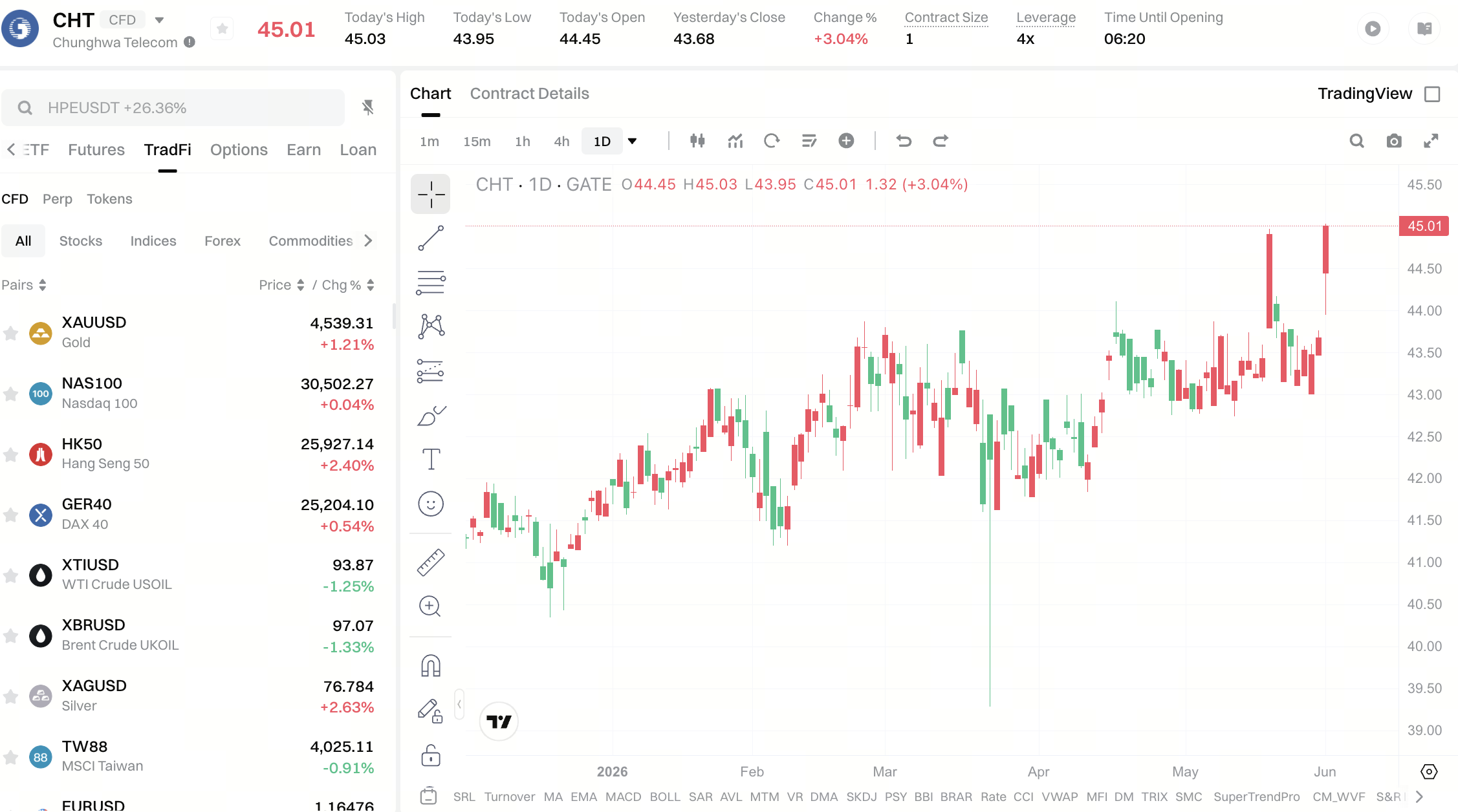
Taking Gate TradFi as an example, users can follow not only the digital asset market, but also traditional financial assets such as stocks, ETFs, indices, and commodities within the same ecosystem. Some markets also offer Gate CFD products, allowing users to participate in price movement trading for related assets through a digital asset account.
No matter how investors choose to participate in the market, they should fully understand the product structure, trading rules, liquidity characteristics, and regulatory requirements in their region.
Chunghwa Telecom’s Strengths and Limitations
Chunghwa Telecom’s key strengths come from the communications infrastructure resources it has accumulated over many years.
Its broad network coverage, stable user base, and enterprise grade service capabilities allow Chunghwa Telecom to maintain a strong position in a highly competitive communications market.
At the same time, data centers, cloud computing, and enterprise services also provide the company with new growth opportunities.
On the other hand, the communications industry is capital intensive.
Network upgrades, spectrum investments, and infrastructure construction all require sustained and substantial funding.
In addition, market competition, technological iteration, and changing user demand can also create challenges for operators’ long term development.
Therefore, Chunghwa Telecom needs to maintain a balance among network construction, digital service innovation, and operational efficiency.
Conclusion
CHT (Chunghwa Telecom) is a leading integrated telecom operator in Taiwan, with businesses covering mobile communications, broadband networks, enterprise services, data centers, cloud computing, and other areas. Supported by communications infrastructure resources accumulated over many years, Chunghwa Telecom plays an important role in the development of Taiwan’s digital economy. As demand for 5G, cloud computing, and digital transformation continues to grow, Chunghwa Telecom is gradually evolving from a traditional telecom operator into an integrated digital infrastructure service provider.
FAQs
What kind of company is CHT?
CHT is the stock ticker of Chunghwa Telecom. Chunghwa Telecom is one of Taiwan’s leading integrated telecom operators, providing mobile communications, broadband networks, and enterprise digital services.
What are Chunghwa Telecom’s main businesses?
Chunghwa Telecom mainly operates mobile communications, fixed line telephony, broadband networks, enterprise communications services, data centers, and cloud computing businesses.
Chunghwa Telecom owns key infrastructure such as communications networks, fiber optic systems, data centers, and cloud platforms, providing the connectivity and computing capacity needed for digital economy activities.
Chunghwa Telecom has broader fixed network and broadband resources, while Taiwan Mobile continues to expand its business layout in mobile communications and digital services.
How does 5G affect Chunghwa Telecom’s development?
5G networks can support higher data transmission capacity and more enterprise level application scenarios, making them an important direction for Chunghwa Telecom to strengthen its service capabilities.
Yes. Through its data centers and cloud platforms, Chunghwa Telecom provides enterprise customers with cloud computing, data hosting, cybersecurity, and digital transformation related services.