In Latin America’s financial market, traditional banks have long been associated with high fees, limited financial service coverage, and restricted digital efficiency. As a result, more fintech companies have begun changing user financial behavior through mobile banking, digital payments, and super app models. Inter&Co is one of the digital banking platforms that has grown rapidly against this backdrop.
From an industry structure perspective, CIB represents more than a digital banking company. It also reflects the broader transformation of Latin America’s financial industry from a “traditional banking system” toward a “digital finance ecosystem.” As mobile payments, e-commerce, and AI financial services develop quickly, digital banking platforms are gradually evolving toward the model of a “financial super app.”
Source: inter.co
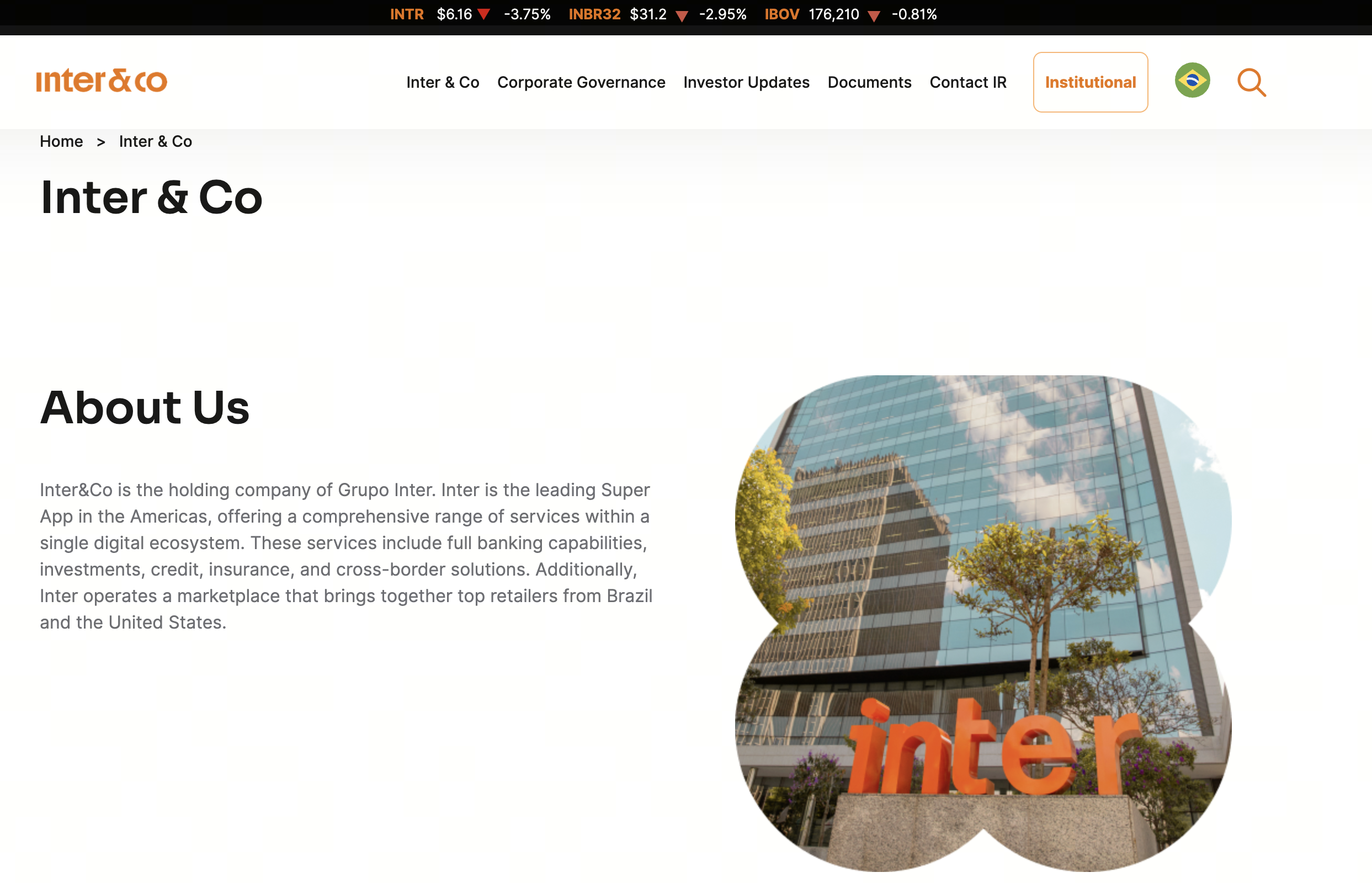
What Is Inter&Co (CIB)
Inter&Co’s origins are closely tied to Brazil’s traditional financial system, but its period of rapid growth truly began during the fast expansion of digital banking and fintech in Brazil. Compared with traditional banks that rely on physical branch expansion, Inter places greater emphasis on mobile services and online financial ecosystems.
Brazil has long been one of Latin America’s largest financial markets, but its traditional banking system is highly concentrated, with major banks holding dominant positions in the market. While this structure has improved the stability of the banking system, it has also left some users facing high financial service costs and limited financial choices for a long time.
For this reason, digital banking has become an important direction of change in Brazil’s financial industry. Fintech platforms such as Inter and Nubank have gradually attracted younger users and internet native users through low fees, mobile payments, and digital accounts.
From an industry perspective, CIB’s development represents not only the growth of a single company, but also the broader development trend of Latin America’s digital finance industry.
CIB’s (Grupo Cibest) Core Business Model
Inter&Co’s business model is essentially a combination of “digital banking + financial ecosystem platform.” Compared with traditional banks that rely mainly on deposits and loans, Inter places greater emphasis on diversified financial services and a user ecosystem.
Its core revenue sources include consumer finance, card services, payment systems, lending services, and wealth management. At the same time, the platform has continued expanding into insurance, e-commerce, and investment services in the hope of increasing the amount of time users spend within its ecosystem.
One important difference between this model and traditional banking is that the platform pays closer attention to “customer lifetime value.” For digital banks, a single financial product often has limited profitability, so platforms usually expand user value through cross-selling.
For example, a user may initially only use a digital account, but later go on to use a credit card, consumer loan, insurance, or even investment services. This is also why more digital banks are moving toward the model of a “comprehensive financial platform.”
How to Trade CIB (Grupo Cibest)
Users who want to buy CIB (Grupo Cibest) can usually participate in market trading through platforms that support U.S. stocks or related overseas financial products. Because CIB is closely connected to Inter&Co, Latin American digital banking, and the fintech industry, many users see buying CIB as one way to observe the development of Latin America’s digital finance market.
At present, some multi-asset trading platforms have begun offering trading services that include stock CFDs, or contracts for difference. In addition to tracking the crypto asset market, users can also trade the price movements of certain overseas stocks, including CIB, through platforms that support stock CFDs. Unlike traditional stock trading, CFDs focus more on price fluctuations themselves and do not involve the actual delivery of shares.
At the same time, products such as Gate CFD launched by Gate are gradually expanding the coverage of digital asset platforms into traditional financial markets. For some users, this type of platform makes it possible to follow crypto assets, stock CFDs, and global market changes within the same trading system.
However, it is important to note that buying CIB or participating in stock CFD trading is still, by nature, an activity in highly volatile financial markets. Different platforms may vary in terms of leverage mechanisms, margin requirements, and product rules, so understanding the trading mechanism and risk structure remains very important before participating in these markets.
How Inter’s Super App Ecosystem Works
The Super App model is one of the important directions in today’s Latin American fintech industry. A super app essentially integrates multiple services into one platform, allowing users to complete payments, banking, shopping, investing, and other needs within a single app.
For Inter, the goal is not simply to become a digital bank, but to build a complete financial lifestyle ecosystem. The platform wants users not only to manage bank accounts within the app, but also to complete consumption, payments, and asset management there.
This model can help the platform improve user activity and retention. When users’ financial, consumption, and payment behaviors are all concentrated on the same platform, the platform’s long-term value per user usually becomes higher.
From an industry structure perspective, super apps have become a core area of competition for many fintech companies, and Inter’s ecosystem strategy is an important reflection of this trend.
Why Brazil’s Digital Banking Market Is Growing Rapidly
The rapid growth of Brazil’s digital banking market is closely related to the country’s financial structure and the development of mobile internet. For a long time, Brazil’s traditional banking system had problems such as high financial service fees, complicated account opening processes, and insufficient financial coverage in some regions.
At the same time, the spread of smartphones and mobile internet has continued to accelerate, allowing more users to complete financial services directly through their phones. This shift has driven the rapid expansion of digital banks.
The emergence of the Pix instant payment system has further changed Brazil’s digital payment ecosystem. Pix allows users to complete real-time transfers at lower cost and with higher efficiency, accelerating the penetration of digital finance.
From an industry perspective, the core logic behind the growth of digital banking in Brazil is essentially the combination of “financial inclusion + mobile internet + fintech.”
How CIB Differs from Traditional Banks
The biggest difference between Inter and traditional banks lies in their operating structures and user acquisition methods. Traditional banks have long relied on physical branches, offline customer service, and large banking systems, while digital banks depend more heavily on mobile platforms and automated systems.
Because they do not operate large networks of offline branches, digital banks can usually reduce certain operating costs. This allows platforms to attract internet users through lower fees or more convenient services.
At the same time, digital banks usually place greater emphasis on data systems and AI risk control capabilities. Online financial services need data analysis to support user credit assessment, risk management, and product recommendations.
Still, digital banks do not necessarily mean a complete replacement for traditional banks. In fact, many large traditional banks are also accelerating their own digital transformation. As a result, competition in Brazil’s financial industry has gradually evolved from “competition among banks” into “competition among financial ecosystems.”
The Latin American digital finance industry has now formed several important players, including Nubank, Inter, Mercado Pago, and digital businesses under large traditional banks.
Among them, Nubank places greater emphasis on pure digital banking and credit card user growth, while Inter focuses more on its “super app ecosystem.” Rather than offering only financial services, Inter aims to build a more complete platform based financial structure.
At the same time, traditional banks such as Itaú are also continuously pushing forward with digital upgrades. This means competition in Latin America’s financial industry is no longer simply about internet companies challenging traditional banks. Instead, the entire financial industry is moving toward digital ecosystems.
Looking at the long-term trend, competition in Latin America’s financial industry is likely to focus on:
-
User scale
-
Digital payment capabilities
-
AI risk control systems
-
Platform ecosystem integration
-
Ability to combine finance and consumption
As a result, competition among digital banking platforms is increasingly resembling competition among internet platform ecosystems.
Risks and Cyclicality in Latin America’s Digital Finance Industry
Although the Latin American digital banking industry is growing quickly, it also has clear cyclical characteristics and risks. Because Latin American economies have long been affected by inflation, exchange rates, and interest rate fluctuations, the financial industry is usually also influenced by macroeconomic cycles.
For digital banks, consumer lending and credit businesses are important revenue sources, but this also means platforms need to face bad debt and default risks. When economic growth slows, financial institutions usually need to strengthen their risk control capabilities.
At the same time, the fintech industry also faces the risk of regulatory change. As digital payments and online finance expand in scale, regulators in different countries usually strengthen requirements around data security, anti-money laundering, and financial stability.
From an industry perspective, although Latin America’s digital finance industry has long-term growth potential, it remains, by nature, a heavily regulated and highly cyclical financial industry.
How AI, Payments, and Super Apps Are Changing Latin America’s Financial Industry
AI and digital payment technologies are gradually changing the way Latin America’s financial industry operates. For digital banks, AI can not only improve risk control efficiency, but also optimize user service and product recommendations.
For example, more financial platforms are beginning to use AI systems to analyze user behavior, supporting loan approvals, risk management, and precision marketing. This data driven model is also an important part of what distinguishes digital banks from traditional banks.
At the same time, mobile payments and super app ecosystems are pushing financial services further toward platformization. In the future, users may no longer use a separate “banking app,” but instead complete payments, shopping, investing, and financial management within an integrated digital platform.
Looking at the long-term trend, Latin America’s financial industry is likely to continue evolving toward “digital platforms + AI finance + super apps,” and the model represented by Inter&Co is an important example of this industry shift.
Conclusion
CIB (Grupo Cibest) represents more than a Brazilian digital banking group. It also reflects the broader trend of Latin America’s financial industry shifting from traditional banking systems toward digital finance ecosystems.
Compared with the traditional banking model, Inter&Co places greater emphasis on digital platforms, a super app ecosystem, and long-term user retention. At the same time, the development of mobile payments, AI risk control, and fintech is pushing Latin America’s digital banking industry into a new stage of competition.
From a long-term industry structure perspective, competition among digital banks in the future may no longer be limited to financial products alone. Instead, it may become a broader platform competition centered on “finance + payments + e-commerce + data ecosystems.”
FAQs
What Kind of Company Is CIB (Grupo Cibest)?
CIB is the stock ticker of Grupo Cibest (Inter&Co). Its core business includes digital banking, payments, consumer finance, and fintech services.
Is Inter&Co a Digital Bank or a Fintech Company?
Inter&Co has the characteristics of both a digital bank and a fintech platform. Its business covers banking, payments, investments, and a super app ecosystem.
Why Is Brazil’s Digital Banking Market Growing So Quickly?
The main reasons are the spread of mobile internet, high fees charged by traditional banks, and rapidly growing demand for digital payments.
What Is the Difference Between Inter and Nubank?
Nubank places greater emphasis on digital banking and credit card services, while Inter focuses more on its super app ecosystem and comprehensive financial platform model.
What Is the Pix Payment System?
Pix is Brazil’s instant payment system. It enables low-cost real-time transfers and has helped drive the rapid adoption of digital payments.
What Are the Risks in Latin America’s Digital Finance Industry?
The main risks include inflation, exchange rate volatility, loan default risk, and changes in financial regulation.