In the global energy market, the value of oil and natural gas stems not only from the resources themselves but also from the ability to transport them safely and efficiently to consumer markets. Whether it is crude oil from shale regions, natural gas from production hubs, or natural gas liquids (NGLs) widely used in the chemical industry, all require an extensive infrastructure network for transportation, storage, and distribution. As a result, beyond exploration and production companies as well as refining and chemical companies, the energy industry has developed a dedicated midstream sector focused on logistics and infrastructure operations.
Enterprise Products Partners is one of the most representative companies in the U.S. midstream energy industry. The company owns pipeline systems, storage and transportation facilities, NGL processing networks, and export terminals spanning multiple core energy regions across the United States. Its business model relies heavily on infrastructure service fees and long-term transportation contracts, setting it apart from traditional energy producers that depend on oil and gas price volatility. This distinction makes EPD a highly representative energy infrastructure operator in the U.S. capital market.
What Is EPD (Enterprise Products Partners)
Enterprise Products Partners, headquartered in Houston, Texas, is one of North America's largest energy midstream companies. The company primarily provides transportation, storage, processing, and export services for crude oil, natural gas, natural gas liquids (NGLs), and petrochemical products. Its core assets consist of a large-scale energy infrastructure network.
The energy industry is typically divided into three segments: upstream, midstream, and downstream. Upstream companies handle exploration and production, downstream companies manage refining, chemical processing, and end sales, while midstream companies act as the critical link between them, providing transportation and logistics. Enterprise Products Partners is a key player in this system, with operations spanning major nodes connecting multiple U.S. energy-producing regions and consumer markets.
Unlike integrated energy companies such as ExxonMobil and Chevron, EPD does not primarily engage in oil or gas extraction. Instead, it functions more like a "highway operator" in the energy industry, charging fees for transportation, storage, and processing services. Because of this, EPD's operational performance is typically more influenced by energy production volumes and transportation demand than by direct exposure to energy price fluctuations.
Enterprise Products Partners' Development History and Market Position
Enterprise Products Partners' development history runs nearly parallel to the construction of modern U.S. energy infrastructure. The company's predecessor dates back to the 1960s, when rapidly growing U.S. energy consumption drove increasing demand for pipeline transportation and storage networks. As the oil and gas industry continued to expand, the company gradually built an infrastructure system covering multiple energy types.
In 1998, Enterprise Products Partners was publicly listed as a Master Limited Partnership (MLP). Over the following decades, the company expanded its business footprint through capital investment, asset integration, and infrastructure development. The U.S. shale oil revolution, in particular, triggered a surge in new crude oil and natural gas production, requiring additional transportation and storage capacity—ushering in a period of rapid growth for EPD.
Today, Enterprise Products Partners stands as one of the most important companies in the U.S. energy midstream sector. Its operations cover crude oil, natural gas, NGLs, and petrochemical products, and it holds a significant position in the energy export market. From a market positioning standpoint, EPD is both a critical infrastructure operator in the U.S. energy supply chain and a major participant in global energy trade.
How EPD's Energy Infrastructure Business Operates
EPD's business model is built on energy transportation and logistics services. When crude oil and natural gas are extracted from wells, energy producers typically do not build complete transportation systems themselves. Instead, they rely on specialized midstream companies for infrastructure support. Enterprise Products Partners fulfills this role through its pipeline, storage, and terminal networks, charging customers for transportation and service fees.
In practice, energy products first enter the main pipeline network through gathering systems, then are transported to refineries, chemical facilities, storage centers, or export ports. For NGLs, separation and processing steps are required before transportation to meet the specifications of downstream industrial customers. EPD holds assets across multiple stages of this process, enabling it to offer relatively integrated services.
A key feature of this model is stability. Because the demand for energy transportation is persistent, many customers sign multi-year contracts with EPD, ensuring reliable transportation capacity and supply chain stability. This allows the company to generate relatively predictable cash flows and is an important characteristic that distinguishes it from energy production companies.
EPD's Role in the U.S. Oil and Gas Industry Chain
The U.S. energy industry chain is typically divided into three parts: resource production, transportation and logistics, and end consumption. Enterprise Products Partners occupies a crucial connecting position within this framework. Without midstream infrastructure support, energy products produced by upstream companies would struggle to reach consumer markets, and downstream companies would lack a stable supply of raw materials.
The U.S. shale oil revolution has driven rapid development in multiple energy-producing regions, such as the Permian Basin, Eagle Ford Shale, and Haynesville Shale, all of which have become major energy production centers. The large volumes of crude oil, natural gas, and NGLs produced in these regions need to be transported through pipeline systems to refineries, chemical parks, and export terminals. EPD is a vital component of this transportation network.
As the United States has gradually become a major global energy exporter, the importance of midstream infrastructure has further increased. Enterprise Products Partners not only serves the U.S. domestic market but also connects to international energy trading networks through its export terminals. Therefore, EPD's development is often seen as an important microcosm of the development of the U.S. energy supply chain and export capacity.
For Enterprise Products Partners, infrastructure assets are the most important source of competitive advantage. Among these, the natural gas liquids (NGL) business is particularly representative. NGLs include ethane, propane, butane, and other products, which are widely used in the petrochemical industry, plastics manufacturing, fuel supply, and industrial production, ensuring long-term stable demand.
Around the NGL value chain, EPD has built a complete network spanning gathering, transportation, storage, and export. The company not only owns extensive pipeline systems but also has constructed NGL fractionation facilities, underground storage facilities, and export terminals. Together, these assets form an infrastructure system with high entry barriers.
| Core Asset Type |
Primary Function |
| Crude Oil Pipelines |
Transport crude oil to refineries and export markets |
| Natural Gas Pipelines |
Connect production areas to consumer markets |
| NGL Transportation Network |
Support the NGL value chain |
| Storage and Transportation Facilities |
Regulate market supply/demand and inventory management |
| Export Terminals |
Facilitate international energy trade |
Because building these assets requires substantial capital investment and regulatory approvals, new entrants find it difficult to replicate similar networks. Thus, a large-scale infrastructure layout not only improves operational efficiency but also forms a key foundation for EPD's long-term competitive advantage.
How the MLP (Master Limited Partnership) Structure Affects Operations
MLP (Master Limited Partnership) is an organizational structure widely adopted in the U.S. energy infrastructure industry. Compared to traditional publicly traded companies, MLPs place greater emphasis on cash flow distribution and typically focus on asset operations with long-term, stable income streams.
The reason Enterprise Products Partners employs an MLP structure is that energy infrastructure is highly predictable. Pipeline transportation, storage services, and terminal operations often rely on long-term contracts, making cash flows more stable than many cyclical industries. The MLP structure is well-suited to these business characteristics.
From an operational perspective, the MLP structure allows EPD to maintain a stable capital return mechanism while continuously investing in infrastructure projects. This is also a key reason many investors are attracted to EPD. Unlike high-growth technology companies, EPD's core value lies more in its long-term operational capability, cash flow management, and the quality of its energy infrastructure assets.
Differences Between EPD, Energy Transfer, and Kinder Morgan
Enterprise Products Partners, Energy Transfer (ET), and Kinder Morgan (KMI) are all major companies in the U.S. midstream energy industry, but they differ significantly in asset structure and business focus.
Enterprise Products Partners has long focused on building the NGL value chain, giving it a strong advantage in NGL transportation, processing, and export. Energy Transfer is characterized by a broad asset coverage spanning crude oil, natural gas, and NGLs, with an extensive network built through continuous expansion. Kinder Morgan, on the other hand, is more concentrated on the natural gas transportation market and holds a significant position in North American natural gas infrastructure.
| Company |
Key Characteristics |
| EPD |
Strong NGL value chain |
| ET |
Broad integrated energy network |
| KMI |
High proportion of natural gas transportation |
Although all three companies are midstream infrastructure firms, their different asset allocations mean they have distinct advantages when facing market changes. For understanding the U.S. energy infrastructure industry, these differences help clarify each company's market positioning.
Key Application Scenarios for EPD
Enterprise Products Partners' infrastructure network serves a wide range of industries. The most direct application scenario is in the crude oil transportation market. Large volumes of crude oil produced from oil fields need to enter refineries via pipeline systems, and EPD's transportation network serves as a crucial bridge between production and processing.
The natural gas market is also a significant component of the company's business. Power plants, industrial manufacturers, and residential consumers all require a stable supply of natural gas. EPD helps maintain the energy supply chain through its natural gas transportation and storage facilities, meeting various market demands.
Additionally, NGL and petrochemical products represent important application scenarios. Modern plastics, chemical materials, and some industrial products rely on NGLs as raw materials. As U.S. energy exports expand, EPD's export terminal facilities have also become key nodes connecting global energy trade. These diverse application scenarios collectively support Enterprise Products Partners' long-term market value.
How to Buy EPD (Enterprise Products Partners) Stock
EPD is the ticker symbol for Enterprise Products Partners listed on the New York Stock Exchange (NYSE). Traditionally, investors can buy EPD through a securities account that supports U.S. stock trading, thereby gaining exposure to the development of the U.S. energy infrastructure industry.
Since Enterprise Products Partners' business is closely tied to U.S. oil and gas transportation, NGL exports, and energy logistics systems, it is often regarded as a key company for observing the U.S. energy supply chain. Its operating performance is typically influenced by energy production volumes, infrastructure utilization rates, and international energy trade activity.
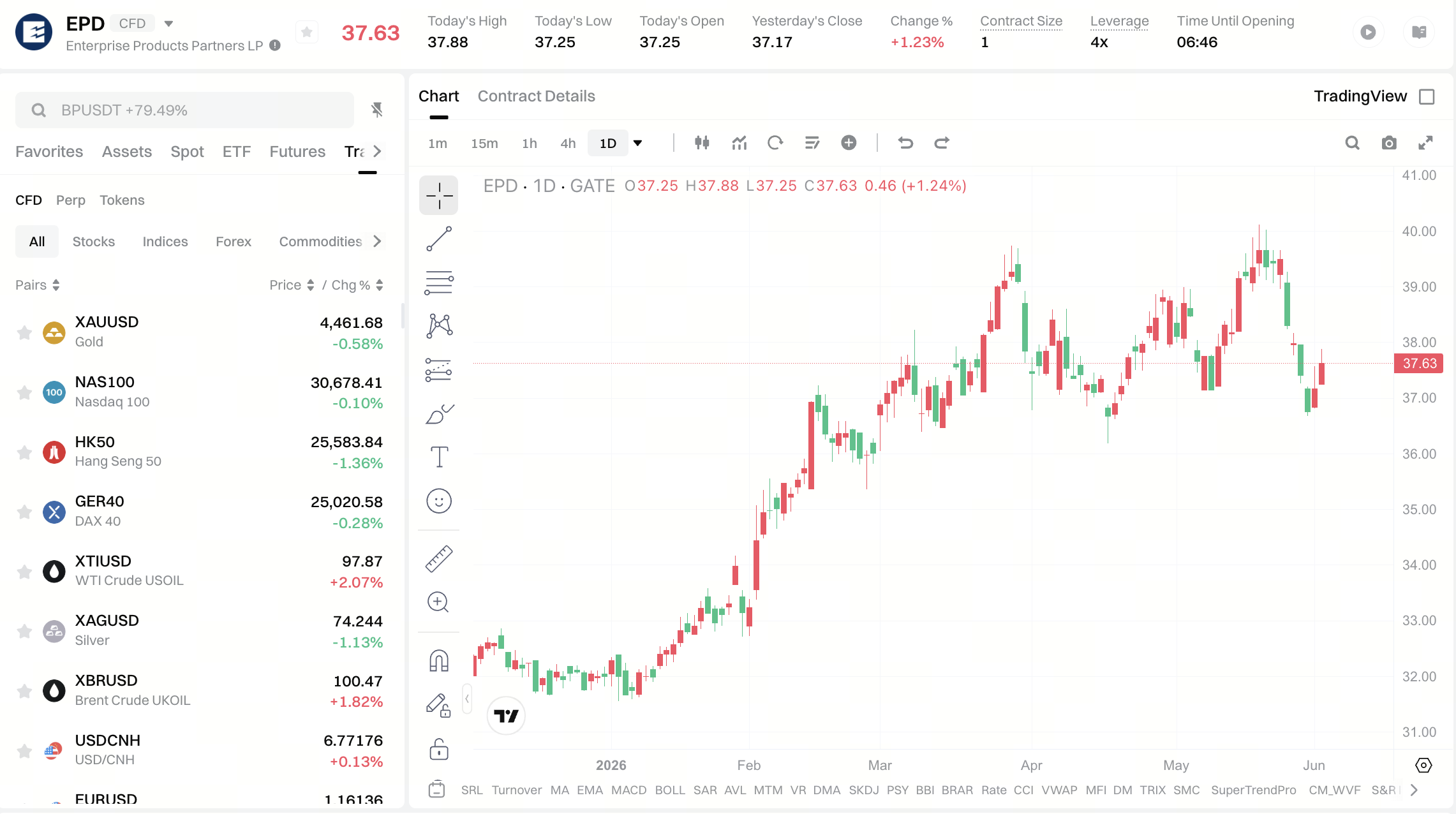
As digital asset markets gradually converge with traditional financial markets, more trading instruments linked to energy company price movements have emerged. For example, some platforms offer CFD products tied to stock prices, allowing users to participate in markets through price changes without directly holding the stock.
Using Gate TradFi as an example, users can monitor different markets—including digital assets, stocks, ETFs, indices, and commodities—within a single ecosystem. Some markets also offer Gate CFD products, providing more options for cross-market asset allocation and price observation.
Regardless of the method used to participate in the market, investors should fully understand the product structure, trading rules, and regulatory requirements in their jurisdiction.
EPD's Advantages and Limitations
Enterprise Products Partners' primary advantage stems from its vast energy infrastructure network. Pipelines, storage facilities, and export terminals have extremely high construction barriers, making it difficult for new entrants to replicate similar asset systems in a short time. As a result, EPD can maintain a significant position in the U.S. midstream energy industry over the long term.
The NGL business is another core advantage for the company. With growing global petrochemical demand and expanding U.S. energy exports, the NGL transportation and export market continues to develop, and EPD has a complete value chain presence in this area. Additionally, long-term transportation contracts and infrastructure service fee models help enhance cash flow stability.
However, EPD still faces challenges from cyclical changes in the energy industry. If U.S. energy production growth slows, utilization rates of some infrastructure assets may be affected. At the same time, large-scale infrastructure projects often face constraints from regulatory approvals, construction costs, and environmental policies. In the long term, the global energy transition trend may also alter demand structures for certain energy types, affecting the industry's development direction.
Summary
EPD (Enterprise Products Partners) is one of the largest energy midstream companies in the United States. Its operations cover the transportation, storage, processing, and export of crude oil, natural gas, natural gas liquids, and petrochemical products. Through its vast infrastructure network and MLP operating model, Enterprise Products Partners plays a key role in the U.S. energy supply chain. Unlike energy producers that depend on oil and gas price volatility, EPD focuses more on providing energy logistics and infrastructure services, with its long-term value built on asset scale, transportation demand, and cash flow stability.
FAQ
What company is EPD?
EPD is the stock ticker for Enterprise Products Partners, one of the largest energy midstream infrastructure companies in the United States, primarily engaged in energy transportation, storage, processing, and export.
Is EPD an oil company?
EPD is not a traditional oil production company. The company primarily operates energy infrastructure, providing logistics services to the energy supply chain through pipelines and storage networks.
What is the MLP structure?
MLP (Master Limited Partnership) is an organizational structure widely used in the U.S. energy infrastructure industry, typically emphasizing long-term asset operation and cash flow distribution.
What energy products does EPD mainly transport?
EPD primarily transports crude oil, natural gas, natural gas liquids, and some petrochemical products, and provides related storage and export services.
What is the difference between EPD and Kinder Morgan?
Both companies are midstream energy firms, but EPD has a stronger advantage in the NGL value chain, while Kinder Morgan is more focused on natural gas transportation.
Why is EPD considered an energy infrastructure company?
Because EPD's core assets are pipelines, storage facilities, and export terminals, and its main revenue comes from energy transportation and logistics services, not energy production itself.