From everyday household power use to large scale factory production, and from data centers to cloud computing platforms, nearly all economic activity depends on a stable electricity supply. Yet electricity does not simply need to be generated. It also has to be delivered safely and efficiently to end users through a vast transmission and distribution network, which is exactly where utility companies provide their core value.
As one of the largest utility groups in the United States, Exelon has long operated large scale power grid networks across multiple states. Unlike oil companies, natural gas producers or renewable energy developers, Exelon does not focus primarily on energy extraction or power generation. Instead, it specializes in building and operating electricity infrastructure. As the U.S. energy system continues to modernize and electrification advances, the utility sector represented by Exelon is becoming an indispensable part of the modern economy.
What Is EXC (Exelon Corporation)?
Exelon Corporation is a U.S. based utility holding company whose core business centers on the operation of electricity transmission and distribution networks. Through several regional utility brands, the company provides electricity services to tens of millions of users across the northeastern and midwestern United States, making it one of the largest electricity delivery companies in the country.
From a business model perspective, Exelon does not primarily rely on power generation for revenue. Instead, it earns returns by operating grid infrastructure. Power generation companies produce electricity, while Exelon is responsible for delivering that electricity from generation facilities to homes, commercial centers, industrial parks and public service institutions. Because this part of the electricity system involves large scale infrastructure investment, it tends to be long term and relatively stable.
In capital market classifications, Exelon is generally categorized within the Utilities sector. Compared with technology or consumer companies, utility companies may grow more slowly, but their businesses often benefit from steady demand and high barriers to entry. As a result, they are important representatives of infrastructure assets in the U.S. capital market.
Exelon’s History and Market Position
Exelon was established in 2000 through the integration of several regional power companies. Through mergers and resource consolidation, the company gradually built a large transmission and distribution network spanning multiple states and grew into an important participant in the U.S. energy industry.
The development of the U.S. power industry is closely tied to the country’s industrialization. As cities expanded, industry grew and the population increased, the scale of the power grid continued to expand. Exelon’s growth took shape against this backdrop. Unlike emerging energy companies that often pursue rapid expansion, Exelon has followed a path closer to that of a traditional infrastructure company, building competitive advantages through long term construction, operation and accumulated expertise.
Today, Exelon’s market position has evolved from that of a traditional regional power company into a large energy infrastructure operator. The company is responsible not only for electricity delivery, but also for grid upgrades, smart grid modernization and support for the energy transition. As electrification continues to rise across the United States, the importance of the grid keeps increasing, further strengthening Exelon’s position in the industry.
How Exelon’s Utility Business Works
Exelon’s utility business is built around the core function of delivering electricity. After electricity is generated at power plants, it must travel over high voltage transmission lines across long distances before entering regional distribution networks and reaching end users. Exelon is one of the key operators responsible for this process.
Unlike competitive industries, the utility sector is typically subject to strict regulation. Since building multiple overlapping power grids in the same area would be neither economical nor practical, many regions have a single primary transmission and distribution network operator. Regulators review companies’ investment plans, operating costs and rate structures to ensure the grid can continue operating reliably while also protecting consumer interests.
This model gives Exelon a relatively stable operating structure. The company must continue investing in infrastructure construction and maintenance, while receiving reasonable returns through regulator approved rate mechanisms. As a result, Exelon’s business logic is closer to long term infrastructure operation than to generating returns from short term market fluctuations.
Exelon’s Transmission and Distribution Network System
Transmission and distribution networks are Exelon’s most important asset base and the core source of the company’s long term value. Whether electricity is generated from natural gas, nuclear power, wind or solar, it ultimately depends on transmission and distribution networks to create commercial value.
The transmission system is mainly responsible for moving electricity over long distances. High voltage lines can carry power generated at power plants to cities and industrial areas, helping meet broad regional energy demand. The distribution system handles the final stage of delivery, safely bringing electricity to end users such as homes, shopping centers, hospitals and factories.
In recent years, Exelon has continued to advance smart grid construction, including digital monitoring systems, automated distribution equipment and smart meter deployment. As the share of renewable energy generation increases, the modern grid must do more than transport electricity. It also needs stronger dispatching capabilities and real time management. As a result, grid operations are gradually shifting from traditional infrastructure toward digital energy platforms.
Exelon’s Role in U.S. Energy Infrastructure
Exelon is an important part of the U.S. energy infrastructure system, playing a role similar to a transportation network within the energy system. If power plants are the production bases of energy, transmission and distribution networks are the essential channels connecting the production side with the consumption side.
In modern society, the importance of a stable power grid is often underestimated. Hospitals need reliable electricity to keep critical equipment running, data centers need it to process internet traffic, and manufacturing plants need it to maintain production continuity. When a large scale grid failure occurs, economic activity and social operations can be significantly affected.
As the United States advances its energy transition and renewable sources such as wind and solar continue to grow, the importance of the grid is increasing even further. Renewable generation is intermittent, which means it requires a stronger transmission and distribution system for coordination and management. In this process, Exelon plays an important role in connecting energy production with consumer markets.
How Exelon Serves Residential, Commercial and Industrial Customers
Exelon serves a wide range of customers, including households, commercial institutions and industrial companies. These different customer groups create a stable and diversified base of demand.
Residential customers are the broadest user group. Household lighting, air conditioning, heating equipment and home appliances all depend on continuous power supply, making residential electricity use an important source of grid demand. As electric vehicles become more common and smart home devices continue to grow, residential electricity demand is also gradually changing.
Commercial and industrial customers consume electricity on a larger scale. Large office parks, retail centers, logistics warehouses and manufacturing plants typically require stable power around the clock. For these businesses, electricity is not just a daily resource. It is a critical condition for maintaining production and operations. As a result, highly reliable grid service is an important need for commercial and industrial customers.
How Exelon Differs from NextEra Energy and Duke Energy
Although Exelon, NextEra Energy and Duke Energy are all major U.S. energy companies, their business structures differ significantly.
| Company |
Core Business |
Key Features |
| EXC (Exelon) |
Transmission and distribution |
Leading scale in utility networks |
| NEE (NextEra Energy) |
Renewables and utilities |
Strong presence in wind and solar |
| DUK (Duke Energy) |
Power generation and utilities |
Integrated energy operating model |
NextEra Energy is best known for its renewable energy portfolio, with globally leading wind and solar assets. Duke Energy operates both large scale power generation and utility networks, giving it broader coverage across the energy value chain.
By comparison, Exelon is more focused on transmission and distribution networks and utility services. This positioning gives it specialized advantages in energy infrastructure operations and ties its operating performance more closely to grid investment and growth in electricity demand.
What Are the Main Use Cases for Exelon’s Services?
Exelon’s services cover almost every major area of modern economic activity. For ordinary consumers, the most direct use case is residential electricity supply. Household lighting, communications devices, appliances and electric vehicle charging all depend on reliable grid service.
Commercial activity also relies heavily on power infrastructure. Shopping centers, office buildings, medical institutions and schools all need continuous electricity every day to operate normally. As digitalization deepens, the commercial sector’s requirements for power reliability are also rising.
One of the fastest growing use cases in recent years comes from the data center industry. The development of artificial intelligence, big data and cloud computing is driving data center construction, and data centers require continuous, highly reliable energy supply. As the digital economy expands, the importance of grid infrastructure continues to rise, creating a new source of long term demand for the utility industry.
How to Buy EXC Stock
EXC is the ticker symbol for Exelon Corporation, which is listed and traded on the Nasdaq market in the United States. Traditionally, investors can buy EXC stock through brokerage accounts that support U.S. stock trading, allowing them to participate in the development of the U.S. utility sector.
Because Exelon’s operating performance is closely tied to grid construction, growth in electricity demand and investment in U.S. energy infrastructure, many investors view it as an important representative company for observing the U.S. utility industry.
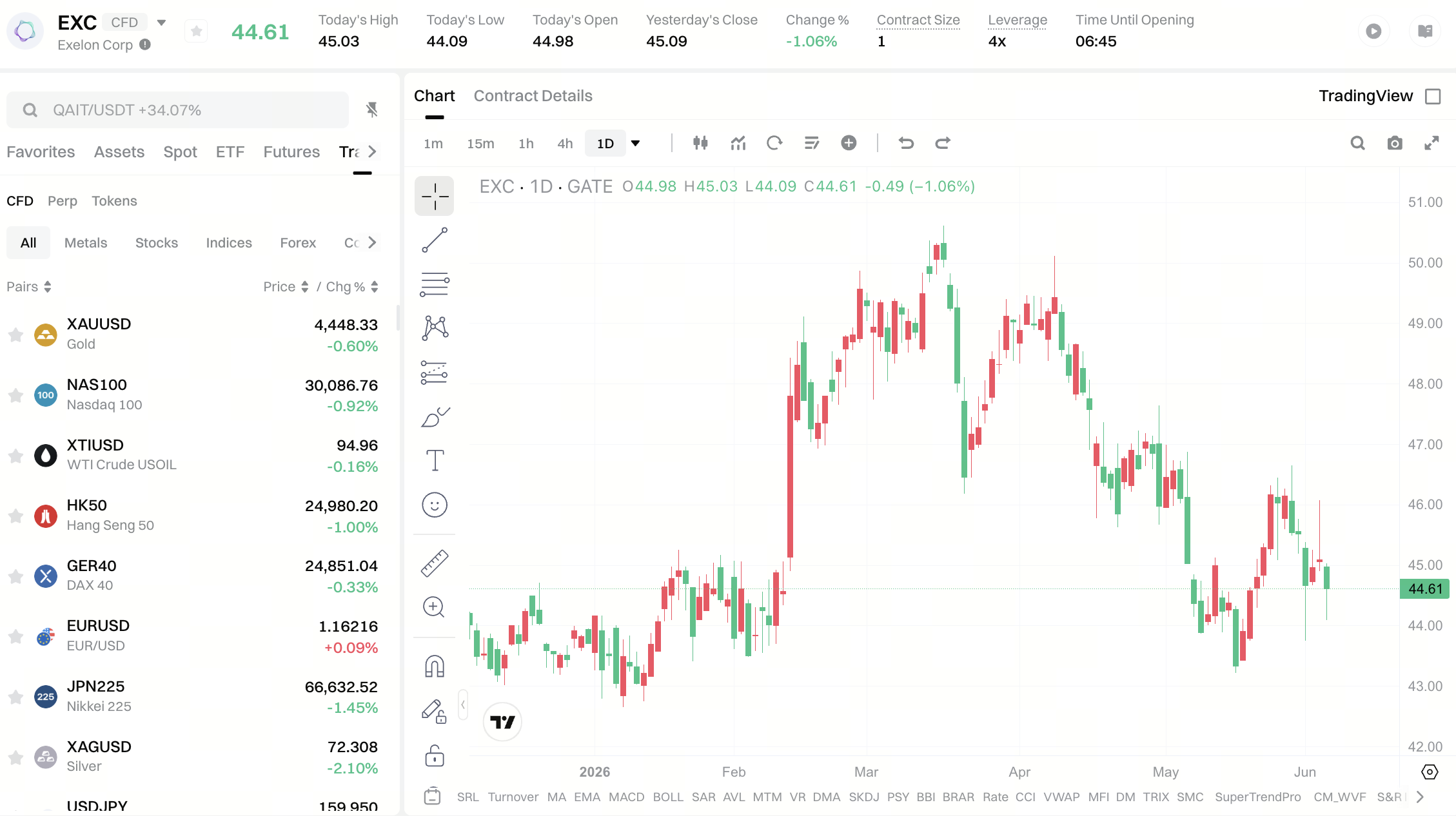
As digital asset markets and traditional financial markets gradually converge, more trading tools linked to U.S. stock price movements have also emerged. For example, some platforms offer CFD products tied to U.S. stock prices, allowing users to participate in market movements through price changes without directly holding the underlying shares.
Gate TradFi is continuing to expand its coverage of traditional financial assets. Users can track digital assets, U.S. stocks, ETFs, indices and commodity markets within a unified account environment. Some markets also offer Gate CFD products, providing more options for cross market asset management and market observation.
Whichever method investors use to participate in the market, they should fully understand the product structure, trading rules and regulatory requirements in their own region.
Exelon’s Strengths and Limitations
Exelon’s greatest strength comes from its vast grid assets and stable utility model. Transmission and distribution network construction requires long term investment and complex approvals, which creates high barriers to entry. At the same time, electricity demand is persistent over the long run, giving the utility sector a high degree of stability.
As data center construction grows, electric vehicles become more widespread and the energy transition moves forward, overall electricity demand in the United States is still increasing. As a grid operator, Exelon has the opportunity to benefit from these long term trends. In addition, smart grid development and digital infrastructure construction create further room for growth.
However, the utility industry also faces certain constraints. Because the business is regulated, companies’ rates and allowed returns on investment usually require regulatory approval, so profit growth often lags behind that of high growth industries. Large scale infrastructure upgrades also require continuous capital investment, placing higher demands on financial management and long term planning.
Conclusion
Exelon Corporation (EXC) is one of the largest utility companies in the United States. Its core business revolves around electricity transmission networks, distribution systems and energy infrastructure operations. Through a large grid system spanning multiple states, the company connects power generators with end users and plays an important role in residential life, commercial activity and industrial production. As the energy transition, digital economy and electrification trend continue to advance, the importance of grid infrastructure keeps rising, and Exelon continues to serve as a key operator in the U.S. energy system.
FAQs
What kind of company is EXC?
EXC is the ticker symbol for Exelon Corporation. Exelon is a major U.S. utility company primarily engaged in the operation of electricity transmission and distribution networks.
What businesses does Exelon mainly operate?
Exelon’s core business is transmission and distribution services. By operating grid infrastructure, it provides electricity services to residential, commercial and industrial customers.
How is Exelon different from power generation companies?
Power generation companies are responsible for producing electricity, while Exelon mainly delivers electricity from generation facilities to end users. This makes it a grid operator rather than an energy producer.
Why is the utility industry considered stable?
Electricity is a basic need in modern society, and transmission and distribution networks have high barriers to entry. As a result, utility companies generally have relatively stable sources of revenue.
How is Exelon different from NextEra Energy?
NextEra Energy is known for its renewable energy assets, while Exelon is more focused on transmission and distribution networks and utility operations.
Why does data center development benefit grid companies?
Data centers require continuous, stable and large scale power supply, so the growth of artificial intelligence and cloud computing usually increases demand for grid infrastructure.