The core logic of the Gold Miners ETF is to enable investors to indirectly participate in gold market movements by holding shares of large gold mining companies. Since mining company profits are typically influenced by gold prices, GDX often fluctuates with gold price changes.
Global risk sentiment, U.S. dollar movements, inflation expectations, and interest rate policies all typically influence gold market performance. At the same time, mining companies' production costs, extraction efficiency, and resource reserves further shape GDX's market structure.
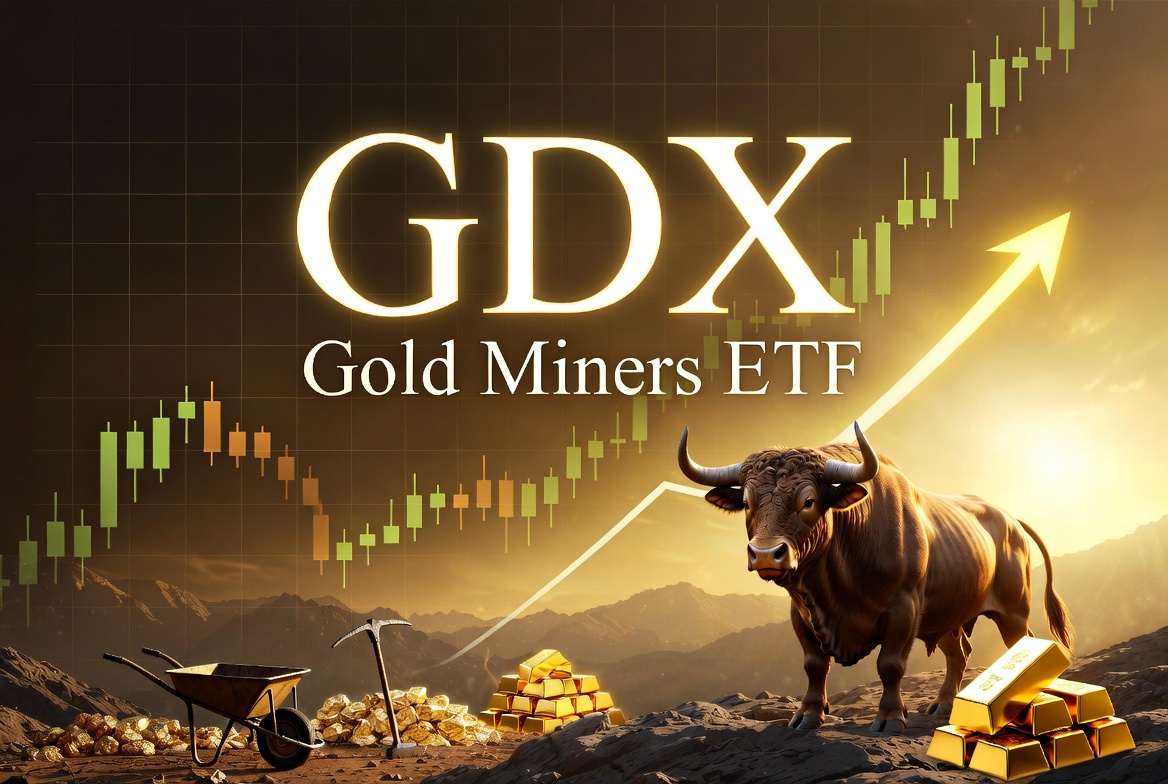
What Is GDX (Gold Miners ETF)
GDX's core purpose is to serve as a concentrated investment vehicle offering a "portfolio of gold mining companies."
Structurally, GDX does not hold physical gold; instead, it holds shares of major global gold mining companies. Thus, GDX is more akin to a gold industry stock index than a physical gold asset.
First, GDX assigns weights to mining companies based on index rules. Large gold producers typically command a higher allocation.
Then, changes in mining company profitability affect the ETF's performance. When gold prices rise, mining company profits often increase in tandem.
Next, the fund's net asset value fluctuates with mining stock prices. Operational risks specific to mining companies also impact GDX.
Ultimately, GDX serves as a key financial instrument bridging the gold market and stock market.
This structure gives GDX characteristics of both gold and stock market assets.
Why the Gold Miners ETF Correlates with Gold Prices
The gold miners ETF correlates with gold prices primarily because mining company revenue is typically derived from gold sales.
Gold mining companies generate cash flow through mining, processing, and selling gold, making their profitability directly sensitive to gold price changes.
First, when gold prices rise, mining companies' sales revenue generally increases.
Then, if mining costs remain stable, mining companies' profit margins may expand.
Next, the market reassesses mining company valuations. Changes in earnings expectations can drive mining stocks higher.
Finally, because GDX holds a large basket of gold mining stocks, it typically tracks gold market movements.
However, GDX tends to be more volatile than gold itself, as mining companies are also exposed to operational costs, geopolitical risks, and stock market sentiment.
GDX's holdings structure centers on major global gold mining companies.
Large gold producers generally offer more stable production, larger reserves, and global operations, so they receive higher weightings in the ETF.
First, the index compiler screens eligible gold mining companies.
Then, the fund allocates weights based on market capitalization, liquidity, and industry classification.
Next, the ETF periodically rebalances its holdings to maintain index tracking.
The table below shows common GDX holdings categories:
| Holdings Type |
Key Characteristics |
| Large Gold Miners |
Stable production |
| Mid-Sized Mining Companies |
Higher growth potential |
| Global Mine Operators |
Geographic diversification |
| Gold Development Companies |
Higher volatility |
This structure means GDX effectively functions as a "global gold mining industry index."
How the Profit Logic of Gold Mining Companies Works
The profit logic of gold mining companies is fundamentally built on the "spread between the gold selling price and mining costs."
Mining companies must continually invest in equipment, labor, energy, and mine operations, so profitability is tied to cost control.
First, mining companies extract gold resources from their mines.
Then, the gold is processed, refined, and sold on the market.
Next, gold sales revenue is reduced by operating costs, transportation costs, and capital expenditures.
Ultimately, profits fluctuate with changes in gold prices and costs.
This mechanism gives gold mining companies a "profit amplification effect."
For example, when gold prices rise by 10%, some mining companies may see profit increases significantly exceeding 10%.
What Is the Difference Between GDX and Physical Gold Investment
The biggest difference between GDX and physical gold lies in the underlying asset.
Physical gold is a precious metal asset, while GDX is a portfolio of gold mining stocks.
First, physical gold prices are primarily driven by safe-haven demand, the U.S. dollar, and global interest rates.
Then, GDX is affected not only by gold prices but also by stock market volatility.
Finally, operational risks specific to mining companies—such as mine accidents, rising energy costs, and regulatory changes—can also impact GDX's performance.
The table below summarizes key differences between GDX and gold ETFs:
| Aspect |
GDX |
Physical Gold/Gold ETF |
| Underlying Asset |
Mining stocks |
Gold |
| Volatility |
Higher |
Relatively lower |
| Return Source |
Corporate earnings |
Gold price movements |
| Stock Market Influence |
Significant |
Weak |
Therefore, GDX is best understood as a "gold industry stock investment tool."
Gold price fluctuations directly influence GDX's market performance.
During a gold rally, mining companies' profit expectations improve, often leading to a corresponding rise in mining stocks.
First, rising gold prices boost mining companies' revenue.
Then, the market reassesses cash flow and future earnings potential.
Next, mining valuations may expand. When risk appetite increases, mining stocks can sometimes outperform gold itself.
However, during a gold downturn, mining companies' profit margins can contract rapidly.
This structure means GDX tends to amplify gold market volatility.
As a result, GDX is often viewed as an industry ETF with a "gold leverage effect."
How the Global Gold Market Affects GDX Trends
The global gold market influences GDX trends through multiple channels.
The U.S. dollar is a key variable for the gold market. A stronger dollar often pressures gold prices.
Global interest rate conditions also affect gold. When rates rise, non-yielding assets like gold become less attractive.
At the same time, inflation and geopolitical risk typically increase safe-haven demand. Gold market volatility in turn affects mining valuations.
First, rising global economic risks drive capital into gold.
Then, higher gold prices improve mining company earnings expectations.
Next, capital flows into gold miners ETFs.
Finally, GDX may exhibit sharper movements than gold.
This structure means GDX is simultaneously influenced by both commodity and equity markets.
GDX, a U.S.-listed gold miners ETF, can typically be traded on securities platforms that support U.S. stocks. Because GDX is highly correlated with the gold market, mining industry, and global safe-haven assets, it has long drawn international interest.
Recently, the China Securities Regulatory Commission reiterated that overseas institutions are prohibited from illegally offering account opening and trading services within China and set a remediation timeline for existing business. This has led some online brokerage platforms to adjust their U.S. stock offerings.
This shift has prompted some users to explore alternative ways to trade U.S. stock ETFs. Beyond traditional securities accounts, some platforms now offer ETF CFDs, synthetic assets, or on-chain stock-like products.
The CFD model does not directly hold the underlying ETF but tracks its price movements through contracts. Some digital asset platforms are also expanding derivative services tied to overseas ETFs.
Meanwhile, products such as Gate CFD are gradually covering global market asset classes, including gold, indices, and overseas ETFs.
However, it's important to note that GDX itself is already a high-volatility industry ETF. When combined with leverage or CFD structures, market risk typically increases.
Before trading GDX or related derivatives, users should pay close attention to:
- Platform compliance scope
- Asset trading type
- Leverage risk
- Liquidity
- Regional restrictions
Regulatory rules for U.S. stock ETFs and derivatives vary by region, so the actual services available may differ significantly.
Summary
GDX is one of the world's most representative gold miners ETFs, reflecting the gold industry's performance by holding shares of gold mining companies.
Unlike direct gold ownership, GDX emphasizes mining companies' profit structures, production capabilities, and stock market performance. As a result, GDX is typically more volatile than gold itself.
Gold prices, the U.S. dollar, global interest rates, and market risk sentiment all continuously shape GDX's market structure and capital flows.
FAQ
What is GDX?
GDX is a gold miners ETF that primarily holds shares of major global gold mining companies to track the overall performance of the gold mining industry.
What is the difference between GDX and a gold ETF?
Gold ETFs typically track the spot gold price directly, while GDX holds gold mining stocks, making it also subject to corporate operations and equity market dynamics.
Why is GDX usually more volatile than gold?
Gold mining companies' profits are amplified by gold price movements, so GDX tends to experience more pronounced swings than gold itself.
Is GDX affected by the U.S. dollar?
Yes, U.S. dollar trends typically influence the gold market, which in turn can affect GDX's performance.
Is GDX considered a high-risk ETF?
GDX is an industry ETF exposed to both gold prices and stock market fluctuations, making it generally more volatile than broad-market index ETFs.