The early blockchain industry relied heavily on overcollateralized lending to keep financial operations secure. But as institutional capital has grown, relying solely on crypto collateral has revealed a major drawback: low capital efficiency. More protocols are now exploring credit lending, real-world assets (RWA), and institutional financing markets. Grove Finance was built as the credit infrastructure to meet this need.
In the institutional DeFi arena, Grove Finance sits at the critical intersection of stablecoin liquidity and credit asset markets. Unlike protocols that focus purely on on-chain lending, Grove Finance prioritizes capital allocation, risk management, and institutional asset onboarding. It positions itself as on-chain credit market infrastructure—not just another lending platform.

The Genesis of Grove Finance
Grove Finance's evolution is closely tied to the Sky ecosystem. Sky, formerly MakerDAO, has long aimed to create a stable, sustainable on-chain monetary system. As the stablecoin supply grew, capital allocation efficiency became a core topic in ecosystem development.
Traditional stablecoin reserve models rely on overcollateralized crypto assets. Grove Finance introduces a more diversified credit asset allocation framework. By channeling some liquidity into institutional-grade credit markets, the stablecoin system can tap into richer yield sources.
Industry trends show on-chain capital markets expanding from crypto-native assets into real-world finance. Grove Finance embodies this shift, building a credit bridge between institutions and blockchain.
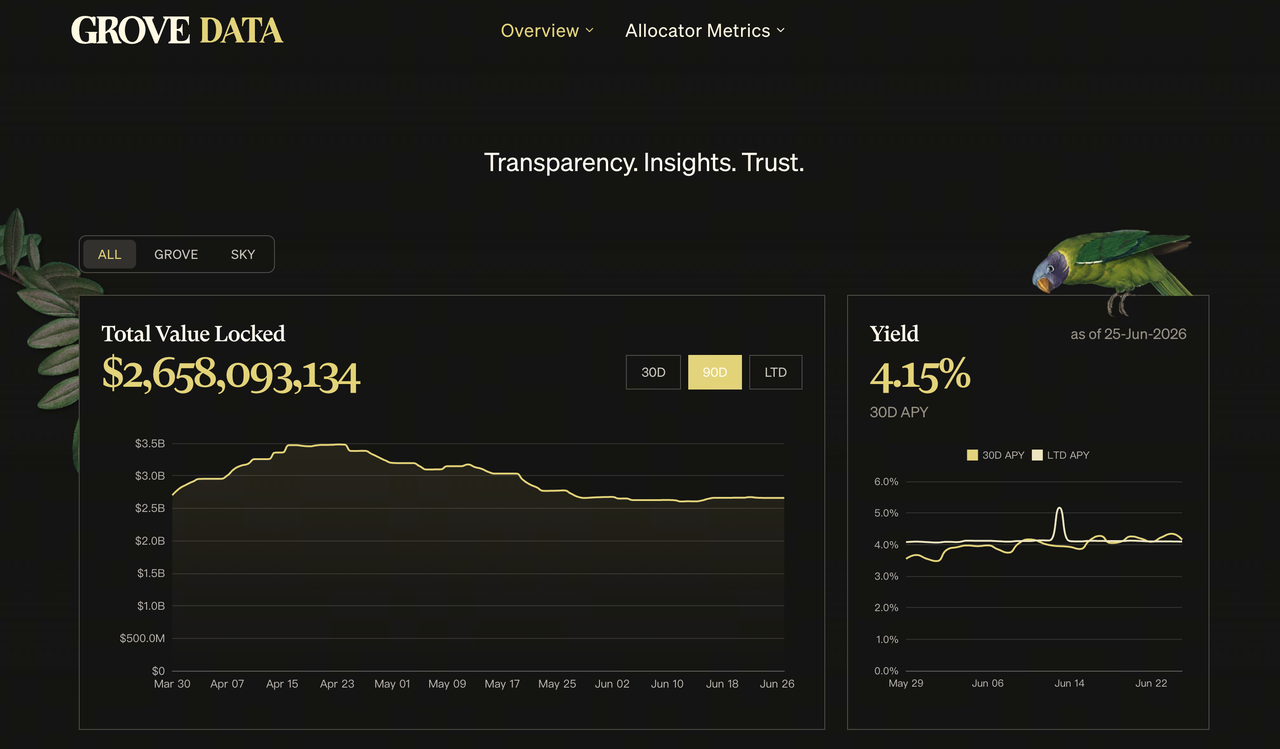 As of June 26, Grove TVL stands at $2.658B. Source: Grove Data
How Grove Finance Works
Grove Finance's core logic follows a capital flow path: "Stablecoin pool → Credit allocation layer → Yield asset market."
When liquidity enters Grove Finance, funds first pass through the allocation layer for risk assessment and asset screening. From there, capital is deployed across different credit markets—including tokenized treasuries, private credit, and corporate financing instruments.
The entire process relies on several infrastructure modules working in tandem.
| Module |
Primary Function |
Role |
| Grove Allocator |
Capital Allocation |
Manages capital distribution |
| Grove Basin |
Liquidity Management |
Supports redemptions and liquidity scheduling |
| Grove Financing |
Credit Market Access |
Connects to institutional financing needs |
| Risk Management Framework |
Risk Control |
Monitors portfolio risk |
This architecture allows Grove Finance to both generate yield and dynamically allocate assets across varying market conditions.
Grove Finance's Core Product Suite
Grove Allocator
Grove Allocator is a key component of the capital allocation layer. It evaluates different credit assets and deploys funds based on risk and return profiles.
Its role parallels a portfolio management system in traditional asset management, but it operates on blockchain and smart contract infrastructure.
Future discussions around "how Grove Allocator works" have become one of the most discussed topics in the Grove ecosystem.
Grove Basin
Grove Basin handles liquidity management and redemption requests.
Real-world assets typically have longer settlement cycles. Grove Basin is designed to balance long-term asset allocation with users' liquidity needs.
The instant redemption mechanism and liquidity buffer built around Basin are also vital parts of the Grove ecosystem.
Grove Financing
Grove Financing provides access to institutional financing markets.
Institutional borrowers can secure on-chain capital through Grove Financing, while the protocol manages risk assessment, credit oversight, and capital deployment.
Grove Savings
Grove Savings creates yield opportunities for stablecoin funds within the ecosystem.
By bridging credit markets and yield-bearing assets, Grove Savings transforms on-chain liquidity into sustainable yield generation.
How Grove Connects On-Chain and Real-World Credit Markets
The core goal of RWA is to map traditional financial assets onto blockchain networks.
Grove Finance focuses on credit-class assets, not physical ones like real estate or commodities. These include government bonds, corporate bonds, private credit, and structured finance products.
| Asset Type |
Typical Features |
Relationship with Grove |
| Treasuries |
Lower risk |
Key allocation asset |
| Private Credit |
Higher yield |
Credit market component |
| Corporate Bonds |
Fixed income |
Institutional financing channel |
| Structured Credit Products |
Risk tranching |
Diversified asset allocation |
Through tokenization, these assets can be held, settled, and managed on-chain, forming a new digital capital market.
How Grove Finance Differs from Other DeFi Credit Protocols
Grove Finance is often compared to Aave, Morpho, and Maple Finance, but they operate in different markets.
Aave primarily offers overcollateralized lending, solving on-chain liquidity needs.
Morpho focuses on optimizing lending market efficiency.
Maple Finance targets institutional credit lending.
Grove Finance positions itself as a credit asset allocation platform, generating yield by connecting stablecoin funds with real-world credit markets.
| Dimension |
Grove Finance |
Aave |
Maple Finance |
| Core Positioning |
Credit asset allocation |
Overcollateralized lending |
Institutional credit lending |
| Yield Source |
RWA and credit markets |
Lending interest rates |
Credit yield |
| Target Users |
Institutional capital |
General DeFi users |
Institutional borrowers |
| Risk Structure |
Portfolio risk |
Collateral risk |
Credit default risk |
These differences make Grove Finance a key piece of infrastructure for institutional-grade on-chain capital markets.
GROVE Token and Governance
The GROVE Token is the governance asset of the Grove Finance ecosystem.
Holders can use GROVE to vote on protocol parameters, the risk management framework, and asset allocation strategies.
Unlike traditional financial institutions governed by boards, on-chain governance uses smart contracts and community voting to execute decisions.
GROVE Token's functions are focused on governance coordination, ecosystem incentives, and long-term protocol development management—not for payments or trading.
Opportunities and Challenges for Grove Finance
Institutional capital entering the blockchain space is a major growth driver for Grove Finance.
As tokenized treasuries and on-chain bond markets expand, credit asset volumes are poised to grow. More financial institutions are exploring blockchain settlement and digital asset management.
At the same time, credit markets carry inherent risks: default, liquidity, and regulatory concerns. Compared to overcollateralized lending, credit markets demand stronger risk management. Asset screening, portfolio construction, and default monitoring will determine Grove Finance's long-term performance.
Summary
As an institutional-grade on-chain credit protocol within the Sky ecosystem, Grove Finance focuses on stablecoin capital allocation, credit market access, and real-world asset integration. Through core modules—Grove Allocator, Grove Basin, and Grove Financing—it has built a full infrastructure stack covering capital allocation, liquidity management, and institutional financing.
With RWA, tokenized treasuries, and institutional DeFi continuing to evolve, on-chain capital markets are expanding from crypto-native finance into real-world credit markets. Grove Finance plays a vital role in bridging stablecoin liquidity with institutional credit assets, becoming an essential part of institutional-grade DeFi infrastructure.
FAQs
What is Grove Finance?
Grove Finance is an on-chain credit protocol for institutional capital markets. It allocates stablecoin liquidity to credit assets and real-world asset markets, serving institutional capital management, credit allocation, and yield generation.
What is the relationship between Grove Finance and Sky (formerly MakerDAO)?
Grove Finance is a key part of the Sky ecosystem. It manages institutional-grade credit markets and capital allocation, while Sky primarily focuses on the stablecoin system and decentralized monetary infrastructure.
What does Grove Allocator do?
Grove Allocator is the capital allocation module of Grove Finance. It assesses credit asset risk and distributes funds across different credit markets and yield asset portfolios.
Is Grove Finance an RWA project?
Grove Finance is an RWA-related infrastructure project. It connects real-world financial markets with the blockchain ecosystem through tokenized credit assets such as treasuries, private credit, and corporate bonds.
What is the difference between Grove Finance and Aave?
Grove Finance focuses on credit asset allocation and institutional capital markets, while Aave provides overcollateralized lending. They differ significantly in capital sources, risk structure, and target users.
What is the purpose of the GROVE Token?
The GROVE Token is used for protocol governance and ecosystem coordination. Holders can vote on risk parameter adjustments, asset allocation decisions, and the protocol's development direction.







