Huntington Bank serves individual and business clients through an extensive branch network and digital banking platform, offering savings, checking accounts, mortgages, personal loans, credit cards, corporate loans, and commercial payment solutions. Its customer base is primarily small and medium-sized enterprises, retail clients, and regional institutions, which gives it a strong regional market share.
In the U.S. banking landscape, HBAN is a mid-to-large regional bank. Unlike national players such as JPMorgan Chase and Bank of America, its competitive edge lies in deep local market engagement, quick customer response, and low-cost operations.
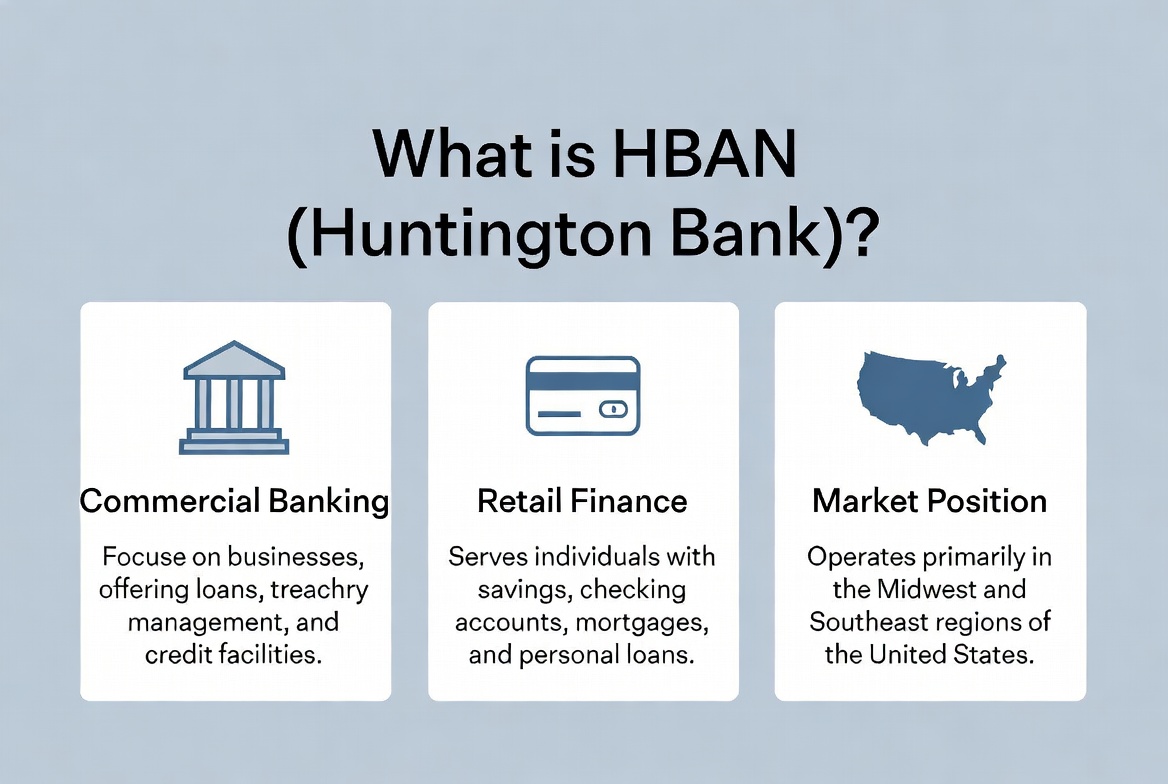
What Is HBAN (Huntington Bank)?
Commercial banks serve a dual role in modern economies as financial intermediaries and service providers. They not only deliver everyday financial services to individuals and businesses but also drive economic growth through lending, payments, investment management, and capital market services. Huntington Bank (NYSE: HBAN), a key U.S. regional bank, holds a stable position by leveraging a deep retail client base and a diversified financial services system.
HBAN's business model balances retail and corporate finance, offering comprehensive financial solutions across savings, loans, payment settlements, and wealth management. The bank also prioritizes digital services and customer experience, helping it stand out in the competitive regional banking market. Understanding HBAN's operations provides investors and market participants with valuable insights into the regional banking ecosystem and its profitability.
Huntington Bank is more than a traditional deposit and lending institution; its core value lies in creating an integrated financial ecosystem through retail banking, corporate finance, and capital market services. This model ensures stable operations during economic cycles while delivering long-term returns to shareholders.
Huntington Bank's History and Market Positioning
Founded in 1866 as a local savings bank, Huntington Bank has evolved over more than 150 years into a regional banking group spanning several Midwestern states. Through mergers, acquisitions, and organic growth, it has steadily expanded its business while enhancing digital capabilities.
In terms of market positioning, HBAN emphasizes a customer-centric regional strategy. It offers not only traditional banking but also specialized services in small business loans, commercial payments, Finanzas, and digital banking. This approach has enabled HBAN to build a portfolio that balances stable income and growth potential.
With the rise of digital banking and fintech, Huntington Bank continuously upgrades its online and mobile services to improve customer experience and reduce operational costs, thereby remaining competitive in the regional market.
How Huntington Bank's Commercial Banking Works
Commercial banking is HBAN's core business, generating spread Rendite by taking deposits and making loans. The bank offers savings, checking, and time deposit accounts to individuals and businesses, using these funds to provide mortgages, commercial loans, and consumer loans.
Interest income is HBAN's primary profit driver, earned through the gap between loan and deposit rates. Meanwhile, Trading-Gebühr and transaction services—such as credit card processing, corporate cash management, and cross-border payments—contribute non-interest income.
Huntington Bank also maintains prudence in risk management and capital allocation, using credit risk assessments, capital adequacy measures, and asset-liability matching to ensure long-term stability. This approach safeguards client funds and provides steady returns to shareholders.
Retail Banking and Personal Financial Services
Huntington Bank's retail banking serves individual clients with savings and checking accounts, mortgages, consumer loans, credit cards, and personal financial products. Digital channels and mobile apps are central to these services, enabling customers to manage accounts, transfer funds, make payments, and conduct financial operations anytime.
Beyond basic needs, the personal financial services system includes wealth management and investment advisory—such as retirement planning, portfolio management, and education fund planning—to help clients reach long-term goals. This integrated approach strengthens customer loyalty while creating diverse revenue streams for the bank.
Corporate Finance and Capital Market Services
Huntington Bank's corporate finance segment is a significant revenue contributor, targeting small and medium-sized enterprises and regional institutions. It provides multi-layered financial support that helps businesses optimize capital efficiency and drive expansion. Corporate finance extends beyond lending to a comprehensive support system for the business lifecycle.
For commercial loans and credit services, HBAN offers credit lines, term loans, and revolving credit to fund daily operations, inventory management, and growth investments. These solutions help businesses maintain cash flow while reducing financing costs.
In capital market services, HBAN provides debt financing arrangements, capital structure optimization, and basic risk management solutions. These offerings generate fee income and foster long-term client relationships, boosting customer stickiness and business stability.
Huntington Bank's Role in the U.S. Regional Banking Market
HBAN is a mid-to-large regional bank in the U.S. system, with a core advantage in deep local market cultivation and a solid client base. Compared to national banks, HBAN focuses on Midwest economic activity, achieving high market penetration in specific regions.
Regional banks typically compete on customer relationships and service flexibility. HBAN leverages its local branch network and community financial services to build enduring ties with individual clients and SMEs, securing a stable deposit base and loan demand.
HBAN also benefits from a favorable cost structure. Its concentrated business scope allows for efficient risk and resource management, helping it maintain stable profitability amid interest rate cycles.
Differences Between HBAN, JPMorgan Chase, and PNC
While all are banks, HBAN, JPMorgan Chase, and PNC differ significantly in scale, business focus, and market positioning. JPMorgan Chase is a global universal bank; HBAN is a typical regional bank. This distinction shapes their functional roles in capital markets.
In business structure, HBAN leans toward retail banking and SME finance, whereas JPMorgan Chase and PNC dominate investment banking, capital markets, and large corporate finance. Thus, HBAN's revenue relies more on local economic conditions and interest income, while large banks enjoy greater diversification.
Regarding customer relationships, HBAN emphasizes deep regional service with personalized financial solutions to boost loyalty. National banks tend to offer standardized products and scaled services. This gives HBAN advantages in flexibility and local adaptability.
Main Applications of Huntington Bank
HBAN's financial services cover a wide range of scenarios for both individuals and businesses, forming a complete retail and commercial finance system. At the individual level, services center on savings, payments, and credit, supporting daily fund management and spending.
For businesses, HBAN supports operations through commercial loans, cash management, and payment settlement systems. These services help optimize cash flow and improve efficiency, particularly for SMEs.
In wealth management and digital banking, HBAN provides investment advisory, retirement planning, and mobile financial services, allowing clients to handle multiple financial needs on one platform, enhancing convenience and overall experience.
How to Buy HBAN (Huntington Bank) Stock
As a NYSE-listed bank stock, HBAN can be traded through standard securities accounts. Its ticker is HBAN, and it belongs to the U.S. regional banking sector, often included in portfolios seeking stable banking returns.
Investment performance is closely tied to interest rates, loan growth, and regional economic conditions. Rising rates typically expand net interest margins, while economic downturns can affect loan demand and credit quality. Therefore, before investing in HBAN, investors usually examine its asset quality, deposit and loan structure, capital adequacy ratio, and the macro environment to assess long-term stability and risk.
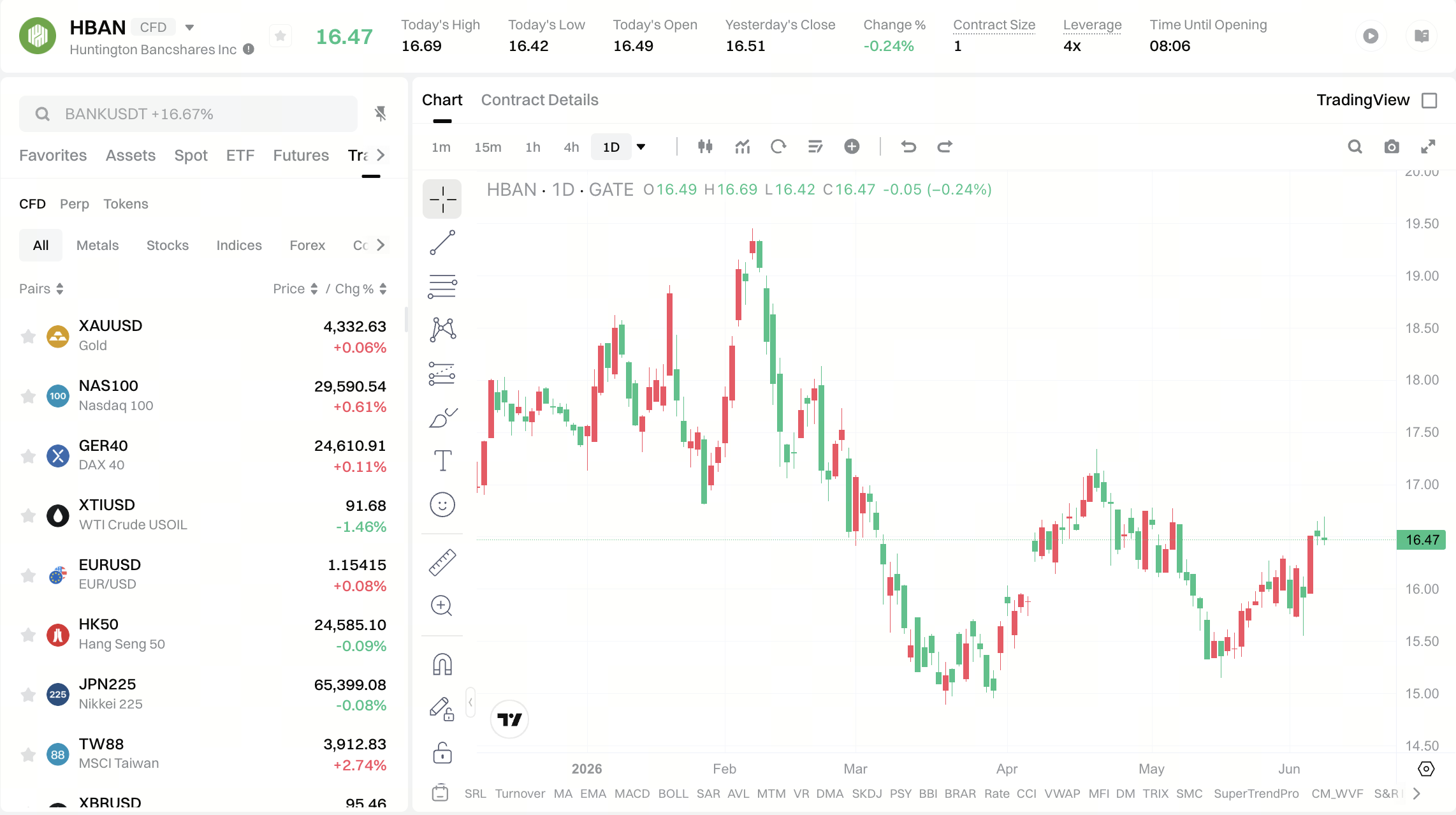
As digital asset and traditional financial markets converge, some platforms now offer products linked to U.S. stock prices. The Gate TradFi platform is expanding its traditional asset coverage, letting users track digital assets, U.S. stocks, ETFs, Index, and commodities from one account. Certain markets also offer Gate CFD products, enabling users to trade U.S. stocks with stablecoins (e.g., USDT), gaining exposure to CPRI price movements without a traditional brokerage account.
Whether using a securities account or digital asset tools, investors should fully understand the product mechanisms, fee structures, risk profiles, and local regulations. A clear grasp of each approach's rights and obligations is essential for safe and effective asset management in global markets.
Advantages and Limitations of Huntington Bank
HBAN's main strengths are its stable regional market base and diversified retail and corporate finance portfolio. By deeply penetrating the Midwest market, the bank secures a reliable deposit base and loan demand, creating a solid operational foundation.
HBAN also demonstrates strong risk management and capital adequacy, allowing it to maintain stable profitability through economic cycles. Digital transformation further boosts service efficiency and customer experience.
However, HBAN has limitations. Its heavy reliance on the regional market restricts growth potential geographically. Additionally, its weaker presence in investment banking and global capital markets results in a relatively narrow revenue structure.
Summary
HBAN (Huntington Bank) is a regional bank centered on retail banking and SME finance. Its business model relies on deposit-loan spreads, corporate financial services, and wealth management. Through a stable regional client base and diverse financial offerings, HBAN maintains a solid position in the U.S. regional banking system.
The bank's core advantages include deep regional engagement and strong customer relationships, enhanced by digital transformation for greater efficiency. Yet its growth remains constrained by geographic limits and business concentration. Overall, HBAN is a classic "stable bank stock," suitable for long-term investors focused on interest rate cycles and regional economic development.
FAQ
What are HBAN's core businesses?
They mainly include retail banking, corporate finance, wealth management, and commercial lending.
What is the biggest difference between HBAN and large banks?
HBAN is a regional bank focused on the Midwest, whereas large banks like JPMorgan Chase operate globally.
What are HBAN's main revenue sources?
Primarily from deposit-loan spreads, corporate service Trading-Gebühr, and wealth management income.
Which clients does HBAN serve?
Mainly individuals, small to medium-sized enterprises, and regional institutional clients.
What factors affect HBAN's stock?
It is mainly influenced by interest rates, loan growth, credit risk, and regional economic performance.