Unlike the conventional image of hotel companies, modern large-scale hotel groups do not necessarily own a vast portfolio of hotel properties. Over the past few decades, the global hotel industry has progressively shifted from an asset-heavy to an asset-light model. Hotel groups now focus primarily on brand development, operational management, loyalty programs, and global reservation networks, while the physical properties are held by real estate investors, hotel owners, or institutional capital.
In line with this industry trend, Marriott International has built a brand ecosystem spanning luxury, upscale, midscale, and extended-stay segments. Its global operations network connects consumers, hotel owners, and the broader travel industry. Today, whether for business travel, leisure, or long-term stays, the Marriott brand stands as a key benchmark in the global hotel industry.
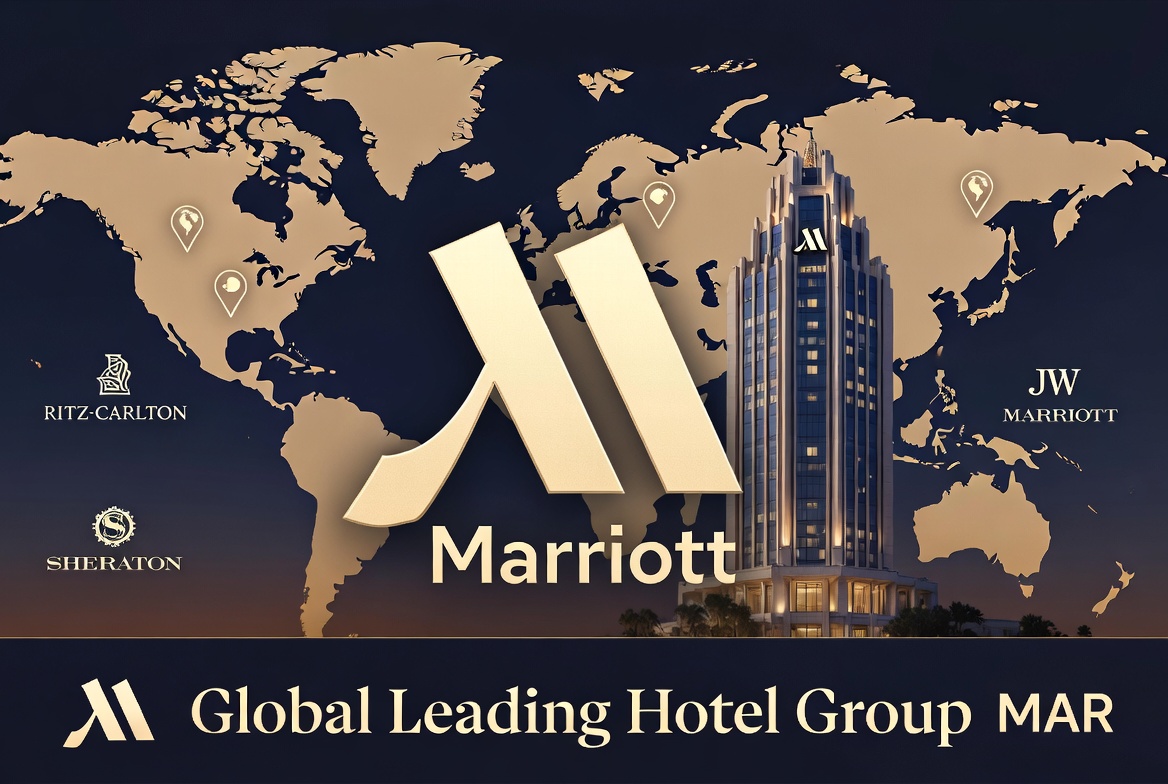
What Is MAR (Marriott International)?
Hotel owners handle property investment and construction, while Marriott International manages brand standards, operational systems, marketing, and global booking platform support. MAR (Marriott International) is one of the world's largest hotel groups, holding a commanding position in the global accommodation and travel market through hotel management, brand licensing, and member ecosystem operations.
This business model enables Marriott to expand its global footprint without owning large-scale real estate. Compared to the traditional asset-heavy hotel model, the asset-light approach typically offers higher capital efficiency and greater scalability.
Today, Marriott International operates hotel brands across multiple consumer tiers in numerous countries and regions, making it a dominant force in the global travel and hospitality industry.
Marriott International's History and Market Position
Marriott's history closely mirrors the evolution of the modern hotel industry. The company traces its roots to 1927, starting as a restaurant business before gradually entering the hotel sector. As global business travel and international tourism expanded, Marriott accelerated its global presence, ultimately building a hotel network covering many countries and regions.
In 2016, Marriott acquired Starwood Hotels & Resorts, one of the most impactful M&A transactions in hotel industry history. This integration brought iconic brands like St. Regis, W Hotels, Sheraton, and Westin under the Marriott umbrella, significantly boosting its market share.
Today, Marriott positions itself not just as a hotel operator but as a global hospitality ecosystem platform. It connects hotel owners and consumers through brands, loyalty programs, digital platforms, and worldwide operational standards, playing a central role in the global accommodation value chain.
How Marriott International's Hotel Management Business Works
Hotel management is one of Marriott International's primary revenue drivers.
Under this model, hotel properties are typically owned, financed, and built by independent investors. Marriott International provides brand licensing, operational systems, management training, marketing support, and service standard enforcement. Once the hotel is operational, Marriott collects management fees as stipulated in the contract.
For hotel owners, joining an international brand offers access to a global reservation network, brand recognition, and proven operational expertise, boosting occupancy rates and efficiency. For Marriott, it enables growth without significant real estate investment.
This model has become a defining trend in the modern hotel industry. Unlike the traditional owned-property approach, the management contract model allows hotel groups to channel more resources into branding, digital operations, and customer service.
Marriott International's Brand Matrix and Global Reach
Marriott's brand system is one of its strongest competitive advantages. Different travelers have distinct needs: business travelers prioritize convenience and meeting facilities, luxury seekers value personalized service and brand prestige, while extended-stay guests focus on comfort and amenities. To address this diversity, Marriott has built an extensive brand matrix.
| Brand Tier |
Representative Brands |
| Luxury |
Ritz-Carlton, St. Regis, JW Marriott |
| Premium |
Marriott Hotels, Sheraton, Westin |
| Select Service |
Courtyard, Fairfield |
| Extended-Stay |
Residence Inn, TownePlace Suites |
Through this multi-brand strategy, Marriott covers everything from luxury tourism to mainstream business travel, maximizing market coverage and customer reach.
Today, Marriott properties span North America, Europe, Asia Pacific, the Middle East, and Latin America, forming a truly global operational network.
How Marriott Bonvoy Creates Value
Marriott Bonvoy is one of Marriott International's most critical customer ecosystems. In the highly competitive hotel industry, acquiring new customers often costs more than retaining existing ones. As a result, major hotel groups build loyalty programs to drive repeat business through points and exclusive perks.
Marriott Bonvoy allows members to earn points on hotel stays and redeem them for free nights, room upgrades, or partner services. As members achieve higher status tiers, they unlock additional benefits like late checkout, executive lounge access, and complimentary upgrades.
For consumers, the program ensures a consistent experience across brands. For Marriott, the loyalty ecosystem boosts retention and generates vast amounts of behavioral data to refine marketing and operations.
Thus, Marriott Bonvoy has become a powerful competitive moat alongside the company's brand portfolio.
Marriott International's Role in Global Travel and Business Markets
Marriott International is more than a hotel group—it is a cornerstone of global travel infrastructure. The business travel market has long been a major demand driver for hotels. Corporate travel, international conferences, and trade shows generate steady accommodation needs. Because business travelers value brand reliability and service consistency, international hotel groups hold a strong competitive edge.
Meanwhile, the global leisure travel market continues to grow. As international tourism recovers, more travelers are choosing standardized, globally recognized hotel brands for a reliable experience.
Marriott's worldwide network connects travel, aviation, meetings and events, and corporate services, making it a linchpin of the global tourism economy.
How Marriott International Differs from Hilton and Hyatt
Marriott, Hilton, and Hyatt are all globally recognized hotel groups, but they pursue different strategies. In terms of scale, Marriott operates one of the largest hotel brand networks, with the broadest market coverage. It has brands in both luxury and mainstream business segments.
Hilton also follows an asset-light model but emphasizes loyalty program strength and brand consistency. Hilton Honors is widely regarded as one of the industry's leading loyalty programs.
Hyatt, by contrast, focuses more on the upscale and luxury segments. While its property count is smaller than Marriott's or Hilton's, its high-end brand influence is significant.
| Company |
Core Differentiator |
| Marriott International |
World's largest brand matrix |
| Hilton |
Strong loyalty ecosystem and brand standardization |
| Hyatt |
Dominant in luxury and upscale segments |
These distinct positions allow each company to cater to different consumer bases and market needs.
Key Use Cases for Marriott International
Marriott services span a wide range of scenarios. Business travel is the most typical use case. Corporate trips, meetings, and industry events require standardized accommodation, and international brands deliver consistent service.
Leisure travel is equally important. Family vacations, resort stays, and international tourism all contribute significantly to Marriott's guest base.
The extended-stay market is also growing steadily. With the rise of remote work, cross-regional assignments, and long-term business postings, extended-stay hotels have become a key segment.
By covering diverse scenarios, Marriott maintains stable operations across different economic cycles and market conditions.
How to Buy MAR (Marriott International) Stock
MAR is the ticker symbol for Marriott International, listed on the Nasdaq Stock Market. Traditionally, investors can buy MAR stock through a brokerage account that supports U.S. equities, gaining exposure to the global hotel and travel industry. Since Marriott's performance is closely tied to global travel, business trips, and hotel demand, it is often seen as a bellwether for the tourism sector.
As digital assets and traditional finance converge, new trading instruments linked to stock prices have emerged. For example, some platforms offer CFD products tied to stock price movements, allowing users to participate in the market through price movements without owning the underlying shares.
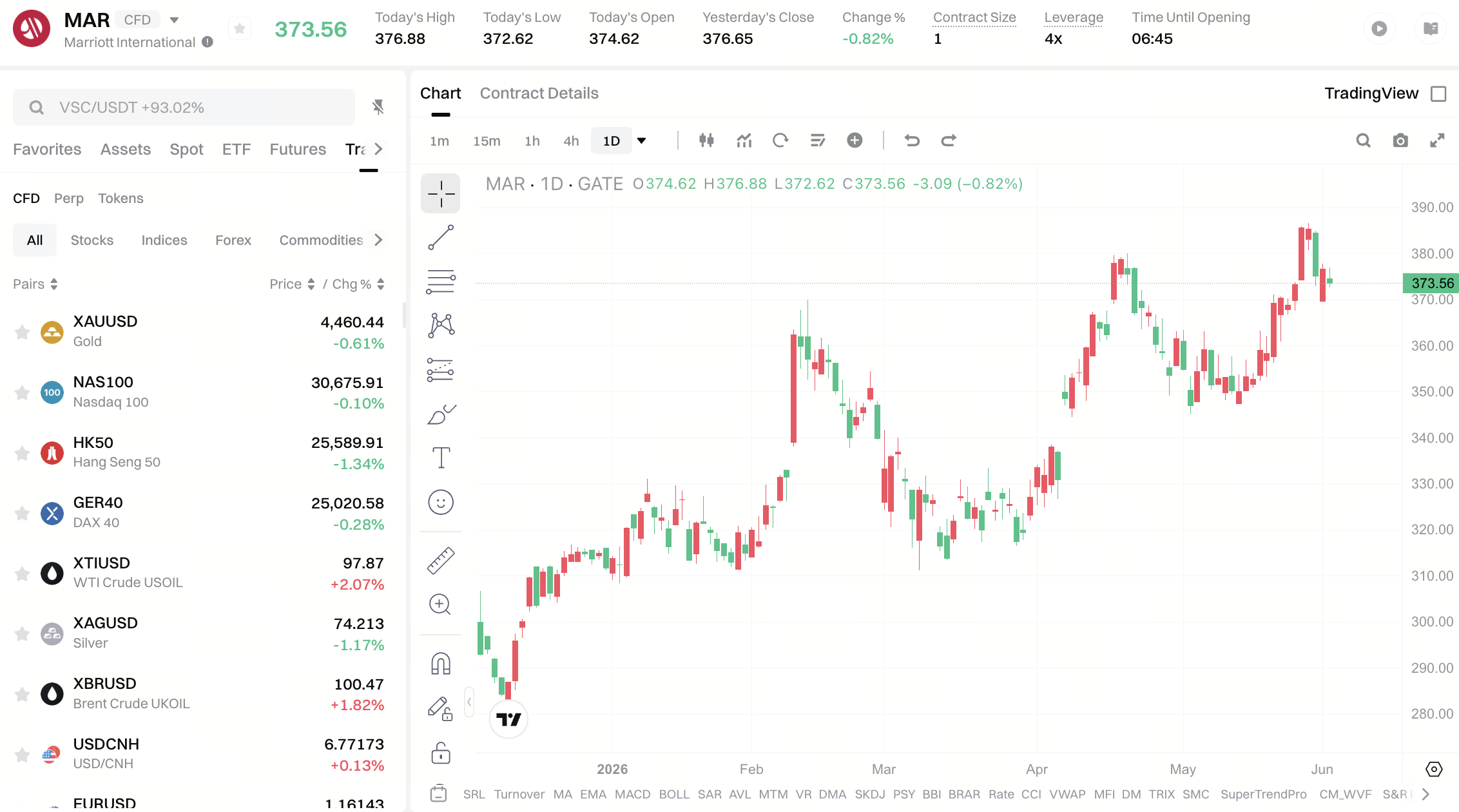
With Gate TradFi, users can track not only digital assets but also traditional financial assets like stocks, ETFs, indices, and commodities within a single ecosystem. Some markets also offer Gate CFD products, providing additional flexibility for cross-market asset allocation and price monitoring.
Regardless of the method, investors must fully understand the product structure, trading rules, and applicable regulatory requirements in their jurisdiction.
Marriott International: Strengths and Limitations
Marriott's greatest strength lies in its global brand portfolio and asset-light business model. Through management contracts and brand licensing, Marriott expands its global scale with minimal capital outlay. Meanwhile, its multi-brand matrix covers diverse consumer segments, boosting market penetration.
The Marriott Bonvoy loyalty program further reinforces customer retention and creates a long-term competitive edge. The vast member network and global property footprint together form a substantial moat.
However, Marriott remains sensitive to global travel market cycles. Economic downturns, falling international travel demand, or public health crises can impact occupancy and industry performance.
Intense competition from online travel agencies, home-sharing platforms, and other hotel groups also pressures the industry to continuously improve service quality and operational efficiency.
Conclusion
MAR (Marriott International) is one of the world's largest hotel management groups, built on a foundation of hotel management, brand licensing, and a member ecosystem. Through its asset-light model, global brand matrix, and Marriott Bonvoy loyalty program, Marriott has created a worldwide hotel network covering business travel, leisure, and extended stays. In the modern travel value chain, Marriott is not just a hotel operator—it is a critical platform connecting consumers, hotel owners, and the global travel market.
FAQ
What company does MAR represent?
MAR is the stock ticker for Marriott International, one of the world's largest hotel management groups, focusing on hotel management, brand licensing, and member ecosystem operations.
Does Marriott International own all its hotels?
No. Most Marriott hotels operate under an asset-light model where properties are owned by independent investors, while Marriott manages the brand and services.
What is Marriott Bonvoy?
Marriott Bonvoy is Marriott International's global loyalty program. Members earn points on stays and can redeem them for free nights, upgrades, and other benefits.
How is Marriott different from Hilton?
Marriott has a broader brand matrix and larger global network, while Hilton places a stronger emphasis on its loyalty program and brand standardization.
Who are Marriott International's main customers?
Marriott serves business travelers, leisure tourists, extended-stay guests, and corporate clients across multiple segments.
What is Marriott International's core competitive advantage?
Marriott's core advantages are its global brand portfolio, asset-light business model, member ecosystem, and worldwide operational network.