As Bitcoin, Ethereum, stablecoins, and Web3 applications expand rapidly, global regulators are zeroing in on investor protection, financial stability, and market transparency. As the first regulatory framework for crypto assets to cover an entire regional market, MiCA is becoming the bedrock of Europe's crypto industry and is widely seen as a key benchmark for future global cryptocurrency regulation.
What Is the MiCA Act?
MiCA stands for Markets in Crypto-Assets Regulation (commonly translated into Chinese as 'Crypto Asset Market Supervision Regulations'), a framework established by the European Union to create a unified regulatory system for crypto assets, giving the digital asset market a clear legal foundation.
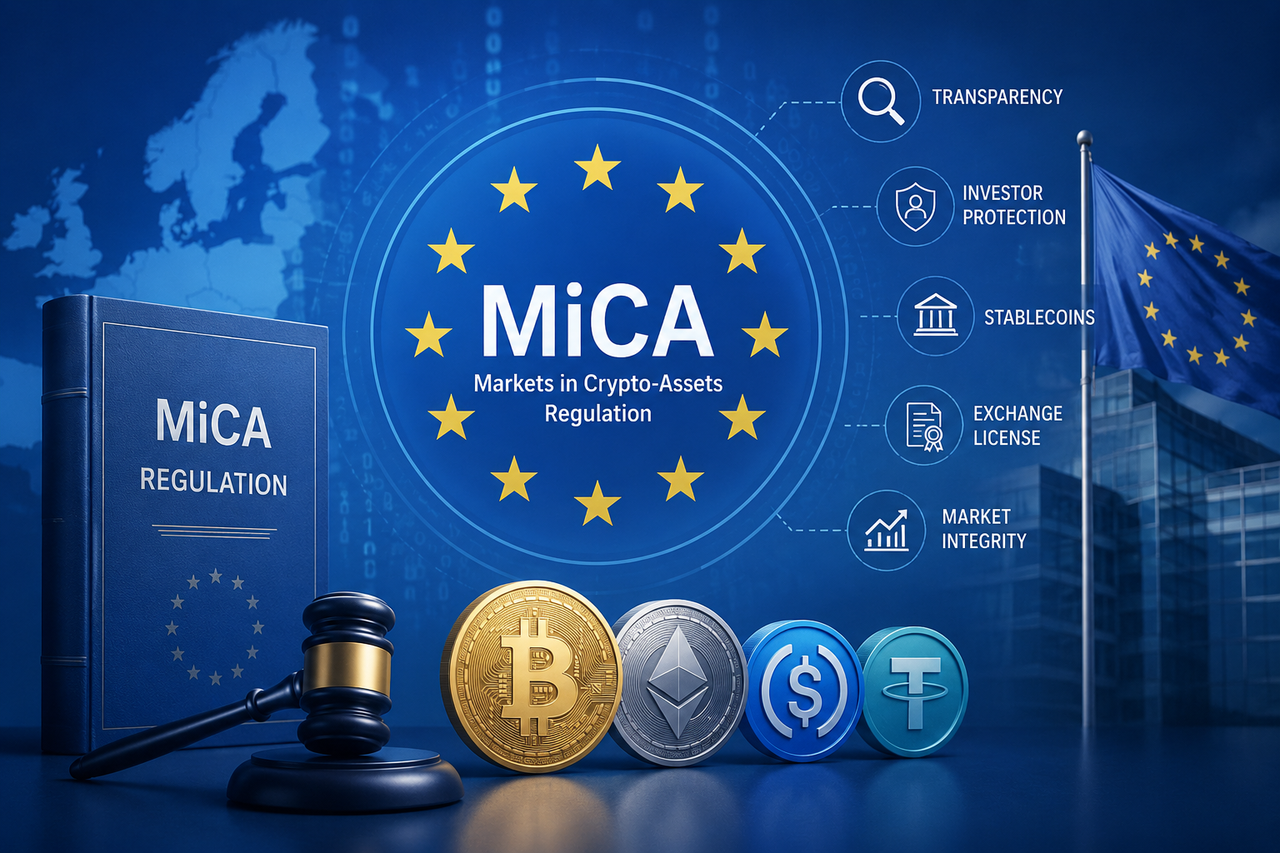
Much like traditional financial regulation, MiCA targets market transparency, investor protection, risk management, and market integrity. The key difference is that MiCA is purpose-built for the crypto asset industry, covering token issuance, stablecoin operations, and cryptocurrency exchanges—among other core activities.
MiCA doesn't target any single cryptocurrency. Instead, it lays down uniform rules for the entire crypto asset ecosystem, enabling businesses to operate in a well-defined regulatory environment.
Why Was the MiCA Act Created?
Before MiCA, EU member states each had their own approach to crypto asset regulation. Some allowed businesses relatively free rein, while others imposed strict controls.
This fragmented landscape made it harder for companies to enter the European market and limited cross-border services. Meanwhile, certain stablecoin projects and crypto asset issuances sparked concerns among regulators about financial stability risks.
MiCA was introduced to solve three core problems:
- Create a unified EU crypto regulatory framework
- Strengthen investor protection
- Provide a clear legal environment for innovative businesses
Uniform rules reduce market uncertainty and support the long-term growth of Europe's digital asset sector.
Which Crypto Assets Does MiCA Regulate?
MiCA covers most crypto assets issued and traded in the EU market, but different categories face different regulatory requirements.
Asset-Referenced Tokens (ART)
Asset-Referenced Tokens (ART) are tied to a basket of assets, such as stablecoins pegged to multiple fiat currencies, commodities, or other assets.
Because they can impact financial stability, ARTs face stricter capital and reserve requirements.
E-Money Tokens (EMT)
E-Money Tokens (EMT) are pegged to a single fiat currency, like a euro or dollar stablecoin.
Fiat-backed stablecoins such as USDC typically fall under EMT rules.
Utility Tokens
Utility tokens are used to access specific products or services, like network usage tokens on a blockchain.
MiCA requires token issuers to provide full information disclosure and risk warnings.
Assets Outside MiCA's Scope
Some NFTs, fully decentralized protocols, and financial instruments already regulated under securities laws generally fall outside MiCA's direct purview. However, each project's structure still needs to be assessed on a case-by-case basis.
How Does MiCA Regulate Cryptocurrency Exchanges?
MiCA introduces the CASP (Crypto-Asset Service Provider) regime—a regulatory framework for crypto asset service providers.
CASP covers:
Once a business obtains a CASP license, it can use the "Passporting" mechanism to operate across the entire EU without applying for permission in each country.
This mechanism significantly cuts cross-border operating costs for European crypto exchanges and helps build a unified market.
How Does the MiCA Licensing System Work?
The MiCA licensing system is a core part of the EU's crypto regulatory framework.
When applying for a CASP license, businesses must submit to their local regulator:
- Governance structure
- Risk control system
- Anti-money laundering policies
- Client asset protection mechanisms
- Information security management plan
After regulatory approval, the business is authorized to offer crypto services across the EU.
Compared to the old model of complying with multiple national regulations, MiCA creates a much more uniform and transparent market access system.
How Does MiCA Regulate Stablecoins?
Stablecoins are one of the most tightly regulated areas under MiCA. Regulators worry that large-scale stablecoins could disrupt payment systems and financial stability, so they've set up specific rules.
Stablecoin issuers must hold sufficient reserve assets, offer redemption mechanisms, regularly disclose reserve status, and establish risk management systems. Projects classified as "Significant Tokens" face even stricter requirements.
As a result, USDT, USDC, and any future European stablecoin projects will need to adjust their operations to comply with MiCA.
How Does MiCA Impact DeFi, DAOs, and NFTs?
MiCA primarily targets crypto projects with identifiable operating entities.
For fully decentralized finance (DeFi) protocols, MiCA does not yet provide a complete regulatory framework. However, if a project has a centralized team or corporate entity, it may still come under regulation.
DAOs are more complex. Although they emphasize community governance, if there's a de facto controller or operating body, regulators may require it to take responsibility.
For NFTs, single, unique digital assets are generally not directly regulated by MiCA. But NFTs issued in large volumes, with financial features, or that are fungible may attract regulatory scrutiny.
How Is MiCA Different From U.S. Cryptocurrency Regulation?
The biggest difference between MiCA and the U.S. approach is the regulatory model.
The EU uses a unified legislative framework, creating clear rules through MiCA.
The U.S., by contrast, relies on multiple agencies—such as the SEC and CFTC—to regulate together.
| Dimension |
MiCA |
U.S. Regulatory System |
| Regulatory Framework |
Single set of rules |
Multiple agencies |
| Scope |
Entire EU |
Federal and state levels |
| Licensing |
CASP license |
Various license types |
| Stablecoin Rules |
Clearly defined |
Still evolving |
| Cross-Border Operations |
Passporting |
Significant state-by-state differences |
This contrast makes MiCA one of the most complete regional crypto asset regulatory frameworks globally.
How Will MiCA Affect the Global Crypto Industry?
MiCA is not just reshaping the European market—it's influencing the global crypto landscape.
More exchanges, stablecoin issuers, and Web3 companies are restructuring their operations to meet MiCA standards, anticipating future compliance needs in international markets.
As other jurisdictions explore similar frameworks, MiCA could become the go-to template for global digital asset regulation, driving the industry toward greater transparency and standardization.
Summary
As the EU's unified cryptocurrency regulatory framework, MiCA covers crypto asset issuance, stablecoin management, exchange operations, and investor protection. Through the CASP licensing system and harmonized rules, MiCA reduces compliance complexity in Europe and gives the digital asset industry a clearer path forward.
With stablecoins, Web3, and institutional-grade digital asset services continuing to grow, MiCA has become a major milestone in global crypto regulation. Its influence now extends well beyond Europe, gradually shaping compliance standards for the entire digital asset industry.
FAQs
When will the MiCA Act officially take effect?
MiCA was formally adopted in 2023 and is being rolled out in phases. Stablecoin rules came first, followed by the full implementation of CASP regulations, completing the framework.
Does MiCA apply to Bitcoin and Ethereum?
MiCA applies to most crypto asset activities offered in the EU market. Bitcoin and Ethereum themselves don't require issuance permission, but businesses involved in trading, custody, and related services must comply.
Will MiCA ban USDT?
MiCA does not directly ban USDT, but it requires stablecoin issuers to meet reserve, transparency, and redemption requirements. Stablecoins that don't comply may be removed from regulated platforms.
What is a CASP license?
CASP stands for Crypto-Asset Service Provider license. Exchanges, custodians, and related service firms need CASP authorization to legally operate in the EU.
Are NFTs regulated by MiCA?
Single, unique NFTs are generally not directly regulated by MiCA. However, NFTs that are fungible, have financial characteristics, or are issued at scale may be subject to review.
Will MiCA affect ordinary cryptocurrency investors?
MiCA primarily targets businesses and service providers, but its investor protection, disclosure, and asset security rules will indirectly benefit everyday users by improving market transparency and compliance standards.