Play-to-Earn (P2E) is a blockchain-based gaming economic model. At its core, it leverages token incentives and NFT asset ownership confirmation to convert players’ in-game activities into measurable on-chain economic yield. Under this model, players move beyond being mere consumers of content—they become participants in the virtual economy, asset holders, and returns distributors. The advent of P2E represents a fundamental overhaul of the traditional gaming economic structure, directly connecting “time invested” with “asset yield” and gradually evolving games from entertainment systems into digital economic networks with financial attributes.
From a technology and industry evolution standpoint, the P2E model's key significance lies in reshaping how virtual assets are owned. In traditional games, centralized servers control all virtual assets, with players holding only usage rights. In Web3 games, however, NFTs and on-chain token mechanisms grant assets true on-chain ownership, enabling trading, composability, and cross-platform transfer. This shift not only boosts asset liquidity but also introduces more complex market dynamics into game economies, giving them structural characteristics similar to real financial markets.
Within the broader Web3 context, P2E is more than just "playing to earn"; it's an economic coordination mechanism built on smart contracts. By leveraging on-chain rules and automated settlement, player actions can directly translate into economic output, giving the gaming system a degree of self-organization. This foundational logic shaped the design of early GameFi projects like Alien Worlds and has since been iterated upon in numerous subsequent blockchain gaming models.
What Is the Play-to-Earn (P2E) Model
At its core, the Play-to-Earn model uses token-based rewards to convert a player's time, actions, and strategic decisions into on-chain yield.
A standard P2E economic structure has three core components: NFT assets, a native token, and a reward distribution system. NFTs provide functional boosts or production capacity, the token serves as the medium for value settlement, and the reward system executes automatically through smart contracts, ensuring rule transparency and verifiability.
This structure excels at driving user engagement, but its long-term viability hinges on sound economic design. If token issuance outpaces demand growth, inflationary pressure can destabilize the entire ecosystem. In essence, P2E is an "incentive-driven economic experiment."
How Alien Worlds Achieves Play-to-Earn
Alien Worlds is a classic P2E game, with an economy centered around mining, NFT tools, and TLM rewards.
Players choose different planets for mining operations. Each mining action calculates yield based on the NFT tool's attributes, planet parameters, and system randomness, distributing rewards in Trilium (TLM). This mechanism fuses "time investment + NFT hashrate + planet rules" into a unified yield model, directly tying player behavior to economic output.
Beyond basic mining, Alien Worlds features quest and combat systems as additional yield paths. Quests typically involve specific on-chain actions or resource gathering, while combat introduces competitive dynamics that make reward distribution more fluid. This multi-path approach deepens user engagement, though the core remains centered on the mining economy cycle.
From a system design standpoint, Alien Worlds functions more as an "on-chain yield simulator" than a complex gaming experience. Its purpose is to validate how token incentives operate in an open environment, not to deliver elaborate gameplay.
Why NFTs Are a Vital Component of the Gaming Economy
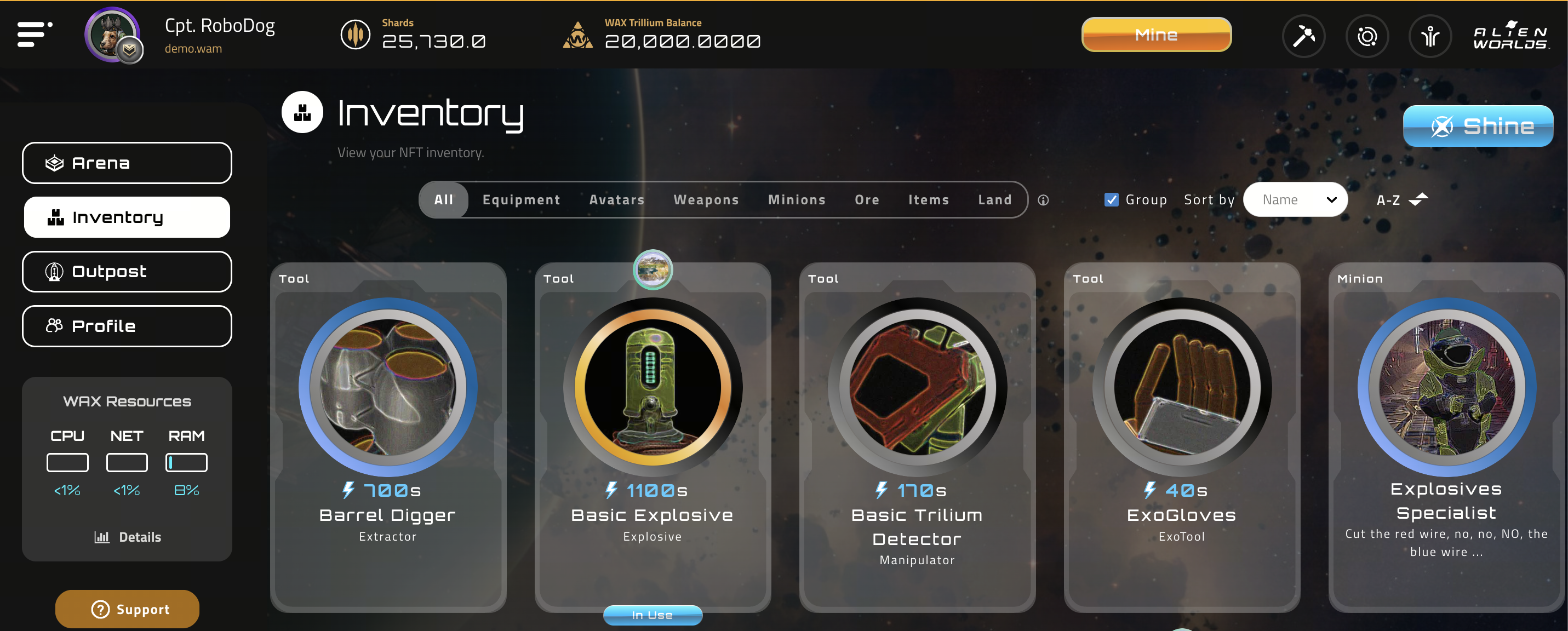
In P2E systems, NFTs act as "production tools," not just digital collectibles. Alien Worlds divides NFTs into three main categories: tools, characters, and land. Tool NFTs determine mining efficiency and yield multipliers, character NFTs influence combat performance, and land NFTs directly impact resource production and long-term yield distribution.
This design transforms NFTs from "asset certificates" into "productivity units." By holding different NFTs, players directly affect their earning potential, strengthening the link between assets and yield. The game economy thus resembles a "capital-driven model" more than a pure entertainment system.
Another critical role of NFTs is enhancing economic composability. Different NFTs can form strategic combinations, allowing players to optimize yield paths through asset allocation—boosting system complexity and encouraging long-term participation.
How Planet DAO Boosts Player Engagement
Planet DAO is the core governance structure of Alien Worlds, placing game rules and economic parameters under community control. Each planet has its own independent DAO, and players stake TLM to earn voting rights on resource allocation, reward ratios, and ecological parameter adjustments.
This shifts control from developers to the community, turning players from passive participants into rule makers. This identity change can theoretically increase long-term engagement, as players not only play the game but also shape how it runs.
In practice, however, DAO governance efficiency and participation remain limited. When users are scattered, voting power often concentrates among a few large holders—a common challenge for current GameFi DAO models.
Alien Worlds' Economic Model: Advantages and Challenges
Alien Worlds' economic model stands out for its clarity, modularity, and a complete on-chain loop built on NFTs, DAOs, and tokens. Its advantages include: transparent rules—all yield and governance logic is verifiable on-chain; low entry barriers—users need only basic NFTs to join the economy; and scalability—the same model can be replicated across different planets.
Yet challenges are equally clear: high token inflation pressure, as sustained user activity depends on reward issuance; limited gameplay variety, with most user actions focused on mining; and heavy reliance on new user growth—when growth slows, the yield model becomes unstable.
These issues are widespread in GameFi, and as an early project, Alien Worlds displays them more acutely.
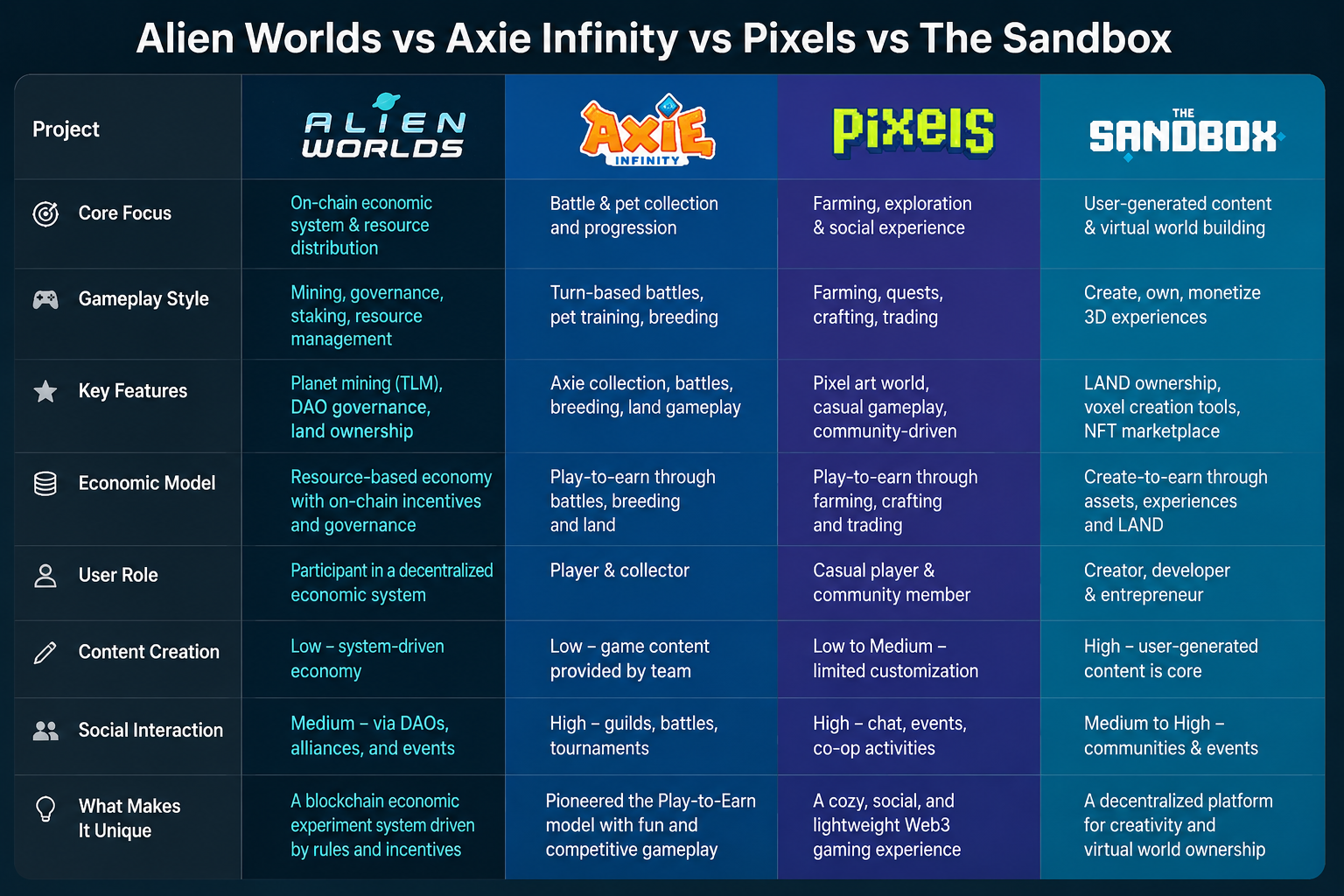
How Alien Worlds, Axie Infinity, Pixels, and The Sandbox Differ
Compared to Axie Infinity, Alien Worlds is more of an "economic simulation system," whereas Axie emphasizes combat and pet breeding.
Compared to Pixels, Alien Worlds focuses on on-chain mechanisms and resource distribution, while Pixels leans toward social and lightweight gameplay.
Compared to The Sandbox, Alien Worlds does not highlight user-generated content; instead, it prioritizes a self-running economic model centered on rules and incentives, not world-building.
Thus, Alien Worlds is better described as an "on-chain economic experiment system" than a traditional metaverse gaming platform.
From Play-to-Earn to Sustainable GameFi
GameFi is evolving from the early single P2E model toward more complex hybrid economies. Early P2E relied on high-inflation incentives to attract users, but as the market matured, this model proved unsustainable. Newer GameFi projects now incorporate quest systems, social features, consumption-driven mechanics, and content-driven models to stabilize the economic loop.
Meanwhile, NFT functionality upgrades and DAO governance improvements are key trends, moving the game economy away from reliance on a single token issuance toward a multi-layered value network. This shift signals that GameFi is transitioning from "incentive-driven" to "structure-driven."
Alien Worlds' Future in the Web3 Gaming Ecosystem
Alien Worlds' future role will likely be that of an "early on-chain economic model reference system" rather than a mainstream gaming product. Its value lies not in visuals or gameplay innovation, but in validating the fundamental logic of combining NFTs, DAOs, and token incentives. This experimental framework has provided an important reference for later GameFi projects.
As cross-chain technology and chain gaming infrastructure mature, Alien Worlds may evolve its governance or asset models, but its core will remain focused on on-chain resource allocation and economic simulation.
Summary
The Play-to-Earn model uses blockchain to reshape game economies, turning player actions into on-chain yield. Alien Worlds, an early P2E pioneer, built a complete on-chain economy using NFTs, TLM, and Planet DAO—offering significant experimental value to the development of GameFi. While challenges like inflation and sustainability remain, its contribution to chain game economic design is undeniable.
Author: Max
Disclaimer
* The information is not intended to be and does not constitute financial advice or any other recommendation of any sort offered or endorsed by Gate.
* This article may not be reproduced, transmitted or copied without referencing Gate. Contravention is an infringement of Copyright Act and may be subject to legal action.
Solana faces both opportunities and challenges in its development. Recently, severe network congestion has led to a high transaction failure rate and increased fees. Consequently, some have suggested using Layer 2 and appchain technologies to address this issue. This article explores the feasibility of this strategy.
Sui is a PoS L1 blockchain with a novel architecture whose object-centric model enables parallelization of transactions through verifier level scaling. In this research paper the unique features of the Sui blockchain will be introduced, the economic prospects of SUI tokens will be presented, and it will be explained how investors can learn about which dApps are driving the use of the chain through the Sui application campaign.
This article introduces the technical principles, framework, and applications of Zero-Knowledge (ZK) technology, covering aspects from privacy, identity (ID), decentralized exchanges (DEX), to oracles.
Tronscan is a blockchain explorer that goes beyond the basics, offering wallet management, token tracking, smart contract insights, and governance participation. By 2025, it has evolved with enhanced security features, expanded analytics, cross-chain integration, and improved mobile experience. The platform now includes advanced biometric authentication, real-time transaction monitoring, and a comprehensive DeFi dashboard. Developers benefit from AI-powered smart contract analysis and improved testing environments, while users enjoy a unified multi-chain portfolio view and gesture-based navigation on mobile devices.