What Is the Prophet AI Prediction Market?
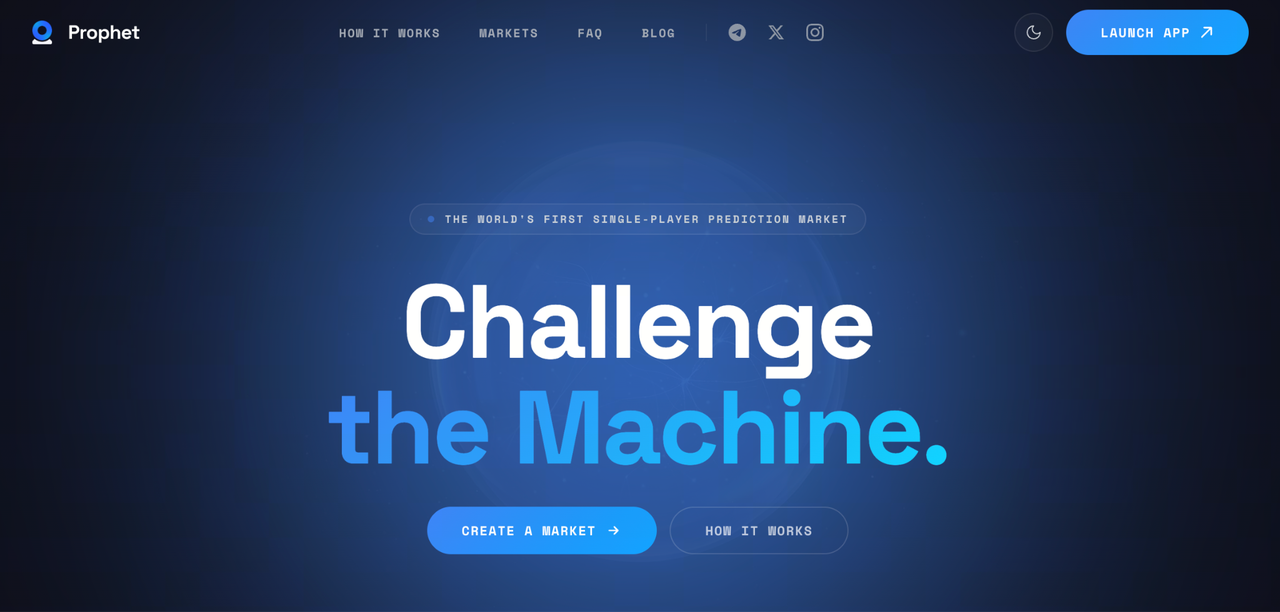 (Source: Prophet)
In traditional prediction markets, trades typically rely on buyers and sellers matching to create liquidity. Prophet, however, takes a different approach by having artificial intelligence (AI) act as the direct counterparty, offering users immediate trading opportunities.
Prophet is a platform where users can bet against AI on the outcome of future events. It allows participants to create and join markets instantly without waiting for other traders to appear.
AI as the Counterparty: How Does the Market Work?
Prophet's core operating design eliminates the need for a matching mechanism. Instead, AI directly handles all trades.
The basic process can be broken down as follows:
- A user creates or joins a prediction market (e.g., whether a specific event will occur).
- The AI calculates the probability of that event using its model and provides a price.
- The user can buy or sell at that price.
- The AI always takes the opposite side of the trade, absorbing the risk.
The key advantage is that no market liquidity is required. This allows almost any topic to be opened for trading instantly, significantly lowering the barrier for long-tail (niche) markets.
How Are Prices Generated? A Multi-Model Mechanism Explained
Prophet does not rely on a single AI model. Instead, it integrates multiple models to generate prices.
The process works as follows:
- Aggregating predictions from multiple large AI models.
- Synthesizing the judgments of these different models.
- Outputting a final probability value.
- Converting that value into a market trading price.
This design aims to improve prediction stability and objectivity by avoiding reliance on any single model's bias.
The same logic applies to market settlement. Once an event outcome is determined, the system settles based on the data and model judgments.
Prophet's Testing Phase: The Tranche Mechanism
 (Source: prophetmarketai)
Prophet is currently rolling out its product in a phased testing approach known as Tranche.
Phase 1 (Tranche 1) has the following characteristics:
- Initial funding: approximately 10,000 USDC.
- Limited participation scale (testing purpose).
- Markets can be created by users.
- Supports short settlement cycles (as fast as approximately 24 hours).
The main goal is to test AI pricing and risk-bearing capabilities in a real market environment.
Differences from Traditional Prediction Markets
Prophet's operating model differs significantly from traditional prediction markets. Conventional markets depend on matching buyers and sellers, where smooth operation hinges on participant numbers and liquidity depth. Furthermore, outcome determination and settlement often require manual intervention or arbitration, making the process relatively complex.
In contrast, Prophet takes a completely different design approach. By having AI provide liquidity directly, the system can create and launch markets quickly, reducing dependence on external participants. Settlement is also automated, greatly improving efficiency and consistency. The core shift is that prediction markets are moving from being participant-driven (market-driven) to being model- and algorithm-driven (model-driven), bringing higher efficiency and scalability.
Advantages and Potential Opportunities
Prophet's model offers several notable advantages:
-
Instant Liquidity
No need to wait for a counterparty, lowering the barrier to entry.
-
Support for Long-Tail Markets
Niche or obscure topics can be opened quickly.
-
High Automation
From pricing to settlement, everything is handled by the system.
-
Continuous Optimization
Every trade feeds data back to the AI model for improvement.
Risks and Limitations
This innovative model still presents challenges and risks:
-
AI Judgment Errors
The model may misjudge event probabilities or outcomes.
-
Lack of Dispute Mechanism
No well-established manual arbitration process currently exists.
-
Limited Capital Size
Initial liquidity is still small, affecting market depth.
-
Regulatory Uncertainty
AI-driven markets remain an emerging area.
Future Development Direction
Prophet's roadmap focuses on several key areas. First, expanding capital scale by introducing more liquidity sources to enhance overall market depth. Simultaneously, the platform will gradually open up to broader user participation, moving from its early relatively closed structure to a more open environment with network effects. On the technical front, Prophet plans to continuously improve model accuracy, bringing probability pricing closer to real-world event distributions, while also enhancing settlement and risk control mechanisms to strengthen system stability and credibility.
From a long-term perspective, this model-centric approach may not only change the design logic of prediction markets but also extend to broader financial applications, becoming part of a new generation of market infrastructure.
Summary
Prophet introduces a novel concept that challenges traditional prediction markets: making AI the core liquidity provider. Through probability pricing, automated settlement, and a model-driven architecture, this approach has the potential to lower barriers and improve market efficiency, enabling wider participation. However, such innovation also brings new challenges—particularly around model reliability, risk control, and market trust—that still require time and continuous refinement. In the context of Web3 and AI convergence, Prophet stands as a cutting-edge experiment, offering a promising direction for the future of finance.







