Tokenized stocks (Tokenized Stock / Tokenized ETFs) connect traditional securities’ underlying rights to on-chain standards like BEP-20, bridging the gap between cross-asset management and on-chain composability. bStocks are issued by BTech Holdings Limited, a Binance ecosystem affiliate. QQQB tracks the QQQ ETF, which follows the Nasdaq 100, making it a flagship asset under the Tokenized Assets category.
From the digital asset perspective, QQQB anchors real stock reserves, enables trading through Binance, and leverages the programmability of BNB Smart Chain—all within a unified framework. Users can access price exposure and dividends (when applicable) on Binance, or withdraw to compatible wallets for use across protocols like Venus, Lista DAO, and PancakeSwap.
What is the QQQB tokenized stock? How does it relate to Invesco QQQ Trust (QQQ)?
QQQB is a tokenized security in the bStocks product line, giving holders economic exposure to Invesco QQQ Trust. The Invesco QQQ Trust (QQQ) tracks the Nasdaq 100 index, covering top companies in tech, consumer, healthcare, and more. QQQB represents equivalent economic rights as a BEP-20 token on the BNB Smart Chain, rather than replicating the ETF share structure.
The relationship is “same underlying asset, different form”: QQQ trades as ETF shares in securities markets, while QQQB maps the Trust’s underlying rights to tokens. Under applicable law, QQQB can be converted 1:1 with the underlying security through Token Conversion. QQQB vs QQQ ETF underlying structure details the comparison across basket composition, mapping logic, and rights boundaries.
| Dimension |
QQQB |
Invesco QQQ Trust (QQQ ETF) |
| Product Form |
BEP-20 tokenized security |
Exchange-listed ETF shares |
| Underlying |
Invesco QQQ Trust economic rights |
Invesco QQQ Trust |
| Issuer |
BTech Holdings Limited |
Invesco |
| On-chain Std. |
BNB Smart Chain · BEP-20 |
Not applicable |
| Contract Addr |
0x205812cdbed920aff76c6580abd681a46d11efc7 |
Not applicable |
This table summarizes the differences in structure and issuance. When verifying the underlying asset, consider both ETF basket composition and token mapping logic—not just the code name.
How does QQQB function on BNB Chain? What do BEP-20 standard, contracts, and on-chain circulation mean?
QQQB is deployed on BNB Smart Chain, following the BEP-20 standard, at contract address 0x205812cdbed920aff76c6580abd681a46d11efc7. BEP-20 defines core interfaces for transfers and approvals, so QQQB is recognized by BSC-compatible wallets and can circulate as a composable asset in DEXs and lending protocols.
Typical on-chain paths include: holding QQQB in a Binance account for spot trading, or withdrawing to a self-custody wallet. After withdrawal, ownership is controlled by your private key, and you can verify contract interactions and balances on BscScan. On-chain movement doesn’t affect the 1:1 reserve, but custody responsibility shifts to the user, who must manage private keys and protocol risks. BEP-20 solves interoperability; when assessing operation, distinguish between the “token technical layer” (which enables DEX swaps, lending collateral, protocol integration) and the “reserve layer” (which determines if real-stock backing is sufficient).
Is QQQB’s 1:1 reserve secure? How does Proof of Collateral verify transparency?
QQQB uses a 1:1 real stock reserve: every circulating token is fully backed by underlying rights at a US-regulated broker. Minting new tokens requires real-stock backing; redemptions adjust reserves in sync, so on-chain supply never exceeds underlying assets.
Proof of Collateral is bStocks’ transparency mechanism. Users can review reserve information and verify that circulating supply matches underlying holdings. Reserve proof addresses asset mapping verifiability, but does not eliminate market volatility or smart contract risk. 1:1 means quantity correspondence, not price locking.
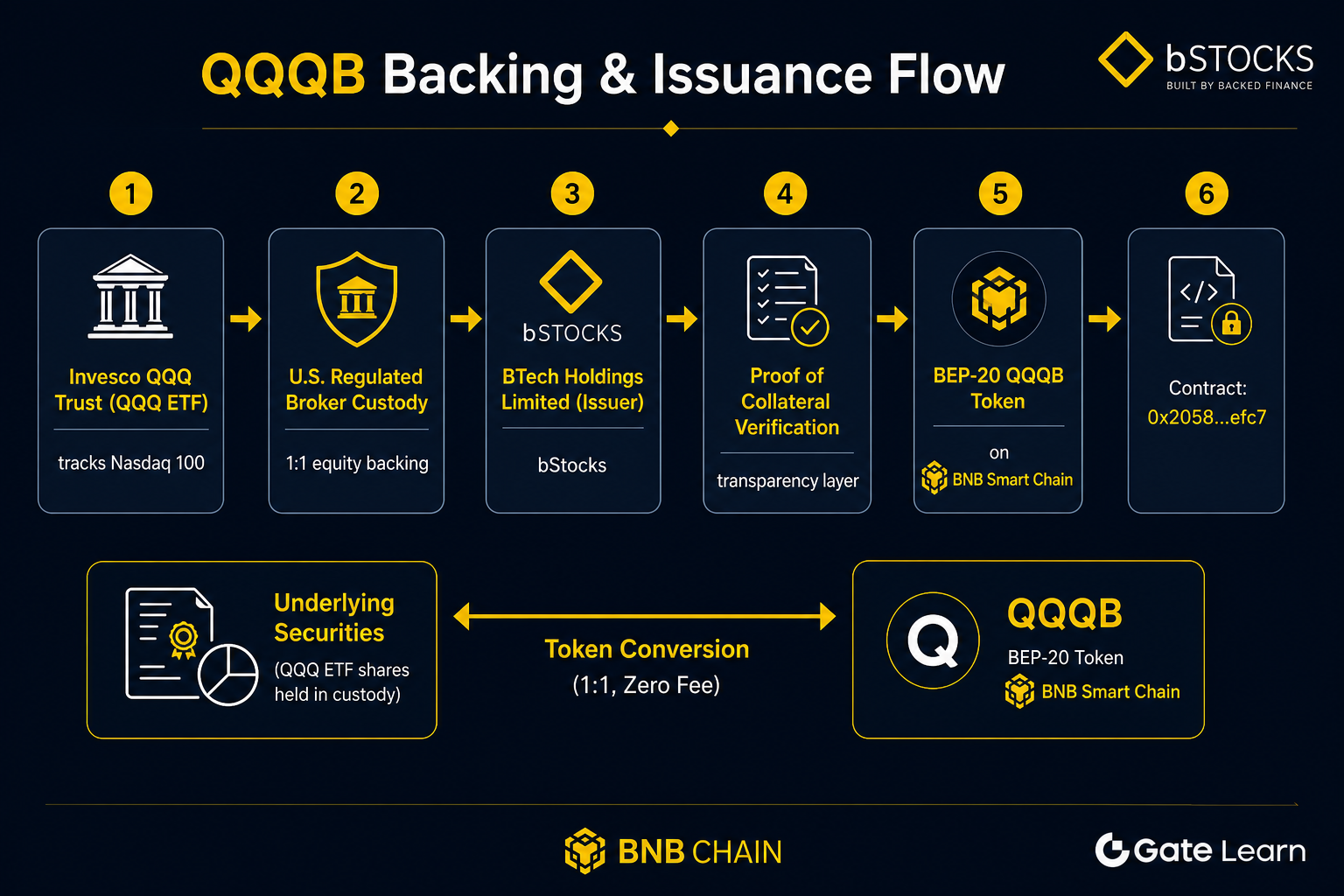 Figure 1. QQQB’s process from Invesco QQQ Trust to 1:1 equity reserve, Proof of Collateral verification, and BEP-20 token issuance.
QQQB 1:1 reserve and corporate action mechanism further explains reserve matching, Proof of Collateral disclosures, and Multiplier triggers. BTech Holdings Limited’s structure has been approved by ADGM FSRA under the “Certificate over select U.S. stocks and ETFs” prospectus. Compliance approval describes issuance and disclosure obligations, but does not guarantee equal conversion or trading rights in all jurisdictions.
How do you acquire and trade QQQB on Binance? What are the spot, Token Conversion, and on-chain withdrawal paths?
Binance is the primary venue for QQQB. There are three main ways to gain exposure: spot market trading, Token Conversion for 1:1 swaps with the underlying security, and on-chain withdrawal to a BSC-compatible self-custody wallet.
Spot trading means searching for the QQQB trading pair on Binance.com and buying or selling via the order book or market order—ideal for quick exposure adjustments. Token Conversion, with Nest Trading Limited, supports free, bidirectional 1:1 swaps between QQQ and QQQB, for seamless switching between securities and tokens. On-chain withdrawal lets you send QQQB to an external wallet, enabling DeFi integration and private key self-custody. Availability, limits, and KYC depend on Binance product pages and applicable law. Conversion highlights 1:1 parity and zero fees, but does not eliminate price volatility.
Can QQQB holders receive dividends? How does the Multiplier mechanism handle corporate actions?
QQQB gives holders economic exposure to Invesco QQQ Trust. When the underlying Trust pays dividends, holders generally receive distributions (when applicable). Distribution timing and settlement are based on Binance account records and bStocks product rules.
Corporate actions (dividends, splits, reverse splits, etc.) are handled via Multiplier rebasing: when the ETF undergoes events that change per-share rights, the Multiplier adjusts accordingly, keeping QQQB holders’ economic exposure aligned with the underlying security. Users don’t need to claim rebasing manually but should verify that balance adjustments match expectations. Tokenization does not grant all the shareholder rights of a traditional brokerage account; governance rights like voting must be checked per product terms.
What can you do with QQQB in DeFi? What composability scenarios exist on BNB Chain?
As a BEP-20 token, QQQB can be used across the BNB Smart Chain DeFi ecosystem: swap or provide liquidity on DEXs like PancakeSwap; use as collateral for borrowing in Venus, Lista DAO, and other protocols; or combine with other BEP-20 assets for on-chain strategies.
Composability boosts capital efficiency but introduces smart contract and liquidation risks, which should be considered separately from underlying asset volatility. Before using DeFi, confirm protocol audits and collateral rules.
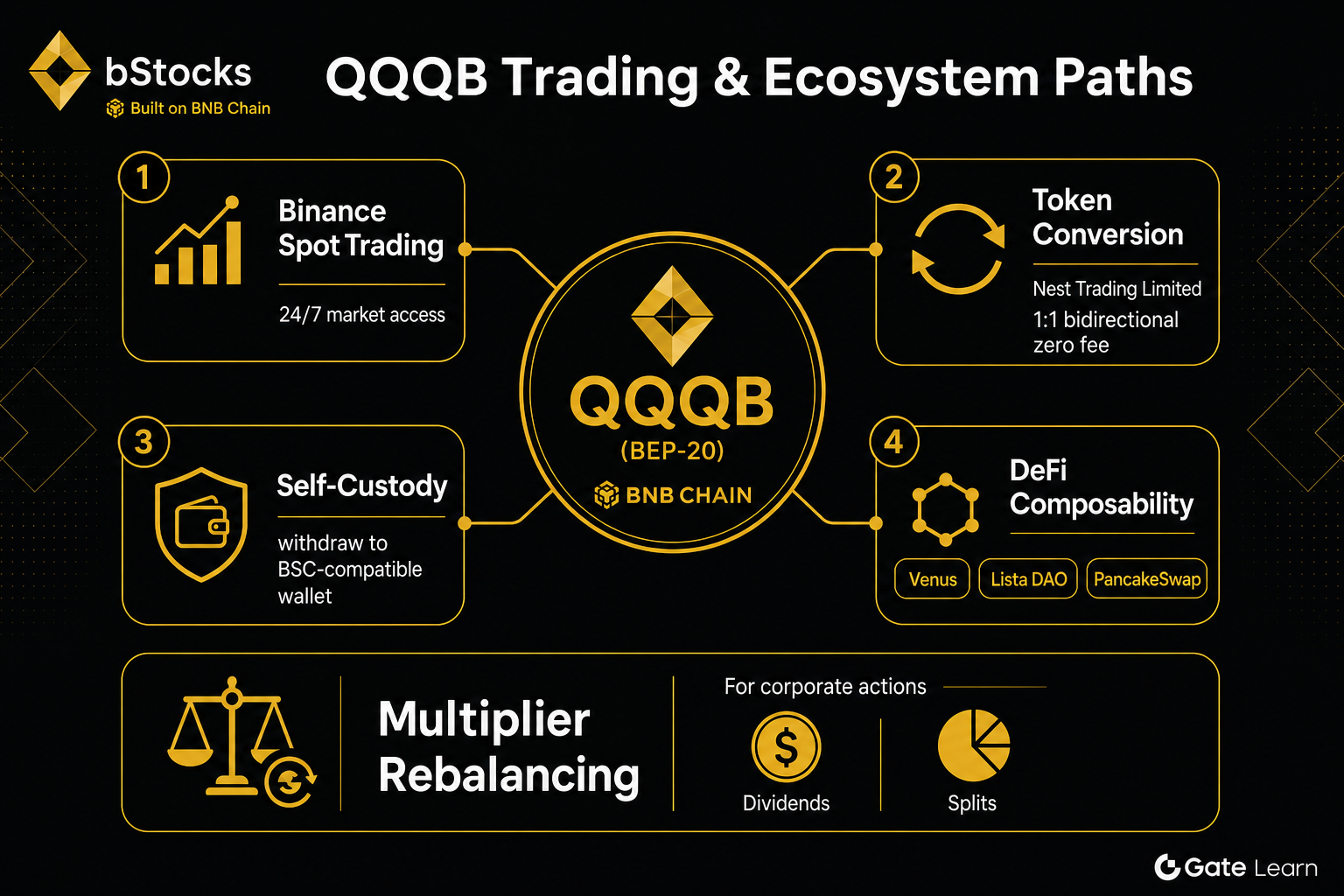 Figure 2. QQQB ecosystem overview: Binance spot, Token Conversion, on-chain self-custody, and BNB Chain DeFi composability.
What are the advantages and risks of holding or trading QQQB tokenized stocks?
Advantages: QQQB combines Nasdaq 100 ETF exposure with 24/7 trading, on-chain self-custody, and DeFi composability. Its 1:1 real-stock reserve and Proof of Collateral provide transparent verification. Token Conversion makes switching between securities and tokens seamless. The BEP-20 standard enables access to leading BNB Chain DeFi protocols.
Risks: Volatility in the underlying QQQ basket impacts QQQB. Spot and DEX liquidity fluctuate. Smart contract, private key management, and protocol liquidation are operational risks. Conversion and trading rights may differ by jurisdiction. Reserve anchoring does not mean risk-free.
| Risk Type |
Typical Manifestation |
Key Verification Points |
| Market Risk |
Nasdaq 100 constituent volatility |
Position sizing, diversification |
| Liquidity Risk |
Thin order book or DEX depth |
Monitor order book, split trades |
| Smart Contract |
Protocol bugs or liquidation |
Audit reports, collateral limits |
| Compliance Risk |
Regional limits, conversion rights |
User agreement, applicable laws |
QQQB risk and compliance boundaries summarizes common misconceptions and a verification checklist.
How does QQQB differ from other tokenized stock/ETF products? Core comparison at a glance
Tokenized stocks/ETFs follow different technical paths: some platforms focus on real-stock reserves, others on on-chain synthetic exposure, with varying approaches to conversion and DeFi support. QQQB is anchored solely to the Invesco QQQ Trust, circulates on BSC as BEP-20, and features Token Conversion and Proof of Collateral.
| Comparison |
QQQB (bStocks) |
Typical on-chain tokenized ETF |
Traditional QQQ ETF |
| Underlying |
Invesco QQQ Trust |
Varies by product |
Invesco QQQ Trust |
| On-chain Std. |
BEP-20 · BSC |
Varies by chain |
None |
| Reserve Model |
1:1 real stock + Proof |
Varies by issuer |
ETF replication |
| Conversion |
Token Conversion 1:1 |
Varies by product |
Not applicable |
| Trading Hours |
24/7 |
Usually 24/7 |
Exchange hours |
QQQB vs QQQ ETF vs other tokenized stocks offers a more comprehensive comparison. Decide whether you want ETF shares, real-stock-backed bStocks tokens, or other synthetic on-chain exposure before choosing.
Summary
QQQB’s core value comes from combining “Invesco QQQ Trust economic exposure + 1:1 real-stock reserve + BEP-20 on-chain circulation + Binance ecosystem conversion and trading.” The focus should be on understanding and executing asset structure, reserve verification, trading paths, corporate actions, and risk boundaries within a unified framework—not just the token symbol.
FAQ
What is QQQB?
QQQB (Invesco QQQ Trust Tokenized bStocks) is a BEP-20 tokenized security issued by BTech Holdings Limited, providing holders with economic exposure to the Invesco QQQ Trust (QQQ ETF, tracking the Nasdaq 100). Each token is backed 1:1 by real-stock reserves at a US-regulated broker, tradable 24/7 on Binance, and supports on-chain withdrawal and DeFi composability.
How does QQQB differ from QQQ ETF?
Both share the Invesco QQQ Trust as the underlying asset, but use different forms: QQQ is an exchange-listed ETF share; QQQB is a BEP-20 token on BNB Chain, tradable on Binance spot, convertible 1:1 via Token Conversion, and withdrawable for DeFi. Account structures, settlement, and rights differ.
How does bStocks work?
bStocks is Binance’s tokenized securities product line, issued by BTech Holdings Limited. It selects US stocks or ETFs as underlying assets, maintains 1:1 real-stock reserves at a US-regulated broker, and issues corresponding BEP-20 tokens. Users can access exposure via Binance spot, Token Conversion, and on-chain withdrawal, verifying reserves through Proof of Collateral.
Is QQQB 1:1 backed by real-stock reserves? How do you verify?
QQQB maintains a 1:1 real-stock reserve for every circulating token. Users can verify circulating supply and underlying holdings through publicly disclosed Proof of Collateral, and track on-chain contracts and transactions on BscScan. Reserve verification ensures transparency, but does not eliminate price risk.
Does QQQB pay dividends? How are dividends settled?
QQQB provides exposure to the underlying Trust, so holders generally receive dividends when the Trust does (if applicable). Distribution timing follows Binance account records. Corporate actions are synchronized via Multiplier rebasing to keep exposure consistent with the underlying security.
What are the risks of trading QQQB?
Key risks are volatility in Nasdaq 100 constituents, differences in Binance spot or DEX liquidity, DeFi smart contract and liquidation risk, private key self-custody risk, and compliance limits on conversion and trading by region. 1:1 anchoring describes asset correspondence, not risk elimination.