As stablecoins increasingly become core infrastructure within the DeFi ecosystem, Reserve Protocol introduces a modular framework for issuing stablecoins. It allows any community or organization to create asset-backed currencies with independent collateral structures. This approach improves flexibility while making stablecoin governance more decentralized.
As on-chain finance continues to evolve, stablecoin design is moving beyond simple fiat pegs toward programmable value-stabilization systems. Reserve Protocol is part of this shift, offering new models for issuing stablecoins and managing risk in digital asset markets.
What Is Reserve Protocol?
Reserve Protocol is a decentralized system designed to issue asset-backed stablecoins. Its core goal is to enable users to create stablecoins backed by a basket of digital assets, rather than relying on a single reserve such as the US dollar.

Within Reserve Protocol, stablecoins are called RTokens. Each RToken is backed by its own basket of collateral assets, which may include stablecoins, tokenized government bonds, or other on-chain assets. This structure allows the protocol to support different types of stablecoins, such as payment-focused tokens, yield-generating tokens, or community-specific currencies.
This design positions Reserve Protocol as a stablecoin infrastructure layer, rather than a single stablecoin project.
How Does Reserve Protocol Work?
The core mechanism of Reserve Protocol combines collateralization, over-collateralization, and a risk-buffer system.
When users mint RTokens, they must deposit predefined collateral assets into the protocol. Based on these assets, the system issues a corresponding amount of stablecoins, with value supported by the underlying asset basket.
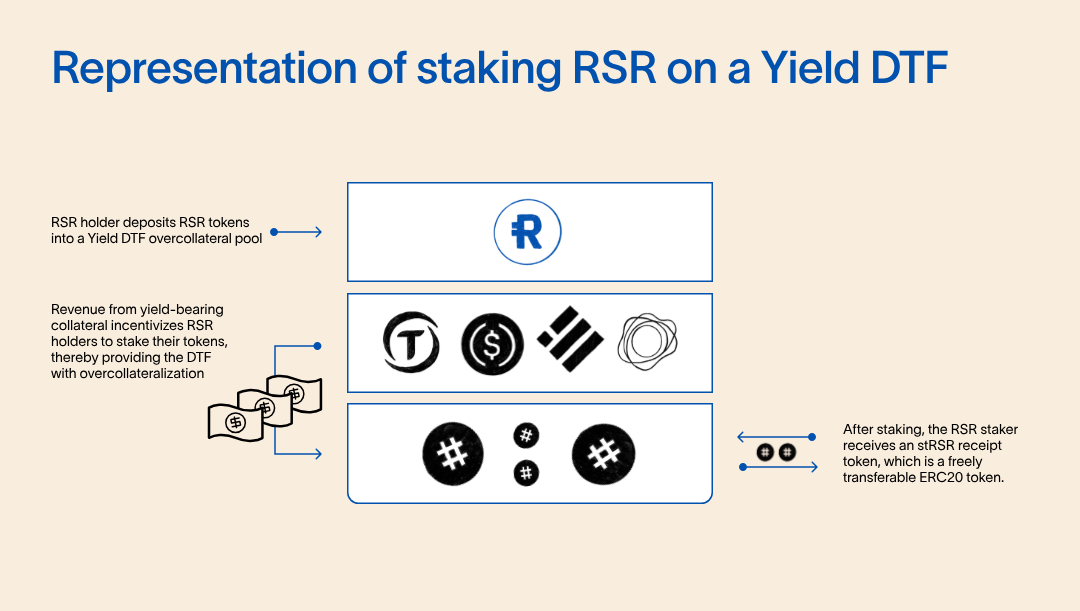
If the value of the collateral declines, the protocol activates its risk-buffer mechanism to absorb losses. RSR holders can stake their tokens on specific RTokens to provide insurance. In cases of under-collateralization, staked RSR is sold to replenish reserves and maintain the stablecoin’s solvency.
This design allows the system to self-correct during periods of market volatility.
What Is the Role of the RSR Token?
RSR is the native utility token of Reserve Protocol and serves three primary functions:
First, governance. RSR holders can participate in protocol decisions, including adjusting collateral compositions, modifying risk parameters, and approving upgrades.
Second, staking and insurance. Users can stake RSR on specific RTokens to provide default protection and earn protocol revenue.
Third, risk absorption. When collateral assets incur losses, staked RSR acts as the first layer of defense, covering shortfalls in reserves.
In this sense, RSR does not function as a price anchor for stablecoins. Instead, it plays a key role in governance and risk management within the protocol.
What Are the Core Components of Reserve Protocol?
Reserve Protocol consists of three main components: RTokens, the collateral basket, and the RSR staking layer.
RTokens are the stablecoins issued by the protocol, each backed by its own asset mix.
The collateral basket defines the types and proportions of assets supporting each stablecoin. This may include multiple stablecoins or other on-chain assets, helping reduce reliance on any single asset.
The RSR staking layer provides additional insurance for RTokens, acting as a buffer when collateral performance deteriorates.
This layered architecture enables flexible design for different stablecoin use cases.
What Are the Use Cases of Reserve Protocol?
Reserve Protocol is primarily used for decentralized stablecoin issuance and on-chain value management.
In DeFi, developers can create stablecoins tailored for lending, payments, or asset management. Some RTokens can be configured with yield-generating collateral, effectively becoming on-chain yield-bearing stablecoins.
The protocol also supports community currencies. DAOs or project teams can design purpose-specific stablecoins for payments, incentives, or governance.
Because of its modular structure, Reserve Protocol can be applied across a wide range of scenarios, including payments, value storage, and financial infrastructure.
How Does Reserve Protocol Differ from Traditional Stablecoins?
Traditional stablecoins such as USDC, USAT, or systems like MakerDAO typically rely on centralized institutions holding fiat reserves, such as bank deposits or short-term government bonds. Their stability depends on off-chain custody.
By contrast, Reserve Protocol issues stablecoins backed by on-chain assets and adds an additional risk buffer through RSR staking. Key differences include:
| Comparison Dimension |
Traditional Stablecoins |
Reserve Protocol |
| Collateral Model |
Centralized fiat reserves |
On-chain asset baskets |
| Governance |
Centralized management |
Decentralized governance |
| Risk Buffer |
Managed by reserve institutions |
Covered by RSR staking |
| Stablecoin Design |
Single model |
Customizable RTokens |
These distinctions make Reserve Protocol better suited for building programmable and governable stablecoin systems.
Advantages and Potential Limitations of Reserve Protocol
One of the main strengths of Reserve Protocol is its modular design and decentralized governance. It enables communities to create customized stablecoins while reducing single-point risk through diversified collateral.
The RSR staking mechanism also introduces an additional risk buffer, improving the system’s resilience.
However, the protocol is relatively complex. Compared to traditional stablecoins, it involves multiple layers of assets, governance parameters, and risk management mechanisms, which may raise the barrier to entry for users.
In addition, if the collateral assets are highly correlated, the system may still face systemic risks under extreme market conditions.
Conclusion
Reserve Protocol offers a decentralized and modular framework for issuing stablecoins. Instead of relying on a single fiat reserve, it maintains stability through diversified collateral and an RSR-based risk buffer.
By combining RTokens, collateral baskets, and governance mechanisms, Reserve Protocol expands the design space for stablecoins within the DeFi ecosystem. As on-chain financial infrastructure continues to evolve, asset-backed stablecoin protocols like this are becoming an important direction for innovation.
FAQs
Is RSR a stablecoin?
No. RSR is a utility token used for governance, staking, and risk absorption. It is not itself a stablecoin.
What are the stablecoins in Reserve Protocol?
They are called RTokens, which are asset-backed stablecoins issued against multiple types of collateral.
What is the purpose of RSR staking?
RSR staking provides insurance for RTokens, helping cover reserve shortfalls when collateral value declines.
Is Reserve Protocol fully decentralized?
Reserve Protocol has decentralized features in governance and asset design, but the specific collateral of each RToken depends on how it is configured by its creator.
What is the biggest difference between Reserve Protocol and traditional stablecoins?
The key difference is that Reserve Protocol supports customizable collateral baskets and includes an RSR-based risk buffer, whereas traditional stablecoins typically rely on centralized fiat reserves.







