What Is Solscan?
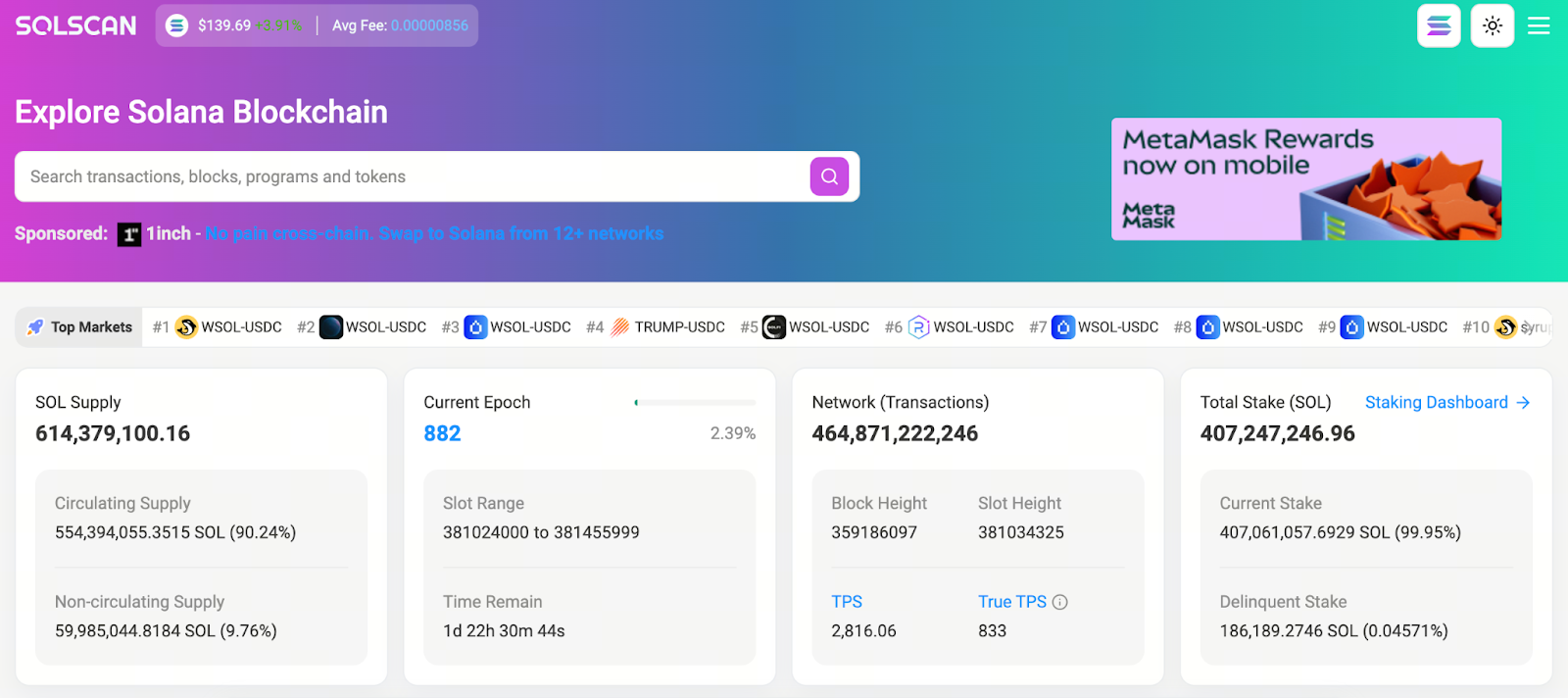
Image: https://solscan.io/
Solscan is a specialized blockchain explorer and analytics platform for Solana. It provides users with real-time access to Solana network data, including transactions, blocks, token contracts, wallet addresses, NFTs, and DeFi protocols. In 2025, Etherscan—Ethereum’s leading blockchain explorer—acquired Solscan, marking a strategic merger of two major network analytics platforms.
Core Features of Solscan
- Transaction and Block Search: Enter a transaction hash to instantly view transaction status, fees, sender and receiver addresses, and other detailed information.
- Wallet Address Analysis: Input any wallet address to see its SOL holdings, token balances, NFTs, and staking status.
- Token and NFT Tools: Solscan enables users to check Solana token information such as circulating supply and holder distribution. Users can also view NFT collections, floor prices, and transaction history.
- Ecosystem Navigation: Use Solscan’s “Ecosystem” page to explore Solana applications segmented by DeFi, NFT, infrastructure, and more—with direct access links.
- Validator Nodes & Staking Information: Solana operates on a PoS consensus mechanism. Solscan offers validator node data—like staking yield, uptime, and delegator count—to help users choose staking targets.
- Security and Developer Tools: Following its acquisition by Etherscan, Solscan introduced advanced analytics dashboards, expanded API support, multilingual SDKs, transaction simulators, and enhanced security alerts.
Solscan Developments in 2025
Early in 2025, Etherscan finalized its acquisition of Solscan, resulting in major upgrades. The team completely redesigned Solscan’s analytics dashboard for more intuitive visualization. Developer tools now include real-time data streaming via WebSocket and more comprehensive APIs and documentation. Solscan added new security features, such as smart contract risk assessments, transaction simulation, wallet activity monitoring, and suspicious behavior alerts for scam detection. Solana’s on-chain activity remains robust, with record-breaking token issuance. For example, according to ChainCatcher, 23,036 new tokens launched in a single day on May 17, 2024.
Recent Solana (SOL) Price Trends and Solscan’s Role
- SOL Market Performance: Gate analysis shows that in August 2025, SOL’s price was approximately $180.
- Price Forecast and Potential: Certain AI models predict SOL could break its all-time high. Some reports forecast a possible surge to $295 within a month.
- Institutional Participation: CME Group plans to introduce SOL futures contracts starting March 2025, highlighting growing institutional interest in Solana.
- Ecosystem Growth: Industry reports confirm that Solana’s total value locked (TVL) in DeFi continues to increase.
These critical developments in price and ecosystem growth make Solscan increasingly essential for on-chain analytics. Users rely on Solscan to track capital flows, verify project legitimacy, and monitor transaction activity—gaining deeper insights into SOL’s value and future trajectory.
Why Solscan Matters to Users, Developers, and Investors
- Regular Users: Users can confirm the success of transfers or check the balance and NFT holdings of a wallet address. Solscan delivers instant results.
- Developers: Use Solscan’s contract interface, analytics dashboard, and API to deploy contracts, test interactions, and monitor user behavior.
- Investors / Analysts: Solscan’s capital flows analytics, token distribution data, and staking metrics empower investors to make more informed risk assessments.
Risks and Considerations When Using Solscan
- Misinterpreting Explorer Functionality: Some users mistakenly assume Solscan is a “wallet,” but it’s actually a blockchain explorer and analytics tool.
- Data Delays and Indexing Issues: Certain tokens—especially newly issued ones—may not be immediately or accurately displayed on Solscan.
- Security Awareness: Although Solscan offers robust features, attackers still employ phishing tactics on Solana. Researchers recently developed SolPhishHunter to identify new types of phishing threats.
- Transaction Failures: Some on-chain transactions still fail due to code errors or network congestion, as highlighted by recent studies.
Summary and Outlook
Solscan is not just Solana’s primary query tool—it serves as a key platform for users, developers, and investors. After its acquisition by Etherscan, Solscan’s data visualization, security, and developer support capabilities saw major improvements. As Solana’s ecosystem rapidly expands—with DeFi TVL growth, active token launches, and rising institutional investment—Solscan’s relevance continues to increase.
Solscan is expected to evolve in several key areas:
- Advanced on-chain analytics and behavioral insights—such as user scoring and project health evaluation
- Improved mobile experience (with mobile alerts and transaction status notifications)
- Localized upgrades for additional languages and regional user bases
For anyone deeply engaged in the Solana ecosystem, proficiency with Solscan is essential for understanding the on-chain landscape. This knowledge supports making well-informed decisions.







