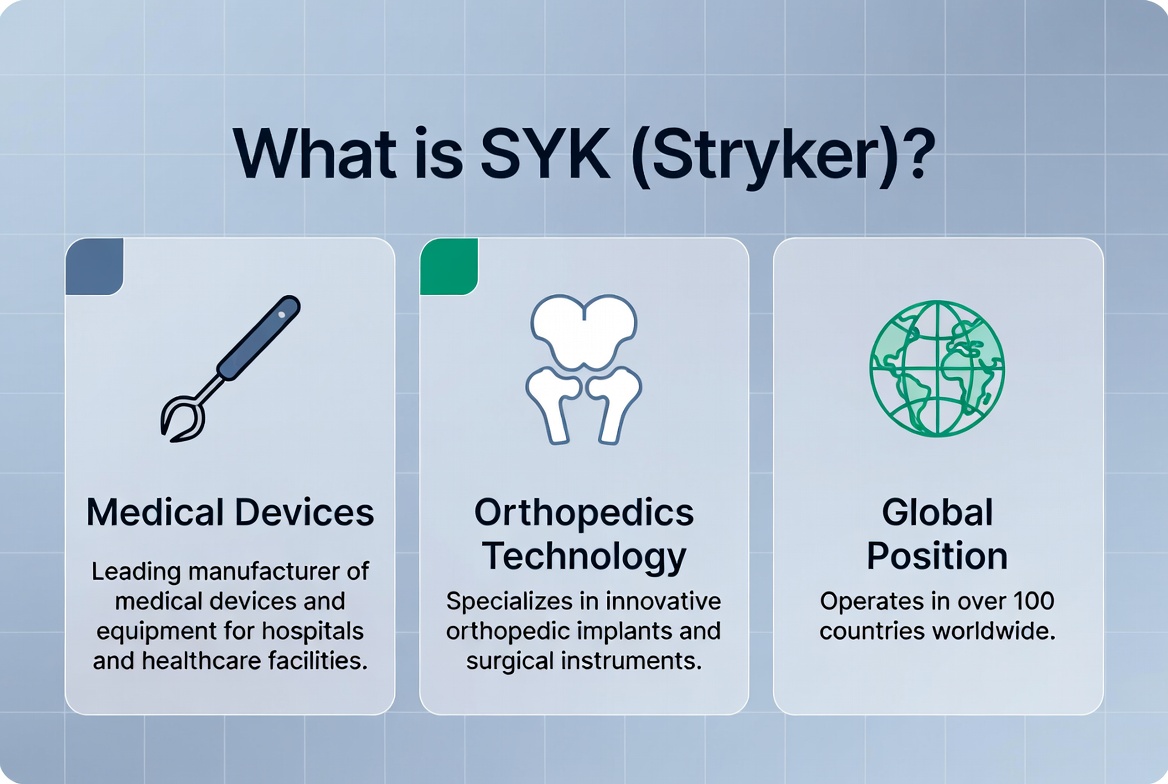
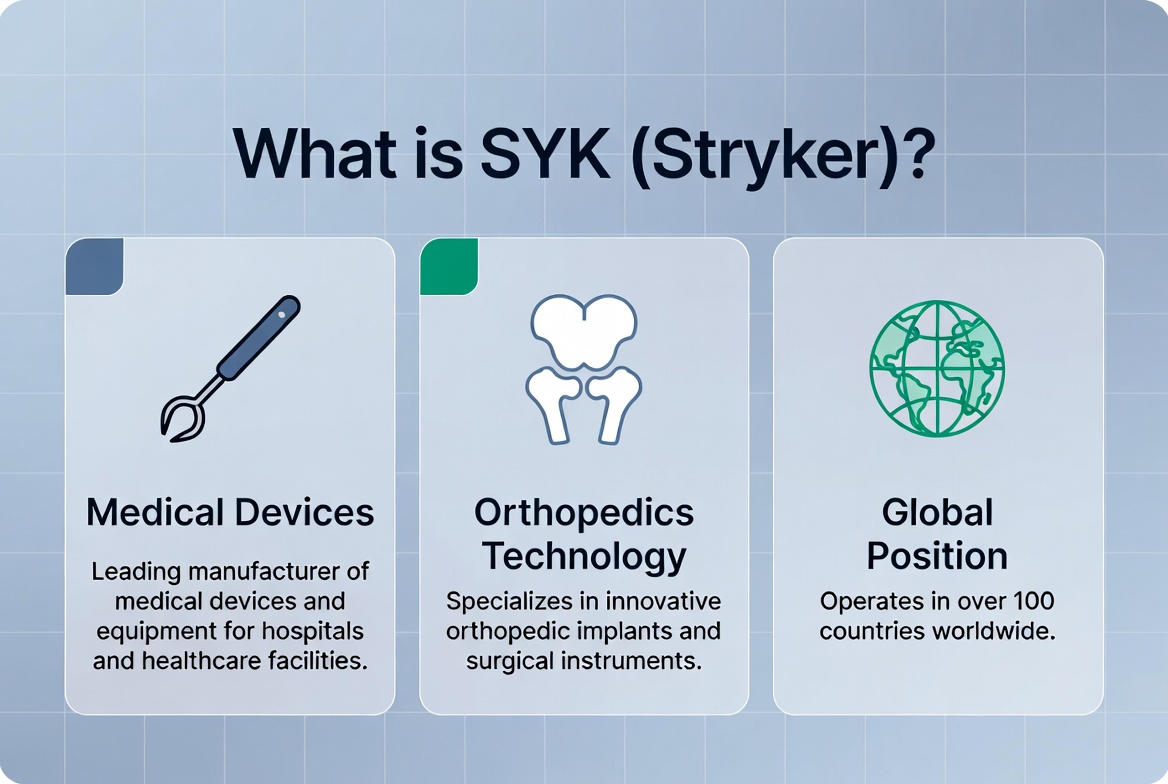
Stryker's core business includes joint replacement systems (such as hip and knee implants), trauma repair devices, endoscopy systems, and advanced surgical equipment. These products are used frequently in orthopedic and complex surgeries, making them a vital component of hospital basic medical configurations.
In terms of its business model, SYK generates stable revenue through long-term hospital procurement contracts and equipment replacement cycles, while consistently enhancing product value via technological innovation, thereby maintaining its competitive edge in the high-end medical device market.
What Is SYK (Stryker)
The medical device industry, a core pillar of the modern healthcare system, improves diagnostic and treatment efficiency and patient outcomes through engineered, technology-driven products. SYK (Stryker Corporation), one of the world's leading medical technology companies, focuses primarily on orthopedic implants, surgical equipment, and medical technology solutions, holding a significant position within hospital surgical systems and clinical treatment workflows.
Stryker's business model revolves around "high-value medical devices + continuous innovation + hospital system integration." Its products are not limited to single-use treatment scenarios but are deeply embedded into hospitals' long-term procurement systems. This model ensures strong income sustainability and predictability while creating high entry barriers.
From an industry standpoint, SYK ranks among the top-tier global medical device companies, alongside Medtronic and Johnson & Johnson Medical, forming the core competitive landscape of the high-end medical device market. Its growth is driven primarily by aging populations, rising surgical demand, and advancements in medical technology.
Stryker's Development History and Market Positioning
Founded in 1941, Stryker initially focused on manufacturing medical devices for basic surgery and hospital operating rooms. As medical technology evolved, the company gradually expanded into orthopedic implants, surgical equipment, and neurological medical fields, building a more comprehensive product portfolio.
Throughout its development, SYK strengthened its capabilities through continuous acquisitions and technology integration, particularly establishing robust technological barriers in orthopedic implants and surgical navigation systems. These acquisitions not only broadened its product lines but also boosted its competitiveness in the high-end medical device market.
In terms of market positioning, SYK targets the high-end medical device segment, emphasizing high precision, high reliability, and long-term clinical value, differentiating itself from low-end disposable consumable manufacturers. With the acceleration of global population aging, the company is transitioning from a single-equipment supplier to a comprehensive medical solutions provider.
How Stryker's Medical Device Business Operates
Stryker's medical device business operates on a core model of "R&D-driven + hospital procurement system + lifecycle renewal." The company consistently invests R&D funds to develop next-generation orthopedic equipment and surgical systems, meeting hospitals' growing demands for precision and efficiency.
Regarding revenue structure, orthopedic implants and surgical equipment constitute its main income sources. These products typically have long usage cycles but generate steady replacement demand as technology upgrades or clinical needs change, thereby creating a continuous revenue base.
Additionally, SYK expands its revenue structure through equipment maintenance, leasing services, and software system integration, evolving its business model from single product sales to a comprehensive medical solution provider, thereby increasing customer stickiness and long-term partnership stability.
Stryker's Orthopedic and Surgical Equipment System
The orthopedic business is SYK's core segment, mainly comprising joint replacement, trauma repair, and spinal surgery products. These products are widely used in fracture treatment, joint degeneration repair, and complex orthopedic surgeries, serving as essential components of hospital basic surgical configurations.
On the surgical equipment side, SYK offers high-end devices such as imaging navigation systems, powered surgical tools, and endoscopy systems. These devices enhance surgical precision, reduce operational risks, and improve overall surgical efficiency, making them critical infrastructure in modern operating rooms.
Through the integration of orthopedic products and surgical equipment, SYK has built a comprehensive solution system covering "preoperative planning—intraoperative execution—postoperative rehabilitation." This highly integrated model enhances hospital procurement stickiness and strengthens the company's long-term competitive advantage in the medical device market.
Why Population Aging Drives SYK Growth
Global population aging is one of the core structural factors driving SYK's long-term growth. As age increases, the incidence of joint degeneration, fractures, and spinal diseases rises significantly, directly fueling growing demand for joint replacement and orthopedic surgeries.
In developed countries, joint replacement has become a highly mature and frequently used standard medical procedure, providing SYK's orthopedic implant products with a stable and predictable long-term demand base. This demand does not depend on short-term economic cycles but rather resembles rigid growth driven by demographic structures.
Meanwhile, the continuous improvement of medical infrastructure in emerging markets is also increasing the penetration rate of orthopedic surgeries, further expanding SYK's global market space and giving its growth greater long-term certainty.
SYK's Role in the Global Healthcare System
SYK plays a dual role in the global healthcare system as a "high-end medical device supplier + surgical solution provider." Its products do not merely serve a single treatment stage but are deeply embedded in the overall hospital surgical workflow.
Within hospital procurement systems, SYK equipment typically has high technical barriers and replacement costs, leading to strong dependence by doctors and hospitals on existing systems, thereby creating high customer stickiness. This structure enhances the stability and sustainability of the company's income.
Additionally, SYK has established comprehensive sales and service networks in many countries worldwide, enabling it to adapt to different healthcare systems and regulatory environments, and thus continuously expand its market coverage globally.
Differences Between SYK, Medtronic, and Johnson & Johnson
SYK, Medtronic, and Johnson & Johnson Medical are all global medical device leaders, but their business structures differ significantly. Medtronic is more focused on cardiovascular and implantable devices, while Johnson & Johnson's business spans pharmaceuticals, consumer health, and diversified medical sectors.
In contrast, SYK's strategy is more concentrated, with its core centered on orthopedic implants and surgical equipment. This focus allows it to build stronger technological barriers and product depth in its niche markets, but it also means a relatively concentrated business structure.
This difference positions SYK more as a "vertically deep medical device company" rather than a comprehensive healthcare conglomerate, with growth more dependent on continuous upgrades in orthopedics and surgical technology.
Key Application Scenarios for SYK
SYK products are widely used in hospital orthopedic surgeries, trauma repairs, and complex surgical procedures. In the orthopedic field, its joint replacement systems are primarily used to treat bone and joint degeneration in elderly patients, representing a typical high-frequency surgical application.
In operating room scenarios, SYK's imaging navigation systems, powered surgical tools, and endoscopy devices are used to enhance surgical precision and safety, optimizing overall surgical efficiency and becoming vital infrastructure in modern operating rooms.
Furthermore, its products extend to emergency trauma treatment and long-term rehabilitation care, covering the complete medical chain from acute treatment to post-operative recovery.
How to Buy SYK (Stryker) Stock
Investors can purchase SYK stock on the New York Stock Exchange (NYSE) under the ticker symbol SYK. Common methods include direct trading through a brokerage account, indirect holding via ETFs, or allocation through index funds.
In investment analysis, SYK is typically classified as a growth-oriented medical device company, with its stock price performance primarily driven by aging population trends, medical expenditure growth, and technology innovation cycles. Therefore, when evaluating SYK, markets tend to focus more on long-term demand structure than short-term financial fluctuations.
As digital asset markets and traditional financial markets gradually converge, some platforms are beginning to offer financial products linked to U.S. stock prices. The Gate TradFi platform is continuously expanding its coverage of traditional financial assets, allowing users to Seguir digital assets, U.S. stocks, ETFs, indices, and commodity markets within the same account environment. Some markets also offer Gate CFD products, enabling users to participate in U.S. stock trading using stablecoins (e.g., USDT), thereby gaining exposure to CPRI stock price fluctuations without needing to open a traditional securities account.
Regardless of whether investors participate in the market through traditional securities accounts or digital asset trading tools, they should fully understand the product mechanisms, fee structures, risk characteristics, and local regulatory requirements. A clear understanding of the differences in rights and obligations under each method is essential for achieving safe and effective asset management in the global capital market.
SYK's Advantages and Limitations
SYK's core advantages lie in its highly specialized positioning in orthopedics and surgical equipment, continuous R&D capabilities, and sales structure deeply integrated with hospital systems. These factors together form the foundation for its long-term growth.
However, its limitations include a relatively high business concentration, significant reliance on the orthopedic and surgical equipment market, and exposure to strict medical regulatory policies, high R&D costs, and intensifying industry competition.
Overall, SYK is a medical device company characterized by "high barriers + moderate concentration + long-cycle driven growth," offering stable growth quality but with a relatively singular structural profile.
Summary
SYK (Stryker Corporation) is a global medical technology company centered on orthopedic medical devices and surgical equipment. Its business model relies on high-value products, long-term hospital procurement systems, and continuous technological innovation. By covering orthopedic treatment and surgical solutions, SYK maintains a stable position in the global medical device market.
In terms of long-term growth logic, aging populations and medical technology upgrades provide sustained demand drivers, but its high business concentration also exposes it to certain industry structural risks. Overall, SYK is a typical high-quality medical growth enterprise.