As the DeFi market shifts from high-volatility assets toward on-chain dollar yield opportunities, yield-bearing stablecoins have emerged as a key bridge between traditional finance income logic and blockchain liquidity. As a core component of the Maple ecosystem, SyrupUSDC goes beyond standard stablecoin functions by channeling institutional credit market yields into on-chain assets, expanding the use cases for stablecoins.
Background of SyrupUSDC
Stablecoins have long been a fundamental pillar of the digital asset market. Traditional stablecoins like USDC and USDT primarily serve payments, settlements, trading, and value storage, with values typically pegged to the US dollar.
With the growth of on-chain finance, users are increasingly focused on capital efficiency for stablecoins. Large amounts of idle stablecoins preserve value but generate no yield directly. Maple Finance created SyrupUSDC to convert interest income from institutional lending into holdable, transferable, and composable on-chain yield assets.
How Does SyrupUSDC Work?
SyrupUSDC operates on top of Maple’s institutional lending infrastructure.
Users first deposit USDC into Maple-related products, and the system mints a corresponding amount of SyrupUSDC at the current exchange rate. Once held, the underlying funds enter Maple’s institutional lending market and continuously earn interest paid by borrowers.
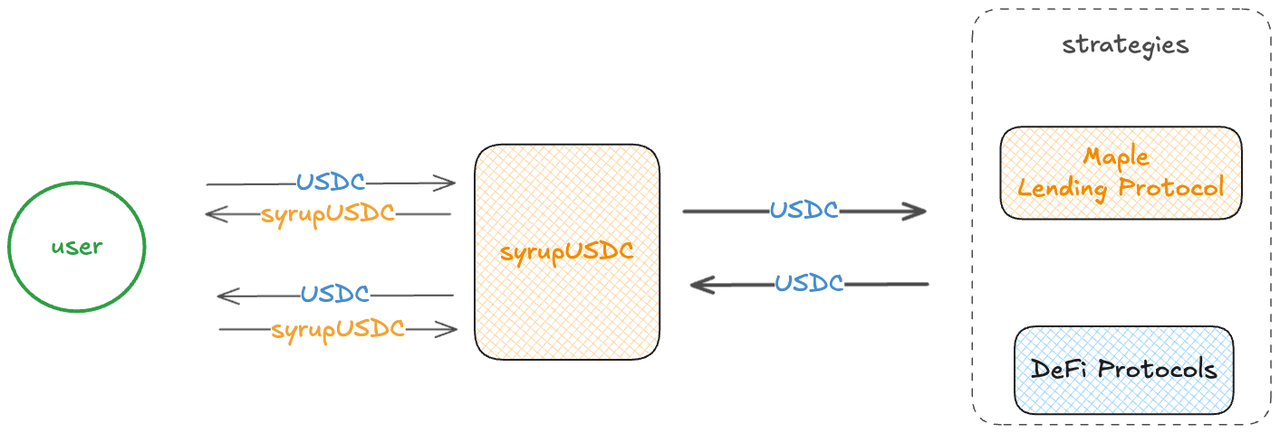
Unlike some yield products that distribute rewards periodically, SyrupUSDC generates returns through net asset value (NAV) growth. As loan interest accumulates, the USDC value represented by each SyrupUSDC gradually increases.
When users redeem, the system converts SyrupUSDC back to the corresponding amount of USDC at the latest exchange rate, realizing the accumulated yield.
What Are the Yield Sources of SyrupUSDC?
SyrupUSDC’s yield primarily comes from Maple’s institutional-grade digital asset loans.
Borrowers on the Maple network include digital asset funds, market makers, quant trading firms, and other professional financial participants. These institutions secure loan limits by posting collateral and pay interest accordingly.
After loan interest enters Maple’s pool, necessary fees and risk reserves are deducted, and the remainder is reflected in SyrupUSDC’s asset value.
Because loans typically have short terms and fixed interest rates, the yield source is relatively transparent—fundamentally different from some DeFi yield models that rely on token emissions.
What’s the Difference Between SyrupUSDC and USDC?
While both SyrupUSDC and USDC are built around the US dollar, they serve distinct purposes.
USDC’s primary goal is price stability for payments, settlements, and on-chain transactions. USDC itself does not automatically generate yield unless actively deposited into lending protocols or yield products.
SyrupUSDC adds a yield-bearing layer to its stablecoin properties. As you hold SyrupUSDC, its value gradually increases as institutional loan income accumulates.
From a risk standpoint, USDC mainly faces issuer risk. SyrupUSDC, in addition to issuer-related risks, also involves credit and liquidity risks from the institutional lending market.
What Are SyrupUSDC’s DeFi Use Cases?
As yield-bearing assets gain importance, SyrupUSDC’s applications continue to expand.
Users can hold SyrupUSDC as a long-term yield asset, earning returns while maintaining on-chain dollar exposure.
Some DeFi protocols also allow SyrupUSDC to participate in liquidity provision, yield aggregation, and collateralized lending, further improving capital efficiency.
Because SyrupUSDC inherently generates yield, its potential in yield tranching products, fixed-income protocols, and asset management strategies is also growing.
What Risks Does SyrupUSDC Face?
While SyrupUSDC aims to provide stable yields, certain risks remain.
Institutional borrower defaults could extend loan recovery timelines or lead to principal losses. Although Maple employs over-collateralization and risk management, credit risk cannot be fully eliminated.
Smart contract risk is a challenge for all on-chain financial products. Protocol code vulnerabilities, oracle anomalies, or third-party integration issues could all affect asset security.
Additionally, during large-scale redemption events, liquidity management may impact the efficiency of asset withdrawals.
Summary
SyrupUSDC—a yield-bearing stablecoin launched by Maple Finance—offers on-chain dollar returns through institutional-grade digital asset lending. Unlike traditional USDC, SyrupUSDC embeds earning capacity directly into the asset, with interest accumulation reflected via exchange rate appreciation.
Its core value lies in bridging the institutional credit market with the DeFi ecosystem, allowing users to access on-chain fixed-income opportunities more simply. However, SyrupUSDC still faces credit risk, smart contract risk, and liquidity risk.
FAQs
Where does SyrupUSDC’s yield come from?
SyrupUSDC’s yield mainly comes from Maple Finance’s institutional-grade digital asset loans. Interest paid by borrowing institutions is added to the NAV and reflected to holders through exchange rate growth.
What’s the difference between SyrupUSDC and USDC?
USDC is a traditional stablecoin for payments and settlements, while SyrupUSDC maintains dollar asset properties while continuously generating yield. The two differ significantly in functional positioning and risk structure.
How is SyrupUSDC’s yield distributed?
SyrupUSDC does not distribute yield by increasing the number of tokens. Instead, it accumulates yield by increasing the USDC value that each SyrupUSDC represents.
What’s the difference between SyrupUSDC and Aave’s aUSDC?
aUSDC’s yield comes primarily from Aave’s on-chain lending market, while SyrupUSDC’s yield comes from Maple’s institutional credit market. Their borrower structures, yield sources, and risk models are all different.