As DeFi, on-chain data, and large language models have evolved, the blockchain industry has begun exploring the potential for AI Agents to engage in financial activities. Traditional DeFi applications typically require users to understand complex protocol rules, transaction workflows, and risk management logic. However, the advent of AI Agents is transforming this interaction, enabling many financial operations to be handled automatically by intelligent agents.
Within the broader convergence of AI and Web3, UnifAI has emerged as a key pillar of Agentic Finance infrastructure. Rather than building a single financial product, its goal is to create an open network that supports the creation, deployment, execution, and collaboration of AI Agents, providing the foundational layer for future autonomous financial systems.
The Origin of UnifAI Network
The blockchain industry has progressed through several phases: value transfer, smart contracts, and decentralized finance. As application complexity has grown, so too has the knowledge and number of steps required for users to participate in DeFi.
At the same time, large language models and AI Agent technology have gained capabilities in reasoning, planning, and task execution. A growing number of developers are now combining AI with on-chain operations, allowing artificial intelligence not only to analyze market data but also to directly manage assets and interact with protocols.
UnifAI Network was born from this context. The project aims to build a unified Agent execution network, enabling AI to access on-chain tools, protocols, and data resources through standardized interfaces, thereby automating financial operations.
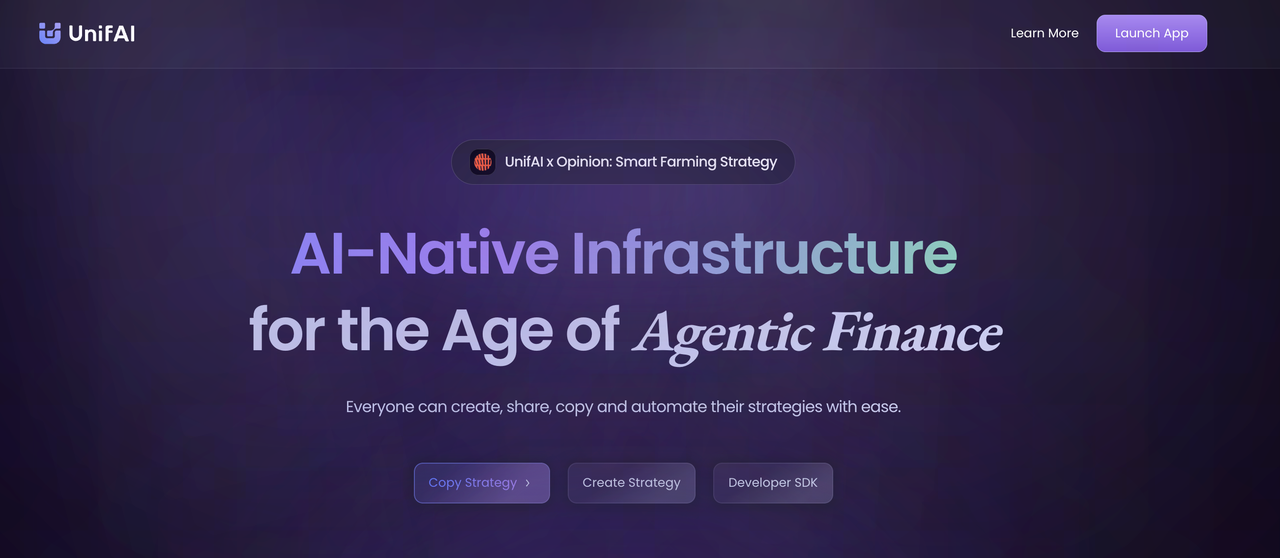
What Is Agentic Finance?
Agentic Finance is a new model in which AI Agents take the lead in executing financial activities.
In traditional finance and DeFi systems, most decision-making and execution falls on the user. Users must actively analyze markets, develop strategies, and manually operate protocols. Agentic Finance delegates parts of these workflows to AI Agents.
Under the Agentic Finance model, AI Agents autonomously plan their action paths based on target tasks. Examples include managing investment portfolios, seeking yield opportunities, executing arbitrage strategies, or monitoring risk conditions.
How Does UnifAI Network Work?
The core operational logic of UnifAI Network's core operational logic relies on the coordinated interaction between AI Agents, the tooling layer, and the execution layer.
Users or developers first set objectives—such as asset allocation, yield optimization, or market monitoring. The AI Agent then analyzes available information to meet the objective and calls upon tool components within the network to execute specific tasks.
The process typically includes the following steps:
-
Receive user goals
-
AI Agent performs task planning
-
Call Unified Tools
-
Interact with on-chain protocols
-
Execute trades or management operations
-
Monitor results and optimize continuously
This architecture enables AI Agents to seamlessly switch between multiple protocols without requiring manual intervention from the user.
What Are the Technical Components of UnifAI's Architecture?
Application Layer
The application layer is the user-facing part, including wallets, Agent apps, strategy marketplaces, and community tools.
Users create tasks, manage assets, or call AI services through the application layer, without needing to engage with the underlying technical details.
Tooling Layer
The tooling layer bridges on-chain protocols and external services.
It provides standardized interfaces that enable AI Agents to access DEXs, lending protocols, oracles, data analysis tools, and other Web3 services.
Through a unified tooling framework, different Agents can share the same capability components, improving development efficiency.
Infrastructure Layer
The infrastructure layer handles network operations, Agent execution, and resource coordination.
This layer ensures Agents can run securely and supports large-scale collaboration and cross-chain task execution.
What Core Products Does the UnifAI Ecosystem Include?
Agentic Wallet
Agentic Wallet is a wallet system designed to support AI Agents in managing assets.
Unlike traditional wallets, Agentic Wallet not only stores assets but can also execute automated tasks and manage complex strategies.
Trading Agents
Trading Agents are specialized AI Agents for trading and market analysis.
These agents monitor market conditions, execute preset strategies, and complete automated trading workflows.
Strategy Marketplace
The Strategy Marketplace allows users to share and reuse strategies.
Developers can publish Agent strategies, and other users can select and deploy them based on their needs.
Trading Community
The Trading Community connects developers, strategy creators, and users.
Agents, strategies, and tools within the community form a synergistic ecosystem that boosts overall network activity.
Open SDK
The Open SDK provides developers with tools for creating Agents.
Developers can build new Agent applications using the SDK and integrate them into the existing ecosystem.
What Are the Functions of the UAI Token?
UAI is the native token of UnifAI Network, serving multiple roles within the ecosystem.
Network Service Payment
Users can pay for Agent service fees, execution costs, or platform feature fees using UAI.
Governance Participation
UAI holders can participate in ecosystem governance by voting on protocol upgrades and parameter adjustments.
Staking Mechanism
Certain network features operate through a staking mechanism.
Participants can lock UAI to support network operations and earn corresponding incentives.
Reputation and Incentive System
UAI is also used to build Agent reputation systems and developer incentive programs.
Creators of high-quality Agents, tools, and strategies can receive rewards for their contributions.
What Are the Application Scenarios for UnifAI Network?
Automated Trading
AI Agents can continuously monitor market conditions and execute trades based on predefined rules.
Yield Optimization
Agents can search for yield opportunities across multiple protocols and automatically allocate funds.
Multi-Chain Asset Management
Through a unified interface, users can manage assets distributed across different blockchain networks.
Risk Monitoring
AI Agents continuously track market changes and position status, identifying potential risks in real time.
Social Strategy Sharing
Users can copy or deploy strategies created by other developers, enabling strategy collaboration and knowledge sharing.
Traditional DeFi platforms mainly offer protocols and tools, with users responsible for all decisions and operations.
UnifAI introduces AI Agents as the executing entities, automating many tasks.
| Comparison Dimension |
UnifAI Network |
Traditional DeFi |
| User Role |
Goal setter |
Operator |
| Execution Entity |
AI Agent |
User |
| Strategy Management |
Automated |
Manual |
| Multi-Protocol Interaction |
Agent coordination |
User switching |
| Learning Barrier |
Relatively low |
Relatively high |
| Scalability |
Agent ecosystem |
Protocol ecosystem |
This difference highlights the fundamental shift in interaction patterns between Agentic Finance and traditional DeFi.
Advantages and Challenges of UnifAI Network
UnifAI enhances the automation of financial operations through AI Agents and reduces the learning burden on users for complex protocols.
The unified tooling layer and open SDK also enable developers to quickly build new applications, fostering Agent ecosystem growth.
At the same time, Agentic Finance still faces challenges in model reliability, execution security, cross-chain compatibility, and governance mechanisms. As AI and blockchain technology continue to advance, these issues will remain key areas of industry focus.
Summary
UnifAI Network, as an AI Agent infrastructure for Agentic Finance, provides the foundational support for AI Agents to participate in on-chain financial activities through a unified tooling layer, intelligent agent execution framework, and open development environment.
Unlike traditional DeFi, which relies primarily on manual user operations, UnifAI emphasizes task planning, protocol interaction, and strategy execution by AI Agents, gradually steering digital financial interactions toward automation and intelligence.
FAQs
What does Agentic Finance mean?
Agentic Finance refers to a model where AI Agents lead the execution of financial activities. AI Agents can autonomously analyze information, plan tasks, and interact with on-chain protocols, enabling automated financial operations.
What is the main purpose of the UAI Token?
The UAI Token is primarily used for network service payments, ecosystem governance, staking mechanisms, developer incentives, and building Agent reputation systems.
Does UnifAI support developers in creating their own AI Agents?
Yes. UnifAI provides an open SDK and tooling framework, allowing developers to build customized AI Agents and automated applications on top of the existing infrastructure.
What is the difference between AI Agents and traditional trading bots?
Traditional trading bots typically execute tasks based on fixed rules, whereas AI Agents possess reasoning, planning, and dynamic decision-making capabilities, enabling them to adjust strategies in response to changing environments.
Which blockchain protocols can UnifAI connect to?
UnifAI uses the Unified Tools framework to connect various blockchain protocols and services, including trading, lending, data analysis, and asset management applications, thereby supporting cross-protocol collaboration.