As the DeFi market develops, decentralized trading protocols have gradually evolved from basic trading tools into on-chain financial infrastructure. Early DEXs mainly solved the problem of on-chain asset swaps. As demand has grown for liquidity management, yield strategies, and on-chain derivatives, the market has begun to need protocol architectures with stronger programmability and scalability. Against this backdrop, Uniswap has continued to advance protocol upgrades and launched Uniswap v4, which places greater emphasis on modularity and developer extensibility.
As one of the most representative DEX protocols in DeFi, Uniswap has long shaped the direction of on-chain liquidity markets through its mechanism design. Compared with v3, which mainly focused on concentrated liquidity, Uniswap v4 goes a step further by using Hooks, custom pools, and the Singleton architecture to improve protocol flexibility and gas efficiency. This shift affects not only the trading experience, but also brings Uniswap closer to an open liquidity operating system, providing foundational support for developers building complex DeFi applications.
What Is Uniswap v4?
As the next-generation upgrade of the Uniswap protocol, Uniswap v4 focuses on strengthening scalability and developer customization. Compared with earlier versions, v4 is no longer just an AMM trading protocol. It is gradually developing into open infrastructure that supports multiple forms of liquidity logic.
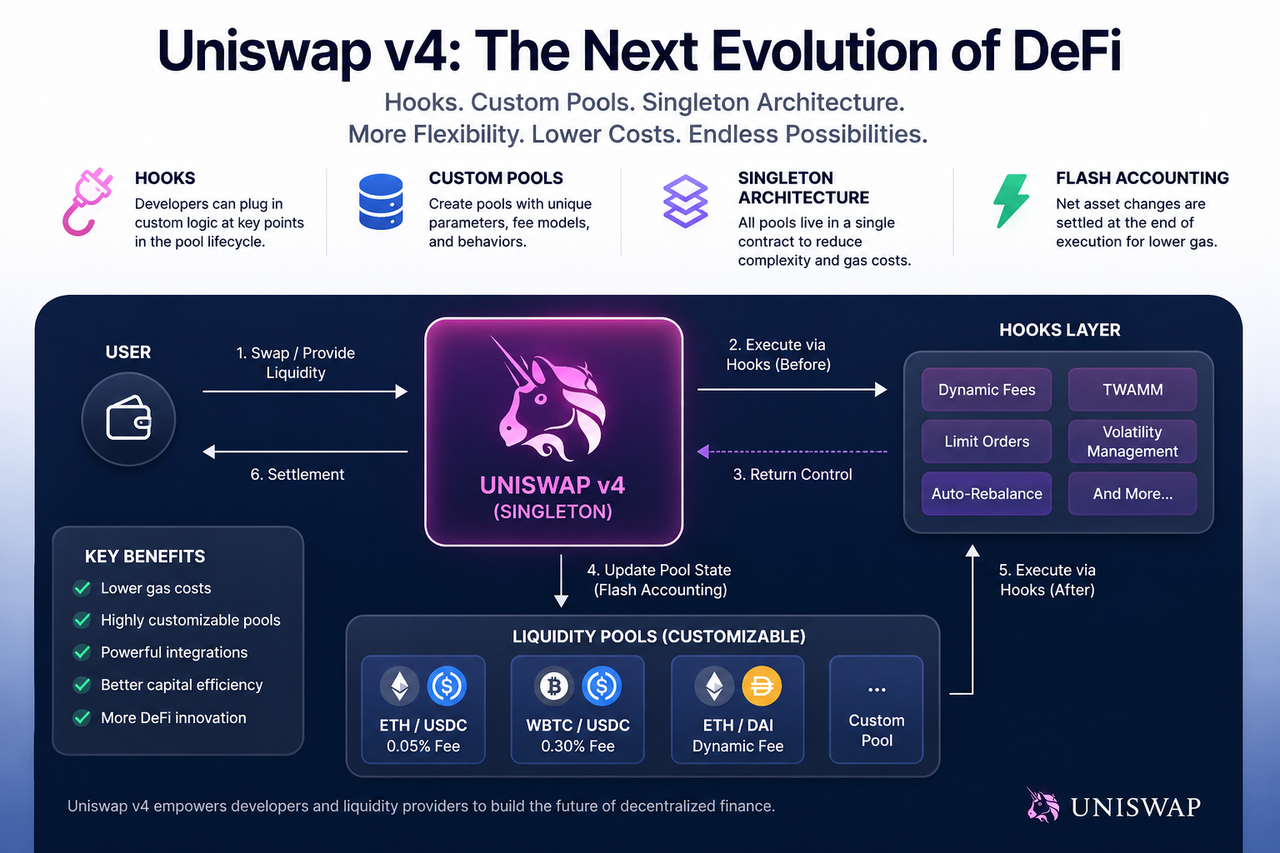
v4 retains the core structure of AMMs and liquidity pools, while allowing developers to insert additional logic into the operation of liquidity pools through Hooks. This means different liquidity pools can have more flexible functional designs instead of relying entirely on the protocol’s default rules.
What Are Hooks?
Hooks are one of the most important upgrades in Uniswap v4. In essence, they are pluggable smart contract modules that allow developers to execute custom logic at different stages of trading or liquidity operations.
For example, Hooks can be used for:
-
Dynamically adjusting fees
-
Automatically compounding LP returns
-
Creating on-chain limit orders
-
Managing volatility
-
TWAMM, or time-weighted automated market making
-
Automatically rebalancing liquidity
With Hooks, Uniswap is no longer just a standardized DEX. It is more like a developer framework that supports a wide range of financial logic.
How Does the Singleton Architecture Work?
In previous versions, each liquidity pool usually corresponded to a separate contract. Uniswap v4 introduces the Singleton architecture, which integrates all liquidity pools into a single core contract.
The main advantages of this design include:
-
Lower gas costs for cross-pool trades
-
More efficient interactions between pools
-
Less repeated contract deployment
-
Greater overall protocol scalability
For aggregated trading and complex DeFi strategies, the Singleton structure can reduce on-chain state switching, helping optimize overall trading efficiency.
How Does Flash Accounting Reduce Gas Costs?
Flash Accounting is an important gas optimization mechanism introduced in Uniswap v4. Its core idea is to settle asset changes all at once at the end of a transaction, rather than transferring assets immediately at every step of an operation.
This approach can reduce the number of on-chain state updates and, in turn, lower transaction costs. For complex trading routes involving multiple liquidity pools, the gas optimization effect may be more noticeable.
As interactions between DeFi protocols continue to increase, Flash Accounting can help improve the efficiency of on-chain capital flows.
How Is Uniswap v4 Different from v3?
Compared with v3, v4 is no longer focused only on concentrated liquidity. Instead, it places greater emphasis on protocol-level programmability.
The core innovation of v3 was allowing LPs to deploy funds within specific price ranges to improve capital efficiency. v4 goes further by allowing developers to customize liquidity pool logic, so different pools can implement distinct functions based on specific use cases.
In addition, v4 optimizes gas costs through the Singleton architecture and Flash Accounting, while also improving execution efficiency for complex trading paths.
Overall, v3 is more focused on liquidity efficiency, while v4 places greater emphasis on an open protocol architecture.
What Impact Does Uniswap v4 Have on DeFi?
The direction of Uniswap v4’s upgrade may change how future DeFi protocols are developed. In the past, many projects had to build complete DEXs or liquidity systems on their own. With v4’s Hooks mechanism, developers can build custom financial logic directly on top of Uniswap.
This model lowers the barrier to developing DeFi applications and may also encourage the emergence of more on-chain financial products, such as automated market making, structured yield strategies, and dynamic risk management systems.
At the same time, v4’s modular design further strengthens Uniswap’s position as on-chain liquidity infrastructure.
Summary
Uniswap v4 is not just another DEX protocol upgrade. It also represents the broader shift of DeFi infrastructure toward modularity and programmability. Mechanisms such as Hooks, custom liquidity pools, the Singleton architecture, and Flash Accounting are gradually transforming Uniswap from a simple trading protocol into an open on-chain liquidity platform.
As DeFi applications become more complex, Uniswap v4’s flexibility and developer extensibility may further drive innovation in on-chain financial products and influence the future direction of decentralized trading protocols.
FAQs
What is the biggest difference between Uniswap v4 and v3?
v3 mainly optimizes concentrated liquidity, while v4 places greater emphasis on Hooks, custom logic, and protocol programmability.
What functions can Hooks enable?
Hooks can be used for dynamic fees, automatic compounding, on-chain limit orders, volatility management, and automated market making.
What does the Singleton Architecture do?
The Singleton architecture integrates multiple liquidity pools into a single contract, helping lower gas costs and improve interaction efficiency.
Will Uniswap v4 reduce trading fees?
Through Flash Accounting and the Singleton architecture, v4 optimizes on-chain state updates, which can help reduce certain transaction costs.
Does Uniswap v4 still use AMM?
Yes. v4 still runs on the AMM model, but it adds more extensibility and customization capabilities.
Why is Uniswap v4 important for DeFi?
v4 improves protocol flexibility and developer extensibility, bringing Uniswap closer to open liquidity infrastructure.