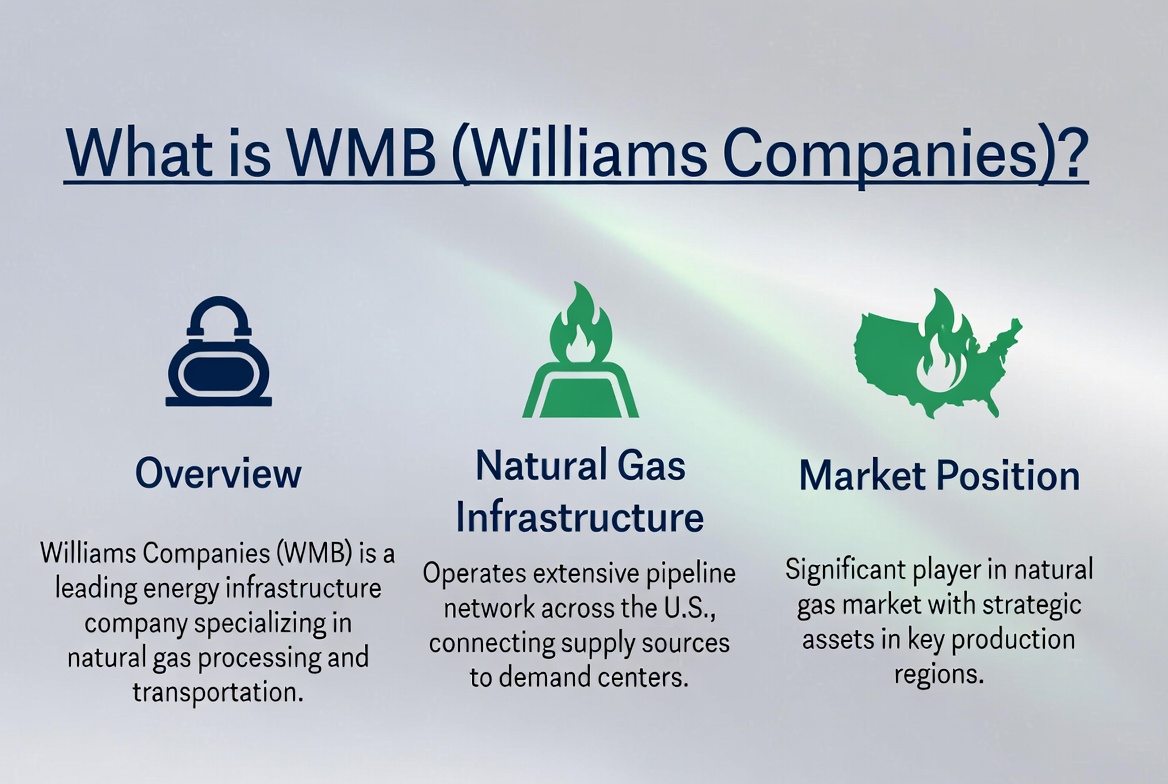
WMB (Williams Companies) is one of the largest natural gas infrastructure operators in the United States. The company has long focused on natural gas transportation, storage, processing, and related energy services, and its operated Transco natural gas pipeline system is widely regarded as one of the most critical gas transportation networks in the country. Unlike traditional energy producers, Williams does not rely on oil and gas extraction for profit but instead participates in the natural gas value chain by operating energy infrastructure.
As U.S. natural gas demand rises, the shale gas revolution advances, and LNG export capacity expands, the importance of natural gas infrastructure continues to grow. As a result, Williams has emerged as a highly representative midstream energy company in the U.S. energy market.
What Is WMB (Williams Companies)
Unlike oil companies familiar to the general public, Williams does not focus on oil and gas extraction. Instead, it is primarily responsible for transporting and circulating natural gas within the industry chain. The company owns an extensive portfolio of natural gas pipelines, compressor stations, storage facilities, and gas processing assets, serving energy producers, utilities, industrial customers, and export terminals.
WMB is the stock ticker for Williams Companies. Headquartered in Oklahoma, the company is one of North America's most important natural gas infrastructure firms.
From an industry chain perspective, Williams is a "midstream" company within the energy sector. Upstream companies handle exploration and extraction, downstream companies manage consumption and end use, while Williams plays the essential role of connecting supply and demand.
This business model allows the company to rely more on infrastructure operating income rather than direct exposure to energy price volatility, giving it a unique position in the U.S. energy system.
Williams' Development History and Market Positioning
Williams' history dates back to the early 20th century. Through sustained growth, the company has evolved from a regional energy player into a major national natural gas infrastructure operator.
Over the past several decades, the U.S. energy market has undergone dramatic changes. The shale gas revolution, in particular, led to a surge in U.S. natural gas production, putting greater demands on transportation and storage infrastructure. By continuously building and expanding its pipeline network, Williams has established a clear industry leadership position.
Today, the company's core identity is as a natural gas transportation and energy infrastructure service provider. Its operations span natural gas production regions, consumer markets, and export terminals, making it a key player in the U.S. natural gas distribution system.
Unlike many energy companies, Williams derives its value primarily from its infrastructure network. Increases in natural gas production, consumption, and export activity all tend to boost pipeline utilization, driving business growth.
How Williams' Natural Gas Infrastructure Business Works
Natural gas cannot go directly to end markets after extraction; it must undergo processing, transportation, and distribution. Williams plays a role in each of these stages.
The company transports gas from production areas to processing facilities via its gathering systems, then moves it through long-distance pipelines to population centers, industrial parks, and power plants. Throughout this process, the gas must be compressed and regulated to ensure stable flow.
Williams' customers include natural gas producers, utilities, power companies, and large industrial users. These customers pay transportation and service fees, forming the company's primary revenue stream.
Because natural gas demand is both long-term and consistent, gas infrastructure tends to generate stable business models. For Williams, the pipeline network itself is its most critical core asset.
Williams' Pipeline Transportation Network System
Natural gas pipelines are the foundation of Williams' business. The company owns a transportation network that covers multiple key U.S. energy regions, connecting production areas, consumer markets, and export facilities.
Compared to rail or truck transport, pipelines offer lower costs, higher efficiency, and greater capacity. As a result, the natural gas industry relies almost entirely on pipelines for long-distance transport.
Williams operates an extensive system of pipelines spanning multiple states, capable of moving gas from major shale gas regions to the East Coast, Gulf Coast, and Midwest markets. This cross-regional capability makes the company a vital component of the U.S. energy supply chain.
As U.S. natural gas consumption and export volumes continue to grow, the importance of pipeline networks is only increasing. For the energy industry, pipelines are not just transportation tools but essential infrastructure for market stability.
Why Transco Is a Critical U.S. Natural Gas Pipeline System
Transco is one of Williams' most significant assets and one of the largest and most influential natural gas pipeline systems in the United States.
The system runs through multiple eastern states, transporting gas from the Gulf Coast and southern regions to major consumer markets on the East Coast. Given the high population density in these areas, Transco shoulders a critical energy supply responsibility.
The East Coast has long been one of the most concentrated regions for natural gas consumption in the U.S. Residential heating, commercial activity, and gas-fired power generation all require a steady supply, and Transco serves as the essential link between supply and demand.
As the share of natural gas in U.S. power generation rises and LNG exports grow, Transco's importance continues to increase. For Williams, this system is not only a core asset but also a key source of competitive advantage.
Williams' Role in the U.S. Energy Market
The U.S. energy market consists of producers, transportation companies, utilities, and end-users. Williams occupies the crucial middle ground that connects all these parties.
If we liken the natural gas market to a logistics system, producers are the factories, end-users are the consumers, and Williams is the logistics network operator handling transportation and storage.
This role allows the company to serve multiple markets simultaneously. Whether natural gas is used for power generation, industrial manufacturing, residential heating, or export, it must pass through infrastructure to reach its destination.
Thus, Williams is not merely an energy company but more accurately an energy infrastructure operator. Its business value is closely tied to the overall functioning of the U.S. energy system.
How Williams Benefits from Natural Gas and LNG Export Growth
In recent years, the U.S. has become a major global gas producer and a key player in the LNG export market. The growth of gas exports is reshaping the U.S. energy landscape.
LNG exports require large volumes of gas to be transported from inland production areas to coastal liquefaction terminals, a process heavily dependent on pipeline infrastructure. As a major pipeline operator, Williams stands to benefit from increased gas flows.
At the same time, natural gas is playing an increasingly important role in the energy transition. Compared to coal, natural gas produces lower carbon emissions and is widely considered a transition fuel.
With rising power demand, expanding exports, and growing industrial applications, the U.S. natural gas market continues to expand, creating long-term growth opportunities for Williams.
How Williams Differs from Kinder Morgan and Enterprise Products
Williams, Kinder Morgan, and Enterprise Products are all well-known U.S. midstream energy companies, but their business focuses differ.
| Company |
Core Business |
Key Areas |
| WMB |
Natural Gas Infrastructure |
Gas Transportation & Transco |
| Kinder Morgan |
Diversified Pipeline Network |
Natural Gas, Oil, CO₂ |
| Enterprise Products |
NGL & Energy Logistics |
Natural Gas Liquids & Export Facilities |
Williams is characterized by its extremely high concentration on natural gas and ownership of one of the most important gas transportation networks in the U.S. Kinder Morgan has a more diversified portfolio, while Enterprise Products has a stronger footprint in natural gas liquids and export terminals.
Although the three companies operate in the same infrastructure sector, each holds a distinct advantage within the value chain.
Main Application Scenarios for Williams
Williams' infrastructure services support a wide range of energy consumption scenarios.
Residential households are major natural gas consumers. Winter heating, hot water, and cooking all rely on gas, much of which flows through pipelines operated by Williams.
The power generation sector is another key application. As the share of gas-fired power generation increases, many power plants depend on a stable gas supply. Industrial enterprises also use natural gas as an energy source or chemical feedstock.
Additionally, the rapidly expanding U.S. LNG export industry is heavily reliant on gas transportation networks. Gas must travel through pipeline systems to reach export terminals before entering the global market.
How to Buy WMB (Williams Companies) Stock
WMB is the ticker symbol for Williams Companies, traded on the New York Stock Exchange (NYSE). Investors can typically buy WMB stock through a brokerage account that supports U.S. equities, gaining exposure to the U.S. natural gas infrastructure sector.
As a typical energy infrastructure company, Williams' performance is closely linked to natural gas demand growth, transportation volumes, and overall U.S. energy market trends. Unlike direct commodity trading, infrastructure companies generate revenue primarily from asset operations and service fees.
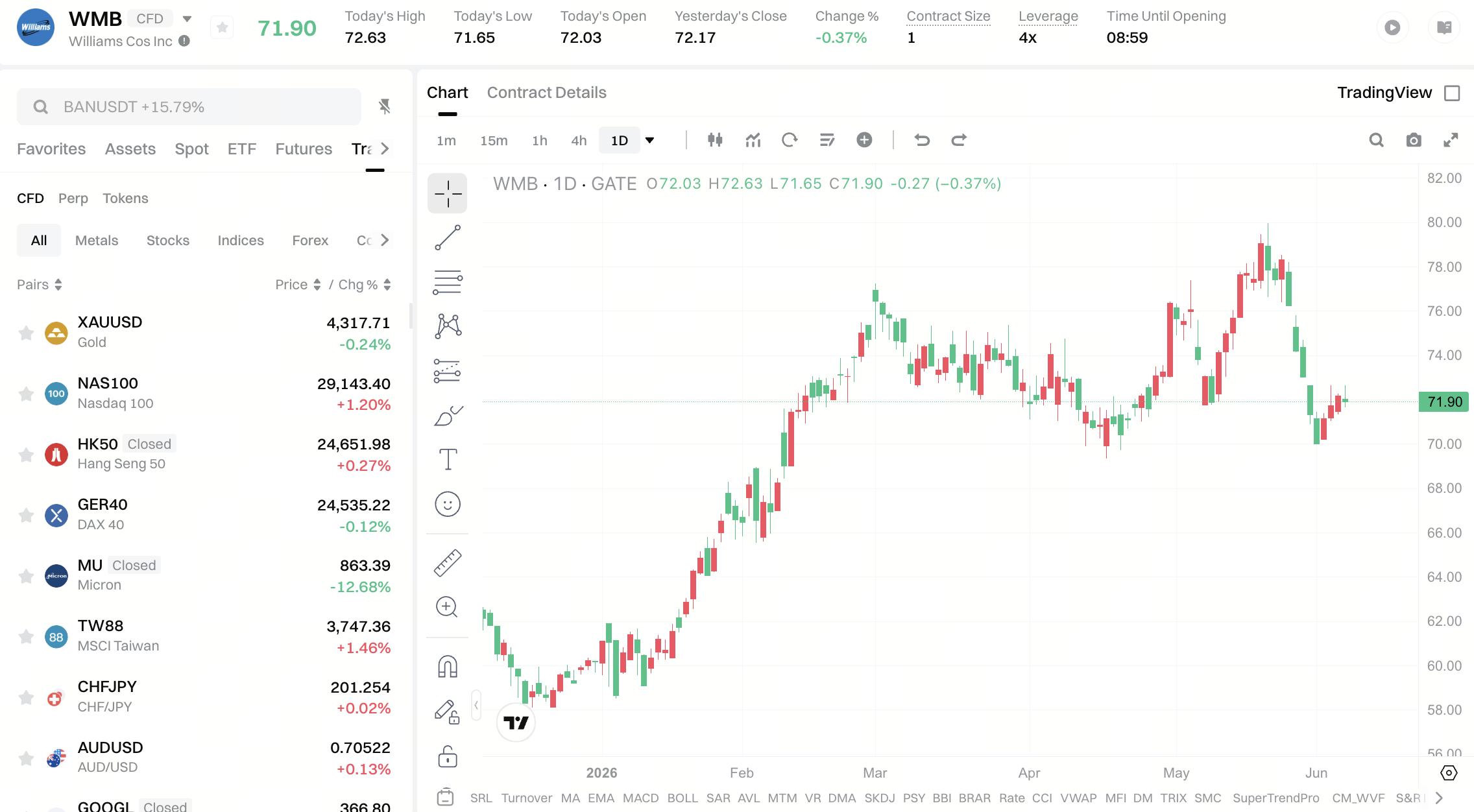
As digital asset markets increasingly converge with traditional finance, some platforms now offer products linked to U.S. stock prices. For example, certain platforms provide CFD products tied to stock prices, allowing users to gain exposure through price movements without directly holding the underlying shares.
Gate TradFi is continuously expanding its coverage of traditional financial assets, enabling users to access digital assets, U.S. stocks, ETFs, indices, and commodity markets within a single account. Some markets also offer Gate CFD products, providing additional options for cross-market asset management.
Regardless of the approach, investors should fully understand the product structure, trading rules, and regulatory requirements applicable in their jurisdiction.
Williams' Advantages and Limitations
Williams' greatest strength lies in its natural gas infrastructure assets. Pipeline networks require long construction timelines, substantial capital investment, and strict regulatory oversight, creating high barriers to entry.
Moreover, the company's ownership of core assets like Transco allows it to play a deep role in the U.S. natural gas transportation system. Growth in gas consumption and LNG exports both tend to drive higher infrastructure utilization.
However, Williams also faces challenges from industry regulation, project approvals, and energy policy shifts. Large infrastructure projects often require lengthy approval processes, and changes in the energy market structure could affect future demand.
Thus, the company combines the stability typical of energy infrastructure with the long-term capital commitment characteristic of the sector.
Summary
WMB (Williams Companies) is a leading U.S. natural gas infrastructure operator, with core activities spanning natural gas transportation, storage, and related energy services. By operating major pipeline systems such as Transco, Williams connects production regions, consumer markets, and export terminals, playing a vital role in the U.S. energy system. As natural gas demand rises, LNG exports expand, and the energy transition progresses, the importance of gas infrastructure continues to grow—and Williams remains a key component of the U.S. energy network.
FAQ
What company is WMB?
WMB is the stock ticker for Williams Companies, a leading U.S. natural gas infrastructure operator.
What industry does Williams belong to?
Williams belongs to the midstream energy infrastructure sector within the energy industry, primarily focused on natural gas transportation and related services.
What is Transco?
Transco is a major natural gas pipeline system operated by Williams and one of the largest gas transportation networks in the United States.
How does Williams primarily generate revenue?
The company generates revenue primarily through fees for natural gas transportation, storage, processing, and infrastructure services.
Why does LNG export benefit Williams?
LNG exports require large volumes of natural gas to be transported to liquefaction terminals, which increases demand for pipeline network usage.
What is the difference between Williams and natural gas producers?
Natural gas producers focus on resource extraction, while Williams focuses on natural gas transportation and infrastructure operation.