Why ETH Staking Still Feels Distant — And How Gate GTETH Reframes the Choice

Beginner
Quick Reads
Last Updated 2026-03-26 06:49:17
Reading Time: 1m
Since Ethereum’s complete shift to Proof of Stake, staking has become a core component of network operations, yet it remains far from universal adoption. This article analyzes the structural constraints of traditional staking from both asset management and user behavior perspectives. It further illustrates how GTETH integrates liquidity and strategic flexibility into ETH staking strategies without sacrificing yield potential, providing modern Web3 users with choices that more effectively address real-world requirements.

The Reality Gap in ETH Staking
Since Ethereum’s full transition to Proof-of-Stake (PoS), staking has become fundamental to network security and consensus operations. Yet, actual participation data and user behavior consistently show that the share of ETH holders actively staking falls short of market expectations.

This shortfall isn’t due to users doubting the value of staking. Instead, the practical aspects of staking remain at odds with most users’ asset management habits. For typical investors, staking doesn’t feel like a natural portfolio extension. It’s viewed as a special, long-term commitment that’s difficult to adjust on the fly.

Operational Costs: The True Barrier to Staking Adoption

The technical requirements for node deployment, the locked status of staked assets, and the opaque nature of reward calculation all make staking more suitable for advanced users than for everyday asset management.

These hidden costs transform staking into a psychologically irreversible decision. For most users who want to remain agile and respond to market shifts, this structure is unwelcoming and directly suppresses participation.

The GTETH Solution

GTETH doesn’t try to educate users on PoS details or require any involvement in node or technical management. Instead, it completely streamlines the process, turning complex staking actions into a one-time asset selection.

Users simply convert ETH to GTETH. From there, all staking-related operations—including node execution, yield generation, and distribution—are handled automatically by the system. For holders, staking becomes a straightforward asset status conversion, not an ongoing management burden.

A New Approach to Yield Presentation

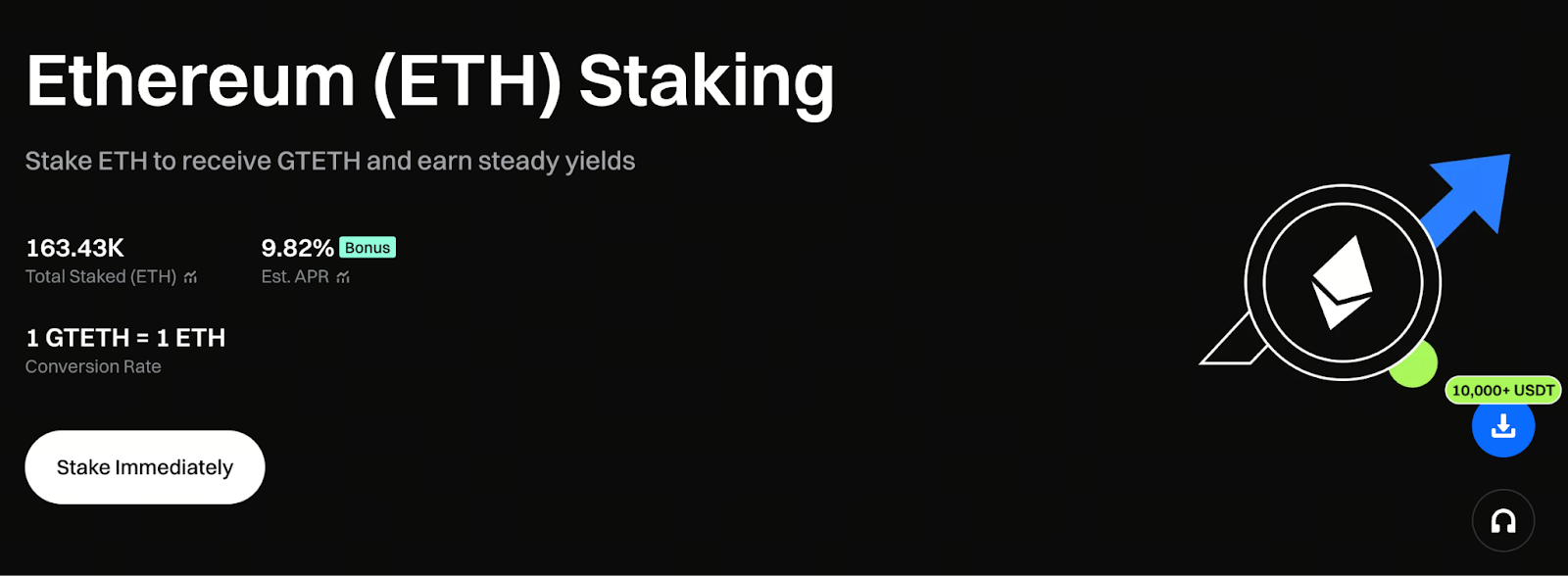
Most staking products pay rewards periodically, requiring users to track payout times and manually claim them. GTETH takes a different path, embedding rewards directly into the asset’s value. Staking returns from Ethereum PoS, along with Gate’s additional GT incentives, are naturally reflected in GTETH’s value over time. As long as you hold GTETH, its value grows automatically with accumulated rewards—no extra steps required—while maintaining full on-chain transparency.

Preserving Full Liquidity

The biggest challenge with traditional staking is the loss of instant access to funds, causing missed market opportunities. GTETH eliminates this restriction at the structural level, enabling both yield and liquidity for the first time. While holding GTETH, users can redeem ETH at will or trade in the market, without waiting for a fixed unlock period. Staking no longer means sacrificing flexibility or having to choose between yield and agility.

GTETH as a Strategic Asset

With liquidity as a default, GTETH’s role advances beyond a simple staking substitute. It becomes a strategic ETH allocation tool, adaptable to market conditions. Whether reallocating during volatility or quickly seizing new investment opportunities, GTETH acts as a flexible node in your portfolio, allowing staking to integrate seamlessly with dynamic asset management for the first time.

A Clear Yield Structure

GTETH’s returns come from two distinct sources:

1. Staking rewards from Ethereum’s PoS mechanism, with an annualized yield of approximately 2.82%.

2. Additional GT incentives from Gate, offering around 7% annualized yield, further boosting total APR.

When users redeem ETH, all accrued rewards are reflected instantly in the final payout—no extra actions or waiting required.

Start your Gate ETH staking journey and unlock on-chain mining rewards today: https://www.gate.com/staking/ETH?ch=ann46659

VIP Level: The Key to Long-Term Efficiency

GTETH’s fee structure is linked to your VIP level. The base fee is 6%, but as your VIP level increases, the effective fee decreases:

  • VIP 5 – 7: 20% fee discount
  • VIP 8 – 11: 40% fee discount
  • VIP 12 – 14: 60% fee discount

The difference may be minor in the short term, but over time—as holdings and returns accumulate—fees become a decisive factor in your final returns.

A Distinct Positioning from Mainstream LSTs

Most liquid staking tokens (LSTs) function as certificates for locked positions, mainly representing staked assets that are difficult to adjust instantly. GTETH, by contrast, serves as a daily asset management tool. Its value updates daily with yield, allows free entry and exit, and preserves both liquidity and returns. In this structure, staking is no longer an isolated portfolio component but a flexible ETH allocation method that can adapt to your strategy.

Conclusion

GTETH’s core value lies not in technical innovation, but in redefining staking’s role. It removes the capital and psychological burdens of lock-ups, preserves PoS yield potential, and builds trust through transparent on-chain mechanisms. As PoS becomes the Ethereum standard, staking no longer needs to be a rigid, long-term commitment. It can now be a flexible allocation choice that moves with the market. For users seeking both liquidity and stable returns, GTETH offers a path that aligns with modern Web3 asset management practices.

Author: Allen
Disclaimer
* The information is not intended to be and does not constitute financial advice or any other recommendation of any sort offered or endorsed by Gate.
* This article may not be reproduced, transmitted or copied without referencing Gate. Contravention is an infringement of Copyright Act and may be subject to legal action.

Related Articles

AI-Native Settlement Layers: How United Stables Is Building the Next Financial Rail
Beginner

AI-Native Settlement Layers: How United Stables Is Building the Next Financial Rail

Stablecoins were originally designed as dollar substitutes within exchanges, primarily used for asset pricing and trade settlement. As on-chain financial ecosystems have matured, their role has expanded beyond simple payments to include collateral assets, cross-chain liquidity mediums, and unified settlement units. In particular, as AI systems and automated agents begin to participate directly in economic activity, demand has risen sharply for programmable value units capable of instant settlement. This shift is pushing stablecoins toward the role of foundational financial infrastructure.
2026-03-25 03:16:17
The ve(3,3) Flywheel Explained: How AERO Tokenomics Powers Aerodrome’s DeFi Economy
Beginner

The ve(3,3) Flywheel Explained: How AERO Tokenomics Powers Aerodrome’s DeFi Economy

In the competition for DeFi liquidity, high-inflation mining alone is no longer enough to build lasting advantages. Aerodrome applies the ve(3,3) economic model to redesign token emissions, voting mechanisms, and revenue distribution, creating a liquidity flywheel centered on governance and cash flow. This article examines AERO tokenomics, the veAERO locking mechanism, and protocol revenue models to explain how Aerodrome builds a sustainable DeFi economic system.
2026-03-25 06:41:58
How Does PAXG Work? In-Depth Overview of the Physical Gold Tokenization Mechanism
Beginner

How Does PAXG Work? In-Depth Overview of the Physical Gold Tokenization Mechanism

PAXG (Pax Gold) is a tokenized asset backed by physical gold, issued by the fintech company Paxos and traded on the Ethereum blockchain as an ERC-20 token. The core concept is to tokenize physical gold on-chain, with each PAXG token representing ownership of a certain amount of gold. This structure enables investors to hold and trade gold in the form of a digital asset.
2026-03-24 19:12:51
Aerodrome Tokenomics: How ve(3,3) Powers Base's Most Profitable DEX
Beginner

Aerodrome Tokenomics: How ve(3,3) Powers Base's Most Profitable DEX

AERO is the native token of Aerodrome Finance, a core decentralized exchange and liquidity protocol in the Base ecosystem. It is primarily used for liquidity incentives and ecosystem operations. veAERO is a governance NFT that users receive by locking AERO, representing both voting power and the right to share protocol revenue. Through a dual track structure of AERO as a utility token and veAERO as a governance credential, Aerodrome separates liquidity usage value from long term governance power, allowing participants to act as liquidity providers, governance decision makers, and revenue sharers within the same system.
2026-03-25 06:40:31
How is the price of PAXG determined? Pegging mechanism, trading depth, and influencing factors
Beginner

How is the price of PAXG determined? Pegging mechanism, trading depth, and influencing factors

PAXG (Pax Gold) is a tokenized asset backed by physical gold reserves, launched by fintech firm Paxos and issued as an ERC-20 token on the Ethereum blockchain. The core concept is to digitally represent real-world gold assets, allowing investors to hold and trade gold via the blockchain network. Because each PAXG token corresponds to a specific quantity of physical gold, its price is theoretically expected to closely track the global gold market.
2026-03-24 19:11:40
Hybrid Collateral Stablecoins: Inside United Stables' Stability and Yield Architecture
Beginner

Hybrid Collateral Stablecoins: Inside United Stables' Stability and Yield Architecture

In the early stages of the crypto market, traditional stablecoins mainly relied on single-reserve or single-collateral models. Their primary focus was price stability and payment convenience, which allowed them to become foundational tools for on-chain trading and capital flows. As the market has entered a more mature financial phase, however, this structure has begun to reveal limitations, including high concentration risk and the difficulty of balancing liquidity with yield. These constraints have driven the evolution toward multi-layer collateral and portfolio-based designs, such as the dual-layer hybrid collateral architecture proposed by United Stables, which seeks to redefine the underlying logic of stable assets.
2026-03-25 03:17:39





