In the context of rapid AI model evolution, computing power growth has expanded from mere GPU performance competition to "system-level infrastructure competition." Communication efficiency, bandwidth capability, and latency control within data centers are becoming key variables that determine the upper limits of AI cluster performance, pushing high-speed interconnects and optical network technologies to center stage.
Around this shift, Marvell's business focus has gradually moved from traditional storage and network chips to an AI-driven data center infrastructure ecosystem. The following analysis breaks down its position within the AI value chain across multiple dimensions, including high-speed interconnect demand, custom ASIC growth, optical interconnect evolution, CPO architecture, competitive landscape, and future development directions.
Why Is Marvell's Custom ASIC Business Growing Rapidly
In recent years, one of Marvell's fastest-growing businesses has been custom ASICs (Application Specific Integrated Circuits).
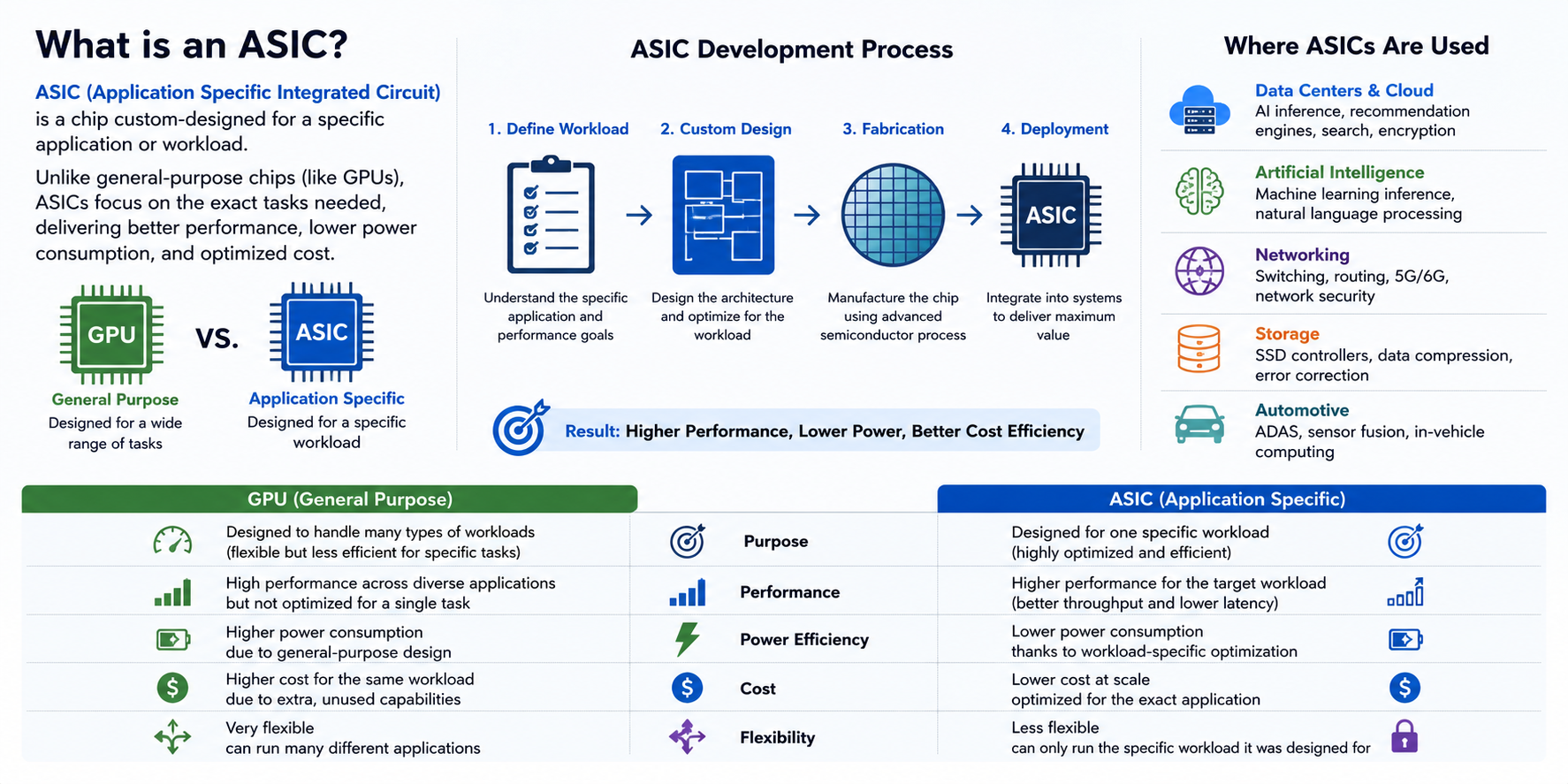
An ASIC is a chip designed specifically for a particular application. Unlike general-purpose GPUs, an ASIC does not need to handle a wide variety of computing tasks. Instead, it is optimized around the customer's specific workloads, enabling a better balance between performance, power consumption, and cost.
For major cloud providers, developing in-house ASICs has become an important trend. For example, AWS has launched the Trainium and Inferentia series of AI chips, Google continues to iterate on its TPUs, and Microsoft has released the Maia AI Accelerator. Although these chips are ultimately marketed under each company's own brand, their development often requires deep involvement from specialized chip design firms.
Marvell plays a key role in this process. The company offers a full range of ASIC design services tailored to customer needs, covering architecture design, high-speed I/O, advanced packaging support, IP integration, and subsequent verification.
Compared to standard chip businesses, custom ASICs offer several distinct advantages.
-
Longer customer collaboration cycles. It typically takes two to three years from initial design to mass production. Once in production, the lifecycle often spans several years, providing relatively stable revenue.
-
Higher customer stickiness. Because ASICs are deeply integrated with the customer's software ecosystem, data center architecture, and supply chain, switching suppliers is costly, making partnerships more durable.
-
Stronger profitability. Although R&D investment is high, the highly customized nature of the products limits price competition, resulting in long-term gross margins that are typically better than those of standardized products.
As global cloud providers continue to increase their AI capital expenditures, the custom ASIC market is expected to keep growing, making it one of Marvell's most important long-term growth drivers.
Why Optical Interconnects Are an Inevitable Direction for AI Cluster Development
If GPUs are the brain of an AI data center, then optical interconnects are its nervous system.
In the past, most servers relied primarily on copper cables for electrical signal transmission. However, as network speeds climb, copper cables face clear limitations.
-
Limited transmission distance. At speeds of 400G, 800G, or even future 1.6T, signal attenuation in copper cables becomes more severe, requiring increasingly complex signal compensation.
-
Rapidly rising power consumption. High-speed electrical interconnects consume significant energy for signal amplification and equalization. In large AI data centers, this energy usage has become a major component of operating costs.
-
High-speed electrical connections are also vulnerable to electromagnetic interference, which can compromise overall stability.
In contrast, optical interconnects offer higher bandwidth, lower latency, lower energy consumption, and longer transmission distances, making them a natural replacement for traditional electrical interconnects.
Marvell has long been active in the optical interconnect space, with products including high-speed DSPs, PAM4 signal processing, optical module controllers, and related chips that cover critical communication links inside AI data centers.
Currently, 400G has become a key deployment standard for large data centers, 800G is rapidly gaining adoption, and 1.6T optical modules are expected to enter commercialization in the coming years. This means the entire industry chain still has significant room for upgrades.
As AI cluster scales continue to grow, optical interconnects are also expanding from inter-data-center connections into racks and even between chips, creating sustained growth opportunities for Marvell.
Why Is CPO Considered the Next-Generation AI Network Architecture
Beyond traditional optical modules, one of the most closely watched new directions in recent years is CPO (Co-Packaged Optics).
In traditional network architectures, switch chips and optical modules are typically deployed separately, requiring high-speed electrical connections for data transmission. As bandwidth increases, these electrical connections not only consume more power but also cause signal loss.
The core idea behind CPO is to package optical components directly with the switch chip, bringing optical signals closer to the computing core. This significantly reduces energy consumption and increases overall bandwidth density.
For future AI superclusters housing tens of thousands of GPUs, this architecture promises to further improve network efficiency.
Marvell has been steadily investing in CPO-related technologies, including high-performance switch chips, DSPs, optical engines, and advanced packaging capabilities, aiming to secure a stronger position in next-generation AI network architectures.
Although CPO is still in the early stages of commercialization, rising data center power consumption has led the market to view it as a key technical direction for future high-speed networks.
How AI Infrastructure Upgrades Drive Marvell's Continued Benefits
The growth in AI computing power brings more than just higher GPU shipments — it drives the simultaneous expansion of the entire infrastructure chain.
As model parameters increase and the number of GPUs grows, data centers must procure more switch chips, optical modules, high-speed network controllers, and interconnect solutions. Each new batch of GPUs typically requires a complete supporting network system. As a result, AI infrastructure investment has evolved from simply purchasing GPUs to system-level construction covering computing, networking, storage, power, and cooling.
Marvell addresses precisely these "non-computing but indispensable" infrastructure areas. As GPU cluster scales expand, network equipment accounts for a growing share of total data center costs, which means the high-speed interconnect market still has significant room for growth.
At the same time, in AI investment and global asset allocation, market participants increasingly rely on cross-market trading capabilities for dynamic rebalancing. For example, the stock trading platform provided by Gate supports 24/7 trading of US, Hong Kong, and Korean stocks, allowing investors to continuously track price movements and capital flows of AI-related assets across different market hours. This enables more flexible participation in the rotation opportunities of the global AI infrastructure cycle.
This mechanism strengthens the global interconnection of the AI industry chain and makes the market pricing of infrastructure companies like Marvell more continuous. Investors can adjust their positions more promptly in response to global AI industry changes, without being limited to a single market's trading hours.
Although all three companies are considered key players in AI infrastructure, their core positions are markedly different.
| Company |
Core Positioning |
Main Products |
Role in AI Industry Chain |
Growth Driver |
| NVIDIA |
AI Computing Layer |
GPU, CUDA software platform, NVLink, DGX systems |
Provides AI computing core |
AI model training and inference demand growth, GPU shipment increase |
| Broadcom |
Networking and Custom ASIC |
Switch chips, network chips, custom ASIC, PCIe switch |
Builds AI data center networking and cloud vendor custom chips |
Hyperscaler cloud vendor capex, high-speed network upgrade, ASIC demand growth |
| Marvell Technology |
High-Speed Interconnect and Connectivity Layer |
Optical interconnects, DSP, switch chips, storage interconnects, custom ASIC |
Connects computing, storage, and networking within AI data centers |
AI cluster scale expansion, optical network upgrade, CPO commercialization, network complexity increase |
NVIDIA is primarily responsible for the AI computing layer, supplying GPUs, the CUDA software ecosystem, and complete AI computing platforms — it is the core provider of AI compute power today.
Broadcom focuses more on switch chips, network infrastructure, and custom ASICs, with deep expertise in enterprise networking and hyperscale cloud data centers, and is a major competitor in the AI ASIC market.
Marvell is more centered on the connectivity layer, including high-speed interconnects, optical networks, DSPs, data center switching, storage interconnects, and custom ASICs.
In simple terms, NVIDIA handles the "compute," while Broadcom and Marvell handle the "connect."
This positioning means Marvell's growth logic does not depend entirely on GPU product cycles. Instead, it benefits more from the overall expansion of AI data centers and the increasing complexity of their networks. As AI clusters continue to scale toward hyperscale, the importance of the connectivity layer is expected to keep rising.
What Challenges Still Exist in the AI Infrastructure Market
Despite the industry's bright long-term prospects, the market in which Marvell operates still faces uncertainties.
The R&D bar for high-speed networking products is extremely high. From advanced process nodes and SerDes technology to high-speed packaging, each generation demands continuous, substantial R&D investment, and the pace of technological iteration is accelerating.
Customer concentration is relatively high. Marvell's main customers are mostly large global cloud service providers, whose capital expenditure cycles directly affect the company's order growth. If the AI investment cycle slows, related revenue may be impacted.
Technology roadmaps also remain fluid. Whether it is the upgrade from 800G to 1.6T or the commercialization of CPO, the entire industry chain must mature in coordination. If new technologies are adopted more slowly than expected, short-term market performance could be volatile.
Competition in the AI infrastructure space is also intensifying. Companies like Broadcom, NVIDIA, and Astera Labs are actively expanding into high-speed interconnects and network chips, ensuring that future competition will remain fierce.
Future Development Directions for Marvell's AI Business
Looking ahead, Marvell's growth focus is likely to center on three areas.
-
Further expanding its custom ASIC business by establishing long-term partnerships with more hyperscale cloud providers, benefiting from the growing demand for AI inference chips.
-
Accelerating the commercialization of optical interconnects and CPO. As AI data center networks continue to upgrade, next-generation high-speed optical networks are expected to become a new growth engine.
-
Driving the platformization of network infrastructure. From switch chips and high-speed interconnects to system-level network optimization, Marvell aims to deliver more comprehensive data center connectivity solutions, rather than just individual chip products.
As AI applications shift from large-scale training to inference deployment, future data centers will place greater emphasis on overall energy efficiency, cost control, and system utilization. Rather than simply boosting GPU performance, the key challenge will be connecting tens of thousands of computing nodes with lower power consumption and higher efficiency — precisely the area where Marvell has long been focused.
Summary
Marvell's value in the AI industry chain lies not in providing computing power directly, but in building the connectivity that enables efficient AI system operation. From high-speed switch chips and optical interconnects to DSPs and custom ASICs, the company covers multiple critical infrastructure links inside AI data centers.
As global AI investment continues, data center construction is shifting from a focus on raw computing power to system-level optimization. The growing importance of network bandwidth, communication efficiency, energy consumption control, and high-speed interconnects has transformed Marvell from a traditional network chip maker into a key player in the AI infrastructure connectivity layer.
Looking forward, as technologies like optical networking, CPO, and custom ASICs continue to mature, Marvell is well-positioned to benefit from the global AI infrastructure upgrade cycle, maintaining long-term growth momentum in the high-speed interconnect and intelligent networking space.