XRP ETF Sees Over $1 Billion in Cumulative Inflows Since November Launch, Driving Institutional Capital Allocation

Last Updated 2026-03-26 19:06:58
Reading Time: 1m
Since debuting in November 2025, the XRP ETF has drawn more than $1 billion in total inflows, breaking the record for crypto ETFs. This article examines the movement of funds, the impact on the market, and emerging trends for the future.

XRP ETF Cumulative Inflows Show Strong Performance
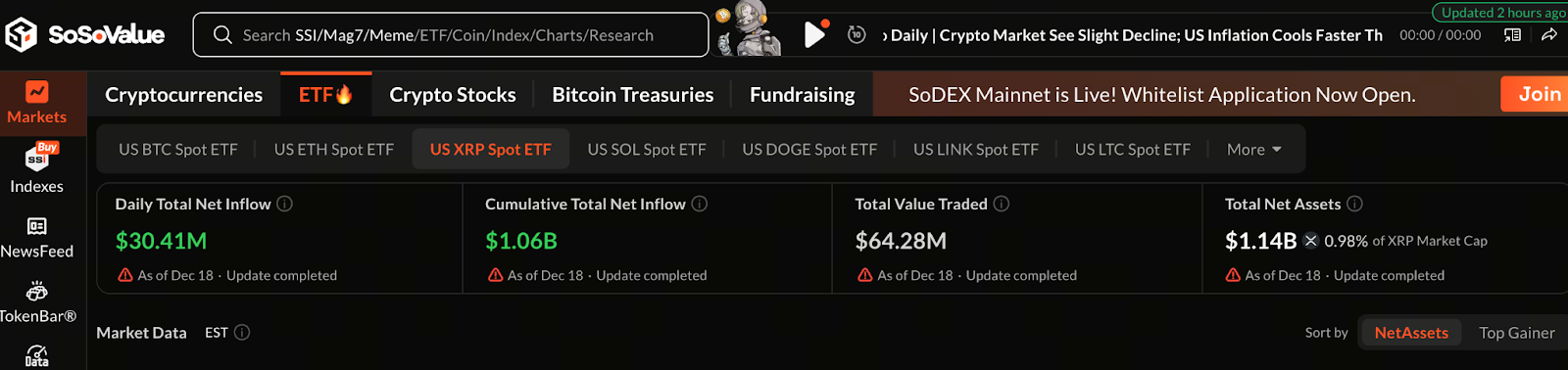

Chart: https://sosovalue.com/assets/etf/us-xrp-spot

In November 2025, the first XRP spot ETFs launched on major U.S. exchanges, drawing immediate and significant market attention. Recent data shows that cumulative capital inflows into XRP ETFs have topped $1.03 billion since listing. Achieving this scale in such a short period highlights strong capital market interest in regulated XRP investment products.

While these inflows still fall well short of those seen by Bitcoin and Ethereum ETFs, the rapid influx is impressive for an alternative crypto asset that has only recently entered mainstream finance. Notably, XRP ETFs have posted consecutive net inflows across multiple trading days, signaling that investors are steadily increasing their allocations rather than making one-off investments.

Why Institutional Capital Is Choosing XRP ETFs

From the institutional perspective, XRP ETFs are attractive primarily for their compliance and risk management advantages.

Unlike directly holding spot tokens, ETFs offer institutional investors a regulated, transparent, and supervised investment channel, reducing complexity around custody, compliance, and operations. ETFs also integrate more seamlessly into traditional asset allocation frameworks, meeting institutional requirements for risk control and auditability.

Furthermore, some institutions still view XRP’s potential in cross-border payments and settlement as part of a long-term strategic narrative. As regulatory clarity improves, the introduction of ETFs fills a previous gap, enabling institutions to allocate to XRP at scale through compliant channels.

Disconnect Between Capital Inflows and XRP Price Performance

Despite sustained ETF inflows, XRP’s price has not experienced a clear, one-sided rally in the short term. Instead, recent price action has remained range-bound, with trends shaped by macro risk sentiment and broader crypto market volatility.

This dynamic suggests that while ETF inflows provide some downside support for XRP, they are not yet sufficient to dictate short-term price trends. Hedging and selling pressure in derivatives markets persist, while some early holders have taken profits during price rebounds, offsetting the impact of new capital to some extent.

As a result, XRP’s current price movement reflects an ongoing tug-of-war between capital inflows and market supply and demand.

Potential Impact of XRP ETFs on Market Structure

From a medium- and long-term perspective, sustained ETF inflows could positively reshape the XRP market:

  • Attracting longer-term capital: Increased institutional participation helps stabilize holdings
  • Reducing liquidity risk: The ETF mechanism’s integration with the spot market helps smooth out short-term volatility
  • Strengthening compliance: Regulated products enhance overall market transparency and institutional acceptance

These developments are expected to gradually transition the XRP market from one dominated by retail traders to a structure with greater institutional participation, laying the groundwork for long-term market growth.

Risk Factors and Key Areas for Continued Monitoring

It’s important to note that, although cumulative inflows into XRP ETFs have surpassed $1 billion, this amount remains modest relative to the overall market and is unlikely to drive decisive price movements in the short term. ETF capital flows are also highly sensitive to market risk appetite and may fluctuate if macroeconomic conditions tighten.

Moreover, XRP’s medium- and long-term performance will depend on several factors, including regulatory developments, shifts in market sentiment, technological evolution, and the broader crypto market cycle.

Conclusion

In summary, sustained inflows into XRP ETFs represent a positive and symbolic signal, demonstrating that institutional investors are gradually building exposure to XRP via compliant channels. However, ETFs primarily signal a shift in market structure and investor composition, rather than serving as a direct catalyst for rapid short-term price gains.

If capital inflows continue to grow steadily and are accompanied by ongoing improvements in market liquidity and depth, XRP’s long-term trajectory could gradually shift onto a more stable and sustainable path.

Author: Max
Disclaimer
* The information is not intended to be and does not constitute financial advice or any other recommendation of any sort offered or endorsed by Gate.
* This article may not be reproduced, transmitted or copied without referencing Gate. Contravention is an infringement of Copyright Act and may be subject to legal action.

Related Articles

AI-Native Settlement Layers: How United Stables Is Building the Next Financial Rail
Beginner

AI-Native Settlement Layers: How United Stables Is Building the Next Financial Rail

Stablecoins were originally designed as dollar substitutes within exchanges, primarily used for asset pricing and trade settlement. As on-chain financial ecosystems have matured, their role has expanded beyond simple payments to include collateral assets, cross-chain liquidity mediums, and unified settlement units. In particular, as AI systems and automated agents begin to participate directly in economic activity, demand has risen sharply for programmable value units capable of instant settlement. This shift is pushing stablecoins toward the role of foundational financial infrastructure.
2026-03-25 03:16:17
The ve(3,3) Flywheel Explained: How AERO Tokenomics Powers Aerodrome’s DeFi Economy
Beginner

The ve(3,3) Flywheel Explained: How AERO Tokenomics Powers Aerodrome’s DeFi Economy

In the competition for DeFi liquidity, high-inflation mining alone is no longer enough to build lasting advantages. Aerodrome applies the ve(3,3) economic model to redesign token emissions, voting mechanisms, and revenue distribution, creating a liquidity flywheel centered on governance and cash flow. This article examines AERO tokenomics, the veAERO locking mechanism, and protocol revenue models to explain how Aerodrome builds a sustainable DeFi economic system.
2026-03-25 06:41:58
How Does PAXG Work? In-Depth Overview of the Physical Gold Tokenization Mechanism
Beginner

How Does PAXG Work? In-Depth Overview of the Physical Gold Tokenization Mechanism

PAXG (Pax Gold) is a tokenized asset backed by physical gold, issued by the fintech company Paxos and traded on the Ethereum blockchain as an ERC-20 token. The core concept is to tokenize physical gold on-chain, with each PAXG token representing ownership of a certain amount of gold. This structure enables investors to hold and trade gold in the form of a digital asset.
2026-03-24 19:12:51
Aerodrome Tokenomics: How ve(3,3) Powers Base's Most Profitable DEX
Beginner

Aerodrome Tokenomics: How ve(3,3) Powers Base's Most Profitable DEX

AERO is the native token of Aerodrome Finance, a core decentralized exchange and liquidity protocol in the Base ecosystem. It is primarily used for liquidity incentives and ecosystem operations. veAERO is a governance NFT that users receive by locking AERO, representing both voting power and the right to share protocol revenue. Through a dual track structure of AERO as a utility token and veAERO as a governance credential, Aerodrome separates liquidity usage value from long term governance power, allowing participants to act as liquidity providers, governance decision makers, and revenue sharers within the same system.
2026-03-25 06:40:31
How is the price of PAXG determined? Pegging mechanism, trading depth, and influencing factors
Beginner

How is the price of PAXG determined? Pegging mechanism, trading depth, and influencing factors

PAXG (Pax Gold) is a tokenized asset backed by physical gold reserves, launched by fintech firm Paxos and issued as an ERC-20 token on the Ethereum blockchain. The core concept is to digitally represent real-world gold assets, allowing investors to hold and trade gold via the blockchain network. Because each PAXG token corresponds to a specific quantity of physical gold, its price is theoretically expected to closely track the global gold market.
2026-03-24 19:11:40
Hybrid Collateral Stablecoins: Inside United Stables' Stability and Yield Architecture
Beginner

Hybrid Collateral Stablecoins: Inside United Stables' Stability and Yield Architecture

In the early stages of the crypto market, traditional stablecoins mainly relied on single-reserve or single-collateral models. Their primary focus was price stability and payment convenience, which allowed them to become foundational tools for on-chain trading and capital flows. As the market has entered a more mature financial phase, however, this structure has begun to reveal limitations, including high concentration risk and the difficulty of balancing liquidity with yield. These constraints have driven the evolution toward multi-layer collateral and portfolio-based designs, such as the dual-layer hybrid collateral architecture proposed by United Stables, which seeks to redefine the underlying logic of stable assets.
2026-03-25 03:17:39





