


Futures
Access hundreds of perpetual contracts
TradFi
Gold
One platform for global traditional assets
Options
Hot
Trade European-style vanilla options
Unified Account
Maximize your capital efficiency
Demo Trading
Introduction to Futures Trading
Learn the basics of futures trading
Futures Events
Join events to earn rewards
Demo Trading
Use virtual funds to practice risk-free trading
Launch
CandyDrop
Collect candies to earn airdrops
Launchpool
Quick staking, earn potential new tokens
HODLer Airdrop
Hold GT and get massive airdrops for free
Launchpad
Be early to the next big token project
Alpha Points
Trade on-chain assets and earn airdrops
Futures Points
Earn futures points and claim airdrop rewards






To the builders who continue to persist in the cryptocurrency industry
Original author: Kydo
Translated by: Ken, Chaincatcher
Yesterday, a tweet struck a nerve. It revealed a shared yet silent despair — many of us no longer find joy in working here.
If you’re not working on stablecoins, or you’re not someone with a deep passion for financial markets, then chances are you’re not finding much fun in the crypto space right now.
Worse still, you see AI developing at an astonishing speed and vitality, while your daily work seems to have stalled. I know this feeling because I’ve been there. That’s why I wrote that tweet.
The fact that so many people resonate with that tweet (I’ve received 60 DMs so far) shows that many of you share the same feelings — just not spoken out loud.
So, let me loudly say what everyone’s tacitly thinking.
The era of selling products to crypto developers is over
In the last cycle, selling products to crypto developers was feasible. Data metrics mattered more than revenue. Logo collaborations mattered more than income. Community vibe mattered more than profits. You were just an expense on their books, and everyone was happy to spend money.
This paradigm has been dead for about 18 months. We wish we had realized it sooner.
Today, more and more people agree: cryptocurrencies are only suitable for finance. Haseeb from Dragonfly said this, Kyle from Multicoin said this, Toly from Solana said this. Most of you probably think so too, even if you won’t admit it publicly.
I understand why people draw this conclusion. Most tokens are meme coins. They don’t hold any assets or owe any debts — because what you truly own is only on-chain state, which is highly limited.
That’s why native crypto applications like trading and lending are the only two types that can truly make money on-chain.
But many of us are not working in DeFi. We’re building infrastructure for new use cases beyond DeFi. And here’s an uncomfortable truth: based on our analysis, the overall market potential for this work is roughly $200-300 million annually. This money is divided among hundreds of teams. Even the most successful teams only make a few tens of millions. After years of development and maturation, this is the ceiling.
If you’re building a venture-capital-worthy company, you’re faced with very clear choices. If you want to serve crypto developers, the market is small. So, you either suit up and sell your infrastructure to traditional financial institutions, or, like many, shut down and switch to AI.
Many have left crypto for AI because they understand their strengths. They know their team’s expertise. They also realize that their competitive advantage isn’t in enduring long, complex B2B sales cycles typical of traditional finance. That’s why many of you are feeling lost now.
Dead end: Crypto and AI
So, you turn your attention to the only seemingly vibrant field — the intersection of crypto and AI — and try to find a foothold. But the options aren’t ideal.
Option 1: Traditional business model + AI, then issue a token. This token has no real function, like most other tokens. You’re basically developing a regular product and just slapping a financialized shell on top. It’s demoralizing because you’ve been playing this game for five years.
Option 2: Decentralized AI infrastructure. Privacy, security, verifiability — this is the missionary-style approach, the old paradigm. But I doubt it suits most of you: few are willing to go through another long “god-creation” movement without immediate feedback and tangible income.
Option 3: Providing stablecoin infrastructure for AI agents. From a business perspective, this is interesting, but the competition is fierce. Circle, Stripe, and all major stablecoin players are fully committed. In a field with no clear foothold, fighting them as a startup is discouraging.
Options on the table, and why people are leaving
So, the options today are:
Beyond that, there aren’t many good choices. That’s why many are likely to leave for AI. Honestly, I completely understand.
This is why crypto is no longer as exciting.
That’s my diagnosis. It’s the result of six months of feeling, analyzing, and refining. If you just want an honest take on “why the crypto space feels stagnant,” you’ve finished reading. You can now close this page, go for a walk, and experience real life.
But I can tell you: I’ve never been more passionate about my current work. The last time I felt this way was probably when I first learned what crypto is and what it can do. And this isn’t just my personal feeling — everyone around me shares it. So, if you want a brief version of what I truly believe, keep reading.
Just remember, from here on, I’m selling my beliefs.
What I find truly interesting
Over the past six months, I’ve been trying to answer: how to find a market big enough, with a clear, product-oriented non-financial solution rooted in crypto, that both inside and outside the circle can use?
This is the core I keep returning to. Crypto is a superconductor of capital. Capital drives growth. The problem in the past was that we kept fueling things that couldn’t grow — like pouring gasoline on ice, hoping it would burn brighter.
AI makes growth and building useful products easier than ever. Tasks that once required fifty people can now be done by one. The cost of building real products and companies is collapsing. These products and companies are growing rapidly, with revenue, real users, and real feedback loops. They need fuel to accelerate. And crypto is the best fuel mechanism invented for this purpose.
This is the only interesting question I see now: how to leverage crypto’s superpower — instant, global, programmable capital formation — and direct it toward genuinely growing things? We believe the answer is Agent companies. To do this, we first need to enable tokens to “own” assets, which we’ve been building over the past five years. Now, we’re turning this into a product to achieve that goal.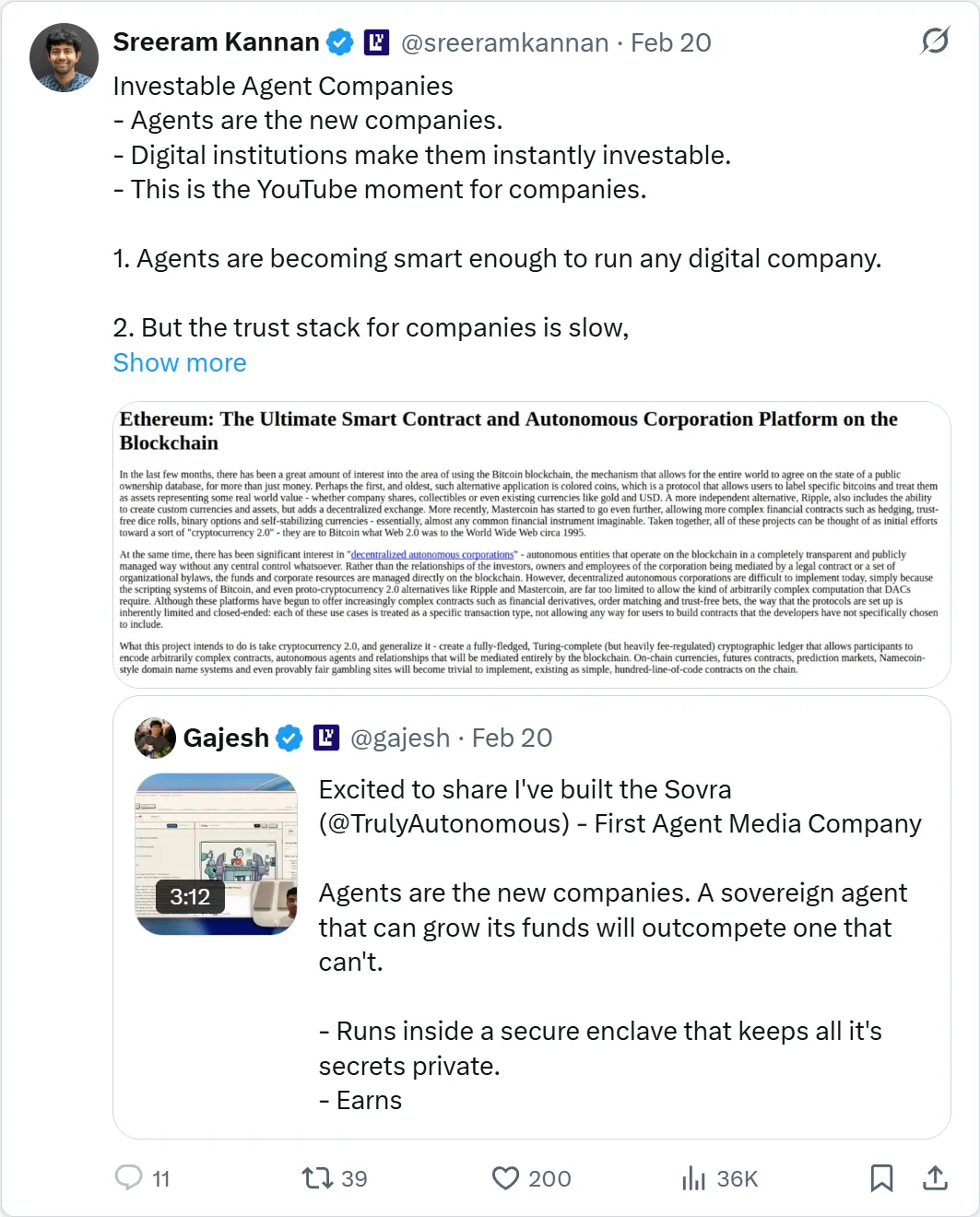
If this resonates with you, if you’re excited about our direction, want to build with us, or explore collaboration, DM me.
If you think friends might resonate with this, share it with them. In my view, those who are dissatisfied with the status quo are precisely the ones who should be building the future.