湘江河畔重相逢

vip
Age 0.3 Yıl
Crypto Market Researcher
Peak Tier 5
No content yet
$SIREN Smash it quickly. What are you waiting for? Finish selling off this one. Then move on to the next plate to keep playing.
SIREN-11,95%
View Original
  • Reward
  • Comment
  • Repost
  • Share
Now that so many are buying the dip to go long, I can confidently have already secured my short position. 🥰🥰🥰😂😂😂😂😂😂😂😂
SIREN-11,95%
View Original
  • Reward
  • Comment
  • Repost
  • Share
$STO Don't mess with Gouzhuang. My heart 🫀 can't take it anymore.
STO-3,53%
View Original
  • Reward
  • Comment
  • Repost
  • Share
$STO Gou Zhuang, don’t pull anymore, I want to get off.
STO-3,53%
View Original
  • Reward
  • 1
  • Repost
  • Share
平淡无奇的心态:
What price level triggers liquidation?
$STO Damn it, it's over. So many empty people. Pump group, are they going to push the price up?
STO-3,53%
View Original
  • Reward
  • Comment
  • Repost
  • Share
#Gate金手指 Personal hourly reward cap: 191.33 EDGEX
• This is the maximum reward you can earn per hour.
Converted to a daily reward cap:
191.33 × 24 = 4591.92 EDGEX
Additionally, the hourly pool cap is 765.3 EDGEX, which is the overall pool distribution limit. Personal rewards will not exceed 191.33 EDGEX/hour.
EDGEX10,09%
View Original
  • Reward
  • 1
  • Repost
  • Share
Macroeconomic Outlook: Expectations of Fed rate cuts are rising, Middle East geopolitical risks are easing, global risk appetite is recovering, and the crypto market is broadly rallying, with ETH showing greater resilience.
• Market Funds: ETH spot ETF funds have shifted from outflows to inflows, with institutional accumulation; total stablecoin holdings have reached new highs, and off-chain funds are ample.
• On-Chain Fundamentals: Staking ratio exceeds 30%, ETH balances on exchanges are continuously decreasing, circulating supply is shrinking; active RWA and Layer 2 ecosystems support long-t
ETH2,68%
View Original
post-image
  • Reward
  • 5
  • 1
  • Share
GateUser-07665dcd:
4 years of ETH killer discourse. Hundreds of L1 launches. Billions in VC funding.
Ethereum went from ~60% TVL dominance to… 57%
View More
Ryakpanda
#创作者冲榜 Web3 Today’s Must-Read | March 30
Today’s Quick Overview
• Hacker claims to have leaked data from 1.5 million bn accounts.
• The US CLARITY Act may ban DeFi token dividends.
• Ethereum plans to build an “economic zone” to unify L2 fragmentation.
• US lawmakers reach a framework agreement on stablecoin yield distribution.
• Canadian legislation bans political donations in cryptocurrencies.
• Crédit Agricole launches 6 crypto ETN products.
• MicroStrategy appears to have interrupted its 13-week consecutive accumulation.
• Geopolitical tensions spike Bitcoin to $67,000.
• World Foundation discounts and sells $65 million worth of WLD.
• Jensen Huang’s endorsement expectations boost Bittensor ecosystem surge.
Today’s Analysis
The market signals today are very strange. If you piece together these ten fragmented news items, you’ll uncover a chilling truth: regulators are conducting a targeted crackdown on “profit rights” in cryptocurrencies. Washington and traditional financial giants are no longer satisfied with just collecting trading fees—they’re targeting the core underlying logic of DeFi and the entire on-chain ecosystem—value capture.
The real main event is in the seemingly mild-named “CLARITY Act.” Analysis from 10x Research points out a critical flaw: once enacted, this bill could directly ban DeFi protocols from distributing yields to token holders.
What does this mean? It means that most DeFi protocols currently operating with narratives of “dividends” or “buybacks and burns” could have their tokens instantly rendered worthless legally, or be forced into the dead end of “securitization.”
Even more interestingly, meanwhile, the US Senate has reached a consensus on stablecoin yield distribution. The underlying logic is clear: decentralized, privately managed yield distribution will be suppressed, while regulated, traditional banking-compatible yield sharing will be legalized. This isn’t regulation; it’s clearing the field, fencing off the lucrative pastures, allowing only the “formal army” in suits to graze.
At this critical juncture, traditional financial giants are acting swiftly. Crédit Agricole has launched six crypto ETN products, essentially grabbing the entry channels for retail and institutional investors. While the native crypto giants are still overwhelmed by the PR crisis of leaking data from 1.5 million accounts, traditional banks are packaging crypto assets into familiar, trusted financial products through compliance shells. This “decentralized assets, centralized channels” trend is accelerating, even causing MicroStrategy, which has been aggressively buying, to seemingly pause its 13-week streak of accumulation. Saylor’s pause may not just be because prices are high but also because he senses a shift in the wind: when compliance costs and regulatory barriers reach heights that ordinary projects can’t even dream of, the game rules in crypto have changed.
Even more intriguing is World Foundation’s move. When WLD’s price hit rock bottom, they chose to sell at a steep discount—this “cut losses to survive” stance is less about raising operational funds and more about a strategic retreat from the current tokenomics model. When the AI sector can still be boosted by Nvidia CEO Jensen Huang’s vague praise to lift Bittensor’s ecosystem, we must realize that the market now lacks intrinsic motivation, relying solely on riding the coattails of old money flows and macro geopolitical tremors to keep its heartbeat.
Web3 is now in a painful “liquidity migration” phase. Ethereum developers propose establishing an L2 “economic zone” to address fragmentation—essentially a defensive move, trying to lock in the shrinking liquidity behind their walls through technical means. But the end of this logic is brutal: if a regulatory hammer like the CLARITY Act really falls, all technical optimizations will be powerless in the face of legal “cutting off financial channels.” The future winners are likely not the most technically skilled geeks but those who can quickly reconfigure protocols to meet “American compliance” standards—professional speculators. Stop focusing on those vague technical narratives; see who is defining yield, because whoever does will define the next cycle.

repost-content-media
  • Reward
  • Comment
  • Repost
  • Share
BTC1,08%
Ryakpanda
Can gold prices return to $5,000 today? | Gold Price Trend Analysis for the Next 15 Days
1. Gold News Analysis
1. Middle East Situation Fully Escalates, Short-term Signs of Relief Are Unlikely
Last Saturday (March 28), Yemen's Houthi forces launched their first direct attack since the current conflict with Israel began, immediately announcing the start of a second round of military operations using cruise missiles, drones, and powerful ballistic missiles aimed directly at key facilities in southern Israel. This move marks the official involvement of the Houthis, aligning directly with Iran and the regional "Resistance Front," significantly increasing the risk of broader geopolitical conflict. Houthi spokesperson Yahya Saree stated clearly that subsequent actions would continue until the US and Israel "stop the aggression." Israel's Defense Forces quickly responded, saying they are prepared for full-scale response and warning that any attack will come at a cost. Meanwhile, the US-Iran confrontation is also escalating. Washington has dispatched two batches of thousands of Marines to the Middle East and plans to deploy soldiers from the 82nd Airborne Division, with officials preparing for ongoing ground operations against Iran that could last several weeks, pending final decisions by President Trump. Iran responded strongly, declaring US and Israeli military and political officials' residences legitimate targets. On the evening of March 29, Tehran experienced two large-scale airstrikes within ten minutes, damaging some power transmission facilities and causing power outages in multiple areas. The Israeli military claimed the strikes aimed to disrupt Iran's weapons production capabilities. Currently, the Middle East conflict is intense, with multiple parties involved, making short-term de-escalation unlikely. The situation remains highly uncertain and is the primary factor influencing gold's safe-haven sentiment.
2. Bull and Bear Factors Offset, Gold Rises and Falls
Influenced by the escalation in the Middle East, during the Asian trading session on March 30, spot gold initially surged to $4,514.42 per ounce but then quickly retreated, falling to around $4,460 per ounce at the time of writing, a nearly 1% decline intraday.
The core reason for gold's rise and fall is the strong offset between bullish and bearish factors:
- Bullish support: Geopolitical escalation drives safe-haven buying, providing a support floor for gold prices.
- Bearish pressure: The conflict pushed US crude oil prices to jump over 3% to $103.38 per barrel (a three-week high), heightening inflation concerns, which dampens expectations for Federal Reserve rate cuts. This, in turn, boosts the US dollar index for five consecutive days, which rose briefly by 0.17% to 100.33 (a new high since March 16). A strong dollar directly suppresses gold prices.
In short, safe-haven sentiment attempts to push gold higher, while a strong dollar exerts downward pressure. The fierce tug-of-war between these forces is the main reason why gold remains in a volatile, non-trending range.
2. Brief Outlook on Gold Price Trends for the Next 15 Days
Over the next 15 days, gold is likely to remain within a broad range with no signs of a trend reversal at this stage:
1. Short-term (1-5 trading days): Core range of $4,380–$4,520 per ounce, with potential volatility driven by unexpected news. Resistance clearly at the $4,500–$4,520 zone; key support at the $4,400 level.
2. Medium-term (6-15 trading days): Core range of $4,350–$4,600 per ounce. Unless there is an unexpected geopolitical escalation, the trend is likely to continue oscillating weakly. If risks intensify, prices may test resistance levels at $4,602 and $4,735, but a strong trend reversal remains unlikely.
Short-term Key Observation Zones for Gold
• Support zone: Focus on $4,415–$4,420, which is the short-term dividing line between bulls and bears, with particular attention to the critical risk level at $4,405.
• Resistance zone: Focus on the high of $4,550 on Friday. A breakout above this level could lead to further resistance in the $4,550–$4,600 range. Longer-term resistance levels are at $4,602, $4,735, and $4,750.
All content in this article is for market analysis and financial knowledge dissemination only and does not constitute any investment advice or operational guidance!
repost-content-media
  • Reward
  • Comment
  • Repost
  • Share
AlleyLittleOverlord
#创作者冲榜
ETH In-Depth Review: The Critical 2000 Level, Institutional Dark Pool Battles and Extreme Sentiment
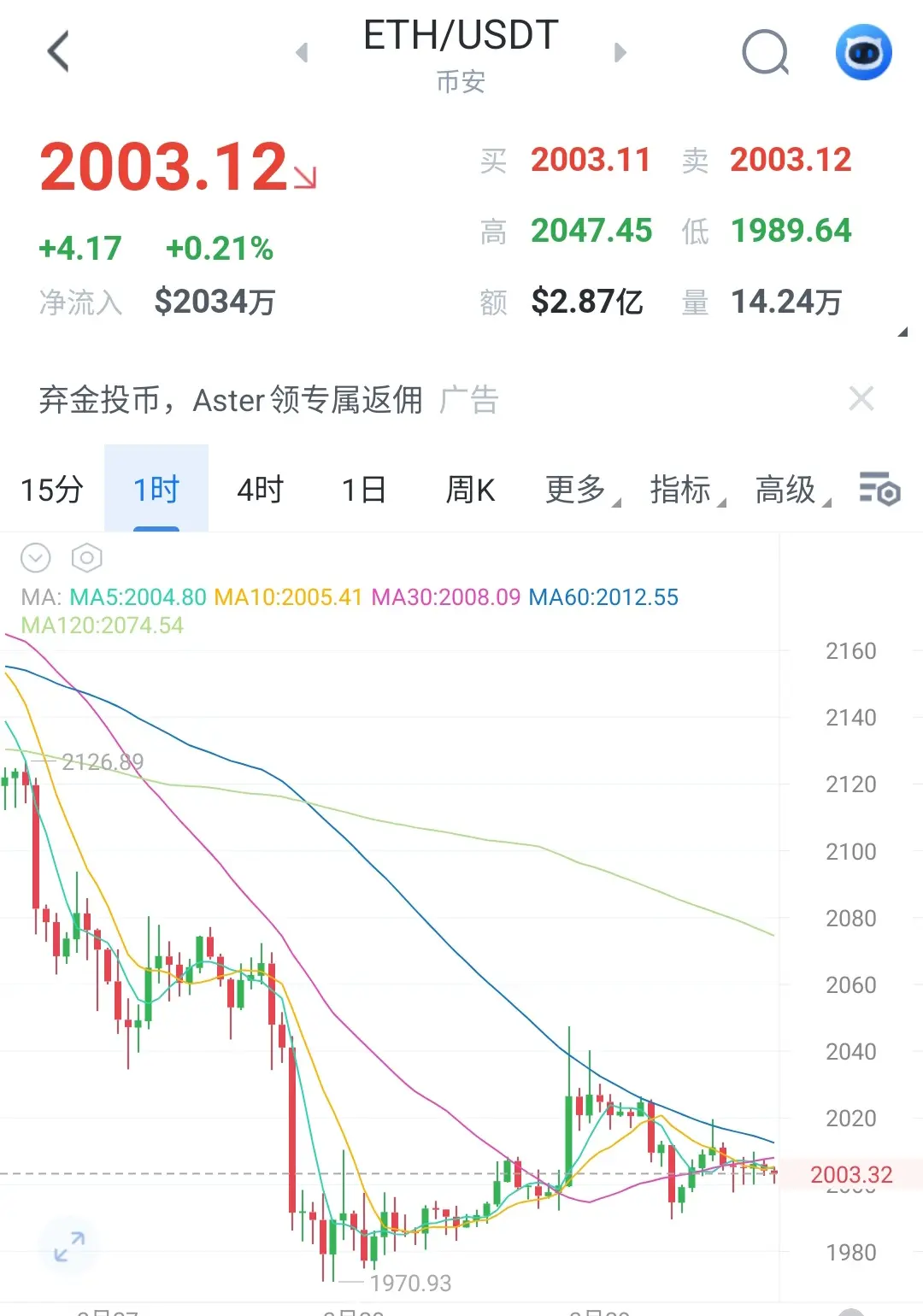
Currently, ETH is trading at 2,003 USDT, barely holding the key 2000 mark, but the medium-term structure remains weak.
Over the past 7 days, it has fallen about 6.9%, with a 90-day total decline exceeding 32%, clearly weaker than BTC, with risk-averse funds favoring Bitcoin. The 24-hour increase is only 0.19%, again underperforming BTC's 0.49%, indicating the bearish pattern persists.
Technical Analysis: Downtrend not broken, but oversold signals are dense
On 4-hour and daily charts, moving averages show a clear bearish alignment: MA7 < MA30 < MA120, and ADX indicates the downtrend is ongoing.
However, key reversal signals have appeared:
- 4-hour MACD shows bullish divergence at the bottom, with price making new lows but momentum recovering.
- Daily CCI and WR indicators have entered oversold zones simultaneously.
The trend remains bearish, but downward momentum is weakening. A reversal window is approaching, but this does not mean an immediate turnaround—more like "it can't fall further, but it hasn't gained strength to rise yet."
Liquidation Risk: Dual-sided heavy pressure
Below, over 600 million USD in long positions are clustered around 1912 USDT, and a break below could trigger a waterfall decline.
Above, nearly 560 million USD in short positions are waiting around 2110 USDT, ready to be liquidated.
Both bulls and bears are waiting for a big K-line to determine the direction.
Market Sentiment: Extreme panic but not entirely hopeless
The current Fear & Greed Index is only 9, entering extreme panic territory.
Negative sentiment towards ETH is at 47%, positive only 38%, with a bearish public opinion.
Market focus is on ETF outflows and large early holdings being sold off.
An overlooked positive signal:
Stablecoins and user activity are beginning to flow back from L2 to the Ethereum mainnet. L2 enthusiasm has temporarily cooled, and the core status of the main chain is being re-emphasized.
Summary:
ETH's current state is clear: the trend is bearish, but sentiment is at full tilt, oversold conditions are stacking, and institutions are quietly accumulating.
This is not an immediate surge signal but a zone where prices are stuck, bottoming out, with the potential for a violent rebound at any time.
2000 is not the bottom, but it is very likely the psychological price for this mid-term correction!
repost-content-media
  • Reward
  • Comment
  • Repost
  • Share
Vice President Vance stated that "withdrawal from Iran will happen soon," which the market interprets as a de-escalation of conflict and a rebound in risk appetite.
• Cryptocurrency markets are most sensitive to geopolitical sentiment, with BTC/ETH rebounding in sync; ETH is relatively stronger.
II. Technical analysis: rebound after oversold conditions
• After the sharp drop on March 27, 120,000 traders were liquidated across the network, totaling $446 million, with high-leverage shorts exiting en masse.
• Price rebounded from the two-week low of $65,997 (BTC), with ETH recovering in tandem.
BTC1,08%
ETH2,68%
View Original
  • Reward
  • Comment
  • Repost
  • Share
Ryakpanda
#创作者冲榜 BTC falls below 66K. What is the essence of this round of decline?
Summary
1. BTC retreated from above 70K to around 66K this week, officially breaking below the consolidation center, indicating a weakening structure.
2. Cumulative liquidation volume this week approached $1 billion, leverage has significantly contracted, and deleveraging is accelerating.
3. ETF outflows continued + exchange net inflows expanded. The core driver of this decline is capital withdrawal.
I. Weekly Market Structure Review
BTC (core asset)
• Weekly high: approximately $71,000
• Weekly low: approximately $65,400
• Current price: approximately $66,000
Structural change: consolidation → breakdown → confirmation of weakness
Key levels:
• Resistance above: $70,000
• Support below: $65,000 (XAUT as safe-haven anchor)
• Weekly range: about 4,500, maintaining high-level oscillation without synchronized decline
Weekly structure summary: 👉 The decline stems from internal crypto deleveraging rather than macro risk shocks.
II. Capital and Leverage Overview
1️⃣ Liquidation Data
• Total liquidations this week: approximately $1 billion
• Peak daily: over $400 million, with clear long squeeze
2️⃣ Open Interest (OI)
• BTC: about $32 billion → $30 billion (continuously decreasing)
• ETH: decreasing in tandem
Active withdrawal of leveraged funds
3️⃣ Funding Rates
• BTC: rapidly fell from positive to near zero
• ETH: long-term near zero
Long position appetite has clearly diminished
4️⃣ ETF & Institutional Funds
• BTC ETFs: continuous net outflows for multiple days
• Institutional behavior: reducing positions + increasing cash holdings
Market lacks incremental capital support
III. On-Chain and Market Behavior
• Exchange BTC net inflow: significantly increased
• Stablecoins: no obvious expansion
• Whales: increased selling pressure mainly through transfer and consolidation > new capital entering
IV. Key Events This Week
1. BTC broke key support level (around 68K)
2. Long liquidation concentrated release (over $400 million in a single day)
3. ETF continuous net outflows suppress the market
4. Miners showed selling behavior
5. Large options expirations triggered volatility
6. Market makers adjusted positions around major pain points
7. ETH trend significantly weaker than BTC
8. Altcoins’ overall liquidity deteriorated
9. Market risk appetite rapidly declined
10. Macro uncertainties intensified emotional volatility
V. Core Logic Breakdown
This decline is not a “sudden negative news,” but a structural issue:
1️⃣ Excessive leverage → Passive clearing. During the previous rally, funds kept increasing leverage through contracts, making the market extremely fragile.
2️⃣ ETF capital shift → Incremental inflow disappears
Continuous ETF outflows imply: 👉 No one is taking the high-position chips
3️⃣ Selling pressure release → Passive price decline
Increased exchange net inflows fundamentally mean: 👉 Someone is actively selling coins 👉 The ultimate result: price drops = leverage liquidations + capital withdrawal stacking
VI. Next Week Market Scenarios
Scenario 1 (Main Path: Consolidation digestion): If:
• BTC holds above $65,000, the market will: → Enter a $65K–$70K consolidation zone → Wait for capital re-entry
Scenario 2 (Risk Path: Further decline): If:
• Breaks below $65,000, the market will: → Test $62K or lower → Trigger a second round of deleveraging
Key indicators to watch:
• Whether ETF outflows stop
• Whether OI continues to decline
• Whether liquidations increase again
VII. Summary 👉
The current market is in a mid-term deleveraging + structural weakening phase. It is not the start of a “bear market,” but also definitely not a “safe zone for bottom fishing.”
repost-content-media
  • Reward
  • Comment
  • Repost
  • Share
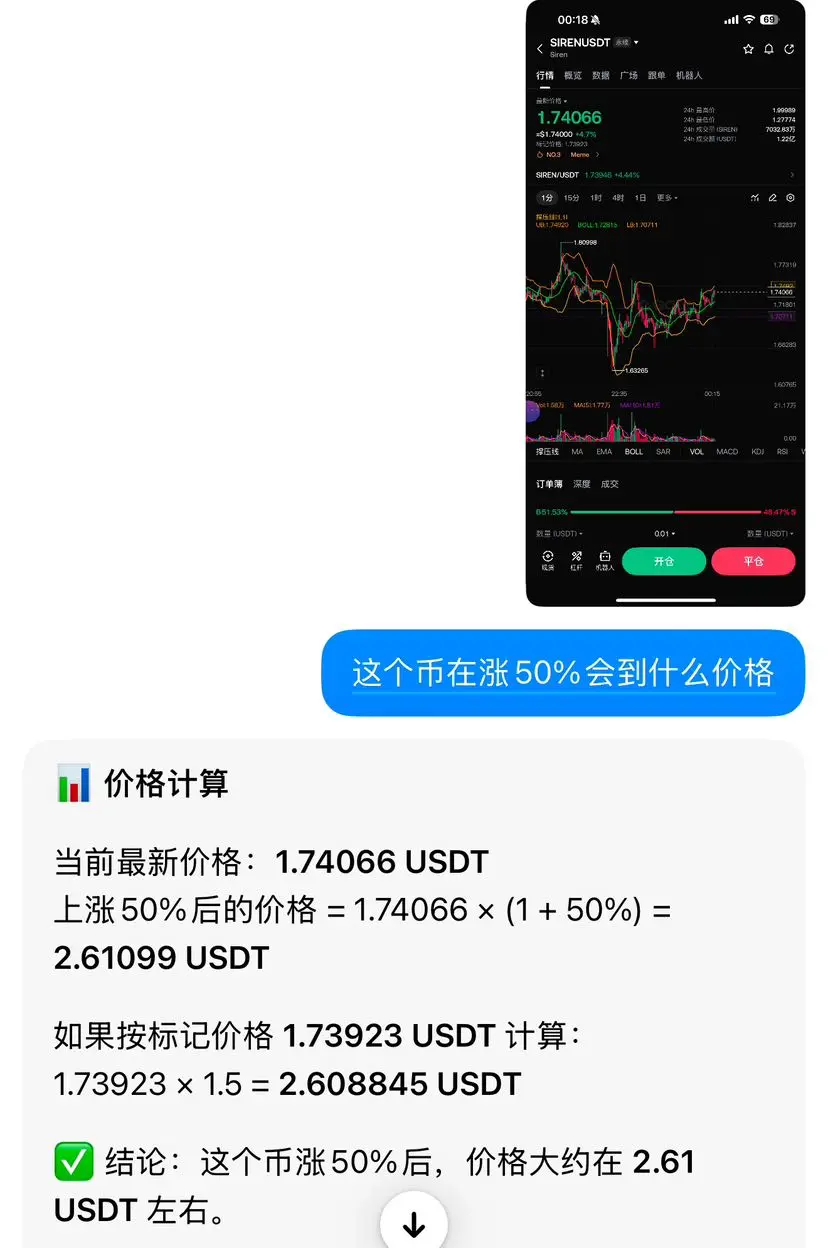
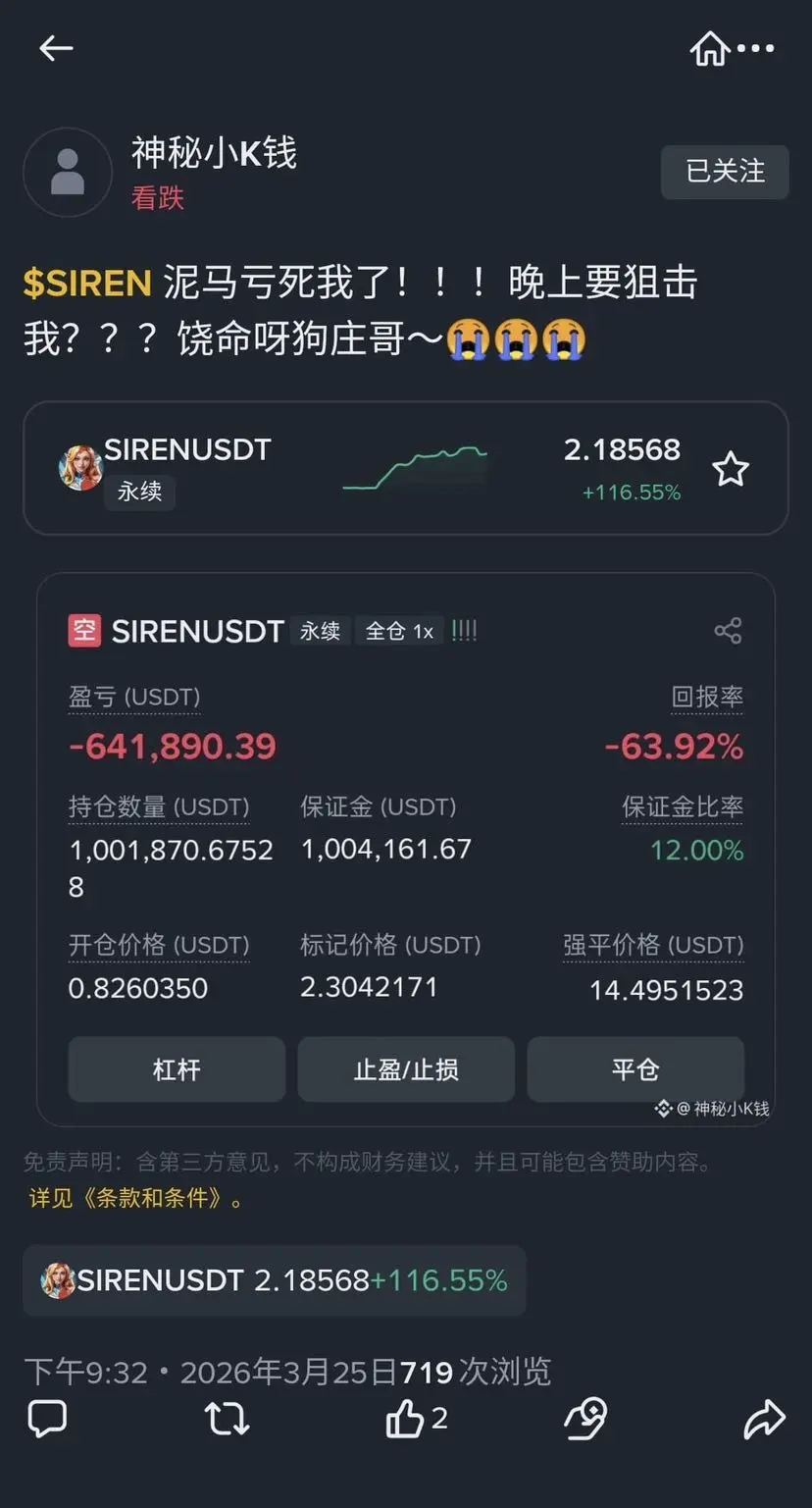
$SIREN Current latest price: 1.74066 USDT
Price after a 50% increase = 1.74066 × (1 + 50%) = 2.61099 USDT
If calculated based on the marked price of 1.73923 USDT:
1.73923 × 1.5 = 2.608845 USDT
✅ Conclusion: After a 50% increase, the price of this coin is approximately around 2.61 USDT.
At this level, you can take a small position and short it.
SIREN-11,95%
View Original
post-image
  • Reward
  • Comment
  • Repost
  • Share
$M , what kind of coin is this? It’s been stuck for so long. Is it that hard?
M4,01%
View Original
  • Reward
  • Comment
  • Repost
  • Share
Most Likely Time Window (2026)
Based on the overall cycle, macro signals, on-chain data, and institutional signals, Q2 2026 (April–June) is the most probable window for ETH to enter a bull market.
• Key Anchor Point: Approximately 500 days after Bitcoin halving in April 2024, falling between late March and mid-April 2026.
• Secondary Window: The second half of 2026 (July–December), when rate cuts, ETF approvals, and upgrades align, increasing the likelihood.
🧩 Key Conditions for Bull Market Initiation (Must Have)
1. Macro Liquidity (Most Critical)
• Federal Reserve Rate Cuts: High probability
ETH2,68%
BTC1,08%
RWA2,16%
View Original
  • Reward
  • 1
  • Repost
  • Share
湘江河畔重相逢:
Make a fortune in the Year of the Horse 🐴
TangHuaBanzhu
Ark Invest, founded by Cathie Wood, continued to significantly reduce holdings in tech stocks such as NVIDIA on Friday.
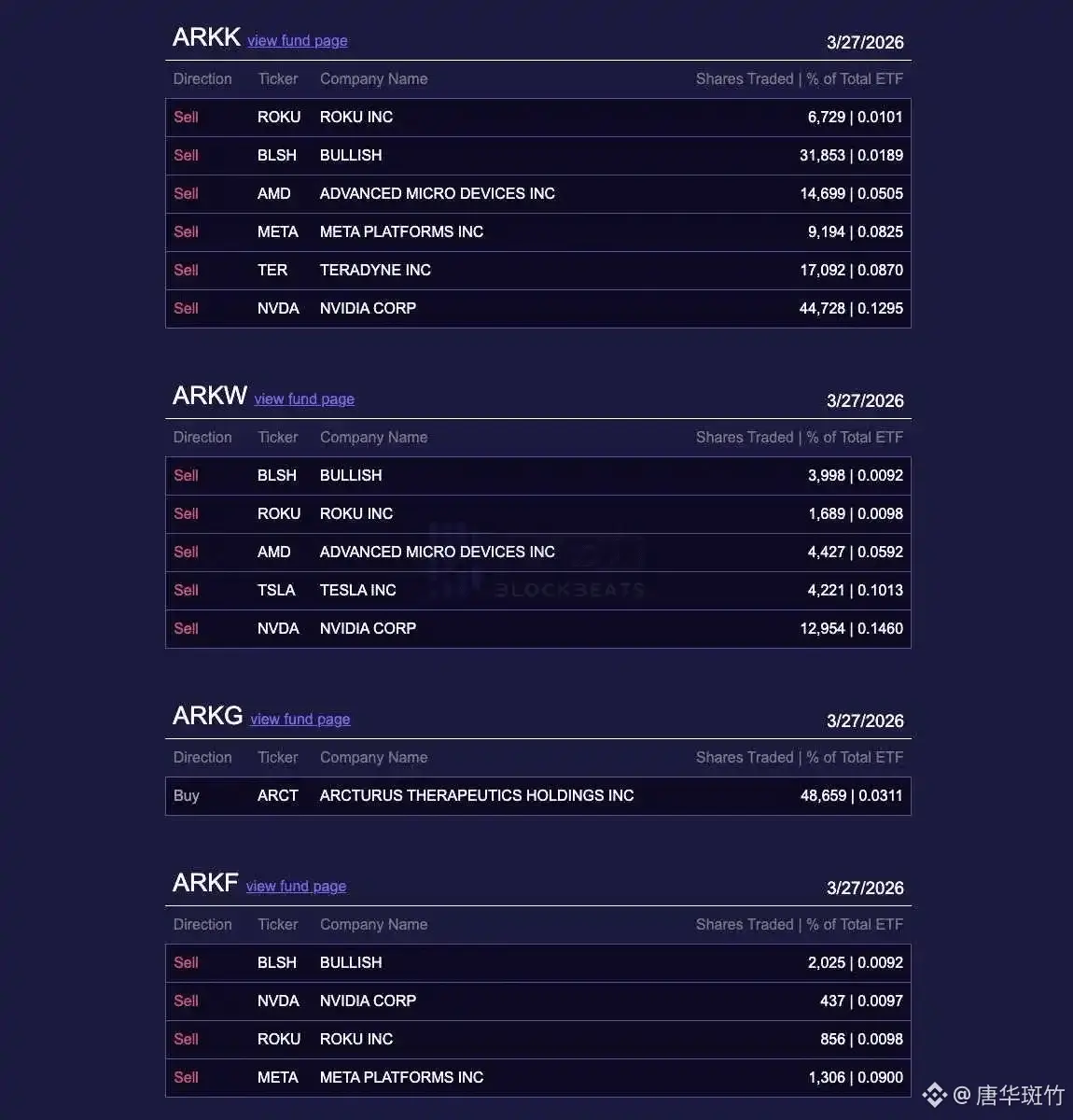
On March 28, according to Ark Invest Tracker, after a large-scale sell-off of tech stocks and crypto ETFs on Thursday, Ark Invest further cut its positions in NVIDIA and other tech stocks on Friday.
This included selling over 58,000 shares of NVIDIA and more than 19,000 shares of AMD, accounting for approximately 0.1%-0.15% of the fund's total value. The fund only bought 48,600 shares of biotech company Arcturus Therapeutics, indicating a shift from AI chip reductions toward medical innovation.
From this information, it appears that Ark Invest, under Cathie Wood, is undergoing a significant rebalancing of its assets. The core of this operation is a systematic reduction in tech stocks, especially giants in the AI chip sector like NVIDIA and AMD, while also sharply decreasing exposure to crypto assets, including Bitcoin ETFs (ARKB) and Coinbase (COIN) stocks. This sell-off is not an isolated event but part of a series of recent actions, suggesting a well-considered strategic adjustment.
Market timing is intriguing. Just before the reduction, Cathie Wood publicly stated that the market was filled with "extreme fear" and believed it was a good time to buy volatile stocks. This statement contrasts sharply with her selling activity, indicating she believes these popular tech stocks and crypto assets may already be fully or even overvalued at the moment, with short-term risk-reward no longer attractive. She is taking profits and reallocating funds into innovation sectors she perceives as having greater potential and that are not yet fully priced by the market.
This behavior is typical of active ETFs. As a fund manager focused on high-growth, high-risk innovative sectors, her portfolio usually maintains high turnover to actively capture explosive opportunities across different fields. Therefore, this rebalancing should not be simply interpreted as a long-term bearish signal on tech or crypto industries but rather as a tactical retreat and repositioning based on short-term valuations, market sentiment, and opportunity costs. It reflects an investment strategy aiming to balance the enormous potential of disruptive innovation with the short-term market overheating. $ETH
{future}(ETHUSDT)
repost-content-media
  • Reward
  • Comment
  • Repost
  • Share
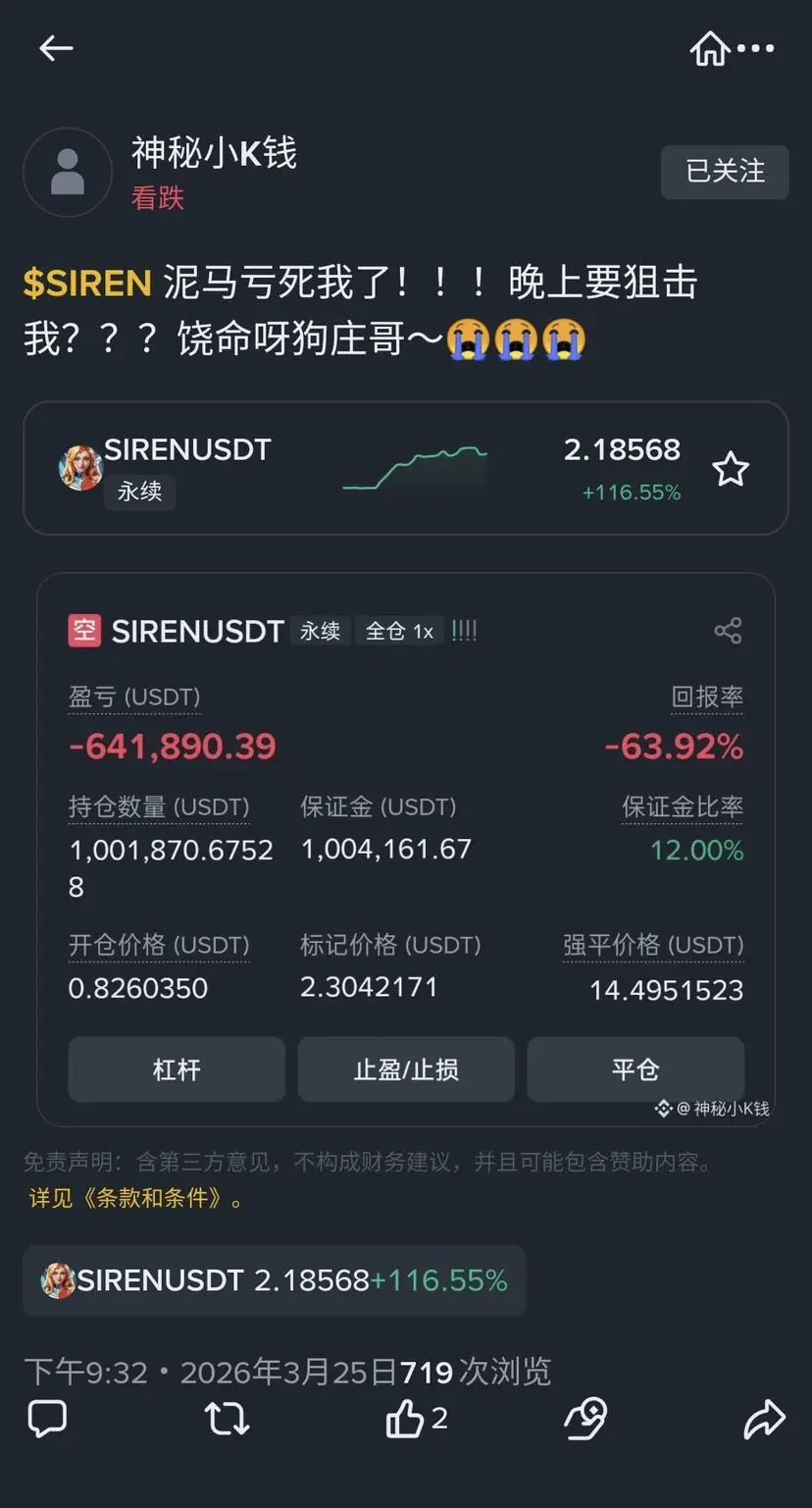
$SIREN Major holder liquidation price $15💲.
SIREN-11,95%
View Original
post-image
  • Reward
  • 8
  • Repost
  • Share
Korean_Girl:
To The Moon 🌕
View More
$SIREN Seeing this chart, I’d better be honest and just place a short order at $15 😂
SIREN-11,95%
View Original
post-image
  • Reward
  • 2
  • Repost
  • Share
Korean_Girl:
To The Moon 🌕
View More
  • Reward
  • 3
  • Repost
  • Share
Korean_Girl:
To The Moon 🌕
View More
$SIREN This dealer keeps letting me arbitrage quite a bit
SIREN-11,95%
View Original
  • Reward
  • Comment
  • Repost
  • Share
  • Pin