Summary
-
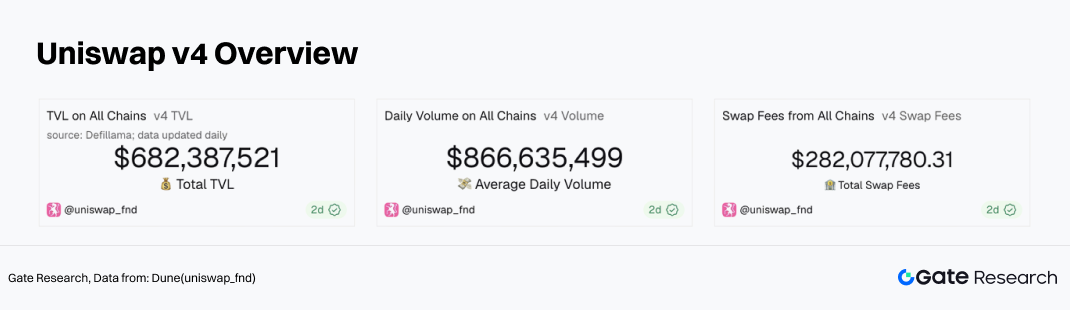
Uniswap V4 Hooks have evolved from a foundational technical innovation into a key driver of ecosystem growth. Uniswap V4's total value locked (TVL) has reached $682 million, cumulative trading volume has surpassed $422 billion, and the number of initialized Hooks has exceeded 41,000.
-
By embedding custom logic at critical stages of a liquidity pool's lifecycle, Hooks enable developers to implement features such as dynamic fees, custom pricing curves, MEV protection, and onchain content generation, accelerating Uniswap's transition into a programmable liquidity platform.
-
Since April, a wave of innovative projects, including uPEG, SATO, and Slonks, has emerged within the ecosystem. Hook use cases have expanded beyond trading into areas such as onchain collectibles, fair launches, and AI-generated content, further driving the convergence of DeFi with content, social, and creator economies.
-
While Hooks demonstrate significant long-term potential, challenges including smart contract security risks, market volatility, regulatory uncertainty, and the performance constraints of increasingly complex Hooks remain key considerations for the ecosystem's continued expansion.
Since its official launch on January 30, 2025, Uniswap V4's flagship innovation, Hooks, has evolved from a technical experiment into a major growth driver for the DeFi ecosystem. Over the past two months, Hook-based projects such as uPEG, SATO, and Slonks have seen rapid growth, prompting exchanges to launch dedicated listings and contributing to significant increases in both onchain TVL and trading activity. According to data from the Uniswap Foundation, Uniswap V4's TVL has reached $682 million, cumulative trading volume has surpassed $422 billion, and average daily trading volume stands at $870 million. The number of initialized Hooks has exceeded 41,000, while Hooked Pools account for approximately 15% to 20% of total trading volume.
This report examines how Hooks are reshaping the liquidity experience through dynamic mechanisms, content generation, and social-driven interactions. Starting with the underlying concepts, it analyzes the wave of innovation that emerged in April 2026, combining onchain data, market performance, user case studies, and risk assessments to explore the role of Hooks as a new engine connecting DeFi with the creator economy.
I. Background
1.1 The Evolution of DeFi Liquidity
Since 2020, DeFi liquidity infrastructure has undergone several major paradigm shifts, progressing from Uniswap V1's constant product market maker model (x*y=k), to V2's support for ERC-20 trading pairs, and later to V3's concentrated liquidity framework. The launch of Uniswap V4 in January 2025 introduced the Singleton architecture, Flash Accounting, and the Hooks plugin system, marking a transition from a protocol governed by fixed rules to a programmable liquidity platform.
Hooks allow developers to inject custom logic at eight critical stages of a pool's lifecycle, including before and after Initialize, Add Liquidity, Remove Liquidity, Swap, and Donate events. This architecture enables features such as dynamic fee models, limit orders, custom pricing curves, and even onchain asset generation without requiring modifications to the core protocol.
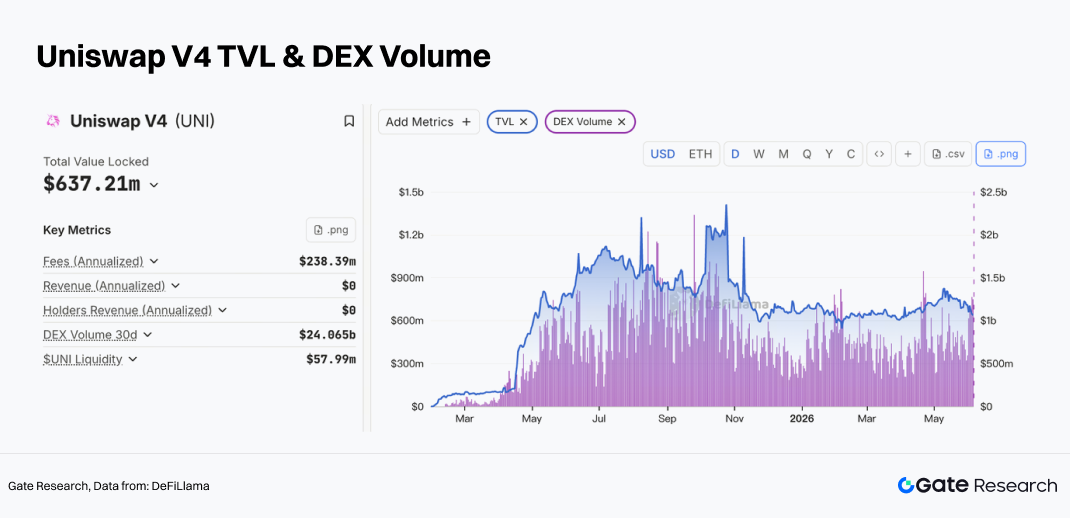
Beginning in April 2026, the Hooks narrative entered a period of rapid expansion. Major exchanges launched dedicated V4 Hooks trading sections, while social media influencers and crypto communities actively discussed projects such as uPEG, SATO, and Slonks. Several Hook-based tokens quickly surpassed $100 million in trading volume. According to DefiLlama, Uniswap's total TVL stands at approximately $2.99 billion, with V4 contributing around $637 million, representing more than 20% of the protocol's liquidity. Over the past 30 days, Uniswap V4 has processed more than $24 billion in DEX trading volume, accounting for roughly 60% of Uniswap's total volume. Innovation driven by Hooks has become a focal point for both retail traders and institutional participants.
1.2 Market Momentum and Core Thesis
Over the past two months, Hook-based projects have seen substantial growth in both TVL and trading activity. SATO has generated cumulative trading volume of $737.5 million, while Slonks recorded a 60x increase in floor price within a relatively short period.
The key innovation behind Hooks is their ability to transform liquidity into an experience through programmability. In traditional DeFi, liquidity providers primarily act as passive capital suppliers. In the Hooks era, LPs become active participants in a growing plugin economy, giving rise to new categories of assets and interactions, including onchain collectibles, bonding curve launches, AI-generated art, and other programmable digital experiences.
To some extent, Hooks have evolved beyond a technical extension of Uniswap. They are emerging as a new engine that brings together DeFi and creative expression through content generation, social engagement, and NFT-like experiences. Looking ahead to the second half of 2026, Hooks could reshape both asset issuance and liquidity provisioning, accelerating DeFi's transition from a utility-focused financial system into a platform-centric and entertainment-driven ecosystem.
II. Uniswap V4 Hooks: Core Concepts
2.1 Definition and Architectural Innovation
Hooks are programmable liquidity plugins in Uniswap V4. They are external smart contracts that can be attached to individual liquidity pools and execute custom logic at key points throughout a pool's lifecycle. The core interfaces include:
-
beforeInitialize / afterInitialize
-
beforeAddLiquidity / afterAddLiquidity
-
beforeRemoveLiquidity / afterRemoveLiquidity
-
beforeSwap / afterSwap
-
beforeDonate / afterDonate
The architectural innovations introduced in Uniswap V4 significantly expand the potential of Hooks.
Unlike Uniswap V1 through V3, where each liquidity pool required its own dedicated smart contract deployment, V4 adopts a Singleton architecture. All pool states are managed by a unified PoolManager contract. This design eliminates redundant deployment costs, reducing pool creation expenses by as much as 99% compared with V3 while substantially improving routing efficiency and multi-hop execution.
More importantly, V4 introduces Flash Accounting. In traditional AMMs, adding liquidity, executing swaps, or removing liquidity requires multiple ERC-20 token transfers, resulting in higher gas costs and increased execution risk. Flash Accounting replaces this model with a net balance settlement approach, where only the final balance changes are settled at the end of a transaction. For example, the protocol records the net inflows and outflows of token0 and token1 before and after a swap, while all intermediate calculations take place in memory. Combined with the Singleton architecture, Flash Accounting enables native ETH support and significantly reduces overall gas consumption. According to official benchmarks and community testing, standard swap operations can reduce gas costs by more than 50% compared with V3, with even greater savings in complex multi-hop transactions.
V4 also introduces the Unlock callback mechanism to ensure transaction atomicity and correctness. External contracts must first invoke Unlock, perform all pool interactions within the callback, and settle balances only after execution is complete. This design minimizes the risk of exposing intermediate states during execution.
Compared with Uniswap V3, Hooks represent a fundamental leap in extensibility. V3's core innovation was tick-based concentrated liquidity, which significantly improved capital efficiency. However, its rules remained largely fixed. Fee tiers were limited, pricing strictly followed the constant-product formula, MEV protection relied on external solutions, and dynamic adjustments or native integrations were difficult to implement. Developers seeking additional functionality often had to fork the protocol or deploy separate contracts, making innovation costly and difficult to iterate.
V4 takes a fundamentally different approach. Hooks allow developers to introduce virtually any custom logic without modifying the core PoolManager contract. Examples include MEV protection through private swaps and limit orders, dynamic fee adjustments, custom pricing curves, and even onchain asset generation. While the immutability of Hooks requires rigorous testing and security audits prior to deployment, it also guarantees deterministic pool behavior and reduces governance-related risks after launch.
At its core, this design transforms Uniswap from a standalone AMM into a programmable liquidity infrastructure platform, laying the foundation for deeper integration between DeFi and the creator economy.
2.2 Core Advantages and Typical Use Cases
The greatest value of Hooks lies in their high degree of customizability, allowing liquidity pools to evolve in real time based on market conditions, user demand, or specific application scenarios.
-
Dynamic Fee Mechanisms: Traditional AMMs use fixed fee rates, whereas Hooks can dynamically return an lpFeeOverride value within beforeSwap based on real-time volatility metrics (calculated through Chainlink oracles or TWAP), gas prices, or even external data sources. This enables intelligent fee adjustment, increasing fees during periods of high volatility to protect LPs while lowering fees during calmer periods to attract trading activity.
-
Custom Pricing Curves: Developers can override the standard constant-product formula within beforeSwap to implement advanced pricing models such as bonding curves, stable-swap mechanisms for low-slippage stablecoin trading, or TWAMM (Time-Weighted Average Market Maker), further expanding the range of possible pool designs.
-
MEV Protection: Hooks can implement private order flow, limit-order execution, or rebate distribution mechanisms through beforeSwap, allowing a portion of the MEV traditionally captured by searchers to be redistributed to LPs or the protocol.
-
External Integration Capabilities: Hooks also enable powerful integrations, such as embedding KYC gating for compliance-based access control, NFT minting logic, or cross-protocol routing calls, creating seamless connections between DeFi, GameFi, and SocialFi applications.
To better understand how Hooks operate, it is useful to examine them through the lifecycle of a liquidity pool.
-
Pool Initialization: When a developer calls initialize, the beforeInitialize Hook is triggered first, allowing the Hook to validate PoolKey parameters, including currency0, currency1, fee, tickSpacing, and the Hook address, as well as configure initial state variables or inject additional data. Once initialization is complete, afterInitialize can be used to record events, distribute launch incentives, or establish onchain references.
-
Liquidity Operations: When users add or remove positions, beforeAddLiquidity and beforeRemoveLiquidity perform validation checks such as position-size limits or risk-parameter verification. After execution, afterAddLiquidity and afterRemoveLiquidity can trigger LP rewards, update user points, or generate dynamic NFT credentials.
-
Swap Execution: Swaps represent the most active Hook environment. beforeSwap can calculate custom pricing, adjust fees, and return deltas that affect execution outcomes. afterSwap can then perform content generation, such as uPEG's pixel-art rendering, distribute social incentives, or allocate protocol fees.
-
Donation Functions: beforeDonate and afterDonate support use cases such as protocol revenue redistribution and charitable donations. The entire process remains highly atomic and efficient.
In practice, Hooks have already enabled a wide range of compelling use cases. Dynamic fee Hooks can automatically increase fees during periods of extreme market volatility, helping reduce impermanent loss for LPs while lowering fees during quieter periods to attract greater trading activity. Onchain asset-generation Hooks, as demonstrated by uPEG, trigger SVG rendering logic during every swap, generating unique pixel-art unicorns based on predefined integer balance thresholds and transforming liquidity provision into a collectible and creative experience. Bonding-curve launch Hooks use custom pricing models to enable fair launches and self-deprecating issuance mechanisms. SATO provides a notable example, automatically halting token minting once supply reaches a predefined threshold, preventing unlimited dilution and strengthening community trust.
Together, these use cases illustrate the core philosophy behind Hooks. Liquidity is no longer a passive pool of capital but a programmable "experience engine." Developers can quickly get started using OpenZeppelin's BaseHook framework, conduct unit testing with Foundry, optimize designs through the Uniswap Foundation's Hook Design Lab, and deploy securely using HookMiner. As a result, Hooks not only reduce gas costs and development overhead but also unlock entirely new possibilities for DeFi innovation in 2026, accelerating the transition of protocols from financial infrastructure into creative platforms.
2.3 Ecosystem Support
In 2025, the Uniswap Foundation launched the Hook Design Lab and Incubator programs, providing technical mentorship, milestone-based grants, and audit subsidies to support Hook developers. In April 2026, the launch of the Hooks Marketplace further expanded the ecosystem, while developer tools such as OpenZeppelin libraries and emerging data standards like Hook Events lowered the barrier to entry for building and deploying Hooks.
As of June 2026, nearly 20,000 deployers have initialized more than 41,000 Hooks across the Uniswap V4 ecosystem.
III. Case Studies of Innovation
Following the rapid expansion of the Hooks narrative after April 2026, a number of standout projects emerged across the ecosystem. The following case studies examine their mechanisms, growth drivers, and market performance.
3.1 uPEG (Unipeg)
uPEG represents one of the most notable examples of onchain programmable collectibles built on Uniswap V4 Hooks. Officially launched on April 16, 2026, the project centers around the custom Hook-powered ERC-20 token $uPEG, which has a fixed maximum supply of 10,000 tokens and is intrinsically linked to a collection of 24×24 pixel unicorn artworks.
Unlike traditional NFT projects that rely on IPFS or centralized storage solutions, uPEG utilizes fully onchain SVG rendering. Whenever a swap occurs within the liquidity pool, the Hook contract generates a hash that encodes information such as image layers, color attributes, and the original holder. An onchain renderer then immediately reads this data and dynamically assembles a unique piece of pixel art. Integer token balances, such as 1, 8, or 37 tokens, correspond to specific image activation thresholds, while fractional balances remain dormant until trading activity pushes them across the next threshold. This design transforms liquidity provision itself into an ongoing creative process, allowing users to acquire collectible experiences naturally through DeFi activity without the need for separate minting transactions.
From an innovation perspective, uPEG combines dynamic mechanics with content generation. The integer-threshold activation model creates both scarcity and surprise, turning every swap into an act of artistic creation and transforming passive liquidity into an interactive creative experience. At the same time, the project blurs the boundary between DeFi and NFT-like experiences. Holding $uPEG effectively grants ownership of a programmable collectible without requiring a separate NFT contract, significantly reducing both user friction and gas costs. This concept of "liquidity as collectibles" serves as one of the clearest demonstrations of the creative potential enabled by Hooks.
In terms of market performance, uPEG experienced rapid growth following launch. Within two weeks, its market capitalization surpassed $34 million at its peak, while cumulative trading volume exceeded $120 million. On April 28, a public purchase by OpenSea's CMO triggered an additional wave of speculation, contributing to a short-term price increase of more than 300% and pushing daily trading volume into the multi-million-dollar range. Although the project later entered a correction phase, by early June its market capitalization had stabilized at approximately $6 million, with daily trading volume around $500,000. Despite significant price volatility, community engagement remained strong. Token ownership gradually became more decentralized over time, while floor-price performance and long-term returns continued to demonstrate notable resilience. Onchain data also showed a high proportion of Hook-driven swap activity, highlighting the mechanism's effectiveness in sustaining trading engagement.
User experiences further illustrate the project's appeal. One early holder wrote on X, "Every swap creates my own unicorn. It's a level of fun that DeFi has never offered before." Social sharing became a powerful growth driver, with many users adopting their generated pixel-art creations as profile pictures or meme content, further amplifying visibility across the ecosystem. The significance of uPEG lies in its ability to transform ordinary LPs from passive capital providers into onchain creators. In doing so, it offers a compelling example of how Hooks can fundamentally reshape the user experience within DeFi.
3.2 SATO
SATO is one of the leading examples of how Hooks can be used to innovate asset issuance and token economic design. Launched in mid-April 2026, the project positions itself as a fully onchain, fair-launch experimental token. Its core mechanism utilizes a custom Hook to implement a bonding curve pricing model while introducing a self-deprecation mechanism. Once token supply reaches 99% of its maximum allocation, the contract automatically triggers the selfDeprecated variable onchain, permanently halting further minting without requiring governance votes or external intervention. This design addresses the unlimited dilution commonly associated with meme tokens and experimental assets, while enhancing transparency and community trust.
The project's innovation is primarily reflected in two areas. First, it introduces transparent onchain economics. Token pricing is determined entirely by a Hook-defined bonding curve rather than the traditional AMM constant-product formula, enabling a smoother issuance process and a fairer launch mechanism. Second, it combines fair-launch principles with strong social and degen participation dynamics. The launch attracted a large number of Uniswap V4 enthusiasts and bonding curve traders, creating a highly community-driven growth cycle. SATO emphasizes transparency and sustainability in token economics, providing a strong complement to uPEG's focus on visual content generation.
Following launch, SATO rapidly grew from a relatively small market capitalization to a peak valuation exceeding $40 million. The Sat1 Hook (SATO Style) has generated cumulative trading volume of approximately $737.5 million, with around $10 million in volume over the past seven days and roughly $700,000 over the past 24 hours. Despite significant volatility, SATO has successfully attracted both degen traders and institutional attention as one of the earliest examples of Hook-based economic innovation, establishing itself as a benchmark for the fair-launch narrative within the Uniswap V4 Hooks ecosystem.
3.3 Slonks and Other Notable Examples
Slonks (SLOP), launched on May 1, introduced an AI image-generation model of just 22.7 KB based on a transformer architecture directly into a Hook contract, enabling fully onchain AI-generated artwork. Following launch, the project's floor price increased by 60x within six days, while daily trading volume briefly surpassed that of established NFT collections such as CryptoPunks. The Slop Hook has generated cumulative trading volume of approximately $17.1 million. Users can fractionalize associated NFTs into SLOP tokens or redeem NFTs by burning SLOP. Fees collected by the Hook are used to repurchase assets and replenish inventory, creating a self-contained economic loop.
Additional projects further demonstrate the versatility of Hooks. Doppler and Angstrom focus on MEV protection and dynamic fee Hooks, establishing leadership positions in both TVL and trading activity. Other projects combining AI and NFTs have expanded Hook applications into areas such as GameFi and RWA-related use cases.
Taken together, these projects highlight the breadth of the Hooks ecosystem. From visual content creation in uPEG, to economic experimentation in SATO, to AI-powered creativity in Slonks, they showcase multiple dimensions of the convergence between DeFi and the creator economy. Through custom Hook logic, each project embodies the core principle of "liquidity as experience." uPEG, SATO, and Slonks transform what would otherwise be routine swap activity into artistic creation, economic participation, or AI-driven interaction, breaking down the traditional boundaries between gaming, NFTs, and DeFi. The resulting social virality has further accelerated adoption, demonstrating that Hooks are more than a technical extension. They are emerging as a key catalyst behind the platformization and entertainment-driven evolution of DeFi.
IV. How Hooks Are Reshaping the Liquidity Experience
The significance of Uniswap V4 Hooks lies in their ability to fundamentally redefine liquidity and the way users interact with it. In traditional DeFi, liquidity providers (LPs) are largely passive participants who earn fees by supplying capital. In the Hooks era, LPs become active contributors to a broader plugin ecosystem and direct participants in the experiences built around liquidity.
4.1 Dynamic Mechanisms
One of the most immediate advantages of Hooks is their ability to introduce dynamic adjustments on a per-swap basis. Within the beforeSwap Hook, custom fees (lpFeeOverride) can be returned in real time and adjusted based on volatility metrics derived from Chainlink oracles or TWAP calculations, gas prices, or other external data sources.
This stands in sharp contrast to the fixed fee tiers of Uniswap V3. During periods of elevated volatility, fees can automatically increase to help reduce impermanent loss for LPs. During quieter market conditions, fees can be lowered to encourage trading activity and improve competitiveness. At the same time, MEV rebate mechanisms can redistribute a portion of searcher profits back to LPs, further improving capital efficiency. In practice, dynamic fee Hooks have significantly enhanced the performance of certain pools and contributed to the growing share of trading activity occurring on Uniswap V4.
4.2 Content Generation
Onchain rendering represents one of the most unexpected breakthroughs enabled by Hooks. In the case of uPEG, every swap triggers the generation of SVG-based pixel art. Slonks goes even further by embedding an entire AI model directly into a smart contract, enabling the onchain recreation of iconic images such as CryptoPunks.
This approach eliminates reliance on IPFS and enables fully decentralized, programmable digital assets. As a result, the boundaries between DeFi, gaming, and NFTs begin to disappear. Liquidity provision is no longer merely about supplying capital to a pool. It becomes a process of content creation and value co-creation, offering users a level of immersion that was previously unavailable within DeFi.
4.3 Social Participation
Hooks also introduce a strong social and community-driven dimension to liquidity. SATO-style bonding curve launches combined with community participation mechanisms enable fair launches and automatic issuance caps. Trading activity can trigger NFT minting, point-based reward systems, or peer-to-peer marketplace interactions, further strengthening user engagement and encouraging viral growth.
Developers can monetize their innovations through Hook fees, while users actively participate in an emerging plugin economy. Together, these incentives create a positive feedback loop in which liquidity, participation, and community growth reinforce one another.
V. Potential Risks and Challenges
While Hooks demonstrate significant potential, their increasing complexity also introduces a range of risks that investors, developers, and users should carefully consider.
The highly customizable nature of Hook logic significantly expands the attack surface. Potential vulnerabilities include reentrancy attacks, delta manipulation, and permission bypass exploits. Developers must adhere to rigorous security practices, including the use of OpenZeppelin's BaseHook framework, formal verification tools such as Certora, and comprehensive security audits. The Uniswap Foundation has also emphasized the importance of multiple rounds of testing prior to deployment to ensure protocol safety.
High volatility is a defining characteristic of many Hook-based projects. While early participants may generate returns of several dozen times their initial investment, speculative bubbles and liquidity depletion are equally common. Corrections of more than 50% within a seven-day period are not unusual, as demonstrated by projects such as uPEG. Investors should therefore approach the sector with caution rather than chasing short-term momentum.
- Regulatory and Adoption Challenges
Compliance concerns surrounding MEV-related mechanisms, the educational barrier for new users, and the immutable nature of Hooks, where logic cannot be modified after deployment, all present potential obstacles to adoption. Regulatory uncertainty may also affect broader market acceptance, particularly among institutional participants.
Although Flash Accounting significantly improves gas efficiency, complex Hooks may still encounter performance bottlenecks under high-load conditions. In addition, data standards and cross-chain compatibility remain areas that require further ecosystem-wide coordination and standardization.
VI. Outlook and Conclusion
6.1 Trend Outlook
As the market moves into the second half of 2026, Hooks are increasingly positioned to become a standard component of the Uniswap V4 ecosystem. More projects at the intersection of DeFi and the creator economy are expected to emerge, spanning areas such as AI-generated art, social DAO governance, and dynamic pricing curves for RWAs.
The launch of the Hooks Marketplace in April 2026, combined with a $500 million incentive program, is expected to further accelerate the development of the plugin economy. Uniswap's position within the broader DeFi landscape is likely to strengthen, with V4 potentially accounting for more than 80% of total Uniswap trading volume. Meanwhile, Layer 2 solutions such as Unichain are expected to facilitate broader cross-chain adoption of Hooks and expand their addressable market.
6.2 Opportunities and Recommendations
-
For Developers: Take advantage of programs such as Hook Design Lab and the Incubator to build differentiated Hooks, participate in ecosystem incentive initiatives, and create a direct path from technical contribution to economic rewards.
-
For Investors: Focus on projects with strong mechanism design, high user engagement, and healthy onchain fundamentals. Long-term value creation should take precedence over short-term hype.
-
For Users: Participate directly in Hook-enabled pools to experience emerging forms of "liquidity as entertainment," while maintaining disciplined risk management and leveraging social participation to enhance engagement and potential upside.
6.3 Conclusion
Uniswap V4 Hooks are driving DeFi beyond its origins as a purely financial tool and toward a more platform-oriented and experience-driven ecosystem. As one of the most important growth catalysts in the 2026 DeFi landscape, Hooks are not only improving liquidity efficiency through programmability but also introducing a new layer of creativity that reshapes both user experiences and asset issuance models.
Projects such as uPEG, SATO, and Slonks have already demonstrated the potential of this new paradigm. The emerging plugin economy may represent the narrative that the crypto market has been searching for during a prolonged period of stagnation. The future of Hooks is no longer a theoretical possibility. It is already beginning to take shape.
Source:
-
Dune:https://dune.com/uniswaplabs/V4-launch-metrics-tracker
-
DeFiLlama:https://defillama.com/protocol/uniswap-V4
-
Uniswap V4:https://v4.uniswap.org/
(Click below to access the full report)
Gate Research is a comprehensive blockchain and cryptocurrency research platform that provides deep content for readers, including technical analysis, market insights, industry research, trend forecasting, and macroeconomic policy analysis. Disclaimer Investing in cryptocurrency markets involves high risk. Users are advised to conduct their own research and fully understand the nature of the assets and products before making any investment decisions. Gate is not responsible for any losses or damages arising from such decisions.