The AI industry has shifted from "piling up data" to demanding high-quality, traceable, and vertical-scenario-specific data. Traditional centralized annotation models now grapple with high costs, difficulty fulfilling long-tail requirements, and contributors missing out on data value. Token-incentivized crowdsourcing platforms aim to tackle pain points like opaque incentives, free-riding, and hard-to-quantify quality with on-chain rules. AGT is Alaya AI's productized version of this approach, and its design directly impacts data supply sustainability, community retention, and whether projects Alaya AI are willing to pay long-term fees.
From a Web3 + AI integration perspective, AGT also serves as the "settlement and permission layer" for model tokenization coordination, multi-chain user access, and open data platform operations. Below, we detail AGT's core uses, allocation and incentive structure, role in the data contribution system, community growth mechanisms, why crowdsourcing relies on tokens, value drivers, investment risks, and long-term potential, giving readers a structured framework for evaluating the growth logic of the Alaya AI data ecosystem.
Per Alaya AI's official docs, AGT has three main roles: access & coordination, contribution & governance, and ecosystem circulation.
For access & coordination, users must stake AGT to participate in data verification, auto-labeling model development, submit custom data requests, list data package offerings, and handle higher-tier data calibration tasks. The official docs stress: AGT staking offers no passive returns or deposit interest—it works like a sunk cost in Proof of Stake, curbing malicious labeling and low-quality volume farming while unlocking high-leverage tasks to reward high-impact contributors.
For contribution & governance, completing training tasks, hitting milestones, and joining platform activities earn AGT directly. Holding and staking AGT also grants DAO voting rights—e.g., on auto-labeling feature priorities and platform proposals. The NFT system consumes AGT at specific levels and interval upgrades, and together with Medallions, determines eligibility for professional AI training tasks.
For ecosystem circulation, AI model developers can create AGT reward pools for custom data needs; the community can fund specific model fine-tuning via AGT staking pools. The platform pledges to use data service revenue to buy back AGT and feed it back into user reward pools, sustaining the "contribute—earn—reincentivize" business loop.
Additionally, the AGT Redemption mechanism, active since 2025, lets users convert task-earned AIA credits into AGT within monthly quotas, creating a regular cadence between task activity and token distribution.

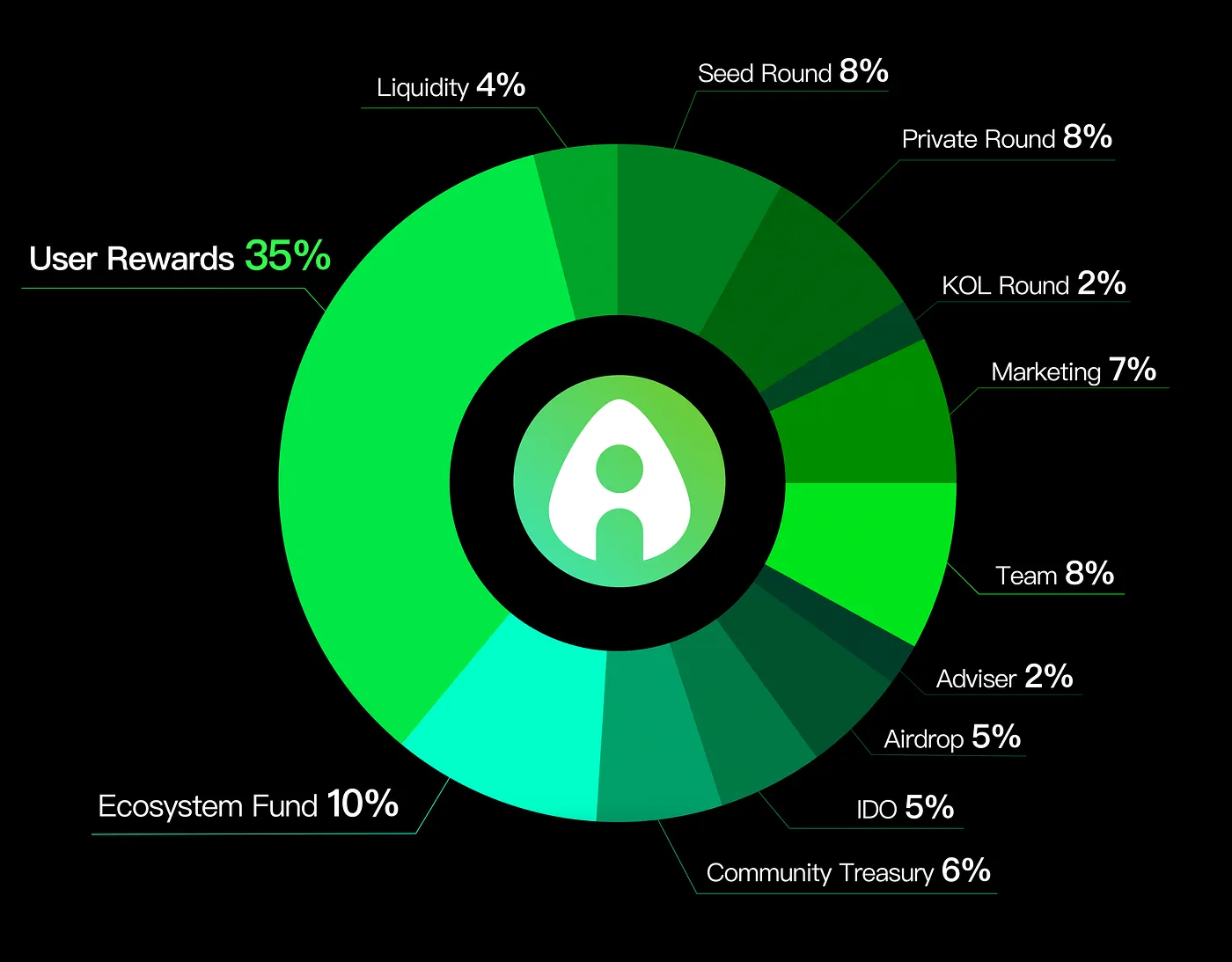
AGT has a fixed total supply of 5 billion tokens. Public tokenomics data shows allocation roughly as follows:
At TGE, ~28% unlocks; the rest follows linear or staged vesting. For the secondary market, the unlock timeline for investor and team tokens is a major supply-side variable.
The incentive mechanism has five layers:
This model's implicit assumption: platform data service revenue must keep growing, and buyback scale must offset selling pressure from unlocks and redemptions. Otherwise, incentive pools increasingly rely on new entrants rather than endogenous cash flow.
Alaya AI sees data as AI’s sole channel to interact with reality, with human feedback key to improving model alignment. AGT connects "who does what, to what standard, and what they get in return."
In collection and annotation, contributors complete multimodal tasks via dApp, with the system blending automated pre-annotation and human verification. AGT staking ties high-value verification tasks to reputation: historical quality scores influence future task allocation, economically rewarding reliable annotators and limiting task frequency for low-scoring users.
In auto-labeling model development, the community stakes AGT to participate in verification and calibration, ensuring model improvements benefit directly from frontline data contributors—not just internal team iterations. Model tokenization lets the Web3 community use AGT staking pools to fund fine-tuning of specific vertical models, shortening the path for small and medium projects to get custom data.
On the demand side, enterprises and AI teams procure datasets through custom data requests and the open data marketplace. AGT acts as a unified coordination unit, making reward rules, settlement, and permissions auditable on-chain, addressing Web2 transparency gaps around data lineage and contributor rights.
For the AI Agent and vertical small model wave, demand for niche data (regional languages, specialized imagery, RLHF feedback) is rising. AGT incentive pools can quickly organize distributed labor aligned with model goals—this is its core advantage over standard annotation outsourcing.
Alaya AI reports a user base in the millions with substantial daily on-chain interactions, and community growth is tightly coupled with token design.
A gamified interface—experience points, energy, daily tasks, quizzes—turns tedious annotation into sustainable habits, lowering the psychological barrier. NFTs are more than collectibles; they determine task eligibility and level credentials. Higher-level NFTs unlock more complex, higher-reward tasks. Upgrading nodes consumes AGT, creating a progression system of "time investment + token spend → capability upgrade."
Monthly AGT redemption provides a predictable "cashing window": contributors submit AIA from the 1st to the 21st (UTC) of each month, then receive AGT from the pool proportionally from the 21st to month-end. This payday-like rhythm maintains activity cycles and reduces disengagement from lingering credits.
Exchange liquidity is another growth lever. AGT listed on KuCoin in May 2025 with spot and bot support, improving global trade accessibility. Market rankings and trading volume influence external capital's appetite for ecosystem risk.
Social referrals and affiliate incentives amplify organic growth: existing users bring in new ones to complete data tasks, earning commissions or bonuses—a cost advantage in the cost-sensitive Web3 environment.
Objectively, user count doesn't equal high-quality annotation output. Quality metrics for community growth should focus on redemption participation rate, number of enterprise custom pools, ODP dataset volume, and the ratio of repeatedly active contributors—not just total users.
Traditional data annotation relies on fiat salaries and centralized platforms, working well in most cases. But when three structural gaps appear in the AI data market, token incentives become a viable solution.
Supply gap: Demand for general and vertical training data outpaces professional annotation capacity, especially in long-tail areas like minority languages, dialects, and medical specialties. Centralized suppliers charge high fees and have long lead times. Tokens let projects globally launch reward pools instantly, paying per task and theoretically improving long-tail supply elasticity.
Participation gap: Much of the fragmented time of knowledgeable professionals goes unused. Gamification + crypto rewards monetize "leisure time," appealing to contributors in emerging markets. Tokens also enable cross-border settlements, bypassing some traditional cross-border labor payment frictions (subject to compliance).
Trust and rights gap: Enterprises increasingly care about data lineage, annotator rights, and secondary use. On-chain records and NFT-based rights representation proactively assert contribution rights. AGT governance gives the community a voice on auto-labeling rules and feature priorities.
Tokens are no silver bullet: without quality guardrails, incentives encourage volume farming. Alaya addresses this with AGT staking, multi-annotator consensus, and a hybrid pipeline of auto-labeling plus expert review. Tokens solve incentive and coordination; quality depends on mechanism design.
AGT's secondary market price is shaped by overall crypto market sentiment and project fundamentals. Key observables include:
AGT is a high-risk crypto asset. Potential holders should watch for:
This is not investment advice. Do your own research and only invest what you can afford to lose.
From an industry trend perspective, the global AI data annotation market is poised for high growth over the next decade, with demand for high-fidelity vertical data and RLHF feedback rising alongside the proliferation of agents and small models. Alaya AI positions itself as "high-fidelity data + open Web3 infrastructure." If its hybrid pipeline of auto-labeling and expert review gains enterprise adoption, AGT could evolve from a "community reward tool" to a "settlement and coordination layer for B2B data services."
The ecosystem roadmap includes expanding ODP and custom data marketplaces, improving DAO governance, reducing participation costs via multi-chain, and collaborating with DePIN and decentralized compute protocols to build an open data-training-deployment stack. If monthly redemption continues long-term, it can become a stable contributor expectation management tool.
Three key variables for AGT's long-term value:
If these three points gradually materialize, AGT could evolve from a speculative asset to a utility asset tied to platform GDP. If it remains confined to credit redemption and short-term hype, it risks narrative exhaustion. The consecutive redemption seasons and KuCoin liquidity integration show the team is reinforcing the "participate—redeem—hold" loop. Going forward, focus on enterprise client cases and revenue disclosures.
The AGT tokenomics model compresses Alaya AI’s data crowdsourcing, auto-labeling, open data marketplace, and community governance into a set of executable on-chain rules: staking for security and high-level permissions, tasks and AIA-AGT redemption for labor rewards, reward pools and model staking for AI project demand, and buybacks to attempt a closed business loop.
The model's growth logic is clear: lower global contributor barriers, improve long-tail data supply elasticity, and maintain stickiness through monthly redemption and NFT progression. At the same time, AGT's price and long-term value hinge on real data demand, platform revenue, and unlock schedules. Investors must dynamically weigh utility growth against supply pressure.
For readers tracking the Web3 AI data track, understanding AGT shouldn't stop at "will it pump or dump." Ask instead: How many annotation tasks are paid for by real AI clients? Are buybacks verifiable on-chain? Is the proportion of high-quality contributors rising? The answers to these questions will tell you more about whether AGT's tokenomics is truly driving the Alaya AI data ecosystem's growth than any short-term price chart.