BIBI Surges 522% in a Short Time, Market Cap Once Broke $13 Million — A Meme Coin Storm You Can’t Ignore

Beginner
Quick Reads
Last Updated 2026-03-27 04:28:24
Reading Time: 1m
BIBI increased 522% in just 24 hours, with its market cap briefly topping $13 million and significantly impacting the cryptocurrency market. This article takes a deep dive into the driving factors, associated risks, and potential future developments.

What Is BIBI?


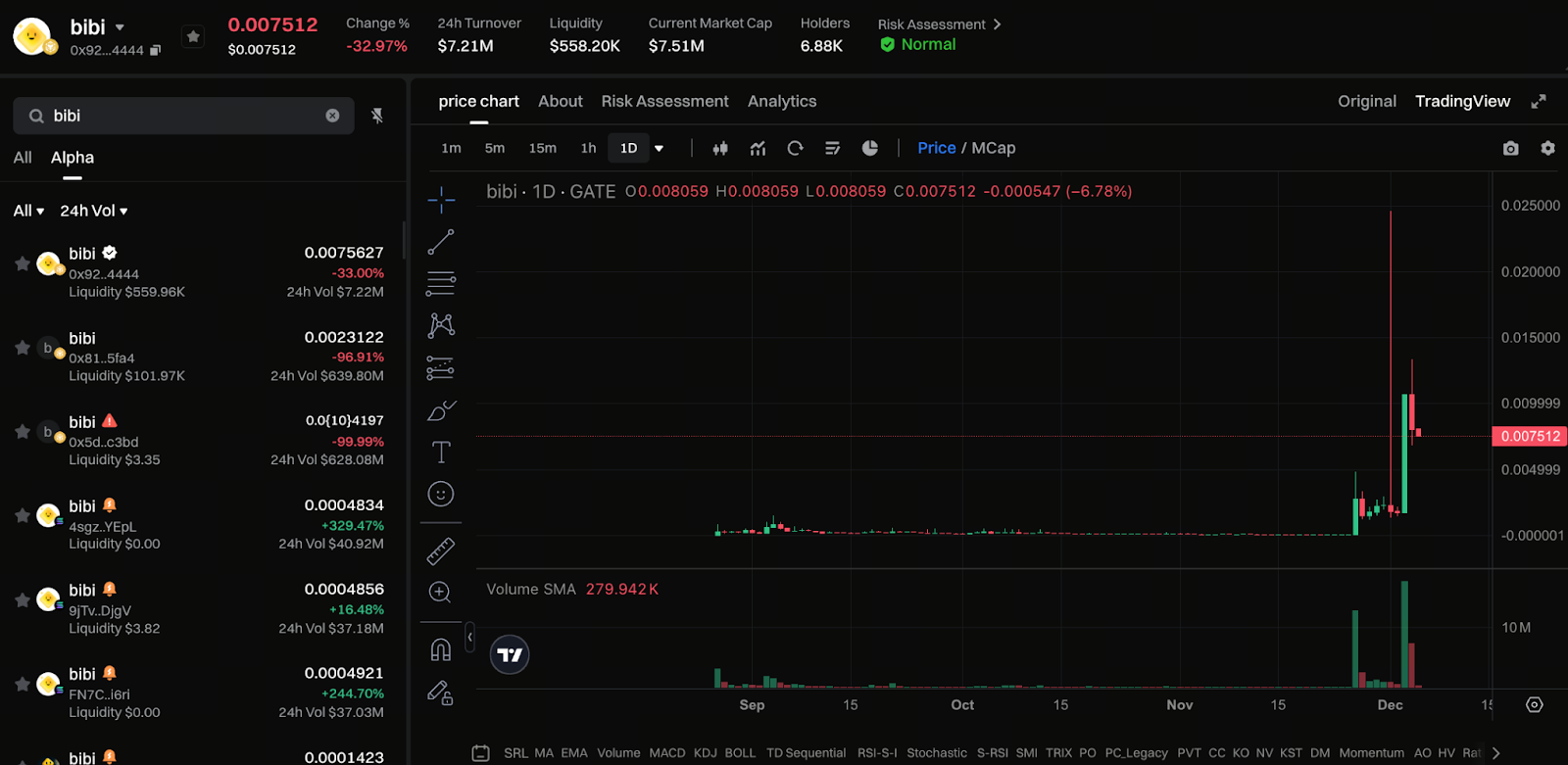
Image source: https://www.gate.com/alpha/bsc-0x9212cf1f9f4a9c69bb010146ba5b0725169d4444

BIBI is a meme token built on BNB Chain. Its name matches the “Bibi AI Tool” launched by a trading platform, which quickly captured attention on social media. The AI tool claims to summarize Web3 project whitepapers in just 30 seconds, drawing users to experiment with it and indirectly increasing the visibility of the BIBI name.

However, it is crucial to note that the BIBI token is merely a meme project with a similar name and is not associated with the official AI tool team. The project does not offer technical innovation or robust use cases. Consequently, its price movements are driven primarily by market sentiment, not by fundamental value.

Key Drivers Behind the 522% Price Surge

Market data shows that BIBI surged 522% in a short span, with its market cap rocketing from under several million dollars to over $13 million at its peak.

The main factors fueling BIBI’s rally include:

1. Small Market Cap and High Speculation Lead to Explosive Moves
Meme tokens with low market capitalization are highly sensitive to even small capital inflows. As a result, once speculation begins, prices can rise rapidly due to momentum.

2. Name-Driven Attention
BIBI shares its name with a trending AI tool, causing some retail investors to mistakenly believe they are connected, which increases buying interest.

3. Community Virality and FOMO Amplification
Discussion volumes spiked on platforms like Telegram and X (Twitter), driving more retail participants into a snowballing FOMO (fear of missing out) rally.

4. Early Positioning by Smart Money
Some on-chain addresses accumulated large amounts of BIBI when the market cap was just around $1 million. Their early entry helped drive sentiment and further fueled the speculative cycle.

How Market Sentiment, Capital, and Speculation Combine to Drive Prices

Unlike mainstream cryptocurrencies, meme token price action is driven primarily by:

  • Community buzz
  • Influencer endorsements
  • Alignment with market trends
  • Speed of short-term capital deployment

BIBI benefited from the combination of “AI hype, small market cap, and community-driven growth,” but such rallies tend to “rise quickly and fall even faster.”

Risks and Pitfalls of Meme Tokens

While BIBI’s price explosion is exciting, it introduces significant uncertainty.

  1. Sharp Gains Followed by Steep Corrections
    Meme tokens often experience rapid pullbacks after surging, which may result in retail investors buying at the peak.
  2. Lack of Real-World Utility
    Without genuine technology, ecosystem, or product support, meme tokens rely on hype and sentiment. Once attention fades, their value is difficult to sustain.
  3. Ponzi-like dynamics
    Most trading activity is concentrated among short-term speculators. If large holders decide to sell, prices can collapse instantly.
  4. Severe information asymmetry
    Community messaging is dominated by emotional hype and lacks rational analysis, which can easily mislead new investors.

How to Stay Rational in Volatile Markets?

When facing explosive rallies like BIBI’s, investors should consider the following strategies:

  • Only invest capital you can afford to lose in high-risk tokens
  • Avoid buying blindly based on community hype
  • Set clear take-profit and stop-loss levels to manage emotional trading
  • Be cautious of accelerated corrections after short-term price spikes
  • Monitor actual capital flows instead of being influenced by market noise

In conclusion, BIBI’s breakout demonstrates the ongoing speculative energy present in the meme token market. Projects that deliver lasting value still require strong technology and ecosystem support. Short-term speculation opportunities exist, but investors should remain highly vigilant.

Author: Max
Disclaimer
* The information is not intended to be and does not constitute financial advice or any other recommendation of any sort offered or endorsed by Gate.
* This article may not be reproduced, transmitted or copied without referencing Gate. Contravention is an infringement of Copyright Act and may be subject to legal action.

Related Articles

What is Fartcoin? All You Need to Know About FARTCOIN
Intermediate

What is Fartcoin? All You Need to Know About FARTCOIN

Fartcoin (FARTCOIN) is a representative meme coin within the Solana ecosystem based on an AI-driven narrative. Its core concept originated from an experiment aimed at exploring the "boundaries between AI Agents and humor." More than just a digital asset with social attributes, the project deeply couples absurd humor culture with on-chain financial logic by integrating autonomous AI interaction models.
2026-04-04 22:01:19
Gold Price Forecast for the Next Five Years: 2026–2030 Trend Outlook and Investment Implications, Could It Reach $6,000?
Beginner

Gold Price Forecast for the Next Five Years: 2026–2030 Trend Outlook and Investment Implications, Could It Reach $6,000?

Analyze current gold price trends alongside authoritative five-year forecasts, integrating an evaluation of market risks and opportunities. This gives investors insight into the potential trajectory of gold prices and the main drivers expected to shape the market over the next five years.
2026-03-25 18:13:30
Aster vs Hyperliquid: Which Perp DEX Will Prevail?
Beginner

Aster vs Hyperliquid: Which Perp DEX Will Prevail?

Aster and Hyperliquid are the two representative protocols of the "purpose-built L1 path" within the current decentralized perpetual exchange (Perp DEX) sector. As a pioneer in the field, Hyperliquid has built a deep liquidity moat through its highly mature order book architecture and strong community consensus. Conversely, Aster, as a rising challenger, seeks to leapfrog the competition in high-performance trading through more aggressive multi-chain aggregation logic, private transaction modules, and an underlying execution environment optimized for 2026 market demands.
2026-03-24 11:58:33
AI-Native Settlement Layers: How United Stables Is Building the Next Financial Rail
Beginner

AI-Native Settlement Layers: How United Stables Is Building the Next Financial Rail

Stablecoins were originally designed as dollar substitutes within exchanges, primarily used for asset pricing and trade settlement. As on-chain financial ecosystems have matured, their role has expanded beyond simple payments to include collateral assets, cross-chain liquidity mediums, and unified settlement units. In particular, as AI systems and automated agents begin to participate directly in economic activity, demand has risen sharply for programmable value units capable of instant settlement. This shift is pushing stablecoins toward the role of foundational financial infrastructure.
2026-03-25 03:16:17
ASTER Tokenomics: Buybacks, Burns, and Staking as the Value Foundation of ASTER in 2026
Beginner

ASTER Tokenomics: Buybacks, Burns, and Staking as the Value Foundation of ASTER in 2026

ASTER is the native equity and governance token of the Aster ecosystem, with its core value built upon a radical "Deflationary Engine." Beyond serving as a governance tool, ASTER integrates multiple utilities including staking rewards, trading fee discounts, and liquidity incentives. Through its deep integration with the upcoming dedicated Layer 1 mainnet, it enables direct value capture from protocol cash flow to token holders.
2026-03-25 07:38:07
Hybrid Collateral Stablecoins: Inside United Stables' Stability and Yield Architecture
Beginner

Hybrid Collateral Stablecoins: Inside United Stables' Stability and Yield Architecture

In the early stages of the crypto market, traditional stablecoins mainly relied on single-reserve or single-collateral models. Their primary focus was price stability and payment convenience, which allowed them to become foundational tools for on-chain trading and capital flows. As the market has entered a more mature financial phase, however, this structure has begun to reveal limitations, including high concentration risk and the difficulty of balancing liquidity with yield. These constraints have driven the evolution toward multi-layer collateral and portfolio-based designs, such as the dual-layer hybrid collateral architecture proposed by United Stables, which seeks to redefine the underlying logic of stable assets.
2026-03-25 03:17:39