BlackRock Bets on Ethereum, Vitalik Buterin Reignites the Gas Futures Debate — What Happens After ETH Falls Below $3,000?

Last Updated 2026-03-26 22:22:39
Reading Time: 1m
Discover the major implications of BlackRock’s Ethereum ETF application, the potential effects of Buterin’s proposed gas futures mechanism on the ETH network, and an in-depth analysis of the factors driving ETH below $3,000 along with insights into future market trends.

Recent developments in the crypto market have spotlighted three key news items: BlackRock’s submission of an Ethereum staking ETF application to the U.S. Securities and Exchange Commission (SEC), Vitalik Buterin’s innovative proposal for gas futures, and the leading Ethereum token, ETH, falling below the critical $3,000 support level amid selling pressure. These stories continue to drive discussion among market participants, creating significant price swings and influencing investor sentiment.

Recap: Three Major Ethereum Market Headlines

Crypto media outlets and trading platforms have been closely tracking three major events in the Ethereum ecosystem: BlackRock’s Ethereum ETF filing, Buterin’s concept for a gas futures market, and ETH’s price breaking below the $3,000 mark during a period of heightened volatility.

The Impact of BlackRock’s iShares Staked Ethereum Trust ETF Filing

BlackRock, the world’s largest asset manager, recently filed with the SEC to register the “iShares Staked Ethereum Trust” ETF. This move demonstrates how traditional financial institutions are seeking to open the Ethereum ecosystem to institutional capital through regulated investment vehicles. The ETF will not only track ETH’s price but also generate yield through staking, giving institutions a new tool and potentially accelerating mainstream capital flows into blockchain assets.

For the ETH market, this development is widely seen as a long-term catalyst. While the price impact may not be immediate, the introduction of an ETF stands to boost market liquidity and institutional participation, enhancing Ethereum’s asset profile and its appeal to sovereign investors.

Vitalik Buterin’s Trustless Gas Futures Market Proposal
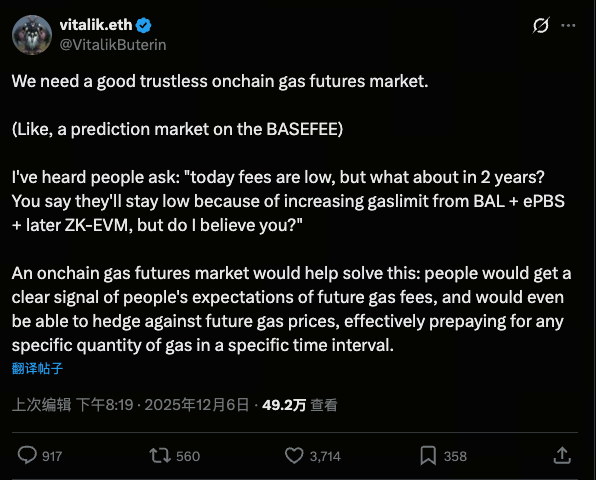

Source: https://x.com/VitalikButerin/status/1997279838252531823

Ethereum co-founder Vitalik Buterin has recently proposed the creation of a blockchain-based market for gas futures. This mechanism aims to give market participants a way to hedge against future gas fee volatility and improve cost transparency. In essence, users would be able to lock in future transaction fees, reducing uncertainty from price swings.

If implemented, this proposal could have a significant impact on DeFi users and on-chain traders. Reliable fee forecasts would make Ethereum a more predictable smart contract platform, likely attracting additional dApp developers and users.

Why Did ETH Fall Below $3,000?
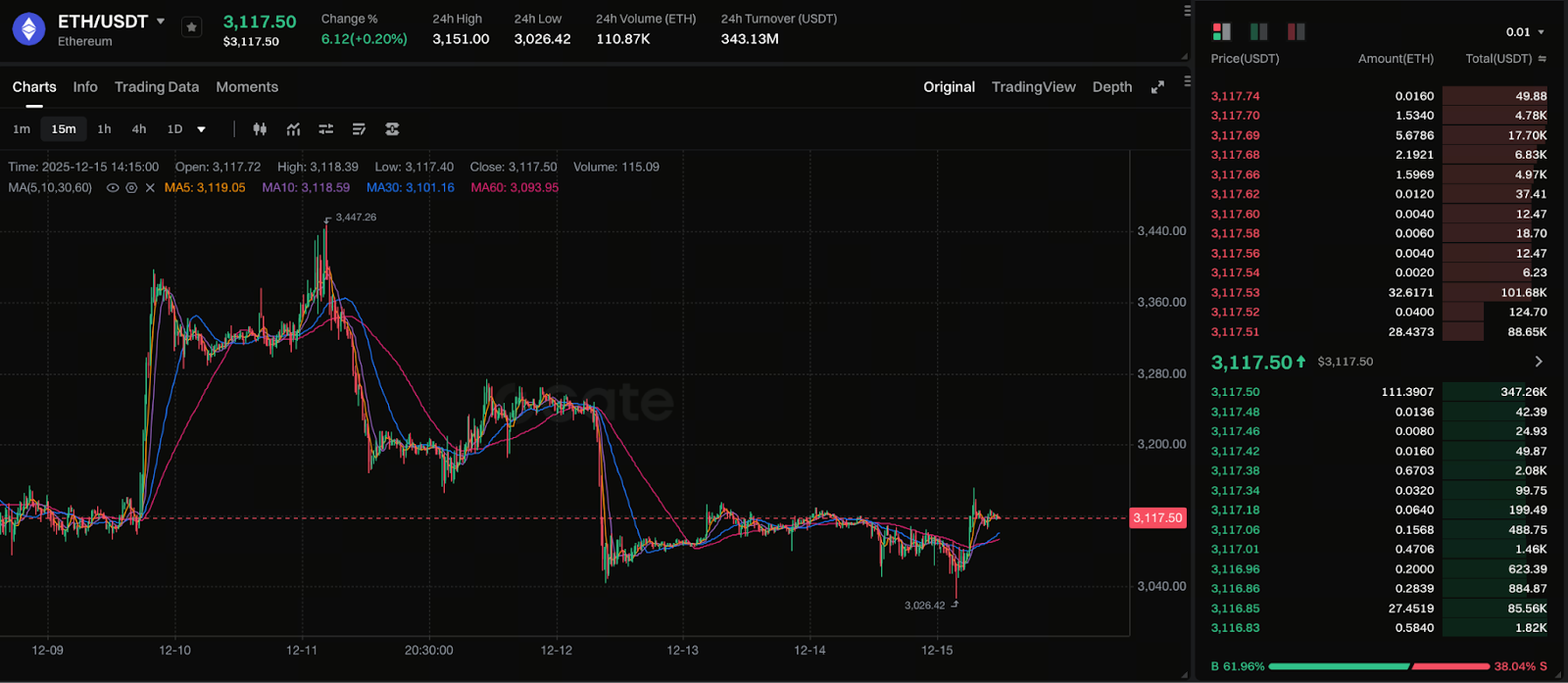

Source: https://www.gate.com/trade/ETH_USDT

Ethereum’s price has recently experienced a sharp decline, briefly falling below the critical $3,000 support level. Market analysts attribute this correction to a combination of factors: weaker risk appetite across crypto markets, tightening macro liquidity, and forced liquidations on exchanges.

In this volatile environment, investor fear has intensified, increasing selling pressure and causing ETH to lose a major psychological level. However, technical analysis indicates that breaking this support does not signal a trend reversal, but rather reflects the kind of volatility typical during structural market adjustments.

What Does This Mean for Investors? Risks and Opportunities

For long-term investors, these events present both risks and opportunities. On the downside, further price drops could trigger stop-losses and pose risks for highly leveraged positions. On the upside, BlackRock’s potential ETF approval and Buterin’s innovative proposal highlight sustained institutional and developer interest in Ethereum. This could help support prices over the medium to long term and deepen market liquidity.

Outlook: Where Is ETH Headed Next?

ETH’s future price trends will continue to depend heavily on market sentiment, macroeconomic conditions, and the pace of on-chain ecosystem development. If the ETF is approved and institutional inflows accelerate, and if gas futures help lower user costs, ETH could enter a new rally. In the near term, though, the fight to hold key support around $3,000 remains a primary focus for the market.

Author: Max
Disclaimer
* The information is not intended to be and does not constitute financial advice or any other recommendation of any sort offered or endorsed by Gate.
* This article may not be reproduced, transmitted or copied without referencing Gate. Contravention is an infringement of Copyright Act and may be subject to legal action.

Related Articles

What is Fartcoin? All You Need to Know About FARTCOIN
Intermediate

What is Fartcoin? All You Need to Know About FARTCOIN

Fartcoin (FARTCOIN) is a representative meme coin within the Solana ecosystem based on an AI-driven narrative. Its core concept originated from an experiment aimed at exploring the "boundaries between AI Agents and humor." More than just a digital asset with social attributes, the project deeply couples absurd humor culture with on-chain financial logic by integrating autonomous AI interaction models.
2026-04-04 22:01:19
Gold Price Forecast for the Next Five Years: 2026–2030 Trend Outlook and Investment Implications, Could It Reach $6,000?
Beginner

Gold Price Forecast for the Next Five Years: 2026–2030 Trend Outlook and Investment Implications, Could It Reach $6,000?

Analyze current gold price trends alongside authoritative five-year forecasts, integrating an evaluation of market risks and opportunities. This gives investors insight into the potential trajectory of gold prices and the main drivers expected to shape the market over the next five years.
2026-03-25 18:13:30
AI-Native Settlement Layers: How United Stables Is Building the Next Financial Rail
Beginner

AI-Native Settlement Layers: How United Stables Is Building the Next Financial Rail

Stablecoins were originally designed as dollar substitutes within exchanges, primarily used for asset pricing and trade settlement. As on-chain financial ecosystems have matured, their role has expanded beyond simple payments to include collateral assets, cross-chain liquidity mediums, and unified settlement units. In particular, as AI systems and automated agents begin to participate directly in economic activity, demand has risen sharply for programmable value units capable of instant settlement. This shift is pushing stablecoins toward the role of foundational financial infrastructure.
2026-03-25 03:16:17
Aster vs Hyperliquid: Which Perp DEX Will Prevail?
Beginner

Aster vs Hyperliquid: Which Perp DEX Will Prevail?

Aster and Hyperliquid are the two representative protocols of the "purpose-built L1 path" within the current decentralized perpetual exchange (Perp DEX) sector. As a pioneer in the field, Hyperliquid has built a deep liquidity moat through its highly mature order book architecture and strong community consensus. Conversely, Aster, as a rising challenger, seeks to leapfrog the competition in high-performance trading through more aggressive multi-chain aggregation logic, private transaction modules, and an underlying execution environment optimized for 2026 market demands.
2026-03-24 11:58:33
Aerodrome Tokenomics: How ve(3,3) Powers Base's Most Profitable DEX
Beginner

Aerodrome Tokenomics: How ve(3,3) Powers Base's Most Profitable DEX

AERO is the native token of Aerodrome Finance, a core decentralized exchange and liquidity protocol in the Base ecosystem. It is primarily used for liquidity incentives and ecosystem operations. veAERO is a governance NFT that users receive by locking AERO, representing both voting power and the right to share protocol revenue. Through a dual track structure of AERO as a utility token and veAERO as a governance credential, Aerodrome separates liquidity usage value from long term governance power, allowing participants to act as liquidity providers, governance decision makers, and revenue sharers within the same system.
2026-03-25 06:40:31
Hybrid Collateral Stablecoins: Inside United Stables' Stability and Yield Architecture
Beginner

Hybrid Collateral Stablecoins: Inside United Stables' Stability and Yield Architecture

In the early stages of the crypto market, traditional stablecoins mainly relied on single-reserve or single-collateral models. Their primary focus was price stability and payment convenience, which allowed them to become foundational tools for on-chain trading and capital flows. As the market has entered a more mature financial phase, however, this structure has begun to reveal limitations, including high concentration risk and the difficulty of balancing liquidity with yield. These constraints have driven the evolution toward multi-layer collateral and portfolio-based designs, such as the dual-layer hybrid collateral architecture proposed by United Stables, which seeks to redefine the underlying logic of stable assets.
2026-03-25 03:17:39





