As meme coins become an increasingly important segment of the crypto asset market, more digital assets driven by internet culture and community consensus are gaining attention. Within this category, Dogecoin, Shiba Inu, and dogwifhat stand out as three representative projects. Each emerged at a different stage of market development and reflects the evolving structural patterns of meme coins.
Although all three rely on community-driven cultural value, they differ significantly in their underlying blockchain architecture, token positioning, ecosystem scalability, and community organization. Understanding these differences helps clarify how various meme coins operate and provides a clearer framework for categorizing them.
What Are the Core Differences Between Dogecoin, Shiba Inu, and dogwifhat?
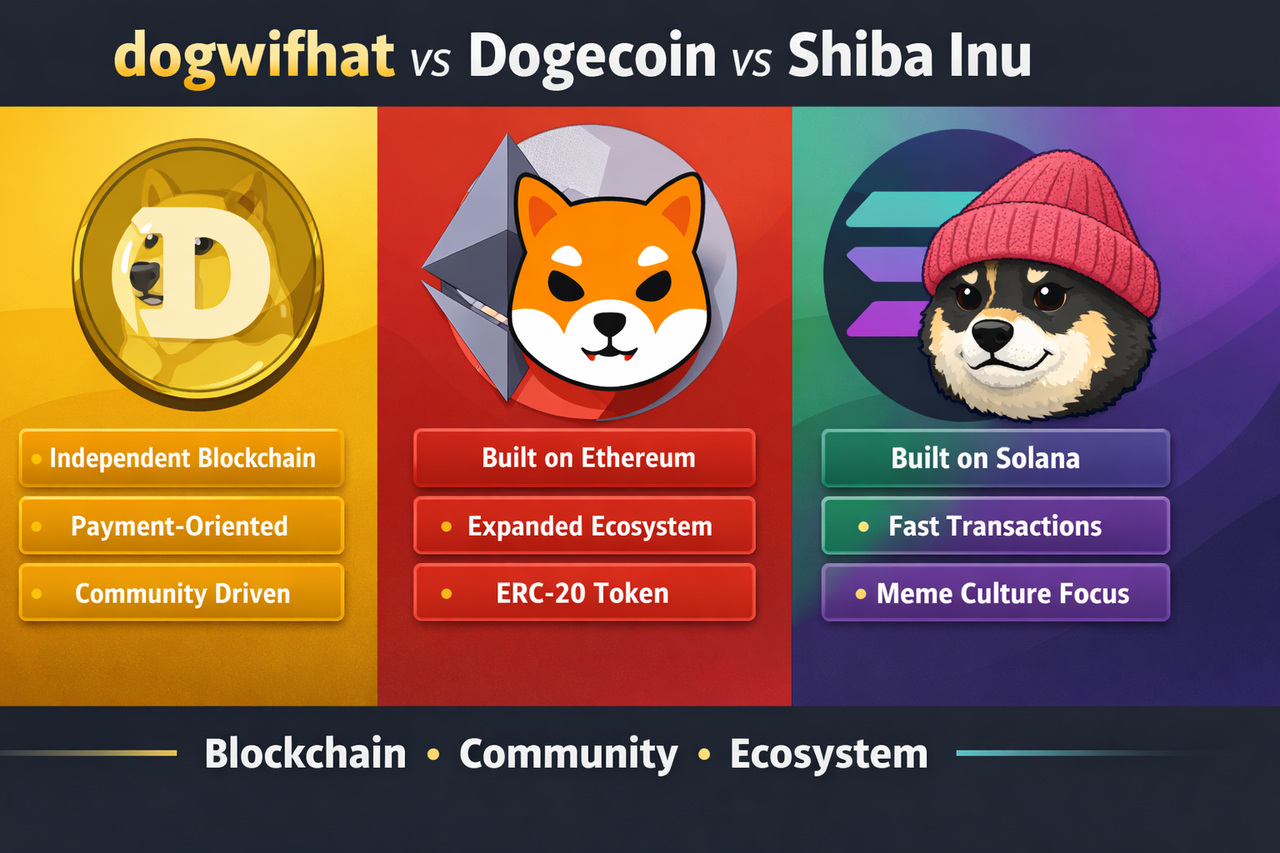
The primary differences lie in their underlying blockchain infrastructure and how value is structured. Dogecoin is a cryptocurrency with its own independent blockchain network; Shiba Inu is an ERC-20 token built on Ethereum with expanded ecosystem functionality; dogwifhat operates as an SPL token on Solana, emphasizing lightweight distribution and community-driven growth.
| Comparison Dimension |
Dogecoin |
Shiba Inu |
dogwifhat |
| Underlying Network |
Independent blockchain |
Ethereum |
Solana |
| Token Standard |
Native asset |
ERC-20 |
SPL Token |
| Transaction Efficiency |
Moderate |
Lower |
Higher |
| Ecosystem Expansion |
Limited |
Strong |
Limited |
| Core Driver |
Community + Payments |
Community + Ecosystem |
Community + Cultural Virality |
| Structural Positioning |
Independent meme coin |
Ecosystem-driven meme coin |
Virality-driven meme coin |
These structural differences directly influence transaction efficiency, scalability, and market positioning. Dogecoin leans toward payment functionality, Shiba Inu toward ecosystem expansion, while dogwifhat emphasizes cultural virality.
What Defines Dogecoin’s Structure?
Dogecoin is one of the earliest meme coins and operates on its own blockchain, with code originally derived from Litecoin. As an independent chain asset, it includes a full consensus mechanism and block production system, making it structurally closer to traditional cryptocurrencies.
This independence gives Dogecoin strong base-layer asset characteristics, as it does not rely on external blockchain ecosystems. At the same time, its community culture defines its identity as a meme coin, combining payment utility with cultural symbolism.
What Defines Shiba Inu’s Structure?
Shiba Inu is built on the Ethereum network as an ERC-20 token. Unlike Dogecoin, it does not operate its own blockchain but relies on Ethereum for transaction processing and asset management.
A key feature of Shiba Inu is its ecosystem expansion. Beyond the base token, it has developed into areas such as decentralized exchanges, NFTs, and Layer 2 solutions. This positions it not only as a meme coin but also as a broader ecosystem project.
What Defines dogwifhat’s Structure?
dogwifhat is an SPL token deployed on Solana, designed with simplicity in mind. Unlike Shiba Inu, it does not focus on building a complex ecosystem. Instead, it prioritizes community engagement and meme-driven identity.
Thanks to Solana’s infrastructure, dogwifhat benefits from fast transaction speeds and low fees, making it well-suited for high-frequency trading and rapid community dissemination. Its minimalist visual identity further strengthens its recognizability as a meme asset.
How Do Their Underlying Networks Differ?
Dogecoin operates on its own blockchain with independent nodes and consensus mechanisms. Shiba Inu relies on Ethereum, while dogwifhat runs on Solana. These infrastructure differences impact transaction speed, fees, and scalability.
In general, Solana offers faster confirmation times and lower fees; Ethereum provides stronger developer capabilities and ecosystem depth; and Dogecoin offers greater network independence. Each environment shapes how the asset functions on-chain.
The Dogecoin community has a long history and broad recognition, with relatively stable cultural dynamics. Shiba Inu has developed a more complex structure centered around ecosystem expansion. dogwifhat, by contrast, maintains a lightweight, fast-moving community driven primarily by social media engagement.
In terms of structure, Dogecoin emphasizes long-term consensus, Shiba Inu emphasizes ecosystem participation, and dogwifhat emphasizes speed of dissemination. These differences define their roles within the meme coin market.
How Does Their Value Logic Differ?
The value of Dogecoin is based on a combination of independent blockchain infrastructure and community consensus. Shiba Inu derives value from ecosystem expansion alongside community culture. dogwifhat, on the other hand, relies primarily on cultural virality and social consensus.
In simple terms, Dogecoin resembles a culturally driven cryptocurrency, Shiba Inu an ecosystem-oriented meme asset, and dogwifhat a purely community-driven cultural token. These distinctions reflect different stages in the evolution of meme coins.
Conclusion
dogwifhat, Dogecoin, and Shiba Inu all fall under the meme coin category, yet their structural positioning differs significantly. Dogecoin represents the independent blockchain model, Shiba Inu the ecosystem expansion model, and dogwifhat the lightweight virality-driven model.
By comparing their differences in infrastructure, community structure, and value logic, it becomes easier to understand the diverse development paths within the meme coin ecosystem and how community culture translates into digital asset value across different technical frameworks.
FAQs
What is the biggest difference between dogwifhat, Dogecoin, and Shiba Inu?
The main difference lies in their underlying networks and ecosystem structures. Dogecoin has its own blockchain, Shiba Inu is built on Ethereum, and dogwifhat runs on Solana.
Why is Dogecoin considered closer to a traditional cryptocurrency?
Because it operates on an independent blockchain with its own consensus mechanism and network infrastructure.
Why does Shiba Inu have a more complex ecosystem?
Because it is built on Ethereum and has expanded into areas such as decentralized finance, NFTs, and Layer 2 solutions.
Why does dogwifhat spread more quickly?
Because it runs on Solana, offering higher transaction efficiency, and relies on a simple, highly recognizable meme for rapid dissemination.
Are all three considered meme coins?
Yes, all three are meme coins, but they represent different structural types and development models within the category.