At the center of this business model is the delivery of continuous and reliable electricity service. Regardless of economic cycles, residential homes, commercial institutions and industrial companies all need stable power supply. This gives the utility sector relatively strong demand stability. For Exelon, revenue growth comes not only from user electricity demand, but also from expanding grid investment and infrastructure upgrades.
Exelon’s service area covers multiple U.S. states, with extensive transmission lines, substations and regional distribution networks. Through its utility subsidiaries, the company provides electricity service to tens of millions of residential, commercial and industrial customers, giving it a leading footprint within the U.S. utility sector.
EXC is the ticker symbol for Exelon Corporation, which is listed and traded on the Nasdaq market in the United States. The company is headquartered in Chicago, Illinois, and is one of the largest transmission and distribution network operators in the country.
From an industry classification perspective, Exelon belongs to the Utilities sector. Compared with growth oriented technology companies, utilities generally place greater emphasis on stable operations and long term infrastructure investment. Their business performance is often closely tied to energy demand growth, grid construction and regulatory policy.
Exelon’s Revenue Sources
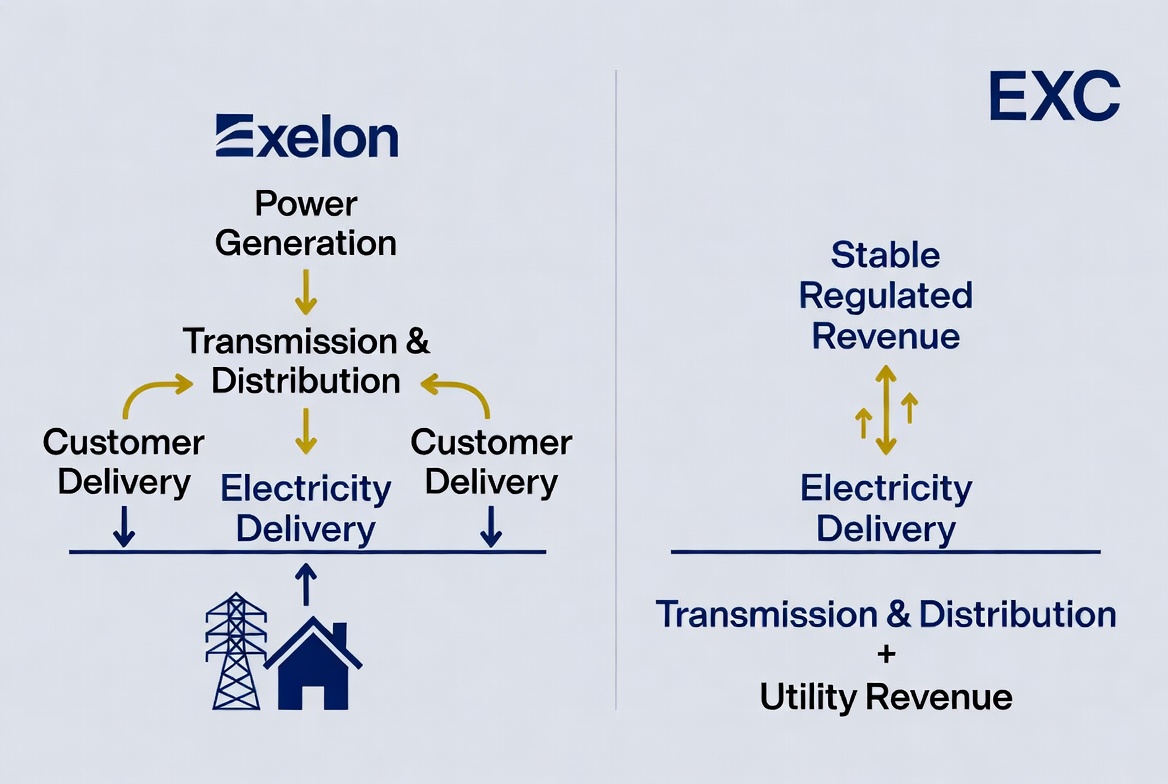
Exelon’s revenue mainly comes from two core segments, transmission services and distribution services, along with auxiliary income related to grid operations. Although the business structure may vary by region, the overall model is consistently centered on electricity infrastructure operations.
The transmission business is mainly responsible for moving electricity over long distances, carrying power generated by power plants to regional load centers. The distribution business handles the final stage of delivery, bringing electricity to homes, commercial buildings and industrial facilities. Together, these two functions form the complete grid service system and represent Exelon’s most important sources of revenue.
Unlike businesses that sell commodities, Exelon does not primarily depend on electricity price fluctuations for revenue. The company is more focused on the scale of its grid assets, operating efficiency and regulator approved returns on investment. As a result, Exelon’s operating logic is closer to long term infrastructure management than to a traditional energy trading business.
| Revenue Segment |
Core Content |
| Transmission business |
Long distance electricity transport services |
| Distribution business |
Delivering electricity to end users |
| Grid operation services |
Network maintenance and system management |
| Infrastructure investment returns |
Regulator approved returns on assets |
This structure allows Exelon to build a relatively stable revenue system and reduce the direct impact of energy price volatility.
How the Transmission Business Generates Revenue
The transmission business is an important part of Exelon’s business model. After electricity is generated at power facilities, it must travel across regions through high voltage transmission networks. The transmission system is the key bridge connecting energy producers with consumers.
Building transmission networks requires substantial capital investment, including the construction of high voltage lines, substation operation and system maintenance. These infrastructure assets often have long useful lives, which allows them to form a stable asset base over time. For Exelon, the transmission network is not only an operating tool, but also one of the company’s most important core assets.
In the U.S. electricity market, transmission businesses are generally overseen by regulators. After companies build new lines, upgrade equipment or expand networks, they can earn corresponding investment returns under the regulatory framework. As a result, transmission revenue comes not only from demand for electricity transport, but also from ongoing infrastructure investment.
How Distribution Networks Contribute Stable Cash Flow
If the transmission system connects energy flows between cities, the distribution network is responsible for delivering electricity to end users. For Exelon, the distribution business is one of its most stable sources of cash flow.
Residential homes, commercial institutions and industrial companies need electricity service every day, so distribution demand is usually highly persistent. Regardless of whether the economy is growing quickly or slowly, residential lighting, hospital equipment, school operations and corporate offices all depend on stable power supply. This gives the distribution business a relatively steady demand base.
Distribution networks also have clear regional monopoly characteristics. Because building multiple overlapping distribution systems would be neither economical nor practical, a region usually has only one main distribution operator. This industry structure allows utility companies to operate existing networks over the long term while continuously improving service capability through maintenance and upgrades.
Why Regulation Shapes the Profit Model
Regulation is a key factor in understanding Exelon’s business model. Unlike fully market based industries, the rates and investment returns of utility companies usually require approval from regulators.
This regulatory system is designed to balance company interests with consumer interests. On one hand, companies need reasonable returns so they can continue investing in grid construction and maintenance. On the other hand, regulators need to prevent users from bearing excessive costs. As a result, the utility industry operates in a distinctive business environment.
For Exelon, regulation is both a constraint and a form of protection. It limits the company’s ability to raise rates at will, but it also provides a higher degree of certainty for long term investment. When the company builds new transmission lines, upgrades substation facilities or deploys smart grid systems, those investments can typically be recovered gradually over future operating periods.
This model means Exelon’s profitability depends more on asset operating efficiency and long term investment planning than on short term market fluctuations.
How Grid Investment Drives Long Term Growth
Grid investment is an important driver of Exelon’s long term growth. As U.S. energy consumption patterns change and the digital economy expands rapidly, modern society’s requirements for grid capacity and reliability continue to rise.
In recent years, data center construction has become an important factor driving electricity demand growth. Artificial intelligence training, large scale cloud computing and internet service operations all require substantial power support, prompting many regions to expand transmission lines and substation facilities. For Exelon, these infrastructure investments not only improve network capacity, but also help expand the future revenue base.
At the same time, the energy transition is also increasing demand for grid upgrades. Integrating renewable sources such as wind and solar requires more complex dispatch systems and more advanced smart grid technologies. By continuing to invest in transmission and distribution infrastructure, Exelon can strengthen the value of its network and maintain an important position in the future energy system.
Over the long term, population growth, electrification and the expansion of the digital economy may all continue to lift grid demand. These trends also form an important foundation for Exelon’s growth logic.
Conclusion
Exelon’s business model is built on transmission networks, distribution systems and long term infrastructure operations. Unlike companies that rely on product sales, Exelon generates revenue by providing continuous and reliable electricity delivery services. The transmission business connects energy production with consumer markets, while the distribution business provides daily electricity service to residents and businesses. Regulation gives the entire business model long term stability. As data center construction, the energy transition and broader electrification continue to advance, grid investment remains an important force driving Exelon’s long term development.
FAQs
What are EXC’s main revenue sources?
EXC’s revenue mainly comes from transmission services, distribution services and infrastructure businesses related to grid operations, with transmission and distribution network operations serving as its core revenue source.
Why is Exelon considered a utility company?
Exelon primarily operates transmission and distribution networks and provides electricity services to residential, commercial and industrial customers, which is why it is classified as a utility company.
What is the difference between transmission and distribution?
Transmission is responsible for moving electricity over long distances, while distribution delivers electricity to end users. Together, they form a complete electricity network system.
How does regulation affect Exelon’s profits?
Regulators review rate structures and investment plans. Companies can earn reasonable returns, but they are also subject to pricing and operating rules.
Why does data center growth benefit Exelon?
Data centers require large amounts of stable power supply, which can increase demand for transmission networks, substation facilities and grid upgrades.
How is Exelon different from energy producers?
Energy producers mainly generate electricity, while Exelon focuses on power delivery and network operations, making it an energy infrastructure service provider.