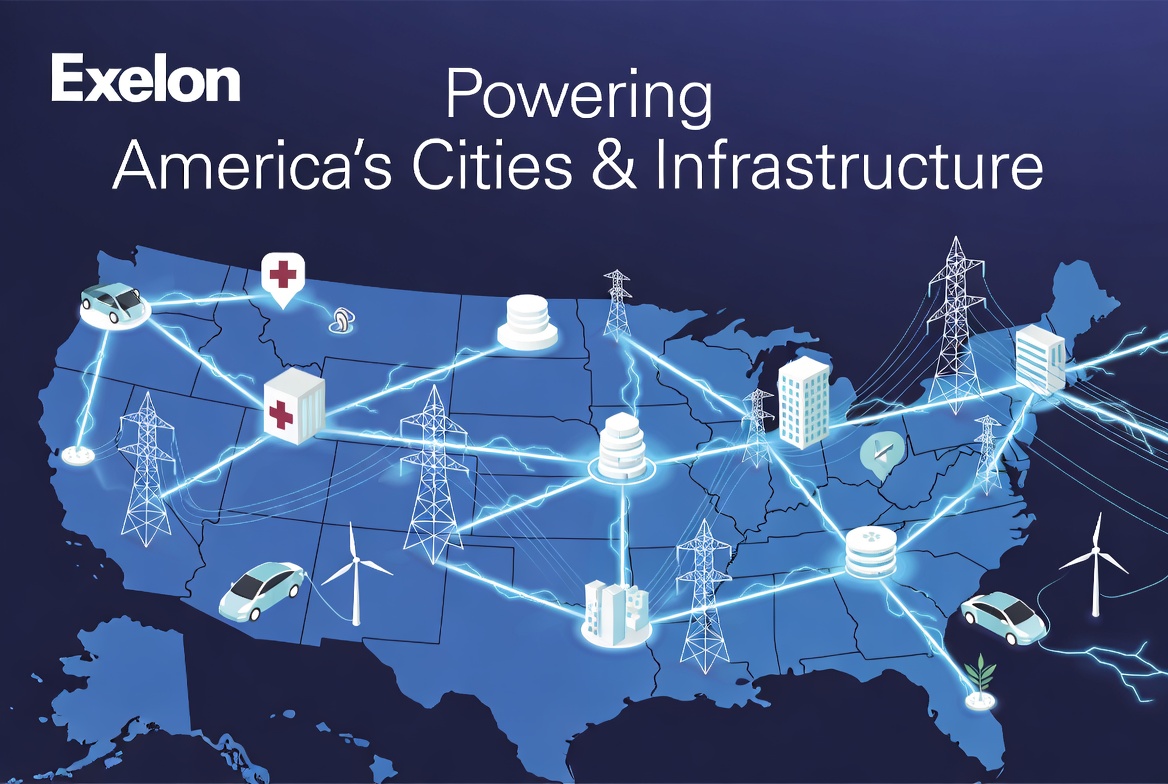
From everyday life in residential homes to the operation of large industrial parks, and from continuous business activity in commercial centers to the around the clock operation of artificial intelligence data centers, nearly all modern economic activity depends on stable electricity supply. Understanding the use cases of EXC, or Exelon Corporation, is also a useful way to understand how modern cities rely on energy infrastructure to keep functioning.
Why the Grid Has Become Critical Infrastructure for the Modern Economy
The power grid is the core network connecting energy production with energy consumption, and it is one of the most important forms of public infrastructure in modern society. Power plants can generate large amounts of electricity, but without a complete transmission and distribution system, that energy cannot truly be converted into economic value. For this reason, the importance of the grid is often comparable to that of highways, airports and communications networks.
Modern cities depend heavily on the electric power system. From traffic lights to hospital equipment, and from office building air conditioning systems to internet servers, nearly every critical facility requires continuous power. When a large scale grid failure occurs, it can disrupt not only daily life for residents, but also business operations, industrial production and public services. Grid reliability has therefore become an important measure of a city’s infrastructure quality.
As the economy becomes increasingly digital, society’s expectations for power quality are also rising. In the past, the grid mainly served as a channel for energy delivery. Today, it must also support energy dispatch, real time monitoring and intelligent management. For utility companies such as Exelon, operating a modern grid is no longer just about maintaining infrastructure. It is a core responsibility that supports the entire economic system.
How Exelon Serves Residential Electricity Demand
Residential users are the broadest customer group in Exelon’s service system. Household lighting, refrigerators, televisions, air conditioners and various smart home devices all depend on a stable grid supply to operate normally. Although each household’s electricity consumption is relatively limited, the sheer scale of residential users forms an important foundation of grid demand.
Through distribution networks spanning multiple states, Exelon delivers electricity from regional substations to communities and residential neighborhoods. To ensure reliable power supply, the company must continuously maintain distribution lines, upgrade aging equipment and quickly repair faults during extreme weather events. This ongoing infrastructure investment is an important reason residents can receive stable electricity service.
In recent years, residential energy consumption patterns have also been changing. Growing demand for electric vehicle charging, the spread of remote work and the increase in smart devices have made household electricity use more complex. This means the future grid will need not only to provide more power, but also to offer stronger dispatching capability and flexibility to adapt to evolving user needs.
How Commercial and Industrial Customers Rely on Transmission and Distribution Networks
For commercial and industrial customers, electricity is not just a basic service. It is a core resource that keeps business operations running. Large shopping malls, office parks, logistics centers and medical institutions need stable electricity every day, otherwise their operating efficiency and service capacity can be directly affected.
Industrial users depend even more heavily on the grid. Industries such as automobile manufacturing, chemical production, metal processing and semiconductor manufacturing typically require production equipment to run continuously. A power outage can not only halt production, but also damage equipment and waste raw materials. As a result, industrial customers usually have extremely high requirements for power reliability.
Exelon’s transmission and distribution networks play a key role in this process. By building highly reliable grid systems, the company can meet the energy needs of different customer groups and help businesses reduce operating risks caused by power interruptions. In a sense, the efficiency of modern commercial and industrial activity rests heavily on stable energy infrastructure.
Why Data Centers and the Digital Economy Need Stable Power
With the rapid growth of artificial intelligence, cloud computing and big data, data centers have become one of the most important emerging use cases for grid services. Data centers must operate servers, storage equipment and network facilities around the clock, so their requirements for power reliability are far higher than those of ordinary commercial users.
Large data centers usually consume enormous amounts of energy. The electricity demand of a hyperscale data center may even be comparable to that of a small or medium sized city. For this reason, power supply capacity has become an important factor in data center site selection. When many technology companies build cloud computing facilities, they give priority to regions with stable grid resources.
For Exelon, rising demand from data centers is creating new infrastructure investment opportunities. As artificial intelligence model training and digital services continue to expand, the U.S. grid system will need to provide greater energy support. In the future, the role of utility companies in the digital economy may become just as important as their role in the traditional energy sector.
How Grid Upgrades Support the Energy Transition
The energy transition does not only mean increasing the share of wind and solar power generation. It also means the entire grid system must be upgraded at the same time. Traditional grids were mainly designed for centralized power generation, while the renewable energy era requires support for more distributed energy connections and more complex electricity dispatch needs.
Wind and solar generation are intermittent. When wind speeds change or weather conditions shift, output can fluctuate quickly. Modern grids therefore need stronger real time monitoring and adjustment capabilities to maintain stable electricity supply. Exelon’s continued investment in smart grid technology in recent years is aimed at adapting to this trend.
In addition to renewable energy integration, the spread of electric vehicles is also driving grid upgrades. In the future, large numbers of vehicles may charge at the same times of day, placing higher demands on grid load management. Through smart dispatching systems and digital infrastructure construction, utility companies can respond more effectively to the new challenges brought by the energy transition.
Why Utility Infrastructure Has Long Term Value
Utility infrastructure is often seen as one of the asset classes with the strongest long term value in the modern economy. The reason is that society always needs stable electricity supply, regardless of economic cycles. Residential life, business operations and public services cannot exist independently of energy infrastructure.
Compared with many industries that depend on changing consumer trends, grid businesses have stronger continuity. Transmission and distribution networks take a long time to build, require significant investment and are subject to strict regulation, which creates high barriers to entry. For companies that have already built large scale network systems, this infrastructure advantage can often be maintained over the long term.
As the digital economy expands, artificial intelligence develops and society becomes more electrified, electricity demand is finding new sources of growth. From a long term perspective, utility companies are not only responsible for energy delivery. They are also becoming important pillars of the modern economy. The grid system operated by Exelon is a clear reflection of this long term value.
Conclusion
Exelon’s core value does not lie in producing energy, but in connecting energy supply with end demand through its vast transmission and distribution network. From residential homes and commercial institutions to industrial facilities and data centers, nearly every important activity in modern society is built on stable electricity supply. As the digital economy develops, the energy transition advances and the artificial intelligence industry expands, the importance of grid infrastructure continues to rise, and Exelon continues to play a key role in the U.S. urban energy system.
FAQs
Which users does Exelon mainly serve?
Exelon mainly serves residential users, commercial institutions, industrial companies and public service facilities, providing stable electricity supply to different customer groups through its transmission and distribution networks.
Why do data centers need highly reliable grids?
Data centers need to operate servers and network equipment around the clock. Even a brief power outage can cause service interruptions and data loss, so they require extremely stable electricity supply.
Why are utility companies important?
Utility companies operate critical infrastructure such as electricity and water systems, providing essential support for the normal functioning of the modern economy and society.
Why does the energy transition require grid upgrades?
Renewable energy generation can fluctuate, so modern grids need stronger dispatching and management capabilities to keep energy supply stable.
How is Exelon different from renewable energy companies?
Renewable energy companies mainly generate electricity, while Exelon primarily operates transmission and distribution networks and is responsible for energy delivery and infrastructure management.
Why does grid infrastructure have long term value?
Electricity demand is long lasting and difficult to replace, while grid construction has high barriers to entry. As a result, transmission and distribution infrastructure is usually regarded as an important asset with long term value.