Genius Stablecoin Bill: A New Era of Stablecoin Regulation in the U.S.

Beginner
Quick Reads
Last Updated 2026-04-03 18:19:21
Reading Time: 1m
The Genius Stablecoin Bill (GENIUS Act), enacted on July 18, 2025, introduces a comprehensive regulatory framework for the U.S. stablecoin market. It sets clear standards for issuer qualifications, reserve requirements, and transparency obligations, fostering both regulatory compliance and innovation across the industry.

Background of the Legislation
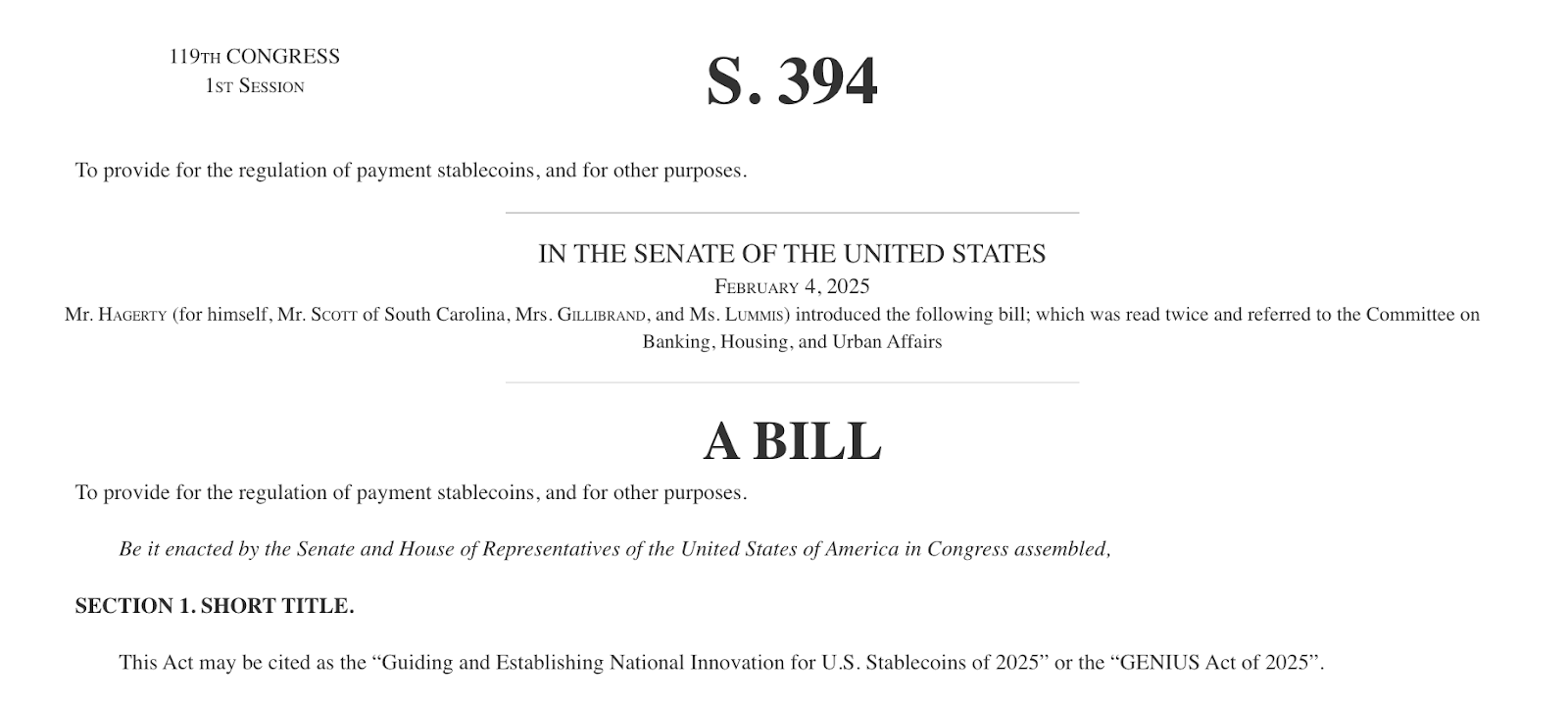

Image: https://www.congress.gov/bill/119th-congress/senate-bill/394/text

On July 18, 2025, the President of the United States signed the Guiding and Establishing National Innovation for U.S. Stablecoins Act, widely known as the Genius Stablecoin Bill. This groundbreaking law represents the first milestone regulation for digital assets in the U.S. Senator Hagerty and colleagues introduced the bill on February 4, 2025, and after extensive deliberations in both chambers of Congress, it passed with more rigorous compliance and oversight requirements. The Genius Stablecoin Bill establishes a comprehensive regulatory framework for the rapidly expanding stablecoin market, aiming to strike a balance between fostering innovation and managing risk.

Key Provisions of the Genius Stablecoin Bill:

  • Licensing Requirement: Only authorized U.S.-based licensed payment stablecoin issuers or foreign issuers regulated under comparable regimes may issue and trade stablecoins under the Genius Stablecoin Bill in the U.S. market.
  • Reserve Requirements: Stablecoins must be fully backed one-to-one or by highly liquid, low-risk assets of equivalent value.
  • Audit and Transparency: Issuers must publicly disclose reserve status, fund usage, and operational details at least every six months.
  • Liquidation and Bankruptcy Priority: Stablecoin holders have legal priority in asset liquidation proceedings if the issuer goes bankrupt. This helps to reduce investor losses.
  • Regulatory Oversight: Smaller issuers may opt for state-level regulation, while larger issuers fall under the supervision of the Federal Reserve, Federal Deposit Insurance Corporation (FDIC), or the Office of the Comptroller of the Currency (OCC).

Impact on Stablecoin Issuers

The Genius Stablecoin Bill sets a higher compliance bar for stablecoin issuers. This is likely to increase industry consolidation. On the other hand, the law provides compliant entities with a well-defined legal status and regulatory path. This creates strong opportunities to expand within the U.S. market. Licensed institutions will likely leverage U.S. Treasuries and other low-risk assets for more robust asset management and innovative product development.

Investor and User Protections

For investors and consumers, the new law offers more reliable value backing and settlement protections for stablecoins under the Genius Stablecoin Bill, reducing risks previously caused by opaque reserves or insufficient asset backing. Regular audits and disclosure measures provide greater transparency for investors, strengthening public trust in the ecosystem.

Industry Outlook

Looking forward, the Genius Stablecoin Bill will drive compliant, large-scale growth in the U.S. stablecoin market. However, the industry will also face critical challenges. These include finding the right balance between robust regulation and high compliance costs, and meeting the challenges posed by cross-border regulatory coordination and rapid technological evolution.

Author: Max
Disclaimer
* The information is not intended to be and does not constitute financial advice or any other recommendation of any sort offered or endorsed by Gate.
* This article may not be reproduced, transmitted or copied without referencing Gate. Contravention is an infringement of Copyright Act and may be subject to legal action.

Related Articles

What is Fartcoin? All You Need to Know About FARTCOIN
Intermediate

What is Fartcoin? All You Need to Know About FARTCOIN

Fartcoin (FARTCOIN) is a representative meme coin within the Solana ecosystem based on an AI-driven narrative. Its core concept originated from an experiment aimed at exploring the "boundaries between AI Agents and humor." More than just a digital asset with social attributes, the project deeply couples absurd humor culture with on-chain financial logic by integrating autonomous AI interaction models.
2026-04-04 22:01:19
Gold Price Forecast for the Next Five Years: 2026–2030 Trend Outlook and Investment Implications, Could It Reach $6,000?
Beginner

Gold Price Forecast for the Next Five Years: 2026–2030 Trend Outlook and Investment Implications, Could It Reach $6,000?

Analyze current gold price trends alongside authoritative five-year forecasts, integrating an evaluation of market risks and opportunities. This gives investors insight into the potential trajectory of gold prices and the main drivers expected to shape the market over the next five years.
2026-03-25 18:13:30
Aster vs Hyperliquid: Which Perp DEX Will Prevail?
Beginner

Aster vs Hyperliquid: Which Perp DEX Will Prevail?

Aster and Hyperliquid are the two representative protocols of the "purpose-built L1 path" within the current decentralized perpetual exchange (Perp DEX) sector. As a pioneer in the field, Hyperliquid has built a deep liquidity moat through its highly mature order book architecture and strong community consensus. Conversely, Aster, as a rising challenger, seeks to leapfrog the competition in high-performance trading through more aggressive multi-chain aggregation logic, private transaction modules, and an underlying execution environment optimized for 2026 market demands.
2026-03-24 11:58:33
AI-Native Settlement Layers: How United Stables Is Building the Next Financial Rail
Beginner

AI-Native Settlement Layers: How United Stables Is Building the Next Financial Rail

Stablecoins were originally designed as dollar substitutes within exchanges, primarily used for asset pricing and trade settlement. As on-chain financial ecosystems have matured, their role has expanded beyond simple payments to include collateral assets, cross-chain liquidity mediums, and unified settlement units. In particular, as AI systems and automated agents begin to participate directly in economic activity, demand has risen sharply for programmable value units capable of instant settlement. This shift is pushing stablecoins toward the role of foundational financial infrastructure.
2026-03-25 03:16:17
2026 Silver Price Forecast: Bull Market Continuation or High-Level Pullback? In-Depth Analysis of Silver Candlestick Chart
Beginner

2026 Silver Price Forecast: Bull Market Continuation or High-Level Pullback? In-Depth Analysis of Silver Candlestick Chart

2026 Silver Price Forecast: Latest Outlook This article integrates current market trends, silver candlestick chart analysis, and momentum factors to assess the potential key support and resistance levels, upside targets, and pullback risks for silver prices. The goal is to help investors make informed, rational decisions.
2026-03-25 16:08:59
ASTER Tokenomics: Buybacks, Burns, and Staking as the Value Foundation of ASTER in 2026
Beginner

ASTER Tokenomics: Buybacks, Burns, and Staking as the Value Foundation of ASTER in 2026

ASTER is the native equity and governance token of the Aster ecosystem, with its core value built upon a radical "Deflationary Engine." Beyond serving as a governance tool, ASTER integrates multiple utilities including staking rewards, trading fee discounts, and liquidity incentives. Through its deep integration with the upcoming dedicated Layer 1 mainnet, it enables direct value capture from protocol cash flow to token holders.
2026-03-25 07:38:07





