With the rise of automated AI applications, AI Agents are evolving from simple chatbots into intelligent systems capable of continuous operation. These systems can analyze information, devise strategies, and call multiple APIs to get things done. Within this framework, AI APIs serve as the core infrastructure linking AI Agents with external services.
At the same time, automated AI systems introduce new challenges, such as managing multi-model calls, optimizing costs, and enabling AI Agents to pay API fees on their own. Today, the x402 automatic payment protocol is becoming a key component of the AI Agent economy, while AI model routing platforms like Gate.AI are helping developers build automated AI Agent ecosystems.
Why Do AI Agents Need APIs?
APIs—application programming interfaces—are the standard way for different software systems to communicate. For AI Agents, they are an essential bridge to external capabilities.
In practice, AI Agents often need to access a variety of services through APIs, including:
-
AI model services (e.g., GPT, Claude, or Gemini)
-
Data interfaces (market data, financial data, etc.)
-
Web services (search engines, social platforms)
-
Blockchain networks (DeFi, smart contracts)
Using these APIs, AI Agents can construct complete automated task workflows. For instance, a DeFi analysis Agent could call an AI model to analyze market data while simultaneously accessing a blockchain API to retrieve real-time transaction information.
What Is the AI Agent API Architecture?
The AI Agent API architecture describes how AI Agents interact with AI models, data services, and external systems. In this setup, Agents call various services through multiple APIs and combine the results into a final output.
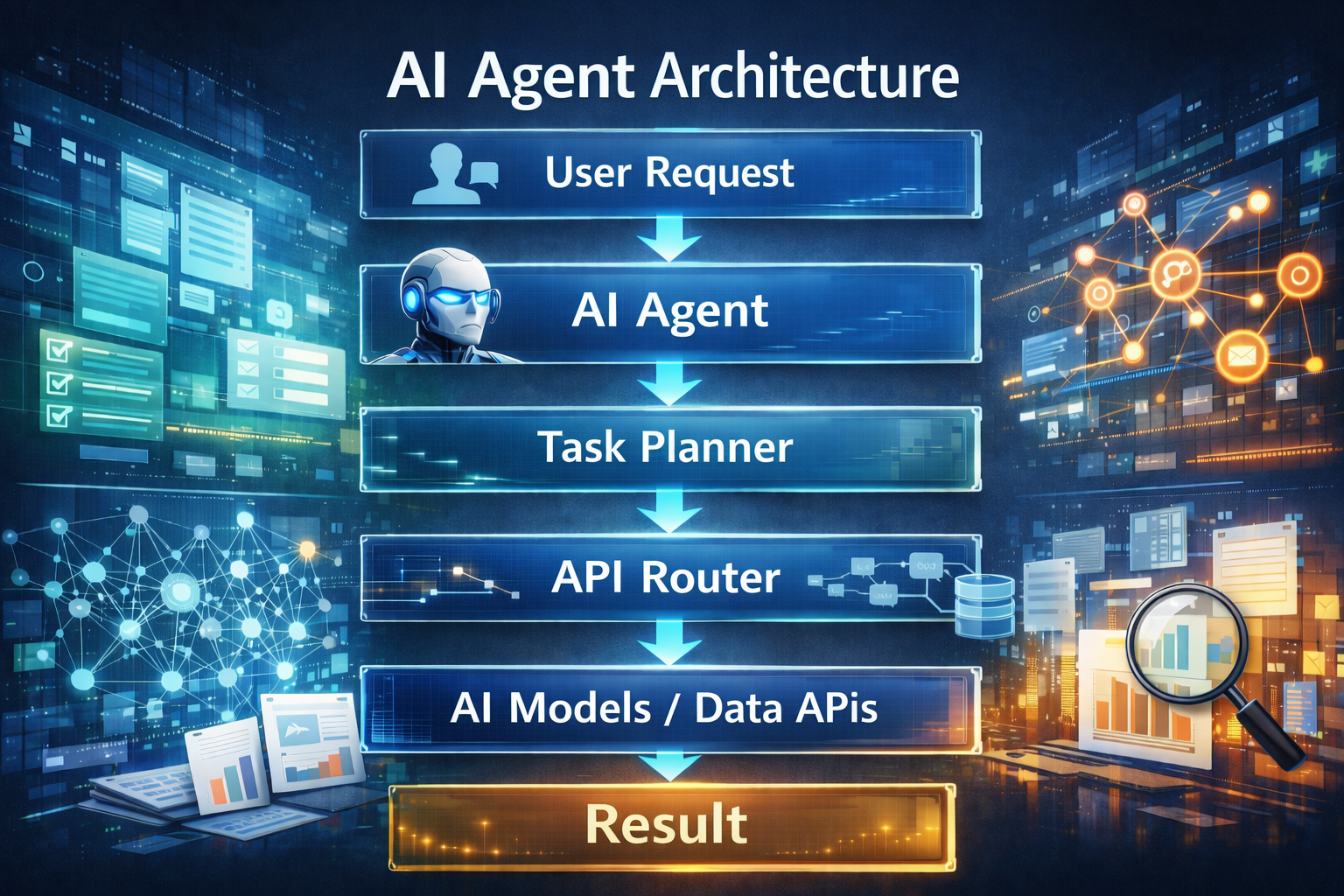
A typical AI Agent architecture includes these components:
Agent Core: Understands the task objective and devises an execution plan.
Task Planner: Breaks down complex tasks into smaller subtasks.
API Router: Determines which API or AI model to call.
AI Models: Provide language understanding, reasoning, or content generation.
External APIs: Supply data, search, or blockchain services.
Payment Layer: Handles automatic payment for API calls.
This architecture lets AI Agents coordinate resources across different systems, enabling more sophisticated automation.
Basic Flow of an AI Agent Calling an AI API
For automated AI applications to interact with different AI models or external services via APIs, the Agent follows a logical sequence—from receiving a task to calling an AI API and producing final results. Generally, this process involves task understanding, task decomposition, model invocation, and result handling.
1. Receive Task
The AI Agent receives a user request or a system-triggered task, such as “analyze a specific market trend.”
2. Task Planning
The Agent breaks the complex task into subtasks, for example:
-
Data collection
-
Information analysis
-
Content generation
3. Call AI API
During analysis or content generation, the AI Agent sends requests to AI model APIs—like calling a large language model for text generation or data analysis.
4. Receive Response
After the API returns results, the AI Agent parses the response and decides on the next step.
5. Execute Next Task
The Agent may call additional APIs or generate the final output.
This cyclic flow is the core mechanism behind AI Agent automation.
Typical Use Cases for AI Agent APIs
As AI Agent technology advances, more applications are relying on AI APIs to build automated systems.
Automated Research Agent
Research-focused AI Agents can autonomously search the web for information and use AI APIs to generate research reports.
DeFi Analysis Agent
In the Web3 space, AI Agents can call on-chain data APIs and AI model APIs to analyze market trends or generate trading strategies.
Automated Customer Service
Some companies are deploying AI Agents that call AI APIs to power intelligent customer service systems, enabling automated responses and issue analysis.
These examples show that AI Agent APIs are becoming a foundational element of the next-generation internet.
Value Exchange Barriers for AI Services: Traditional Payment vs. On-Chain Settlement
As AI Agents gain the ability to automatically call various online services, a new question arises: how do AI Agents pay for API usage?
Traditional internet API payment methods typically involve:
-
Creating an account
-
Linking a credit card
-
Pre-funding a balance
-
Monthly billing
This model is designed for human users and is ill-suited for AI Agents, as automated systems cannot complete the traditional payment workflow.
If AI Agents need to continuously call paid APIs—for AI models or data services—a payment mechanism that supports machine-automated execution is required.
Automatic API Payment: The Role of x402
The x402 protocol is an internet protocol standard for enabling automatic API payments. It extends the HTTP 402 Payment Required status code to allow machines to handle the API payment process autonomously.
In an x402-enabled system, the API call flow looks like this:
-
The AI Agent sends a request to the API
-
The API returns HTTP 402 Payment Required
-
The response includes the price for this request
-
The AI Agent completes the payment using digital assets (e.g., stablecoins)
-
The API returns the model response
This mechanism allows AI Agents to make API calls and payments without human intervention.
Compared to traditional payment models, x402 offers:
-
Machine-to-machine (M2M) payment support
-
Pay-as-you-go model
-
No need for pre-funded accounts
-
Better fit for automated AI systems
The Role of Gate.AI in the AI Agent Ecosystem
Beyond payments, the AI Agent ecosystem faces another critical challenge: efficiently managing multiple AI models.
Different AI models vary in capability, cost, and response speed. For instance:
In traditional setups, developers often need to integrate each AI model’s API separately, increasing complexity.
Gate.AI steps in as a unified AI model routing platform for AI Agents. Through Gate.AI, Agents can access multiple AI models via a single API, automatically select the best model for the task, and dynamically optimize cost and performance.
Moreover, Gate.AI supports the x402 automatic payment protocol, allowing AI Agents to pay API fees with digital assets autonomously. This design makes Gate.AI a critical infrastructure component that connects AI models, automatic payment systems, and AI Agents.
Advantages and Risks of the AI Agent Call Architecture
As automated AI applications grow, AI Agents calling external services via APIs has become a common architectural pattern. This approach lets Agents access AI models, data services, and blockchain apps to automate complex tasks. However, while boosting efficiency, it also introduces potential challenges.
Advantages:
First, the AI Agent API architecture significantly enhances automation. Agents can automatically complete multi-step tasks—like gathering data, analyzing it, and producing results—by calling different APIs. Second, the architecture is highly flexible; developers can mix and match services—integrating AI models, search services, and data APIs into a single application—to build more complex automated systems. Finally, by invoking multiple AI models through APIs, the system can choose the most suitable model based on task complexity, striking a balance between performance and cost.
Risks:
The first risk is cost control. If Agents call APIs too frequently, especially high-performance AI models, operating costs can quickly spiral. The second is security: Agents need access to various external services, and inadequate permission management could lead to data leaks or misuse. Finally, there’s the risk of external dependency: if an API service goes down or its interface changes, the entire automation flow could be disrupted.
Therefore, when designing an AI Agent architecture, developers typically need to incorporate cost management, security controls, and stable infrastructure to ensure long-term, reliable operation.
Conclusion
AI Agents are becoming a vital component of automated internet applications. By calling AI APIs, these intelligent systems can access AI models, data services, and blockchain applications to accomplish complex tasks.
In the AI Agent architecture, APIs serve as the crucial infrastructure linking different systems. Through API call mechanisms, AI Agents can automatically execute tasks and continuously refine their workflows.
However, as the AI Agent economy expands, the need for automatic payment becomes clear. The x402 protocol extends the HTTP 402 status code to offer a new solution for automated API payments.
Meanwhile, AI model routing platforms like Gate.AI integrate multi-model access and automatic payment capabilities, providing comprehensive infrastructure for AI Agents. As automated AI services become more widespread, such platforms are likely to play an increasingly important role in the future internet ecosystem.
FAQs
What Is an AI Agent API?
An AI Agent API is the mechanism that allows AI Agents to call AI models or external services through application programming interfaces, enabling AI systems to autonomously access different resources and complete tasks.
Why Do AI Agents Need APIs?
APIs enable AI Agents to access AI models, data services, or blockchain applications, thereby automating the execution of complex tasks.
Can AI Agents Pay for APIs Automatically?
On the traditional internet, AI Agents struggle with payment processes. However, via the x402 protocol, AI Agents can use digital assets to automatically pay for API calls.
How Do AI Agents Call Multiple AI Models?
AI Agents can use an AI model routing platform (such as Gate.AI) to access multiple AI models and automatically select the best one based on task requirements.