IBIT ETF Investment Outlook for 2026: Price Trends, Institutional Positioning, and Market Opportunities

Beginner
Quick Reads
Last Updated 2026-03-26 07:43:02
Reading Time: 1m
Gain a comprehensive understanding of the latest IBIT ETF price trends, capital flows, and institutional strategies. This analysis, set against the 2026 market backdrop, offers readers objective investment guidance and strategic perspectives.

What Is the IBIT ETF?

The IBIT ETF (iShares Bitcoin Trust) is a spot Bitcoin exchange-traded fund launched by BlackRock, the world’s largest asset manager. Listed on major securities exchanges, it provides traditional financial investors with a regulated and convenient channel for Bitcoin exposure. The ETF’s holdings are directly tied to Bitcoin, but investment occurs through standardized securities, making it suitable for both institutional and individual investors.

Recent Price Performance and Fund Flow Trends
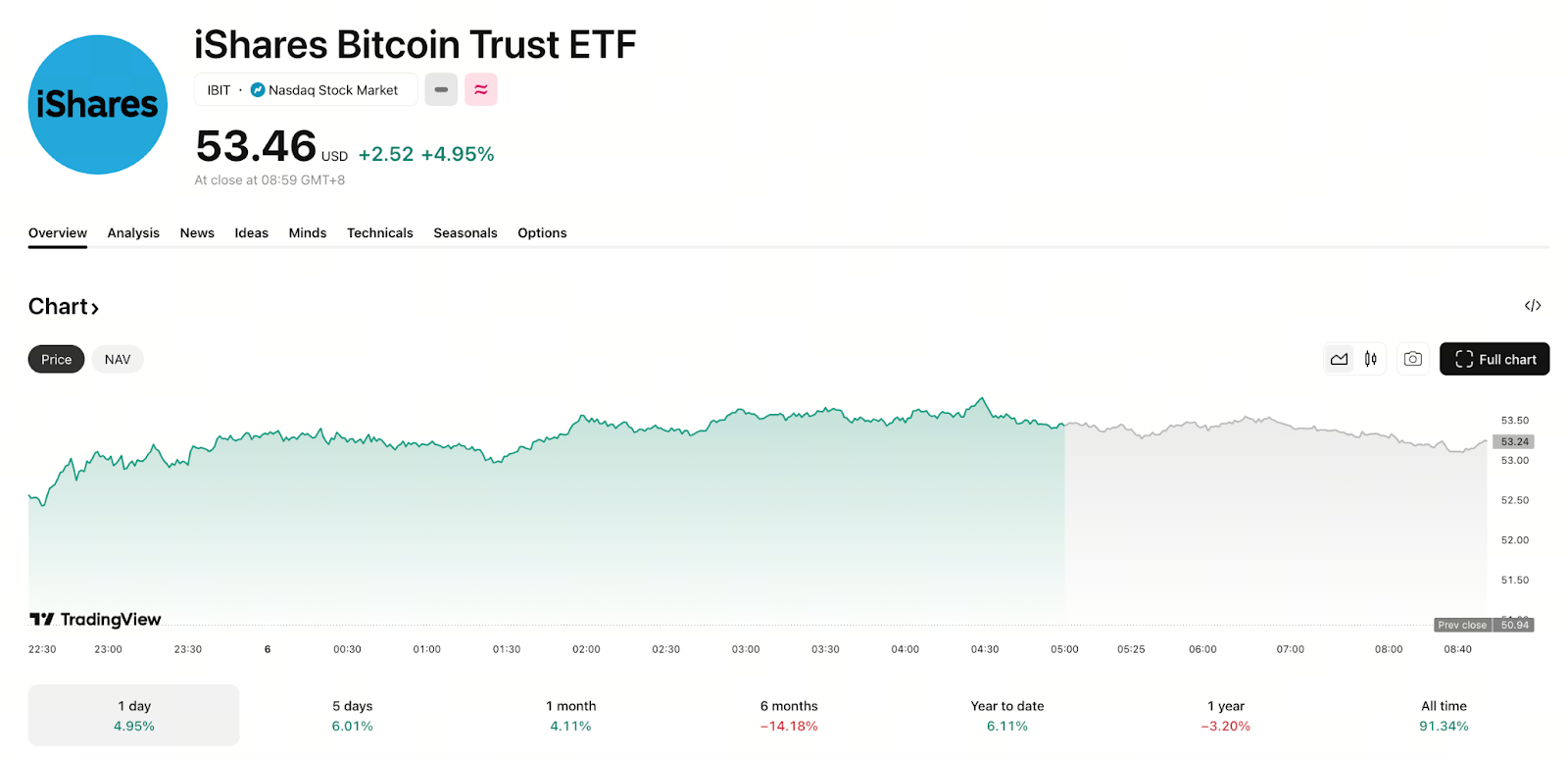
Recent data indicates that, despite short-term downward pressure on IBIT ETF’s price, fund flows remain remarkably resilient. The latest weekly statistics show IBIT led all spot Bitcoin ETFs in net inflows, demonstrating that capital has not exited the fund in response to price volatility.

In 2025, overall fund flows reveal that IBIT continues to attract significant capital. Even with a negative annual return (estimated at approximately -9.6% by some measures), IBIT ranks among the top ETFs. This trend reflects sustained confidence among long-term investors in Bitcoin ETFs.

Institutional Perspectives on IBIT’s Future Prospects

IBIT ETF’s institutional appeal is driven by several key factors:

  • Rapid asset growth, with the fund reaching historic milestones in a short timeframe and becoming one of the largest ETFs in the market.
  • Enhanced options liquidity, as market participants raise contract limits and deepen trading, which supports greater institutional engagement.
  • The ETF structure enables institutions to more easily include IBIT in pension funds, mutual funds, and asset management portfolios, meeting compliance and audit requirements more effectively than direct crypto holdings.

Collectively, these advantages position IBIT as both a primary gateway for Bitcoin investment and an increasingly important element in institutional asset allocation.

IBIT ETF vs. Bitcoin Price: A Comparative View

Although IBIT’s price closely tracks Bitcoin, its net asset value may diverge from the spot price due to factors such as fund fees, trading mechanisms, and liquidity. ETF investors should recognize these differences and adjust their expectations and risk models accordingly. Bitcoin itself, traded around the clock, often experiences greater price volatility.

Furthermore, at certain market stages, ETF fund flows and Bitcoin price movements may diverge. This is a common occurrence, arising from structural dynamics within capital markets. Understanding these distinctions helps investors avoid equating ETFs with spot Bitcoin as identical investment vehicles.

Key Investment Considerations

For those considering IBIT ETF as an investment, keep the following in mind:

  • Long-term versus short-term outlook: While ETF fund flows tend to be stable over the long term, short-term price volatility can be pronounced.
  • Risk management: Maintain balanced allocations and avoid overexposure to a single asset class.
  • Macroeconomic factors: Interest rate changes and evolving crypto regulations can impact both Bitcoin and ETF performance.

Sound analysis and diversified portfolio construction remain optimal strategies, rather than concentrating investments in a single asset.

Conclusion and Outlook

Overall, IBIT ETF stands out as a leading spot Bitcoin ETF, offering scale, robust institutional participation, and steady long-term capital inflows. As the market matures, IBIT is expected to continue its stable growth through 2026. Investors who objectively assess price fluctuations and fund flow trends in line with their risk tolerance can leverage this product for more effective digital asset allocation.

Author: Max
Disclaimer
* The information is not intended to be and does not constitute financial advice or any other recommendation of any sort offered or endorsed by Gate.
* This article may not be reproduced, transmitted or copied without referencing Gate. Contravention is an infringement of Copyright Act and may be subject to legal action.

Related Articles

AI-Native Settlement Layers: How United Stables Is Building the Next Financial Rail
Beginner

AI-Native Settlement Layers: How United Stables Is Building the Next Financial Rail

Stablecoins were originally designed as dollar substitutes within exchanges, primarily used for asset pricing and trade settlement. As on-chain financial ecosystems have matured, their role has expanded beyond simple payments to include collateral assets, cross-chain liquidity mediums, and unified settlement units. In particular, as AI systems and automated agents begin to participate directly in economic activity, demand has risen sharply for programmable value units capable of instant settlement. This shift is pushing stablecoins toward the role of foundational financial infrastructure.
2026-03-25 03:16:17
The ve(3,3) Flywheel Explained: How AERO Tokenomics Powers Aerodrome’s DeFi Economy
Beginner

The ve(3,3) Flywheel Explained: How AERO Tokenomics Powers Aerodrome’s DeFi Economy

In the competition for DeFi liquidity, high-inflation mining alone is no longer enough to build lasting advantages. Aerodrome applies the ve(3,3) economic model to redesign token emissions, voting mechanisms, and revenue distribution, creating a liquidity flywheel centered on governance and cash flow. This article examines AERO tokenomics, the veAERO locking mechanism, and protocol revenue models to explain how Aerodrome builds a sustainable DeFi economic system.
2026-03-25 06:41:58
Aerodrome Tokenomics: How ve(3,3) Powers Base's Most Profitable DEX
Beginner

Aerodrome Tokenomics: How ve(3,3) Powers Base's Most Profitable DEX

AERO is the native token of Aerodrome Finance, a core decentralized exchange and liquidity protocol in the Base ecosystem. It is primarily used for liquidity incentives and ecosystem operations. veAERO is a governance NFT that users receive by locking AERO, representing both voting power and the right to share protocol revenue. Through a dual track structure of AERO as a utility token and veAERO as a governance credential, Aerodrome separates liquidity usage value from long term governance power, allowing participants to act as liquidity providers, governance decision makers, and revenue sharers within the same system.
2026-03-25 06:40:31
How Does PAXG Work? In-Depth Overview of the Physical Gold Tokenization Mechanism
Beginner

How Does PAXG Work? In-Depth Overview of the Physical Gold Tokenization Mechanism

PAXG (Pax Gold) is a tokenized asset backed by physical gold, issued by the fintech company Paxos and traded on the Ethereum blockchain as an ERC-20 token. The core concept is to tokenize physical gold on-chain, with each PAXG token representing ownership of a certain amount of gold. This structure enables investors to hold and trade gold in the form of a digital asset.
2026-03-24 19:12:51
How is the price of PAXG determined? Pegging mechanism, trading depth, and influencing factors
Beginner

How is the price of PAXG determined? Pegging mechanism, trading depth, and influencing factors

PAXG (Pax Gold) is a tokenized asset backed by physical gold reserves, launched by fintech firm Paxos and issued as an ERC-20 token on the Ethereum blockchain. The core concept is to digitally represent real-world gold assets, allowing investors to hold and trade gold via the blockchain network. Because each PAXG token corresponds to a specific quantity of physical gold, its price is theoretically expected to closely track the global gold market.
2026-03-24 19:11:40
DePIN Identity Network and Real World Applications: How Humanity Protocol Brings on-chain Identity Into the Physical World
Beginner

DePIN Identity Network and Real World Applications: How Humanity Protocol Brings on-chain Identity Into the Physical World

Most Web3 identity systems remain confined to on-chain environments and struggle to achieve meaningful adoption in real world settings. Through a DePIN architecture and physical verification hardware, Humanity Protocol aims to bring decentralized identity into access control systems, hospitality, public services, and offline events, allowing on-chain identity to function not just as a digital credential, but as foundational infrastructure for real world access.
2026-03-25 07:40:53





