A medida que la tecnología de IA descentralizada evoluciona, distintos proyectos avanzan con estrategias propias para resolver los retos de la confianza computacional y la eficiencia en la optimización de modelos. Los desarrolladores suelen enfrentarse a dilemas entre el rendimiento de la inferencia, la capacidad de entrenamiento y los esquemas de incentivos a la hora de elegir la infraestructura. Así, la comparativa entre OpenGradient y Bittensor resulta paradigmática en este campo.
Las diferencias clave se concentran en tres dimensiones: arquitectura de red, método de computación e incentivos económicos. Estos factores, en conjunto, determinan el posicionamiento y los casos de uso de cada red de IA.
¿Qué es OpenGradient?
OpenGradient es una red de computación descentralizada orientada a la ejecución de inferencias de IA y la verificación de resultados.
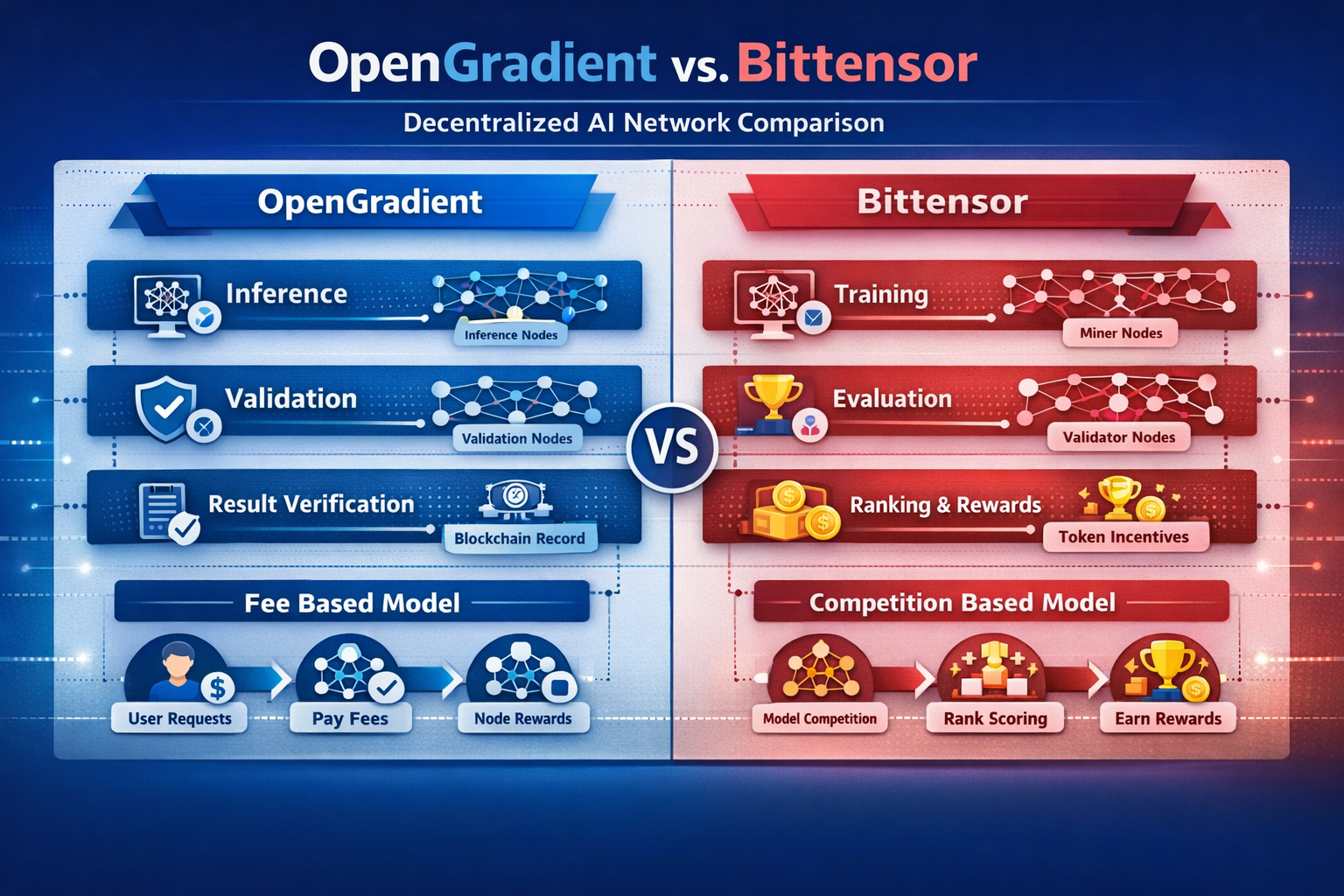
A nivel funcional, el sistema OpenGradient canaliza las solicitudes de los usuarios hacia nodos de inferencia, que procesan las tareas. Los nodos de verificación comprueban de manera independiente los resultados, asegurando la fiabilidad de las salidas. Esta arquitectura prioriza la computación verificable frente a la mera maximización del rendimiento del modelo.
La red está compuesta por nodos de inferencia, nodos de verificación y una capa de datos, separando la ejecución y la verificación en un sistema computacional estratificado.
Este enfoque permite ejecutar inferencias de IA sin depender de un único actor de confianza, lo que convierte a OpenGradient en la opción idónea para contextos donde la precisión de los resultados es esencial.
¿Qué es Bittensor?
Bittensor es una red descentralizada centrada en el entrenamiento de modelos y la optimización competitiva.
Los nodos compiten presentando salidas de modelos, y el sistema asigna recompensas en función de la calidad de dichas salidas, generando un entorno de entrenamiento orientado por el mercado. Así, se incentiva a los nodos a perfeccionar constantemente sus modelos para maximizar los beneficios.
La red se estructura en nodos mineros y nodos validadores. Los validadores evalúan la calidad de las salidas de los modelos y determinan el reparto de recompensas.
Este sistema utiliza incentivos económicos para fomentar la mejora continua de los modelos y la auto-optimización de la red.
¿En qué difieren OpenGradient y Bittensor en arquitectura de red?
OpenGradient y Bittensor apuestan por enfoques arquitectónicos distintos.
OpenGradient emplea una estructura estratificada que separa la ejecución de inferencias de la verificación. Bittensor, por su parte, recurre a una arquitectura competitiva, optimizando el rendimiento de los modelos a través de la competencia entre nodos.
OpenGradient apuesta por la modularidad —capas de acceso, ejecución y verificación—, mientras que Bittensor se centra en sistemas internos de puntuación e incentivos.
| Dimensión |
OpenGradient |
Bittensor |
| Tipo de arquitectura |
Estructura estratificada |
Red competitiva |
| Módulos principales |
Inferencia + Verificación |
Entrenamiento + Evaluación |
| Relación entre nodos |
Ejecución colaborativa |
Competencia directa |
| Método de expansión |
Expansión modular |
Expansión por competencia entre nodos |
| Objetivo |
Fiabilidad de resultados |
Optimización de modelos |
En síntesis, OpenGradient optimiza la confianza computacional, mientras que Bittensor se orienta a la mejora del rendimiento del modelo.
¿Cómo difieren los mecanismos de inferencia de OpenGradient de los de entrenamiento de Bittensor?
La diferencia esencial reside en el enfoque computacional.
OpenGradient se especializa en la inferencia: procesa entradas y genera resultados a partir de modelos existentes, siempre con verificación independiente. Bittensor, en cambio, se centra en el entrenamiento, mejorando los modelos de forma continua mediante ciclos competitivos.
El flujo de trabajo de OpenGradient es fijo: distribución de solicitudes, ejecución de inferencia y validación de resultados. Bittensor opera en ciclos continuos de competencia y ajuste de modelos.
Así, OpenGradient resulta óptimo para cómputo en tiempo real, mientras que Bittensor sobresale en el entrenamiento y la optimización de modelos a largo plazo.
¿Cómo se diseñan y distribuyen los incentivos?
La estructura de incentivos determina el comportamiento de los nodos.
OpenGradient remunera a los nodos por tareas de inferencia y verificación, con una compensación directamente ligada a la demanda de los usuarios. En cambio, en Bittensor las recompensas proceden de la propia red, en función de la calidad de las salidas de los modelos.
El modelo de OpenGradient se basa en el uso, mientras que el de Bittensor depende de la competencia.
En consecuencia, los ingresos en OpenGradient están directamente vinculados a la demanda de computación real, mientras que los incentivos en Bittensor dependen de la evaluación interna de la red.
¿Cómo se reparte el control de los datos y los modelos?
La distribución del control condiciona el grado de apertura de la red.
En OpenGradient, normalmente los usuarios o desarrolladores aportan los modelos, mientras que los nodos se encargan de la ejecución y verificación. En Bittensor, son los propios nodos los que gestionan y optimizan sus modelos.
OpenGradient funciona como una plataforma de computación; Bittensor, como un mercado de modelos.
La conclusión: OpenGradient pone el foco en el servicio computacional, mientras que Bittensor resalta el valor competitivo de los modelos.
¿En qué difieren los escenarios de aplicación y el desarrollo del ecosistema?
El enfoque de aplicación refleja el diseño fundamental.
OpenGradient se adapta mejor a la inferencia en tiempo real y a la verificación de resultados, como en la toma de decisiones automática y el análisis de datos. Bittensor está orientado al entrenamiento de modelos y al crecimiento de las capacidades de IA.
El ecosistema de OpenGradient gira en torno a los desarrolladores y las aplicaciones, mientras que en Bittensor el protagonismo recae en los modelos y la competencia entre nodos.
Por tanto, estas redes no son equivalentes: cada una responde a una fase diferente del desarrollo de infraestructuras de IA.
Resumen
OpenGradient y Bittensor representan dos alternativas en la IA descentralizada: OpenGradient se centra en la inferencia y la verificación, apostando por la confianza computacional, mientras que Bittensor pone el énfasis en el entrenamiento y la competencia para la mejora continua de los modelos.
Preguntas frecuentes
¿Cuál es la diferencia fundamental entre OpenGradient y Bittensor?
OpenGradient se centra en la inferencia y la verificación; Bittensor en el entrenamiento y la competencia de modelos.
¿Por qué OpenGradient da prioridad a la verificación?
Para garantizar resultados de inferencia fiables y evitar la dependencia de nodos individuales.
¿Cómo funciona el mecanismo de incentivos en Bittensor?
Los nodos compiten generando salidas de modelo de alta calidad y reciben recompensas en función de ello.
¿Sirven para los mismos escenarios?
No exactamente: OpenGradient está optimizado para aplicaciones de inferencia y Bittensor para el entrenamiento de modelos.
¿Qué red es más adecuada para los desarrolladores?
Depende: OpenGradient es ideal para inferencia en tiempo real, mientras que Bittensor destaca en la optimización de modelos.