XRP Price Prediction: Ripple Expands Custody and Tokenization Strategy as Price Holds $2.89 Support

Last Updated 2026-03-29 15:33:00
Reading Time: 1m
Ripple has taken significant steps in advancing the infrastructure for stablecoins and tokenized assets. The company co-hosted a seminar in Singapore with the Blockchain Association Singapore (BAS), where it introduced four core principles for digital asset custody to accelerate its strategic initiatives in this sector.

Foreword

Ripple (XRP) has recently attracted attention from institutions and investors, driven by policy initiatives and market momentum. In addition to co-hosting a seminar in Singapore with the Blockchain Association Singapore (BAS), where it outlined four key principles for digital asset custody, Ripple is accelerating stablecoin and tokenization infrastructure buildout to reinforce its leadership in institutional adoption.

Ripple’s Focus on Digital Asset Custody

Ripple’s leadership emphasizes that digital asset custody is a critical entry point for institutions entering the crypto market. At the seminar, Ripple highlighted four core initiatives:

  1. Compliance by Design: Meeting stringent regulatory standards, such as asset segregation and recovery requirements from the Monetary Authority of Singapore (MAS)
  2. Diverse Custody Models: Providing options for third-party, hybrid, or self-custody to meet institutional needs
  3. Operational Resilience: Adhering to emerging digital operational resilience rules (such as the EU’s DORA) to ensure systems withstand disruptions and recover swiftly
  4. Governance Structure: Clear division of roles, independent oversight, and comprehensive audit trails to ensure trust and transparency

Ripple notes that these standards not only support stablecoins and cross-border payments, but will also drive the growth of Real-World Asset (RWA) Tokenization.

Stablecoin and Tokenization Outlook

During the event, Ripple further introduced its US dollar stablecoin, Ripple USD (RLUSD), which operates under a New York State trust company license. This model mandates strict reserve segregation, third-party audits, and a full 1:1 US dollar reserve backing. By integrating APIs, anti-money laundering (AML) controls, and programmable compliance tools, Ripple believes its custody infrastructure can accelerate the real-world adoption of tokenized assets. Use cases include cross-border trade finance, cash flow management, and digital notes.

XRP Price Performance and Technical Analysis

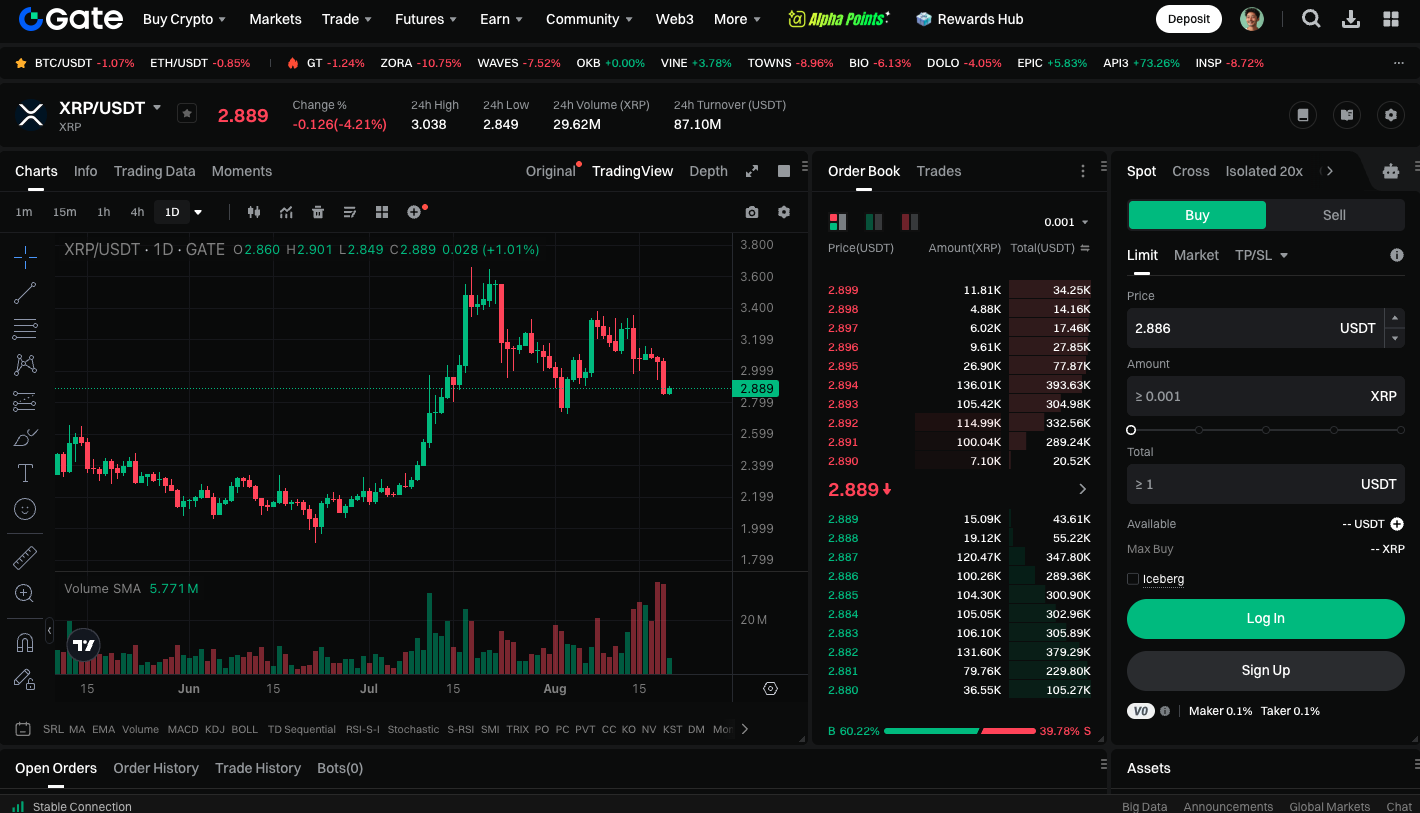
Despite strong fundamentals, XRP has recently experienced price pressure. Over the past week, XRP fell from a high of around $3.40 and is currently fluctuating near $2.89, approximately 18% below the July peak of $3.65. Technical analysis indicates:

  • Key Support Zone: The $3 to $2.9 range; a break below could lead to a test of $2.7–$2.8
  • Short-Term Resistance: $3.20—if broken, a fresh rebound could begin

At the time of writing, daily trading volume reached $6.57 billion, indicating high market activity. The on-chain NVT ratio has dropped to 111.8, suggesting that trading activity relative to market cap has increased—a positive indicator of healthy network usage.

You can trade XRP spot: https://www.gate.com/trade/XRP_USDT
Conclusion

Ripple’s aggressive expansion in custody and tokenization infrastructure positions XRP for long-term growth. In the short term, prices remain influenced by technical resistance and pending regulatory developments. If bulls can hold the $2.90 support and break above the $3.20 resistance, the market may see the next rally.

Author: Allen
Disclaimer
* The information is not intended to be and does not constitute financial advice or any other recommendation of any sort offered or endorsed by Gate.
* This article may not be reproduced, transmitted or copied without referencing Gate. Contravention is an infringement of Copyright Act and may be subject to legal action.

Related Articles

What is Fartcoin? All You Need to Know About FARTCOIN
Intermediate

What is Fartcoin? All You Need to Know About FARTCOIN

Fartcoin (FARTCOIN) is a representative meme coin within the Solana ecosystem based on an AI-driven narrative. Its core concept originated from an experiment aimed at exploring the "boundaries between AI Agents and humor." More than just a digital asset with social attributes, the project deeply couples absurd humor culture with on-chain financial logic by integrating autonomous AI interaction models.
2026-04-04 22:01:19
Gold Price Forecast for the Next Five Years: 2026–2030 Trend Outlook and Investment Implications, Could It Reach $6,000?
Beginner

Gold Price Forecast for the Next Five Years: 2026–2030 Trend Outlook and Investment Implications, Could It Reach $6,000?

Analyze current gold price trends alongside authoritative five-year forecasts, integrating an evaluation of market risks and opportunities. This gives investors insight into the potential trajectory of gold prices and the main drivers expected to shape the market over the next five years.
2026-03-25 18:13:30
Aster vs Hyperliquid: Which Perp DEX Will Prevail?
Beginner

Aster vs Hyperliquid: Which Perp DEX Will Prevail?

Aster and Hyperliquid are the two representative protocols of the "purpose-built L1 path" within the current decentralized perpetual exchange (Perp DEX) sector. As a pioneer in the field, Hyperliquid has built a deep liquidity moat through its highly mature order book architecture and strong community consensus. Conversely, Aster, as a rising challenger, seeks to leapfrog the competition in high-performance trading through more aggressive multi-chain aggregation logic, private transaction modules, and an underlying execution environment optimized for 2026 market demands.
2026-03-24 11:58:33
AI-Native Settlement Layers: How United Stables Is Building the Next Financial Rail
Beginner

AI-Native Settlement Layers: How United Stables Is Building the Next Financial Rail

Stablecoins were originally designed as dollar substitutes within exchanges, primarily used for asset pricing and trade settlement. As on-chain financial ecosystems have matured, their role has expanded beyond simple payments to include collateral assets, cross-chain liquidity mediums, and unified settlement units. In particular, as AI systems and automated agents begin to participate directly in economic activity, demand has risen sharply for programmable value units capable of instant settlement. This shift is pushing stablecoins toward the role of foundational financial infrastructure.
2026-03-25 03:16:17
How Does Kite Work? An In-Depth Look at Kite's Identity and Programmable Permission Architecture
Beginner

How Does Kite Work? An In-Depth Look at Kite's Identity and Programmable Permission Architecture

Kite is an EVM compatible Layer 1 blockchain network that runs on proof of stake. It is designed to give AI agents verifiable identity, programmable permissions, and real time settlement in an on-chain execution environment. In Kite's design, AI is no longer only a tool that follows instructions. It becomes an economic participant with independent on-chain identity and direct control over assets. Within secure and auditable infrastructure, an AI agent can complete payments, call services, and coordinate tasks autonomously, making Kite a foundational layer for the emerging agent economy.
2026-03-25 06:02:34
DePIN Identity Network and Real World Applications: How Humanity Protocol Brings on-chain Identity Into the Physical World
Beginner

DePIN Identity Network and Real World Applications: How Humanity Protocol Brings on-chain Identity Into the Physical World

Most Web3 identity systems remain confined to on-chain environments and struggle to achieve meaningful adoption in real world settings. Through a DePIN architecture and physical verification hardware, Humanity Protocol aims to bring decentralized identity into access control systems, hospitality, public services, and offline events, allowing on-chain identity to function not just as a digital credential, but as foundational infrastructure for real world access.
2026-03-25 07:40:53