# Article Introduction
**AIAGENT (Casper AI) Price Analysis & Investment Guide**
This comprehensive report delivers professional insights into AIAGENT token valuation, currently trading at $0.0005184 with extreme bearish conditions (-90.12% yearly decline). The analysis synthesizes historical price trends, market fundamentals, AI agent ecosystem growth projections, and macroeconomic factors to forecast 2026-2031 price trajectories. Designed for investors seeking exposure to AI-blockchain convergence, the guide addresses market positioning, risk assessment, and strategic trading methodologies through Gate platform. Core sections examine technological infrastructure development, enterprise adoption potential, regulatory challenges, and institutional investment strategies. Whether you're exploring entry points during depressed valuations or analyzing long-term tokenomics, this resource equips you with data-driven forecasting models and actionable portfolio allocation frameworks for AIAGENT investment decisions
Introduction: Market Position and Investment Value of AIAGENT
Casper AI (AIAGENT) is a transformative cryptocurrency token built on the secure and scalable Casper blockchain that empowers users to create, customize, and tokenize AI Agents with ease. As of January 1st, 2026, AIAGENT has achieved a market capitalization of $652,073.14 with a circulating supply of approximately 425,357,144 tokens, currently trading at $0.0005184 per token. This innovative asset, recognized as a pioneering solution in the AI agent deployment space, is playing an increasingly critical role in democratizing AI technology for individuals and enterprises worldwide.
This article will provide a comprehensive analysis of AIAGENT's price trajectory and market dynamics, integrating historical trends, supply-demand fundamentals, ecosystem development, and macroeconomic factors to deliver professional price forecasts and actionable investment guidance for discerning investors.
Casper AI (AIAGENT) Market Analysis Report
I. AIAGENT Price History Review and Current Market Status
AIAGENT Historical Price Evolution
- January 7, 2025: Reached all-time high of $0.019999, marking peak market enthusiasm for the project
- December 8, 2025: Declined to all-time low of $0.0003983, representing significant market correction
- 2025 Performance: Year-to-date decline of -90.12%, reflecting considerable bearish pressure throughout the period
AIAGENT Current Market Conditions
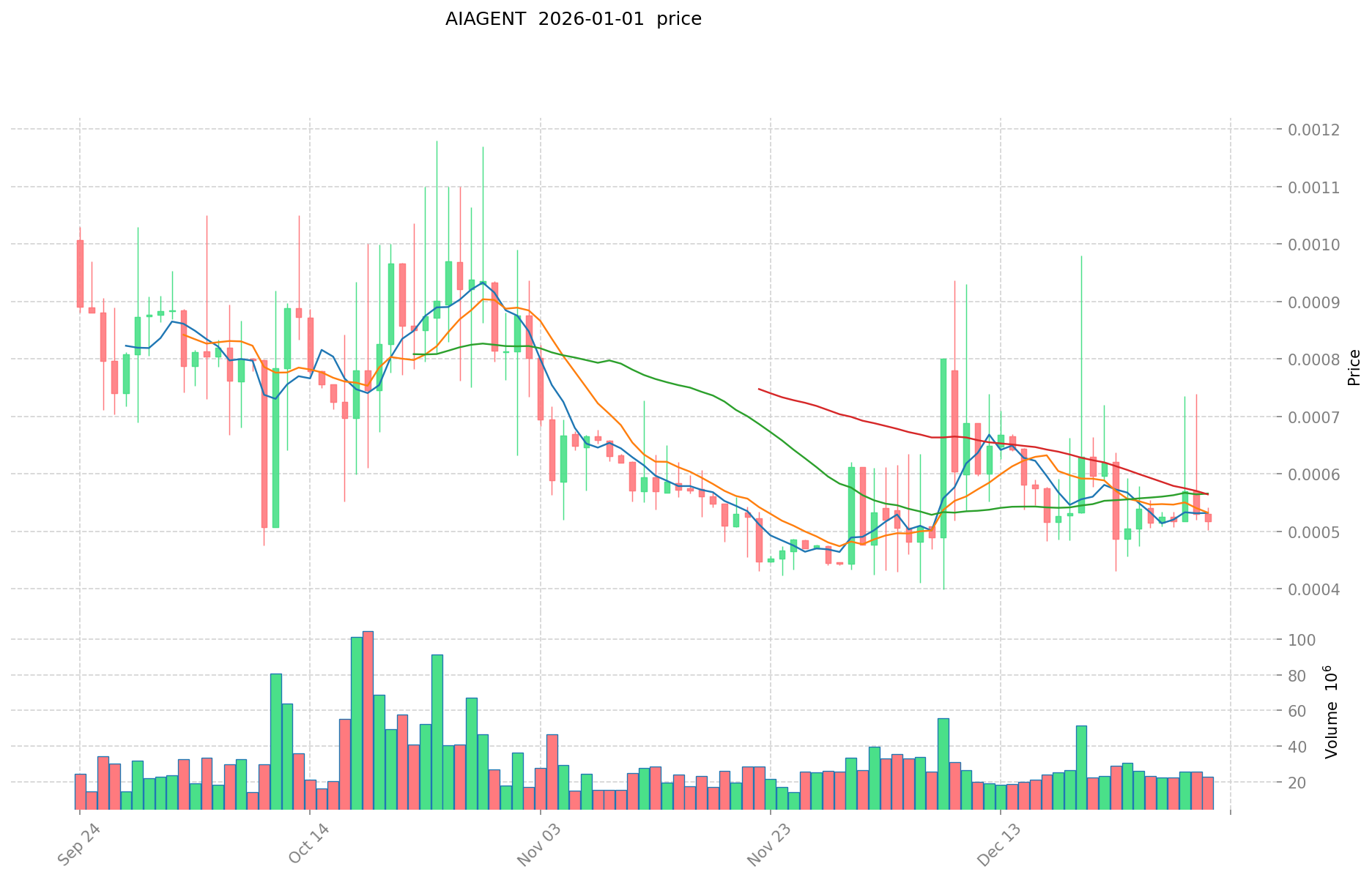
As of January 1, 2026, AIAGENT is trading at $0.0005184, positioned near its historical lows. The token exhibits a market capitalization of $220,505.14 with a fully diluted valuation of $652,073.14.
The 24-hour price movement shows a -2.5% decline, while short-term performance displays modest recovery signals with a +0.35% gain over the past hour and a +5.67% weekly increase. Over the 30-day period, the token has appreciated +8.00%, suggesting some stabilization from depressed levels.
Market metrics indicate:
- 24-hour trading volume: $11,717.30
- Circulating supply: 425,357,144 AIAGENT tokens (33.82% of total supply)
- Total supply: 1,257,857,144 tokens
- Active holders: 2,294
- Market dominance: 0.000020%
The current market environment reflects extreme fear sentiment (VIX rating of 20), with the token trading at approximately 97.4% below its all-time high, indicating depressed valuation levels relative to peak market cycles.
View current AIAGENT market price
AIAGENT Market Sentiment Indicator
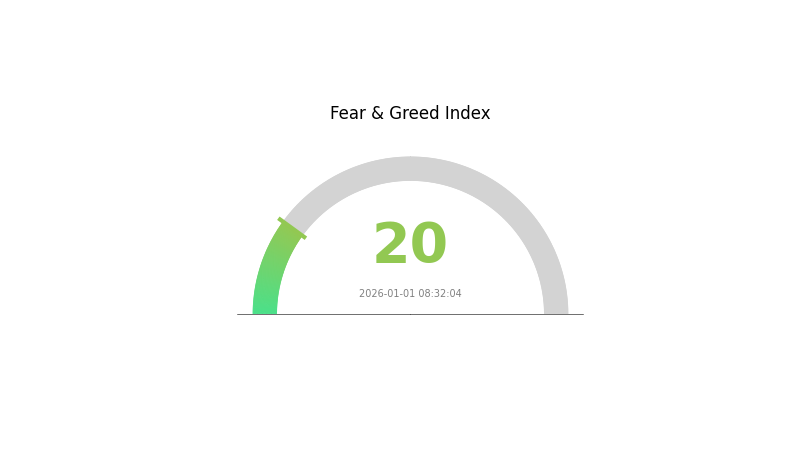
2026-01-01 Fear and Greed Index: 20 (Extreme Fear)
Click to view current Fear & Greed Index
The cryptocurrency market is experiencing extreme fear with the Fear and Greed Index standing at 20. This historically low reading signals significant market pessimism and risk aversion among investors. During periods of extreme fear, asset prices often reach attractive entry points for long-term investors. However, heightened volatility and potential further downside remain concerns. Market participants should exercise caution, conduct thorough research, and consider their risk tolerance. Such extreme sentiment readings can precede market rebounds, making this a critical period for strategic decision-making on Gate.com and other trading platforms.
AIAGENT Holdings Distribution
Address holdings distribution refers to the concentration of token supply across different wallet addresses on the blockchain. This metric provides critical insights into the decentralization structure of a project and helps investors assess potential risks associated with token concentration and market manipulation.
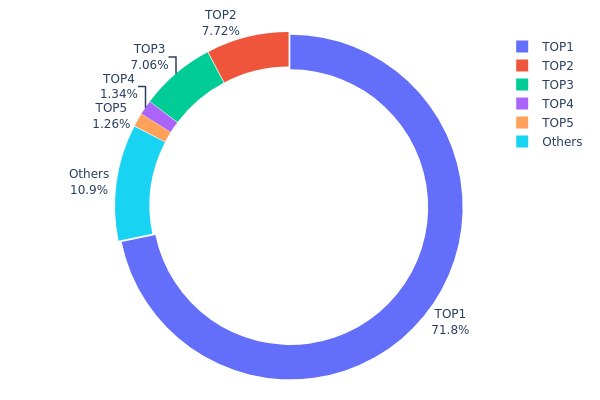
AIAGENT exhibits significant concentration risk in its current distribution structure. The top holder commands 71.75% of the total supply with 902.55 million tokens, representing an exceptionally high level of centralization. The second and third largest holders collectively account for 14.76% of the supply, meaning the top three addresses control approximately 86.51% of all AIAGENT tokens in circulation. This extreme concentration in the hands of a few entities substantially increases the vulnerability of the token to potential large-scale liquidation events or coordinated sell-offs. The remaining addresses, excluding the top five holders, collectively possess only 10.89% of the supply, highlighting the pronounced disparity in wealth distribution.
This concentrated holding structure presents notable implications for market dynamics and token stability. The dominant position of the primary holder creates considerable counterparty risk, as a single large transaction could trigger significant price volatility. Additionally, such heavy concentration may impede genuine market price discovery and liquidity formation, as the true free-floating supply available for trading remains substantially constrained. The current distribution pattern reflects limited decentralization, suggesting the project retains characteristics typical of early-stage token allocation rather than an evolved market ecosystem with distributed ownership. These factors warrant careful consideration when evaluating AIAGENT's long-term viability and market resilience.
Click to view current AIAGENT Holdings Distribution
| Top |
Address |
Holding Qty |
Holding (%) |
| 1 |
0x0529...c553b7 |
902547.59K |
71.75% |
| 2 |
0x0d07...b492fe |
97090.67K |
7.71% |
| 3 |
0x4982...6e89cb |
88770.10K |
7.05% |
| 4 |
0x328a...68798d |
16909.85K |
1.34% |
| 5 |
0xd018...f8b7da |
15905.94K |
1.26% |
| - |
Others |
136632.99K |
10.89% |
Core Factors Affecting AIAGENT Future Price
Technology Development and Ecosystem Construction
Large Language Model Evolution
-
Large Model Architecture Innovation: The global large language model market is projected to grow from USD 4.5 billion in 2023 to USD 82.1 billion by 2033, with a 10-year CAGR of 33.7%. Large language models serve as the core driving force for AI Agent development, and technological iterations directly propel AI Agent market expansion. Major model manufacturers are accelerating API input/output pricing reductions, entering a "volume-for-price" commercial model phase that drives inference volume growth.
-
Historical Pattern: As large language models mature in fundamental capabilities, the industry transitions from model pretraining (PreTrain) focus in 2023 to emphasis on inference, workflow optimization, and context engineering in 2024-2025. This progression supports AI Agent commercialization.
-
Current Impact: Continued breakthrough in multi-modal interaction, memory, and reasoning capabilities will enhance AI Agent effectiveness, directly influencing market adoption rates and price dynamics.
Infrastructure Development
-
Cloud-Side Deployment: Global public cloud market reached USD 481.9 billion in 2023 with 22.4% year-over-year growth, creating favorable conditions for AI Agent application incubation. Cloud computing platforms provide foundational support for enterprise-scale AI Agent deployments.
-
End-Side Expansion: Gen AI smartphone shipments are projected to exceed 550 million units by 2027, reaching 43% market penetration. AI PC penetration is expected to reach 60%+ by 2027 from 20% in Q3 2024. Edge AI deployment enables widespread consumer-facing AI Agent applications through mobile and personal computing devices.
-
Market Scale Growth: The global AI Agent market reached approximately USD 5.2 billion in 2023, with cloud-side applications comprising 64%. The market is projected to reach USD 88.1 billion by 2032, representing a CAGR exceeding 36.5% over the 2023-2032 period.
-
Development Infrastructure: LangChain framework evolution and emergence of enterprise-grade platforms such as LangSmith Agent Builder, AutoGen, and Salesforce/Google enterprise solutions enable complex AI Agent system development. These frameworks reduce development barriers and accelerate commercialization timelines.
-
No-Code Solutions: Introduction of no-code AI Agent creation tools and customizable sandbox environments democratizes agent development, expanding the ecosystem of agent-based applications beyond specialized developers.
Enterprise Application Verticals
-
Business Process Transformation: AI Agents demonstrate high ROI in enterprise vertical applications. Financial AI risk control achieves 462% ROI. Applications span customer service, software development, financial services, medical diagnostics, legal document processing, and industrial optimization—with financial and legal sectors showing highest commercialization maturity.
-
Embodied Intelligence Integration: AI Agents enhanced by large language models elevate embodied intelligence systems' intelligence levels, accelerating robotics commercialization. Known participants include Tesla, Figure.ai, and domestic companies DJI and Unitree. China's humanoid robot shipments are projected to reach 350,000 units by 2030, with market value potentially reaching USD 58.1 billion by 2030.
Macroeconomic Environment
Fiscal and Monetary Policy Support
-
Capital Injection: National-level government guidance funds establish regional sub-funds supporting early-stage hard technology investments. Domestic government funding for AI and intelligence sectors shows significant increases, providing structural policy support for AI Agent market development.
-
Market Recovery: Hong Kong stock market recovery in 2025 reopens exit channels for innovation enterprises, establishing healthy capital cycles for venture capital participation in AI Agent startups.
Market Expansion and Investment Dynamics
-
Funding Acceleration: AI Agent market experienced explosive growth with USD 3.8 billion in 2024 financing—triple the 2023 level. VC investment focus shifted from foundational large models to AI application layer, particularly AI Agent solutions, following DeepSeek open-source releases and mainstream media attention.
-
Investment Trends: Market consolidation occurs around differentiated vertical solutions with clear business models and strong technical moats, rather than undifferentiated general-purpose agents. Investors increasingly emphasize technology depth, industry experience, and commercialization pathways over speculative potential.
-
Geographic Diversification: Multi-polar market layout emerging across Southeast Asia, Latin America, and Middle East regions. China's AI Agent market expansion increasingly targets global markets beyond domestic competition.
Market Confidence Reconstruction
-
Global Recognition: Chinese AI innovation gains international investor attention following breakthrough developments like DeepSeek and leading robotics companies. This perception shift drives structural capital allocation changes toward Chinese AI enterprises.
-
Competitive Advantage Recognition: Chinese enterprises demonstrate superior "unit intelligence cost"—achieving equivalent AI capability at significantly lower investment than Western competitors. DeepSeek's model costs approximately one-tenth of certain Western equivalents, establishing comparative advantage in cost-efficient intelligence.
Risk Factors and Market Challenges
Technology Maturity Constraints
-
Hallucination and Reliability Issues: Current large language models demonstrate "hallucination" problems, knowledge staleness, and execution fragility, limiting autonomous agent reliability. High-trust applications requiring guaranteed accuracy face significant barriers to adoption.
-
Technical Bottleneck: Model capability ceiling remains uncertain. Sustained ability to solve increasingly complex problems requires breakthrough innovations in reasoning, planning, and execution coordination.
Market and Commercial Barriers
-
User Trust Requirements: Universal personal agent applications demand exceptionally high user trust levels. Failures in financial management, booking accuracy, or schedule reliability carry significant consequences, creating adoption friction.
-
Competitive Intensity and Market Fragmentation: Large model manufacturers rapidly replicate and integrate agent capabilities, compressing differentiation windows. Vertical domain specialists face competition from generalist platforms as ability cascades accelerate.
-
Enterprise Adoption Challenges: General-purpose B2B agents often require extensive user verification and correction, with user cognitive and time costs exceeding Agent-provided efficiency gains in many scenarios. True value requires deep industry domain knowledge and customization.
Regulatory and Compliance Risks
-
Data Security and Privacy Governance: Tightening data protection regulations and privacy monitoring increase compliance requirements for agent deployment, particularly in regulated industries like finance and healthcare.
-
Macroeconomic Sensitivity: Consumer demand weakness due to economic downturn could reduce AI Agent adoption rates and monetization potential across consumer-facing applications.
The AI Agent market demonstrates significant long-term growth potential driven by foundational technology breakthroughs and expanding enterprise adoption. Price dynamics will reflect market capacity to achieve reliable, economically viable agent implementations across diverse industry verticals while navigating competitive pressures from incumbent technology platforms.
III. 2026-2031 AIAGENT Price Forecast
2026 Outlook
- Conservative Forecast: $0.00038 - $0.00057
- Neutral Forecast: $0.00052 (average expectation)
- Bullish Forecast: $0.00057 (with sustained market interest and ecosystem development)
2027-2029 Medium-term Outlook
- Market Stage Expectation: Gradual accumulation phase with potential volatility, transitioning toward broader adoption as AI agent technology matures
- Price Range Forecast:
- 2027: $0.00034 - $0.0007
- 2028: $0.00054 - $0.00091
- 2029: $0.0004 - $0.00104
- Key Catalysts: Advancement in AI agent infrastructure, increased institutional participation, integration with major platforms, and growth in decentralized AI applications
2030-2031 Long-term Outlook
- Base Case: $0.00047 - $0.00128 (sustained growth with moderate ecosystem expansion and mainstream adoption of AI agent technologies)
- Bullish Case: $0.00083 - $0.00151 (accelerated development of AI agent protocols, significant partnership announcements, and breakthrough in real-world applications)
- Transformative Case: $0.00151+ (revolutionary adoption of AI agents across enterprise and consumer sectors, major regulatory clarity, and network effects driving exponential growth)
- 2031-12-31: AIAGENT projected at $0.00151 (representing 110% cumulative appreciation from 2026 baseline, reflecting maturation of the AI agent ecosystem)
| 年份 |
预测最高价 |
预测平均价格 |
预测最低价 |
涨跌幅 |
| 2026 |
0.00057 |
0.00052 |
0.00038 |
0 |
| 2027 |
0.0007 |
0.00054 |
0.00034 |
4 |
| 2028 |
0.00091 |
0.00062 |
0.00054 |
19 |
| 2029 |
0.00104 |
0.00077 |
0.0004 |
48 |
| 2030 |
0.00128 |
0.00091 |
0.00047 |
74 |
| 2031 |
0.00151 |
0.00109 |
0.00083 |
110 |
Casper AI (AIAGENT) Professional Investment Strategy and Risk Management Report
IV. AIAGENT Professional Investment Strategy and Risk Management
AIAGENT Investment Methodology
(1) Long-term Holding Strategy
- Suitable Investors: Believers in AI agent tokenization and decentralized blockchain infrastructure, investors seeking exposure to emerging AI + Web3 convergence
- Operational Recommendations:
- Accumulate AIAGENT during price dips below $0.0005, targeting positions when volatility presents buying opportunities
- Set a 12-24 month holding horizon to participate in potential ecosystem growth as adoption of AI agents increases
- Reinvest any trading rewards from the platform back into token holdings to compound positions
(2) Active Trading Strategy
- Technical Analysis Tools:
- Relative Strength Index (RSI): Monitor overbought conditions above 70 and oversold conditions below 30 to identify reversal opportunities
- Moving Averages (MA): Use 20-day and 50-day moving averages to confirm trend direction and support/resistance levels
- Wave Trading Key Points:
- Capitalize on the 24-hour price volatility range ($0.0005024 - $0.0005323) through micro-trading during liquidity events
- Execute swing trades based on the positive 7-day performance (+5.67%) and 30-day momentum (+8%), but remain cautious given the severe 1-year decline (-90.12%)
AIAGENT Risk Management Framework
(1) Asset Allocation Principles
- Conservative Investors: 1-3% of total portfolio
- Active Investors: 3-8% of total portfolio
- Professional Investors: 5-15% of total portfolio (with robust hedging mechanisms)
(2) Risk Hedging Solutions
- Portfolio Diversification: Balance AIAGENT holdings with established cryptocurrencies and traditional assets to mitigate concentration risk
- Dollar-Cost Averaging (DCA): Deploy capital gradually over 6-12 months rather than lump-sum investing to reduce timing risk
(3) Secure Storage Solutions
- Hot Wallet Solution: Gate.com Web3 Wallet for frequent trading and liquidity, enabling seamless interaction with the CSPR AI platform
- Cold Storage Approach: Transfer significant holdings to non-custodial wallets for long-term security when not actively trading
- Security Considerations: Never share private keys or recovery phrases; enable two-factor authentication on all exchange accounts; verify contract addresses before token transfers to avoid phishing scams
V. AIAGENT Potential Risks and Challenges
AIAGENT Market Risks
- Extreme Volatility: AIAGENT has experienced a catastrophic 90.12% decline over one year, with a historical high of $0.019999 followed by a low of $0.0003983, indicating severe price instability and potential liquidity challenges
- Limited Trading Volume: Daily trading volume of only $11,717.30 with just one exchange listing indicates thin liquidity and potential difficulty exiting large positions without significant price slippage
- Small Market Capitalization: At $652,073 fully diluted valuation, AIAGENT remains an extremely micro-cap asset vulnerable to manipulation and sudden capital withdrawal
AIAGENT Regulatory Risks
- Emerging Regulatory Scrutiny: AI-powered token platforms may face increasing regulatory examination as governments develop clearer frameworks for tokenized services and decentralized autonomous systems
- Blockchain Compliance: Changes in BSC (Binance Smart Chain) network regulations or governance could impact token functionality and legal status across jurisdictions
- Securities Classification: Regulatory authorities in different regions may determine that AI agent tokens constitute unregistered securities, potentially restricting trading and causing legal complications
AIAGENT Technology Risks
- Smart Contract Vulnerabilities: The AIAGENT token operates on BSC infrastructure, exposing it to potential smart contract bugs, exploits, or security flaws that could compromise token functionality or user funds
- Platform Adoption Challenges: The CSPR AI platform's success depends on widespread adoption of AI agent tokenization—a nascent concept with unproven market demand and unclear use cases
- Blockchain Scalability: Although Casper blockchain aims for scalability, network congestion or limitations could impair the speed and cost-effectiveness of deploying and trading AI agents
VI. Conclusions and Action Recommendations
AIAGENT Investment Value Assessment
AIAGENT represents a highly speculative opportunity at the intersection of artificial intelligence and blockchain tokenization. While the CSPR AI platform's concept of enabling users to create and tokenize AI agents within minutes is innovative, the project faces significant execution risks. The token's severe 90.12% one-year decline, minimal trading volume, and micro-cap status underscore the extreme volatility and liquidity constraints characteristic of early-stage crypto projects. The platform remains unproven in terms of real-world adoption and revenue generation. Investors should view AIAGENT primarily as a high-risk, high-reward venture capital-like allocation rather than a conventional asset.
AIAGENT Investment Recommendations
✅ Beginners: Start with a minimal exploratory position (0.5-1% of portfolio) only after thoroughly researching the CSPR AI platform and understanding the complete loss of capital risk; prioritize paper trading or simulator practice before committing real funds
✅ Experienced Investors: Consider a 3-5% allocation if you have strong conviction in AI agent tokenization as a long-term trend; implement strict stop-loss orders at 15-20% below entry price and use dollar-cost averaging over 6-12 months
✅ Institutional Investors: Conduct extensive due diligence on the Casper blockchain's technical infrastructure, the team's development track record, and the CSPR AI platform's user acquisition metrics before considering allocation; negotiate OTC pricing through Gate.com's institutional services for large positions
AIAGENT Trading Participation Methods
- Direct Spot Trading: Purchase AIAGENT through Gate.com's spot trading interface using BTC, ETH, or USDT pairs for immediate exposure
- Gradual Accumulation: Execute multiple smaller purchases over weeks or months via DCA strategy to average down entry price and reduce timing risk
- Platform Integration: Participate directly in the CSPR AI ecosystem by creating and tokenizing AI agents, which may provide utility-based returns beyond pure token appreciation
Cryptocurrency investment carries extreme risk. This report does not constitute investment advice. Investors must conduct independent research and consult qualified financial professionals before making any decisions. Never invest funds you cannot afford to lose completely.
FAQ
What is AIAGENT token? What are its main uses and value sources?
AIAGENT token powers AI agent operations on blockchain, primarily used for transaction fees, developer incentives, and ecosystem governance. It bridges AI and cryptocurrency, enhancing financial tool accessibility and enabling autonomous smart contract execution in decentralized networks.
How to predict AIAGENT token price? What are common analysis methods?
Predict AIAGENT price using technical and fundamental analysis. Common methods include moving averages, trading volume analysis, and market sentiment indicators to identify trends and price patterns.
What are the main factors affecting AIAGENT price?
AIAGENT price is primarily influenced by market demand, trading volume, ecosystem development, technological upgrades, regulatory changes, and overall cryptocurrency market sentiment. Token adoption rate and project milestones also play significant roles.
What technical indicators should be focused on in AIAGENT price prediction technical analysis?
Focus on trading volume, price trends, moving averages, RSI indicator, MACD, support and resistance levels, market capitalization growth, adoption metrics, and volatility index for comprehensive technical analysis.
AI Agent ecosystem shows strong growth potential with innovative applications driving adoption. Leading projects like VIRTUAL and Fetch.AI demonstrate significant price appreciation through technological advancement and expanding use cases. As AI integration deepens in blockchain infrastructure, agent tokens are positioned for sustained value growth.
AI Agent ecosystem shows strong growth potential with innovative applications driving adoption. Leading projects like VIRTUAL and Fetch.AI demonstrate significant price appreciation through technological advancement and expanding use cases. As AI integration deepens in blockchain infrastructure, agent tokens are positioned for sustained value growth.
What are the main risks to consider when investing in AIAGENT tokens?
Key risks include market volatility, project hype, technical challenges, and regulatory uncertainty. AIAGENT's value depends on adoption rates and competitive developments in AI agent technology. Investors should conduct thorough research before committing capital.
* The information is not intended to be and does not constitute financial advice or any other recommendation of any sort offered or endorsed by Gate.