# Article Introduction
**TosDis (DIS) Price Analysis: Comprehensive DeFi Protocol Investment Guide**
This article delivers a professional 2026-2031 price forecast for TosDis (DIS), a decentralized finance protocol token currently trading at $0.5614. The analysis integrates historical price patterns, market supply dynamics, and macroeconomic factors to provide actionable investment strategies for DeFi investors. The guide addresses three key investor segments—beginners, experienced traders, and institutional investors—through customized risk management frameworks and portfolio allocation recommendations. By examining DIS's price history, current market sentiment (Fear Index: 26), token holding distribution, and regulatory challenges, this comprehensive resource equips readers with data-driven insights for evaluating DIS's speculative investment potential within diversified cryptocurrency portfolios traded on Gate.
Introduction: Market Position and Investment Value of DIS
TosDis (DIS) is a decentralized deposit protocol providing a variety of white-label DeFi products, dedicated to creating an efficient and systematic environment for the DeFi industry. Since its launch in 2021, TosDis has established itself as a comprehensive solution in the decentralized finance ecosystem. As of January 2026, DIS has a market capitalization of approximately $56,061.68, with a circulating supply of around 74,998 tokens, trading at approximately $0.5614 per token. This "one-stop DeFi interoperable solution," as its name suggests, is playing an increasingly important role in the DeFi sector through its diverse product offerings including staking services, yield farming, peer-to-peer lending platforms, and a fully-featured decentralized trading platform with competitive fees.
This article will provide a comprehensive analysis of TosDis's price trajectory from 2026 to 2031, integrating historical patterns, market supply and demand dynamics, ecosystem development, and macroeconomic factors to deliver professional price forecasts and practical investment strategies for investors seeking exposure to this DeFi protocol token.
I. DIS Price History Review and Current Market Status
DIS Historical Price Evolution Trajectory
-
February 2021: Project launch with initial price of $57, marking the beginning of DIS trading history. The token subsequently experienced significant appreciation, reaching an all-time high of $253.52 on February 6, 2021.
-
May 2023: Following extended market downturn, DIS reached its all-time low of $0.0094393 on May 13, 2023, representing a substantial decline from peak valuations as market conditions deteriorated across the DeFi sector.
-
2024-2026: Token entered a recovery phase with gradual price stabilization and recent upward momentum through early 2026.
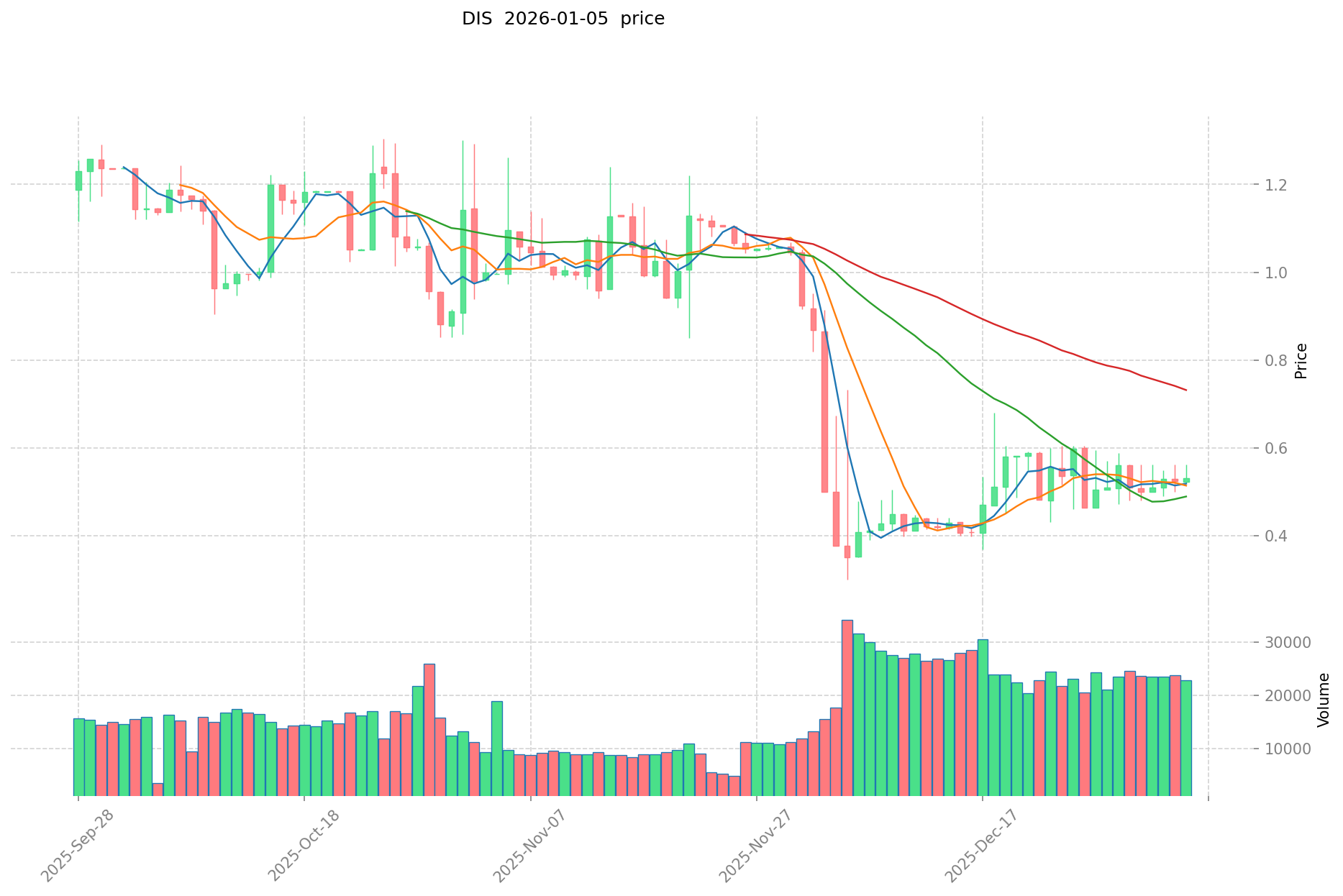
DIS Current Market Status
As of January 6, 2026, DIS is trading at $0.5614, reflecting a notable 5.78% increase over the past 24 hours. The token has demonstrated positive momentum over intermediate timeframes, with a 11.26% gain over the past 7 days and an 18.92% increase over the past 30 days. However, the 1-year performance shows a -61.65% decline, indicating substantial recovery remains needed from historical peaks.
The 24-hour trading range spans from $0.5268 (low) to $0.6045 (high), demonstrating moderate volatility. Daily trading volume reached $12,790.02, while the fully diluted market capitalization stands at $56,061.68, with a circulating market cap of $42,103.88. The token maintains a circulating supply of 74,998 DIS out of a total supply of 99,860.50, representing 74.998% circulation ratio. The market share remains minimal at 0.0000016%, reflecting DIS's position as a relatively smaller asset within the broader cryptocurrency ecosystem.
Click to view current DIS market price
DIS Market Sentiment Index
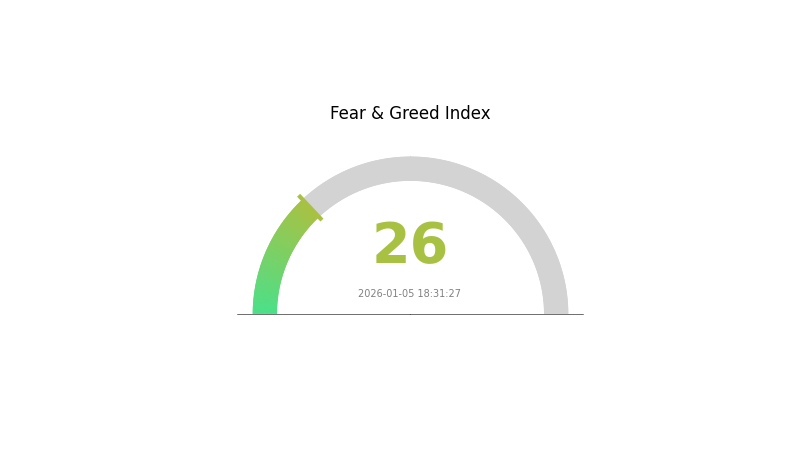
2026-01-05 Fear and Greed Index: 26 (Fear)
Click to view the current Fear & Greed Index
The crypto market is currently experiencing a fear-driven sentiment with an index reading of 26. This low score indicates heightened market anxiety and cautious investor behavior. Market participants are showing increased risk aversion, suggesting potential selling pressure and defensive positioning. Such fear-driven conditions often present opportunities for contrarian investors who identify undervalued assets. Monitor market developments closely on Gate.com to stay updated on sentiment shifts and potential trading opportunities.
DIS Holding Distribution
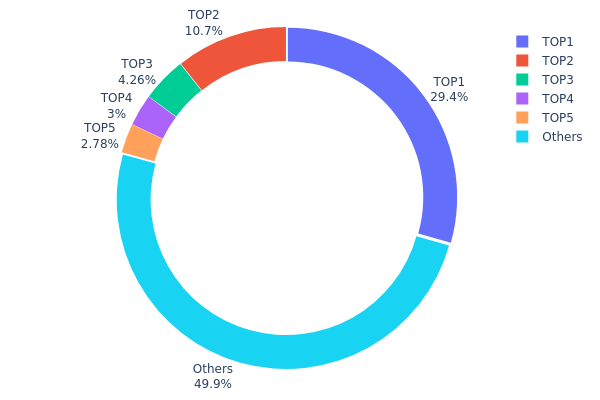
The address holding distribution chart illustrates the concentration of DIS tokens across different wallet addresses on the blockchain, providing critical insights into token ownership structure and potential market dynamics. By analyzing the top holders and their proportional stakes, we can assess the degree of decentralization and identify concentration risks that may influence price stability and market behavior.
The current holding distribution of DIS reveals moderate concentration characteristics, though with notable skewing toward major holders. The top address controls 29.35% of total supply, while the second and third largest holders account for 10.65% and 4.25% respectively. Collectively, the five largest addresses hold approximately 50.02% of all DIS tokens in circulation. This distribution pattern suggests that half of the token supply remains distributed among other addresses, which indicates a reasonable degree of fragmentation. However, the dominance of the leading address, representing nearly one-third of total holdings, presents a potential concentration risk that could impact price discovery and market confidence.
The current address distribution structure reflects a moderately decentralized market architecture. While the top holder's significant stake could theoretically facilitate large-scale transactions or price movements, the substantial portion held by distributed smaller addresses (49.98%) provides some resilience against unilateral market manipulation. The distribution suggests that DIS has achieved a balanced token ownership model, neither excessively centralized nor entirely fragmented. This structure indicates emerging market stability with adequate participant diversity, though continued monitoring of major holder movements remains essential for evaluating long-term market development and institutional confidence.
View the current DIS holding distribution
| Top |
Address |
Holding Qty |
Holding (%) |
| 1 |
0x3c5e...584c9f |
29.32K |
29.35% |
| 2 |
0x0d07...b492fe |
10.64K |
10.65% |
| 3 |
0xad5b...cff7a3 |
4.25K |
4.25% |
| 4 |
0xd48f...57ea92 |
3.00K |
3.00% |
| 5 |
0xb774...e6458f |
2.77K |
2.77% |
| - |
Others |
49.88K |
49.98% |
II. Core Factors Impacting DIS Future Price
Supply Mechanism
- Halving Mechanism: DIS undergoes periodic halving events, during which block rewards are reduced.
- Historical Patterns: Past halving events have typically driven long-term price appreciation.
Macroeconomic Environment
- Interest Rate Impact: High prevailing interest rates or reduced consumer spending may drag down the entertainment industry.
- Consumer Spending Sensitivity: Disney's performance is closely tied to consumer discretionary spending patterns and economic conditions.
III. DIS Price Forecast for 2026-2031
2026 Outlook
- Conservative Forecast: $0.5377 - $0.5601
- Base Case Forecast: $0.5601
- Optimistic Forecast: $0.61051 (requires sustained market stabilization and positive ecosystem developments)
Mid-term Perspective (2027-2029)
- Market Stage Expectation: Gradual recovery and consolidation phase with increasing adoption momentum
- Price Range Predictions:
- 2027: $0.56775 - $0.79601
- 2028: $0.58015 - $0.87714
- 2029: $0.44682 - $1.00339
- Key Catalysts: Ecosystem expansion, increased institutional interest, technology upgrades, and market sentiment improvements
Long-term Outlook (2030-2031)
- Base Scenario: $0.72385 - $1.13493 (assuming continued market development and moderate adoption acceleration)
- Optimistic Scenario: $0.89364 - $1.349 (contingent on breakthrough technology implementations and widespread market acceptance)
- Transformational Scenario: $1.349+ (extreme favorable conditions including major partnerships, regulatory clarity, and exponential user growth)
Note: All price predictions are subject to market volatility, regulatory changes, and macroeconomic conditions. Investors are advised to conduct thorough research on Gate.com and other reputable platforms before making investment decisions.
| 年份 |
预测最高价 |
预测平均价格 |
预测最低价 |
涨跌幅 |
| 2026 |
0.61051 |
0.5601 |
0.5377 |
0 |
| 2027 |
0.79601 |
0.5853 |
0.56775 |
4 |
| 2028 |
0.87714 |
0.69066 |
0.58015 |
23 |
| 2029 |
1.00339 |
0.7839 |
0.44682 |
39 |
| 2030 |
1.13493 |
0.89364 |
0.72385 |
59 |
| 2031 |
1.349 |
1.01429 |
0.568 |
80 |
TosDis (DIS) Professional Investment Strategy and Risk Management Report
IV. DIS Professional Investment Strategy and Risk Management
DIS Investment Methodology
(1) Long-term Holding Strategy
- Suitable For: Risk-averse investors with long-term portfolio horizons seeking exposure to decentralized finance infrastructure; institutional investors evaluating DeFi protocol investments.
- Operation Recommendations:
- Establish positions during market downturns when DIS trades below its long-term moving averages, taking advantage of the -61.65% one-year decline to accumulate at lower price levels.
- Implement dollar-cost averaging over 6-12 month periods to reduce timing risk and smooth entry prices across market cycles.
- Store DIS tokens on Gate.com with hardware security integration for institutional-grade custody, ensuring private key management and enabling staking participation within the TosDis protocol ecosystem.
(2) Active Trading Strategy
- Technical Analysis Tools:
- Support and Resistance Levels: Utilize the 24-hour trading range (high: 0.6045, low: 0.5268) and historical all-time high (253.52) as key technical reference points for setting entry and exit positions.
- Volume Analysis: Monitor the 24-hour trading volume of 12,790.015421 DIS against weekly and monthly averages to identify breakout opportunities and validate price movements.
- Wave Trading Key Points:
- Capitalize on the positive 7-day (+11.26%) and 30-day (+18.92%) momentum trends while monitoring for potential exhaustion signals near resistance levels.
- Execute tactical exits when price approaches the 24-hour high of 0.6045, securing profits before potential retracement to support levels.
DIS Risk Management Framework
(1) Asset Allocation Principles
- Conservative Investors: 2-3% of digital asset allocation, treating DIS as a speculative satellite position within a diversified portfolio.
- Active Investors: 5-8% of total cryptocurrency holdings, balancing DIS exposure with more established layer-1 blockchain tokens.
- Professional Investors: Up to 10-15% of alternative investment sleeve, potentially using DIS as part of a systematic DeFi protocol strategy.
(2) Risk Hedging Solutions
- Position Sizing Discipline: Limit individual DIS position size to no more than 3% of total investable assets to contain downside exposure from extreme volatility.
- Portfolio Diversification: Combine DIS holdings with complementary DeFi protocol tokens and non-correlated digital assets to reduce unsystematic risk and enhance risk-adjusted returns.
(3) Secure Storage Solution
- Custody Approach: Utilize Gate.com's secure wallet infrastructure with multi-signature authentication for DIS token management, ensuring institutional-grade security protocols for medium to large holdings.
- Cold Storage Integration: Implement hybrid custody models combining Gate.com's exchange wallet for active trading with offline storage solutions for long-term position preservation.
- Security Best Practices: Never share private keys or recovery phrases; enable withdrawal whitelist functionality on Gate.com; regularly audit transaction logs and maintain backup recovery procedures separate from primary devices.
V. DIS Potential Risks and Challenges
DIS Market Risk
- Extreme Volatility: DIS exhibits exceptional price volatility with a -61.65% annual decline despite recent recovery, demonstrating the token's susceptibility to market sentiment shifts and potential for significant drawdowns.
- Low Market Capitalization Exposure: With a total market cap of only $56,061.68 and dominance of 0.0000016%, DIS operates in an illiquid market segment vulnerable to slippage, manipulation, and sudden price dislocations.
- Limited Exchange Presence: Trading on only one exchange (Gate.com) creates concentration risk and reduces liquidity accessibility, potentially trapping investors during market stress periods.
DIS Regulatory Risk
- Unclear Legal Classification: As a decentralized finance protocol token, DIS faces ongoing regulatory uncertainty regarding its treatment as a security versus utility token across different jurisdictions.
- Evolving DeFi Compliance Requirements: Regulatory bodies worldwide continue developing frameworks for DeFi governance, staking mechanisms, and white-label solutions, creating potential compliance liabilities for protocol operators.
- Jurisdictional Constraints: Investors in certain regions may face restrictions accessing TosDis services or holding DIS tokens due to evolving local cryptocurrency regulations.
DIS Technical Risk
- Smart Contract Vulnerabilities: As a decentralized protocol managing deposits and trading functions, TosDis faces inherent smart contract audit and security risks that could result in fund loss.
- Protocol Obsolescence Risk: Competition from established DeFi platforms with superior user experience, liquidity depth, and governance mechanisms may render TosDis technology or economic model obsolete.
- Network Dependency: The protocol's functionality depends on Ethereum network stability and transaction costs, creating operational risks during network congestion or gas fee spikes.
VI. Conclusion and Action Recommendations
DIS Investment Value Assessment
TosDis (DIS) represents a speculative investment opportunity within the decentralized finance infrastructure sector. While the protocol's positioning as a one-stop DeFi interoperable solution aligns with industry infrastructure trends, the token exhibits characteristics consistent with early-stage, high-risk protocols: significant price volatility (-61.65% annually), minimal market adoption (1,536 token holders), concentrated liquidity, and limited exchange presence. The recent short-term recovery (5.78% 24-hour, 11.26% 7-day) suggests renewed interest, but the long-term fundamental value proposition requires substantial execution on white-label DeFi products, staking services, lending platforms, and DEX functionality. Investors should approach DIS as a venture-stage crypto asset suitable only for risk capital allocation.
DIS Investment Recommendations
✅ Beginners: Limit DIS to 1-2% portfolio allocation or paper trading only; conduct thorough due diligence on TosDis protocol features before any capital commitment; prioritize education on DeFi mechanics and smart contract risks.
✅ Experienced Investors: Consider 3-5% allocation within a diversified DeFi protocol portfolio; implement systematic position sizing rules with defined stop-losses at 20-25% below entry; monitor protocol development progress and community governance participation.
✅ Institutional Investors: Evaluate DIS within systematic alternative investment sleeves (5-10% allocation) only if comprehensive protocol audit reports, developer team vetting, and custodial infrastructure meet institutional standards; utilize Gate.com's institutional trading services for optimal execution.
DIS Trading Participation Methods
-
Spot Trading on Gate.com: Execute buy/sell orders directly on Gate.com's spot market using the DIS/USDT or DIS/ETH trading pairs, optimal for long-term position building with standard limit and market orders.
-
Gate.com Wallet Management: Store DIS holdings in Gate.com's secure wallet infrastructure with withdrawal address whitelisting, two-factor authentication, and transaction signing verification to prevent unauthorized access.
-
Protocol Participation: Engage directly with TosDis decentralized platform features including stake-mining services, liquidity provision for DeFi farming, and peer-to-peer lending protocols to generate yield beyond passive holding.
Disclaimer: Cryptocurrency investment carries extreme risk. This report does not constitute investment advice. Investors must conduct independent analysis and consult professional financial advisors before making investment decisions. Never invest capital exceeding your loss tolerance. Past performance does not guarantee future results. DIS token exhibits high volatility and illiquidity characteristics suitable only for sophisticated investors with substantial risk capital.
FAQ
What are the main price drivers for Disney (DIS) stock?
Disney stock price is primarily driven by quarterly financial reports, including revenue and profit growth. Strong earnings beats typically trigger significant price appreciation. Investor sentiment and market expectations also play crucial roles in price movements.
How to analyze Disney stock's long-term investment value and valuation level?
Analyze Disney's valuation through forward P/E ratio(39x), P/B ratio(1.78x), and enterprise value metrics. Monitor streaming profitability transition, theme park performance, and linear TV decline. Current valuation appears premium; focus on 2026 catalysts including DTC profitability and cost management for long-term value assessment.
What is the impact of Disney's streaming business (Disney+) growth on stock price?
Disney+ subscriber growth positively impacts stock price, but high streaming costs and other business pressures limit gains. Stock performance depends on multiple factors beyond Disney+ alone, including theme parks revenue and overall profitability trends.
What are professional analysts' price predictions for Disney stock in 2024-2025?
Professional analysts predict Disney stock will fluctuate between 64.32 to 138.54 USD in 2025, with an average forecast of 101.43 USD, indicating significant market volatility during this period.
What are the advantages and disadvantages of Disney stock compared to competitors like Netflix and Amazon?
Disney offers lower valuation and smaller market cap versus Netflix and Amazon. Netflix commands higher valuations, while Amazon exceeds Disney in total market value. Disney's strength lies in traditional media and diverse entertainment portfolio including theme parks and merchandise.
What are the main risk factors affecting Disney stock price?
Key risks include declining traditional TV viewership, substantial streaming content investments, macroeconomic sensitivity affecting theme parks and subscription services, and competition in the media industry.
* The information is not intended to be and does not constitute financial advice or any other recommendation of any sort offered or endorsed by Gate.