# 2025 DVI Price Prediction: Expert Analysis and Market Forecast for Digital Video Interface Technology
## Article Overview
This comprehensive analysis examines Dvision Network (DVI), a blockchain-based VR ecosystem token currently trading at $0.0002699, through detailed price forecasting and investment strategy frameworks. The article addresses critical investor needs by providing historical price trajectory analysis, current market metrics, and professional price predictions spanning 2026-2031, alongside actionable investment methodologies and risk management protocols. Designed for investors seeking data-driven DVI market insights, this guide evaluates ecosystem fundamentals, macroeconomic factors, and technical indicators while offering tailored strategies for beginners, experienced traders, and institutional investors. Combining market sentiment analysis with risk assessment frameworks, the article equips stakeholders with evidence-based forecasts and practical trading guidance on Gate for navigating D
Introduction: Market Position and Investment Value of DVI
Dvision Network (DVI) stands as a blockchain-based VR content ecosystem, presenting a new virtual reality world where users can engage in immersive digital experiences at the center of the fourth industrial revolution. Since its launch, DVI has established itself within the Web3 and metaverse sectors. As of January 2026, DVI maintains a market capitalization of approximately $269,900, with a circulating supply of 246.77 million tokens and a current price trading around $0.0002699. This digital asset continues to play an evolving role in the virtual reality and blockchain ecosystems.
This article will provide a comprehensive analysis of DVI's price trajectory and market dynamics as we move through 2026, examining historical price patterns, market supply-demand dynamics, ecosystem development, and broader macroeconomic factors. Through this detailed examination, we aim to equip investors with professional price forecasts and actionable investment strategies for navigating the DVI market in the coming period.
I. DVI Price History Review and Current Market Status
DVI Historical Price Evolution Trajectory
- November 2021: DVI reached its all-time high of $3.05, marking the peak of market enthusiasm during the broader cryptocurrency bull market of that period.
- 2022-2025: Extended bear market phase, with DVI experiencing a severe decline from its historical highs, losing approximately 98.18% of its value over the one-year period.
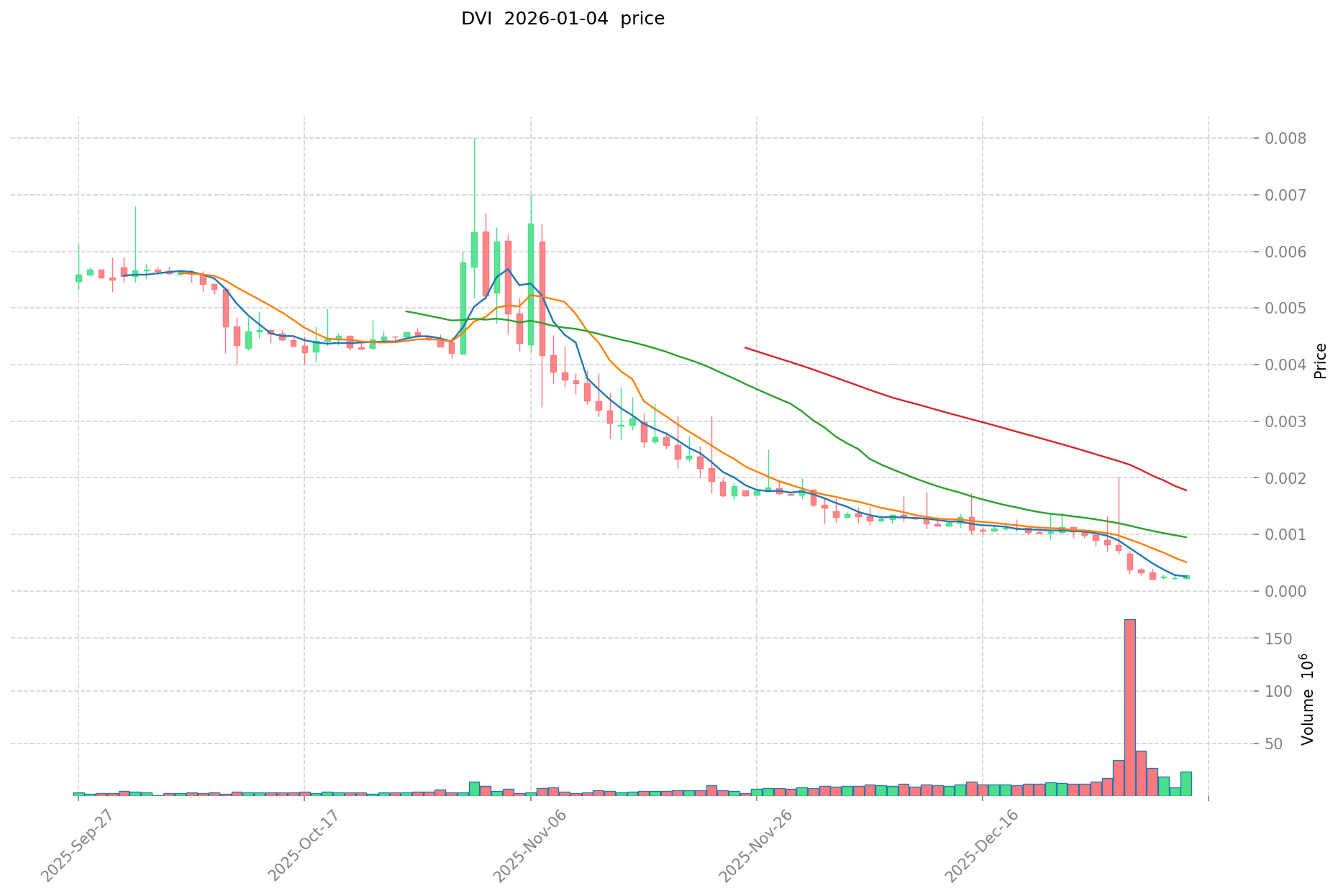
- December 2025: DVI touched its all-time low of $0.00022399 on December 29, 2025, representing the lowest point in the token's trading history.
DVI Current Market Snapshot
As of January 4, 2026, DVI is trading at $0.0002699, reflecting a notable recovery of 21.52% over the past 24 hours. The token's 24-hour trading range spans from $0.0002214 to $0.0002749.
The circulating supply stands at approximately 246.77 million DVI tokens out of a total supply of 1 billion tokens, resulting in a circulation ratio of 24.68%. The current market capitalization is valued at $66,603.19, with a fully diluted valuation of $269,900. DVI currently ranks 5,374 in terms of market capitalization and maintains an extremely minimal market dominance of 0.0000081%.
The 24-hour trading volume totals $3,198.35, indicating relatively low liquidity. However, the recent weekly performance shows significant downward pressure, with DVI declining 68.88% over the past seven days and 79.89% over the past month. The token is held by 2,166 addresses, demonstrating limited holder distribution.
Click to view current DVI market price
DVI Market Sentiment Indicator
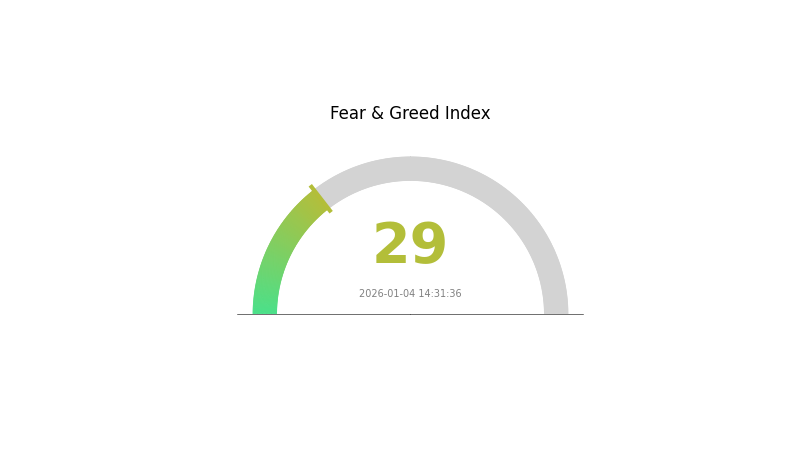
2026-01-04 Fear and Greed Index: 29 (Fear)
Click to view current Fear & Greed Index
The cryptocurrency market is currently dominated by fear sentiment, with the index standing at 29. This indicates heightened market anxiety and risk aversion among investors. During periods of fear, market volatility typically increases, and investors tend to adopt cautious strategies. This environment often presents both challenges and opportunities for traders and long-term investors. Those with strong conviction may view this as a potential entry point, while risk-averse participants may choose to reduce their exposure. Market participants should remain vigilant and adjust their strategies accordingly based on their risk tolerance and investment objectives.
DVI Holdings Distribution
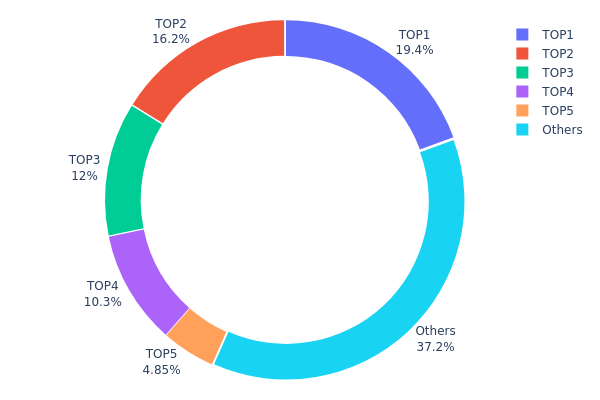
The address holdings distribution map represents the concentration of token ownership across the blockchain network, illustrating how DVI tokens are allocated among different wallet addresses. This metric is fundamental for assessing decentralization levels and identifying potential concentration risks that could influence market dynamics and price stability.
Analysis of the current DVI distribution reveals a moderate concentration pattern. The top four addresses collectively control 57.91% of total supply, with the leading address alone accounting for 19.41%. While this concentration is notable, it falls below levels typically associated with severe centralization concerns. The top address holding approximately 194.18 million tokens represents a significant position, yet the distribution gradually diminishes through subsequent ranks, with the fifth-largest holder controlling only 4.85%. Importantly, addresses beyond the top five collectively represent 37.24% of supply, indicating meaningful participation from the broader holder base and suggesting a degree of distributed ownership that mitigates extreme concentration risks.
This distribution structure reflects a market characterized by both institutional or early stakeholder presence and emerging community participation. The absence of a single dominant holder combined with meaningful smaller-scale ownership suggests reasonable resilience against potential market manipulation. The proportion held by secondary addresses demonstrates adequate liquidity dispersion, which supports more stable price discovery mechanisms. While the top-tier holders retain considerable influence over market movements, the relatively balanced tail distribution indicates an evolving decentralized structure that maintains functional market participation across multiple stakeholder categories.
Click to view current DVI Holdings Distribution
| Top |
Address |
Holding Qty |
Holding (%) |
| 1 |
0x96ad...b28d97 |
194178.68K |
19.41% |
| 2 |
0xc8ca...412884 |
161739.27K |
16.17% |
| 3 |
0x7be7...654071 |
120473.12K |
12.04% |
| 4 |
0x7429...438927 |
102945.79K |
10.29% |
| 5 |
0xd058...630d41 |
48507.22K |
4.85% |
| - |
Others |
372155.93K |
37.24% |
II. Core Factors Affecting DVI Future Price
Macroeconomic Environment
-
Inflation and Price Level Impact: Core consumer price index and GDP deflator levels significantly influence future price trends. Excessively low price levels (such as year-over-year below 0.5%) may themselves affect future price movements.
-
Output Gap and Economic Slack: The size of the output gap—measuring excess capacity in the real economy—directly impacts price trajectory. As the output gap narrows and the effects of commodity price declines weaken, inflation is expected to gradually recover in the medium term.
-
Commodity Price Dynamics: Fluctuations in commodity prices represent a key deflationary vulnerability factor affecting future core inflation rates and overall price movements.
Market Sentiment and Technical Factors
- Support and Resistance Levels: Support and resistance points serve as fundamental anchors for all price structures. These levels reflect where major market participants and retail traders have previously paused, faced losses, and re-entered positions, directly determining price momentum and directional movement.
Three、2026-2031 DVI Price Forecast
2026 Outlook
- Conservative Prediction: $0.00018 - $0.00027
- Neutral Prediction: $0.00027 (average expected level)
- Optimistic Prediction: $0.00031 (requires sustained market interest and positive sentiment)
2027-2029 Medium-term Outlook
- Market Stage Expectation: Gradual recovery phase with consolidation patterns, transitioning from stability to moderate growth momentum
- Price Range Prediction:
- 2027: $0.00024 - $0.00042
- 2028: $0.00023 - $0.00047
- 2029: $0.00039 - $0.00054
- Key Catalysts: Increased adoption of underlying technology, market sentiment improvement, ecosystem development milestones, and potential regulatory clarity in major markets
2030-2031 Long-term Outlook
- Base Case Scenario: $0.00042 - $0.00071 (assumes steady market growth and consistent adoption)
- Optimistic Scenario: $0.00071 - $0.00087 (assumes accelerated ecosystem expansion and mainstream institutional interest)
- Transformational Scenario: $0.00087+ (assumes breakthrough technology implementation, significant partnership announcements, or major market paradigm shifts)
- 2031-12-31: DVI projected at $0.00087 (potential peak during favorable market conditions with 119% cumulative gain from 2026 baseline)
| 年份 |
预测最高价 |
预测平均价格 |
预测最低价 |
涨跌幅 |
| 2026 |
0.00031 |
0.00027 |
0.00018 |
0 |
| 2027 |
0.00042 |
0.00029 |
0.00024 |
8 |
| 2028 |
0.00047 |
0.00036 |
0.00023 |
31 |
| 2029 |
0.00054 |
0.00041 |
0.00039 |
52 |
| 2030 |
0.00071 |
0.00048 |
0.00042 |
77 |
| 2031 |
0.00087 |
0.00059 |
0.00039 |
119 |
Dvision Network (DVI) Professional Investment Strategy and Risk Management Report
IV. DVI Professional Investment Strategy and Risk Management
DVI Investment Methodology
(1) Long-term Holding Strategy
- Target Investors: Investors with strong risk tolerance and belief in VR blockchain ecosystem development
- Operation Recommendations:
- Accumulate DVI tokens during market downturns, considering the project's long-term VR content ecosystem vision
- Hold positions through market volatility cycles, as VR adoption and blockchain integration may take years to materialize
- Participate in ecosystem development through staking or governance opportunities if available
(2) Active Trading Strategy
- Technical Analysis Tools:
- Support and Resistance Levels: Identify key price points at $0.0002214 (24-hour low) and $0.0002749 (24-hour high) for entry and exit signals
- Volume Analysis: Monitor the 24-hour trading volume of $3,198.35 to assess liquidity and confirm breakout strength
- Wave Trading Key Points:
- Utilize the significant 24-hour price increase of 21.52% to identify potential reversal patterns
- Apply caution given the severe 7-day (-68.88%), 30-day (-79.89%), and 1-year (-98.18%) declines, indicating extended bearish pressure
DVI Risk Management Framework
(1) Asset Allocation Principles
- Conservative Investors: 0.5-1% of portfolio
- Aggressive Investors: 2-5% of portfolio
- Professional Investors: 5-10% of portfolio
(2) Risk Hedging Solutions
- Dollar-Cost Averaging: Spread investments over multiple purchase periods to reduce timing risk
- Position Sizing: Limit individual DVI position to prevent portfolio concentration risk given extreme price volatility
(3) Secure Storage Solution
- hardware wallet Recommendation: Use secure hardware storage solutions for long-term holding to protect against exchange hacking risks
- Hot Wallet Method: For active trading, maintain minimum balances on Gate.com and use Gate Web3 wallet for selected asset management
- Security Considerations: Enable two-factor authentication on all exchange accounts, use strong passwords, never share private keys, and verify contract addresses before transactions
V. DVI Potential Risks and Challenges
DVI Market Risk
- Extreme Volatility: DVI has declined 98.18% over the past year, demonstrating extreme price instability unsuitable for conservative investors
- Liquidity Constraints: With only 1 exchange listed and 24-hour volume of $3,198.35, trading liquidity is severely limited, creating potential slippage risks
- Market Cap Concentration: Current market capitalization of only $66,603.19 indicates a micro-cap asset with minimal market depth
DVI Regulatory Risk
- VR and Metaverse Regulation: Evolving global regulations around virtual reality platforms and digital content ecosystems may impact project viability
- Cryptocurrency Classification: Changes in how regulatory authorities classify blockchain-based VR tokens could affect trading availability and compliance requirements
- Jurisdiction-Specific Restrictions: Certain countries may restrict access to DVI or similar VR blockchain projects, limiting market expansion
DVI Technical Risk
- Smart Contract Vulnerability: As a blockchain-based project deployed on both Ethereum and BSC chains, potential security flaws in smart contracts could expose user assets
- Ecosystem Development: The project's success depends on actual VR content ecosystem adoption and integration, which remains unproven at scale
- Cross-Chain Interoperability: Managing token functionality across multiple blockchains introduces technical complexity and potential failure points
VI. Conclusion and Action Recommendations
DVI Investment Value Assessment
Dvision Network represents a speculative opportunity in the intersection of VR technology and blockchain ecosystems. However, the project faces significant headwinds: a devastating 98.18% year-over-year decline, micro-cap market position ($66,603 market cap), minimal trading liquidity, and concentrated listing on a single exchange. While the long-term vision of a blockchain-based VR content ecosystem holds conceptual merit, current market performance and execution uncertainty present substantial investment risks. The recent 21.52% 24-hour increase may reflect speculative recovery rather than fundamental improvements.
DVI Investment Recommendations
✅ Beginners: Avoid DVI entirely. The extreme volatility, minimal liquidity, and unproven ecosystem make this unsuitable for portfolio building. Focus on established blockchain projects first.
✅ Experienced Investors: Only consider DVI as a high-risk speculative position limited to 1-2% of portfolio, with strict stop-loss discipline at -20-30%. Conduct thorough due diligence on ecosystem development progress before committing capital.
✅ Institutional Investors: Avoid DVI due to illiquidity, single-exchange limitation, and micro-cap classification. The position size constraints prevent meaningful portfolio exposure without creating execution challenges.
DVI Trading Participation Methods
- Gate.com Spot Trading: Purchase DVI directly on Gate.com using market or limit orders, with awareness of potential wide spreads given low liquidity
- Long-term Cold Storage: For believers in the project thesis, transfer purchased tokens to secure hardware wallets for multi-year holding periods
- Risk-Managed Entry: Use staged buying approach during confirmed support levels with strict profit-taking at 15-25% gains due to volatility profile
Cryptocurrency investment carries extreme risk. This report does not constitute investment advice. Investors must make decisions based on personal risk tolerance and conduct thorough independent research. Always consult qualified financial professionals before investing. Never invest capital you cannot afford to lose entirely.
FAQ
What is DVI? What factors determine its price?
DVI is the native token of Dvision Network, a metaverse platform. Its price is primarily determined by market demand, trading volume, ecosystem development, user adoption, and overall cryptocurrency market sentiment.
How to predict DVI's future price? What are the common analysis methods?
Predict DVI's future price using technical and fundamental analysis. Technical analysis examines historical price patterns and trading volume. Fundamental analysis considers output gaps, inflation expectations, and market sentiment to forecast price movements.
What is DVI's historical price trend? What was the price change over the past year?
DVI reached its all-time high of over $3.16 USD in November 2021. Over the past year, DVI has experienced significant price decline. As of January 2026, the specific year-over-year percentage change remains variable based on market conditions.
What are the main risk factors affecting DVI price?
DVI price is primarily affected by output gap and inflation expectations. Negative output gaps and weak financial asset prices are the key risk factors driving DVI volatility.
How does DVI's price prediction difficulty and accuracy compare to similar assets?
DVI price prediction is generally more challenging than similar assets due to lower market activity and limited data availability. However, with increasing adoption and trading volume, prediction accuracy continues to improve steadily.
What are professional institutions and analysts predicting for DVI's future price?
Professional institutions predict DVI will continue growing through 2025-2030, supported by market supply-demand dynamics and macroeconomic factors. Predictions are based on historical data and market trends analysis.
* The information is not intended to be and does not constitute financial advice or any other recommendation of any sort offered or endorsed by Gate.