The article delves into the comprehensive price trends and forecasts for MilkyWay (MILK) from 2025 to 2030, focusing on factors influencing price movement such as market dynamics, macroeconomic conditions, and supply mechanisms. It addresses investor concerns, presenting professional strategies for long-term holding and active trading, along with risk management approaches. The content is structured to offer market analysis, price drivers, future price outlook, investment strategies, and potential risks. Readers, particularly investors and traders in the cryptocurrency sector, will gain insights into MILK's market position and investment value, empowering them to make informed decisions using data from Gate.
Introduction: Market Position and Investment Value of MILK
MilkyWay (MILK) is the first and largest liquid staking and restaking protocol in the modular ecosystem. As of December 26, 2025, MILK has achieved a market capitalization of $5,200,000 with approximately 238,900,000 tokens in circulation, trading at around $0.0052 per token. This protocol-based asset is playing an increasingly critical role in the liquid staking and restaking sector of the modular blockchain ecosystem.
This article will provide a comprehensive analysis of MILK's price trends for the period from 2025 to 2030, combining historical price patterns, market supply and demand dynamics, ecosystem development, and macroeconomic factors to deliver professional price forecasts and practical investment strategies for investors.
MilkyWay (MILK) Market Analysis Report
I. MILK Price History Review and Current Market Status
MILK Historical Price Evolution
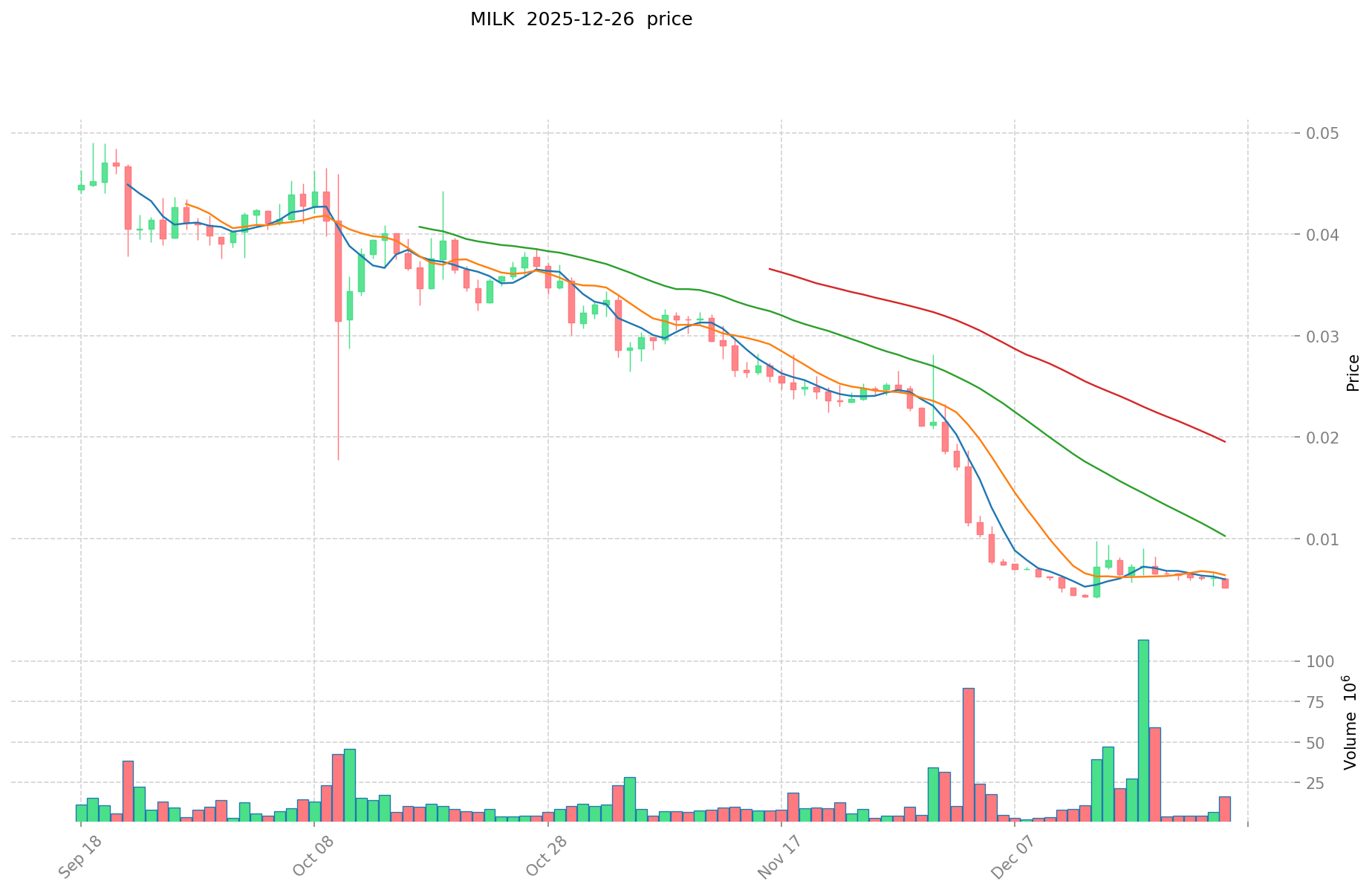
MilkyWay (MILK) was published on December 26, 2025, marking its entry into the cryptocurrency market. Since its launch, the token has experienced significant volatility:
-
December 2025 (Launch Period): MILK reached its all-time high (ATH) of $0.2919 on April 29, 2025, representing the peak of early market enthusiasm for the modular ecosystem's liquid staking and restaking protocol.
-
December 2025 (Recent Period): The token recorded its all-time low (ATL) of $0.004107 on December 14, 2025, reflecting severe market correction and sustained downward pressure over the year.
MILK Current Market Position
As of December 26, 2025, MILK is trading at $0.0052, with the following market metrics:
Price Performance:
- 1-hour change: +1.00% ($0.000051 change)
- 24-hour change: -7.61% ($0.000428 decrease)
- 7-day change: -27.63% ($0.001985 decrease)
- 30-day change: -78.50% ($0.018986 decrease)
- 1-year change: -97.73% ($0.223875 decrease)
Market Capitalization & Supply:
- Current market cap: $1,242,280.00 USD
- Fully diluted valuation (FDV): $5,200,000.00 USD
- Market cap to FDV ratio: 19.91%
- Circulating supply: 238,900,000 MILK (19.91% of total supply)
- Total supply: 1,000,000,000 MILK
- Maximum supply: 1,200,000,000 MILK
Trading Activity:
- 24-hour trading volume: $216,575.95
- Current ranking: #2,468 by market capitalization
- Market dominance: 0.00016%
- Available on 9 exchanges
Market Sentiment:
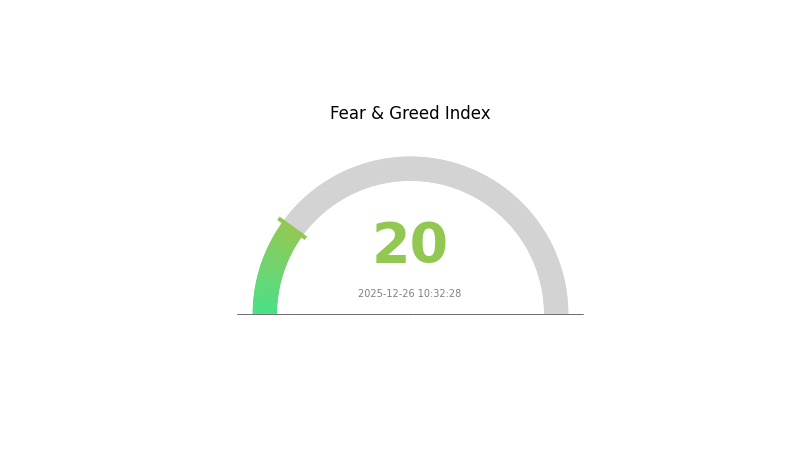
- Current market emotion indicator: Extreme Fear (VIX: 20)
Click to view current MILK market price
MILK Market Sentiment Index
2025-12-26 Fear and Greed Index: 20 (Extreme Fear)
Click to view current Fear & Greed Index
The market is currently experiencing extreme fear, with the Fear and Greed Index at 20. This indicates heightened investor anxiety and significant market pessimism. During such periods, risk aversion dominates trading behavior, often leading to price pressures and reduced market liquidity. However, extreme fear can present opportunities for contrarian investors who view market dislocations as entry points. Monitor key support levels closely and consider your risk tolerance before making trading decisions. Stay informed through Gate.com's comprehensive market data and sentiment analysis tools.
MILK Holdings Distribution
The address holdings distribution chart illustrates the concentration of MILK tokens across different wallet addresses on the blockchain. This metric is essential for evaluating the decentralization level of the token ecosystem, as it reveals how token supply is distributed among various stakeholders. By analyzing the top holders and their proportional stakes, investors and analysts can assess potential concentration risks and understand the underlying market structure of the MILK token economy.
Currently, the available data does not display specific holder information or concentration percentages, which limits a comprehensive assessment of MILK's current centralization characteristics. However, a healthy token distribution typically features a diverse holder base where no single address dominates an excessive portion of the total supply. When evaluating address distribution, it is crucial to consider whether tokens are held across numerous independent addresses or concentrated among a limited number of entities, as this distinction directly impacts the token's resilience against potential market manipulation.
The distribution pattern of MILK tokens significantly influences market dynamics and price stability. A well-distributed token base generally supports more stable market conditions and reduces the likelihood of sudden price movements triggered by individual large holders. Monitoring address concentration levels provides valuable insights into the on-chain structural integrity and the degree of decentralization achieved by the MILK ecosystem. For the most current and detailed holdings data, participants can access comprehensive analysis through Gate.com's market data tools.
Click to view the current MILK Holdings Distribution

| Top |
Address |
Holding Qty |
Holding (%) |
Analysis of MILK Price Drivers
II. Core Factors Affecting MILK Future Price Movement
Supply Mechanism
-
Raw Milk Production Cycle: Raw milk production is primarily determined by dairy cattle inventory levels and per-cow milk yield. The supply adjustment cycle is generally 3-4 years, as dairy cattle require approximately two years from birth to milk production. This creates a significant lag between demand fluctuations and supply response.
-
Historical Patterns: Since July 2008, China's raw milk market has experienced three major adjustment cycles. The first cycle (January 2008 - July 2009) saw a 25% price decline followed by a 39% price increase (August 2009 - March 2011). The second cycle (March 2014 - June 2015) experienced a 20% cumulative decline. The third cycle, beginning September 2021, has seen a 25% cumulative decline with extended duration.
-
Current Impact: As of 2024, China's milk output reached 4,079 million tons, marking the first decline since 2018 with a year-over-year decrease of 2.8%. Production declined 5.8% and 9.0% in Q3 and Q4 respectively, indicating accelerating capacity adjustments. However, the adjustment remains sluggish relative to the oversupply situation that emerged in late 2022. Raw milk prices in December 2024 reached 3.11 yuan/kg, down 15.03% from year-end 2023, representing historical lows on an inflation-adjusted basis.
Macro-Economic Environment
-
Commodity Price Dynamics: Feed costs, particularly corn and soybean meal, significantly impact dairy production economics. In 2024, corn prices declined 14.8% and soybean meal prices fell 21.3% year-over-year, reducing production costs to 3.46 yuan/kg on average. However, raw milk prices have declined even more sharply, creating continued economic pressure on dairy farmers.
-
Domestic Consumption Trends: Dairy product consumption experienced its largest decline in recent years, with apparent consumption of milk falling 4.6% to 5,869 million tons in 2024. Per capita consumption decreased to 41.5 kg. This demand contraction reflects broader consumer spending pressures on dairy products.
-
Import Dynamics: In 2024, China imported 2,768 million tons of dairy products, down 9.5% year-over-year and representing the third consecutive year of significant import declines. Notably, imported whole milk powder prices increased significantly starting in May 2024, exceeding domestic raw milk prices for the first time in over a decade. This price inversion is expected to moderate import pressure going forward. As dairy input costs stabilize and domestic prices potentially recover in 2025, import volumes face rebound pressure, which could maintain loose supply-demand relationships domestically.
Three、2025-2030 MILK Price Forecast
2025 Outlook
- Conservative Forecast: $0.0043 - $0.00519
- Neutral Forecast: $0.00519
- Optimistic Forecast: $0.00731 (requiring sustained market demand and positive ecosystem developments)
2026-2028 Mid-term Outlook
- Market Stage Expectation: Potential recovery and growth phase with gradual market stabilization, characterized by increasing adoption and ecosystem expansion.
- Price Range Forecast:
- 2026: $0.00575 - $0.00806 (20% upside potential)
- 2027: $0.00386 - $0.01045 (37% upside potential)
- 2028: $0.00537 - $0.01285 (69% upside potential)
- Key Catalysts: Enhanced tokenomics implementation, increased institutional participation through platforms like Gate.com, strategic partnerships, and network utility expansion.
2029-2030 Long-term Outlook
- Base Case: $0.00898 - $0.01147 in 2029; $0.00725 - $0.0116 in 2030 (108-114% cumulative gains from 2025)
- Optimistic Scenario: $0.01285+ by 2028 (sustained market momentum with 69% growth), potentially extending to $0.0116+ range through 2030 (assuming mainstream adoption acceleration)
- Transformative Scenario: $0.01285+ sustained through 2030 (extreme favorable conditions including major protocol upgrades, significant DeFi integration, and substantial ecosystem growth)
- 2025-12-26: MILK trading near current levels with stabilization indicators present
| 年份 |
预测最高价 |
预测平均价格 |
预测最低价 |
涨跌幅 |
| 2025 |
0.00731 |
0.00519 |
0.0043 |
0 |
| 2026 |
0.00806 |
0.00625 |
0.00575 |
20 |
| 2027 |
0.01045 |
0.00716 |
0.00386 |
37 |
| 2028 |
0.01285 |
0.0088 |
0.00537 |
69 |
| 2029 |
0.01147 |
0.01083 |
0.00898 |
108 |
| 2030 |
0.0116 |
0.01115 |
0.00725 |
114 |
MILK Investment Analysis Report
IV. Professional Investment Strategy and Risk Management for MILK
MILK Investment Methodology
(1) Long-term Holding Strategy
- Target Investors: Risk-averse investors seeking exposure to the modular blockchain ecosystem and liquid staking protocols
- Operational Recommendations:
- Dollar-cost averaging (DCA) to accumulate MILK at regular intervals, reducing the impact of price volatility
- Hold positions through market cycles to benefit from potential protocol adoption and ecosystem expansion
- Monitor protocol performance metrics and update holdings based on fundamental developments
(2) Active Trading Strategy
- Technical Analysis Considerations:
- Price Action Analysis: MILK is trading at $0.0052 with a 24-hour decline of -7.61%, indicating short-term bearish pressure that should inform entry and exit points
- Volume Analysis: Current 24-hour volume of $216,575.95 provides liquidity reference for position sizing
- Trading Operation Points:
- Utilize support levels near the 24-hour low of $0.00513 as potential entry points for swing trades
- Exercise caution given the severe 30-day (-78.5%) and 1-year (-97.73%) declines, which suggest extended downtrend conditions
MILK Risk Management Framework
(1) Asset Allocation Principles
- Conservative Investors: 0.5-1% of portfolio
- Active Investors: 1-3% of portfolio
- Professional Investors: 3-5% of portfolio
(2) Risk Hedging Solutions
- Position Sizing Strategy: Limit individual MILK positions to prevent concentrated exposure, especially given the token's volatile performance and current market challenges
- Portfolio Diversification: Balance MILK holdings with other blockchain infrastructure and staking protocol exposure to mitigate protocol-specific risks
(3) Secure Storage Solutions
- Self-Custody Approach: Use Gate Web3 wallet for secure MILK storage with direct control over private keys
- Exchange Custody: Maintain trading positions on Gate.com for active trading operations, utilizing platform security features
- Security Considerations: Enable two-factor authentication, maintain secure backup of wallet recovery phrases, and avoid sharing private keys or seed phrases with any third parties
V. Potential Risks and Challenges for MILK
MILK Market Risks
- Severe Price Depreciation: MILK has declined 97.73% over the past year from historical highs of $0.2919 to current levels of $0.0052, indicating significant historical losses and potential further downside risk
- Liquidity Constraints: With a 24-hour trading volume of only $216,575.95 and a circulating market cap of $1,242,280, MILK exhibits limited liquidity that could amplify price swings during large transactions
- Low Market Adoption: Ranking 2,468 with only 0.00016% market share demonstrates limited institutional and retail adoption compared to established staking protocols
MILK Regulatory Risks
- Evolving Compliance Framework: Staking and restaking protocols may face regulatory scrutiny as financial authorities globally develop clearer guidelines for digital asset staking mechanisms
- Jurisdictional Uncertainty: Different regulatory approaches across jurisdictions could impact protocol accessibility and token utility in specific regions
- Securities Classification Risk: Authorities could classify MILK or staking rewards as securities, potentially triggering compliance obligations that affect protocol operations
MILK Technical Risks
- Smart Contract Vulnerabilities: As a liquid staking and restaking protocol, MILK is exposed to technical risks inherent in complex smart contract systems, including potential bugs or exploits
- Modular Ecosystem Dependency: Protocol success depends on adoption and stability of the underlying modular blockchain ecosystem, where technological shifts could impact MILK's value proposition
- Slashing and Validator Risks: Restaking mechanisms introduce technical risks where protocol participants could face slashing events or validator-related losses under adverse conditions
VI. Conclusions and Action Recommendations
MILK Investment Value Assessment
MilkyWay (MILK) positions itself as a significant player in the modular ecosystem's liquid staking and restaking segment. However, the token faces substantial challenges: extreme price deterioration (-97.73% annually), minimal market capitalization relative to the broader cryptocurrency market, and limited trading liquidity. While the protocol addresses an important infrastructure need, current market conditions suggest elevated risk levels. Potential investors should carefully evaluate whether the long-term strategic value of participating in modular ecosystem staking justifies the significant risks associated with this early-stage protocol token.
MILK Investment Recommendations
✅ Beginners: Avoid or invest only minimal amounts as a high-risk experimental position; prioritize understanding the modular blockchain ecosystem and liquid staking mechanisms before participation
✅ Experienced Investors: Consider small accumulation positions during extreme weakness if you have conviction in modular blockchain adoption, while maintaining strict stop-loss disciplines
✅ Institutional Investors: Monitor protocol metrics and ecosystem development; consider positions only after comprehensive due diligence on technical architecture, team credentials, and market traction
MILK Trading Participation Methods
- On-chain Trading: Participate directly through protocols and decentralized interfaces listed on MilkyWay's ecosystem
- Centralized Exchange Trading: Trade MILK on Gate.com, which currently supports the token across 9 exchanges total, ensuring institutional-grade security and liquidity
- Staking Participation: Engage with the protocol's core liquid staking and restaking mechanisms to earn potential yield, though technical and smart contract risks should be thoroughly evaluated
Cryptocurrency investments carry extreme risk and volatility. This report does not constitute investment advice. Investors should make decisions based on their individual risk tolerance and financial circumstances. Consult with qualified financial advisors before making investment decisions. Never invest more capital than you can afford to lose completely.
FAQ
What is the future outlook for milk prices?
MILK prices are projected to average $21.35 per cwt in 2025, with 2026 forecasted at $20.40 per cwt. Stable production and slight price decline expected in 2026 as market conditions stabilize.
Will milk prices go up in 2025?
Yes, milk prices are projected to increase in 2025. The national average milk price is forecasted at $21.60 per cwt, reflecting rising demand and production costs throughout the year.
Will milk prices go down?
Yes, milk prices are likely to decline into 2026. Growing milk supplies, increased production per cow, and strong global competition will keep prices under pressure. Steady demand cannot absorb the surplus, maintaining downward price momentum.
Why the average price of milk increased from $3.00 last year to $3.50 this year?
The 16.7% price increase reflects inflation and rising production costs including feed, labor, and energy expenses. Supply chain disruptions and increased demand also contributed to this upward price movement.
What factors affect milk prices the most?
Milk prices are primarily driven by supply and demand dynamics, milk quality components such as fat and protein content, production costs, and seasonal market fluctuations. Trading volume and market sentiment also significantly influence price movements.
How do global dairy supply and demand impact milk prices?
Global dairy supply and demand directly affect milk prices. When supply exceeds demand, prices fall; when demand outpaces supply, prices rise. The GDT index dropped 4.3% in 2025 as production exceeded demand, with butter prices declining 12.4%.
What strategies can consumers use to save money on milk purchases?
Buy milk in bulk during sales to reduce per-unit costs. Choose store brands over premium options. Use milk strategically in recipes to minimize waste. Consider purchasing powdered milk as a cost-effective alternative for certain uses.
* The information is not intended to be and does not constitute financial advice or any other recommendation of any sort offered or endorsed by Gate.